
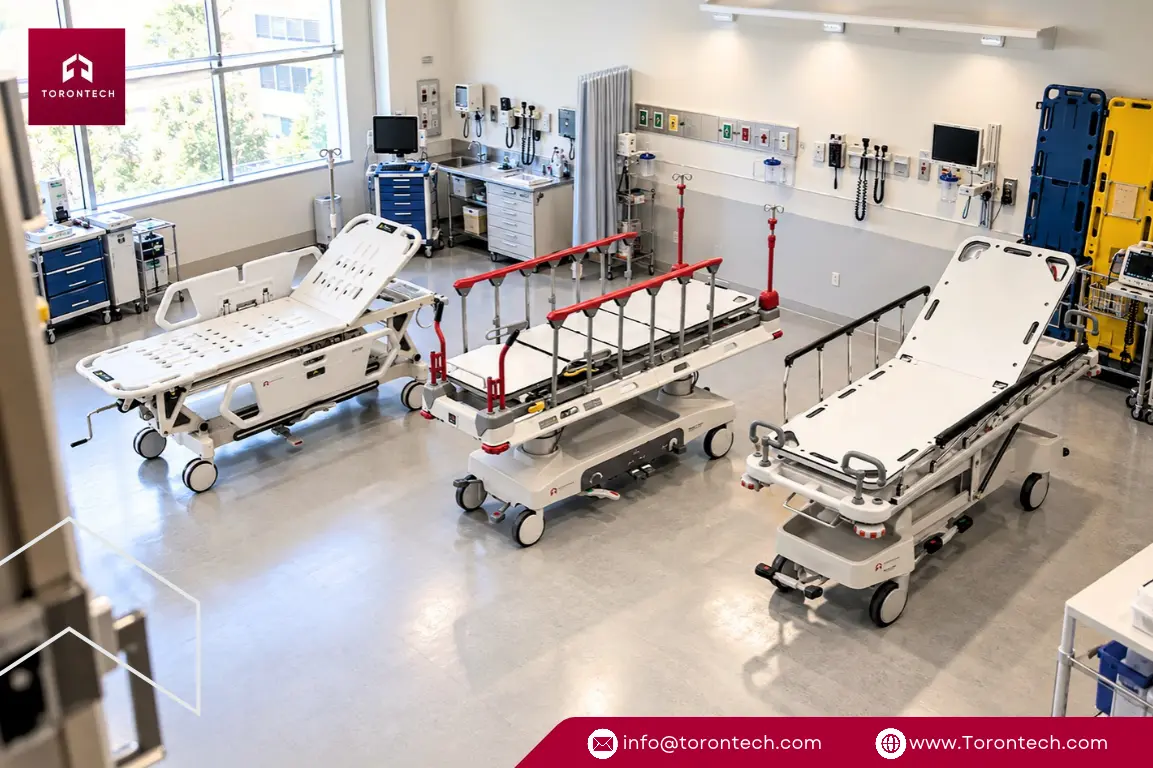
Manual vs Hydraulic vs Electric Stretcher Guide
Is your healthcare facility equipped to protect caregivers from physical injury without draining your capital budget? Treating patient transport as an afterthought leads straight to injured staff and strained department finances.
At Torontech, we manufacture cost-effective ToronCare platforms engineered directly for standard U.S. and Canadian medical facilities. This manual vs hydraulic vs electric stretcher evaluation gives procurement directors an executive, unvarnished look at how different drive mechanics perform when seconds count.
Executive Decision Matrix: Platform Tier Comparison
For procurement committees that need verified baseline data immediately (because materials managers rarely have time to sift through fifty-page technical brochures when equipment requisitions are due), this executive matrix outlines the mechanical limits, vertical travel, chassis mass, and primary clinical indications across the ToronCare fleet:
| Stretcher Tier | Primary Drive Mechanism | Height Travel Span | Key Articulation Limits | Chassis Net Weight | Primary Clinical Indications |
|---|---|---|---|---|---|
| Manual Transfer Platforms (ToronCare 1130, 1140, 1140 A/B/C, 1170) | Mechanical crank-adjust gear assemblies; optional 0–400 mm lateral slide (1170) | 281–509 mm (1130 ultra-low) up to 560–862 mm (1140 / 1140 C) | Backrest: 0–89° (1130); zero fluid-based tilting | 67 kg (1130) to 92 kg (1170) | Ambulatory surgery centers, outpatient clinics, routine horizontal corridor transport |
| Hydraulic Elevation Platforms (ToronCare 1150, 1150 A, 1160, 1180, 1180 A, 1190) | Dual-sided hydraulic foot pedals; gas-spring backrests; dual-hydraulic + crank (1180) | 500–813 mm (1150) up to 575–1110 mm (1160 extended) | Backrest: 0–85°; Trendelenburg: 0–13°; Knee Gatch: up to 0–55°; Chair position | 82 kg (1150) to 130 kg (1180 A) (1190: Not Documented) | Emergency departments, Level-1 trauma bays, PACU, patient hygiene routines (1190) |
| Electric Multi-Axis Platforms (ToronCare 1180 E) | Electric motor height and tilt; gas-spring backrest and knee gatch (6 functions total); foot-pedal motor controls (head and foot ends) | 565–790 mm | Backrest: 0–70°; Trendelenburg: 0–12°; Knee Gatch: 0–40°; Chair position | 140 kg | Prolonged observation wards, diagnostic imaging suites, interventional scanning, direct patient weighing |
| Operating Room Connecting Platforms (ToronCare 1110, 1110 B, 1120) | Auto-docking clean-zone lock; mechanical 0–400 mm lateral slide (1120) | 585–925 mm (1120) up to 665–913 mm (1110 B) | Backrest: 0–85° (1110 / 1110 B) | 130 kg (1110 / 1110 B) to 151 kg (1120) | Surgical suites, sterile-to-non-sterile barrier patient handoffs with zero floor-wheel cross-travel |
Drive Mechanisms: Mechanical, Hydraulic, and Electric Analysis
Evaluating equipment options requires assessing how each actuation system handles continuous physical demands. In our assessment, procuring complex motorized drives for routine transit corridors represents unnecessary capital expenditure, whereas deploying unassisted manual cranks in high-acuity trauma bays creates severe operational bottlenecks.
Manual Transfer Platforms
In any direct manual vs hydraulic stretcher evaluation, manual stretchers serve as dependable, mechanically uncomplicated workhorses. From an engineering and fiscal perspective, we believe manual stretchers are often unfairly dismissed as obsolete; when deployed strategically across lower-acuity corridors, they remain exceptionally cost-effective assets for large-scale fleet deployments.
Manual units rely on mechanical crank systems for primary vertical elevation, operating completely independent of electrical outlets or hydraulic fluid seals. From an operational standpoint, manual stretchers are available for immediate transport with zero battery charging downtime. However, clinical engineering teams must account for operator workload: biomechanical testing confirms that initiating horizontal motion with manual patient transport equipment demands initial peak hand forces between 222 N and 450 N.
To minimize physical strain across long facility corridors, our ToronCare manual fleet combines structural chassis weight reduction with mechanical assists:
- Core Corridor Transport Fleet:
- ToronCare 1140: Height range: 560–862 mm; backrest: 0–85°; net weight: 75 kg; utilizes a 1-hand dampened drop-rail mechanism that simplifies bedside transfers.
- ToronCare 1140 A: Height range: 505–860 mm; backrest: 0–85°; net weight: 75 kg; incorporates integrated dual-side angle indicators alongside gas-spring polypropylene (PP) side barriers.
- ToronCare 1140 B: Height range: 524–845 mm; backrest: 0–80°; net weight: 75 kg; features a blow-molded bed deck and an integrated polymer utility tray for medical supplies.
- ToronCare 1140 C: Height range: 560–862 mm; backrest: 0–85°; net weight: 77 kg; equipped with 4 individually adjustable side rails (2 per side) for modular patient protection.
- Specialized Ingress and Lateral Transfer:
- ToronCare 1130: Height range: 281–509 mm; backrest: 0–89°; net weight: 67 kg; features an ultra-low clearance profile and an integrated polymer tray, allowing limited-mobility patients to transfer with minimal step-up effort.
- ToronCare 1170: Height range: 590–850 mm; net weight: 92 kg; incorporates aluminum alloy (Al-alloy) rotating transfer rails and a direct lateral sliding surface with 0–400 mm travel.
Hydraulic Elevation Platforms
In our hospital stretcher comparison, hydraulic platforms represent the operational sweet spot for acute receiving units. They eliminate the chore of battery charging while sparing clinical staff the physical fatigue of manual vertical cranking.
Caregivers depress foot pedals on either side of the chassis to raise, lower, or tilt the platform hands-free, maintaining direct control over patient airway and monitoring equipment. These fluid-driven lifting mechanisms enable staff to align the platform flush with hospital beds, minimizing the physical pulling effort and accidental trauma associated with unassisted bed-to-stretcher repositioning.
Biomechanical field studies indicate that hydraulic foot-pedal elevation substantially eases vertical lifting exertion compared to unassisted manual handling, though independent prehospital research notes that handling heavy stretchers during vehicle loading without mechanical assists can still impose lumbar compression exceeding 3.4 kN at L5/S1 during steep forward flexion.
While specialized vehicular research investigates hydraulic suspension circuits to damp road transit vibration in ambulances, in-hospital stretcher hydraulics serve a different operational purpose: the hydraulic circuit is dedicated strictly to vertical lifting and tilt, while corridor tracking stability relies directly on central-locking 360-degree castors and a retractable 5th directional wheel. Our ToronCare hydraulic models feature closed fluid circuits, gas-spring backrest assists, Trendelenburg tilting, and radiolucent decks:
- Core Triage and Imaging Fleet:
- ToronCare 1150: Height range: 500–813 mm; backrest: 0–85°; Trendelenburg: 0–12°; net weight: 82 kg; features bilateral foot pedals, gas-spring PP rails, and an X-ray translucent deck.
- ToronCare 1150 A: Height range: 640–867 mm; backrest: 0–68°; Trendelenburg: 0–12°; knee gatch: 0–53°; net weight: 112 kg; provides upright chair positioning, arm-board side rails, and an X-ray translucent top.
- ToronCare 1160: Height range: 575–1110 mm; backrest: 0–85°; Trendelenburg: 0–13°; net weight: 100 kg; delivers an expansive vertical travel span, gas-spring backrest, 4 corner bumpers, and an X-ray translucent board.
- Advanced Multi-Function and Hygiene Systems:
- ToronCare 1180: Height range: 630–860 mm; backrest: 0–85°; Trendelenburg: 0–13°; knee gatch: 0–30°; net weight: 105 kg; integrates a dual-hydraulic elevation system alongside manual crank articulation, dual push handles, and 6 total positioning functions.
- ToronCare 1180 A: Height range: 660–885 mm; backrest: 0–85°; Trendelenburg: 0–12°; knee gatch: 0–55°; net weight: 130 kg; provides 6 positioning setups, full chair seating, and our widest knee gatch range.
- ToronCare 1190 (Dedicated Bathing Stretcher): Height range: 585–815 mm; Trendelenburg: 0–13°; features bilateral foot pedals, detachable rails, and cushioned waterproof polyvinyl chloride (PVC) / polyethylene (PE) foam padding for patient hygiene procedures.
Electric and Multi-Axis Platforms
When evaluating an electric vs hydraulic hospital stretcher, the operational choice lies between manual hydraulic pumping and motorized elevation and tilt. We view electric-assist platforms as high-yield institutional assets: while unnecessary for basic holding areas, they provide immense operational efficiency in high-turnover observation units where patients require continuous vertical and postural adjustments.
While isolated electric linear actuator components weigh approximately 22.4% of equivalent bare hydraulic pump assemblies in laboratory bench tests, complete commercial electric stretchers exhibit higher overall chassis mass due to structural battery enclosures, control modules, and multi-motor frames, as demonstrated by the 140 kg net weight of the ToronCare 1180 E. Crucially, this dry electromechanical architecture removes the contamination risk of hydraulic fluid leaks on clinical floors from ruptured lines or degraded seals.
Certain hybrid platforms combine electric control modules with hydraulic rams, enabling caregivers to activate a manual bleed valve to lower the deck during facility electrical outages. Contemporary electric units utilize motor-driven wheel axles and logic-switched control circuitry directly connected to running gear. One operational factor must be planned for: motorized lifting sequences can take 1.5 to 3.4 times longer than rapid, unassisted manual maneuvers.
ToronCare 1180 E (Electric Transfer Stretcher): Height range: 565–790 mm; backrest: 0–70° (gas-spring); Trendelenburg / Reverse Trendelenburg: 0–12° (electric motor); knee gatch: 0–40° (gas-spring); net weight: 140 kg. Integrates electric motor drives for vertical travel and Trendelenburg tilt with gas-spring assisted backrest and knee articulation across 6 total positioning functions.
Elevation and tilt are operated via foot pedals at both head and foot ends, paired with upright chair positioning, an X-ray translucent bed deck, and an optional integrated weighing scale that allows clinicians to verify patient mass without lateral transfer onto a separate floor scale.
Operating Room Transfer Systems
For surgical suites that enforce clean-zone boundary containment, specialized transfer systems eliminate wheel-borne floor contaminants:
- ToronCare 1110: Height range: 660–910 mm; backrest: 0–85°; net weight: 130 kg; locks together automatically and utilizes PP gas-spring rails.
- ToronCare 1110 B: Height range: 665–913 mm; backrest: 0–85°; net weight: 130 kg; features an auto-docking lock paired with rotating arm-board side rails.
- ToronCare 1120: Height range: 585–925 mm; net weight: 151 kg; utilizes a manual crank to slide the top surface 0–400 mm directly onto the operating table.
Clinical workflow research demonstrates the financial validity of this approach: in a published study conducted within the U.S. Veterans Affairs healthcare system, operating directly on a mobile stretcher platform was demonstrated to be a safe, cost-effective alternative to transferring patients onto fixed surgical tables during outpatient hand surgeries, saving approximately 111.28 USD per case in sterile drape supplies while maintaining turnover efficiency without increasing surgical complication rates.
Standardized Platform Architecture
We believe essential safety engineering should never be treated as an optional upgrade. Every model in the ToronCare series incorporates a standardized architectural foundation designed for durability and staff usability:
Corridor Steering Dynamics
Every ToronCare stretcher operates on central-locking 360° castors supported by a retractable 5th directional steering wheel. (Materials managers know how difficult it is to control a heavy, drifting transport cart down busy hallways; the 5th wheel provides positive, straight tracking).
Ergonomic studies indicate that directional running gear and transport assist systems can decrease operator trunk muscle strain and three-dimensional spinal loads by 6% to 21%, while laboratory evaluations of powered transport devices demonstrate significant reductions in the physical manpower required to propel hospital beds.
Fall Prevention Systems
Padded side rails and structural fall-prevention barriers are integrated across every platform. Transport safety assessments show that single-action mechanical latches reduce dropping hazards significantly compared to legacy drop-leg hardware that can jam under pressure.
Bilateral Operational Ergonomics
Operating controls on both flanks of the stretcher are essential. Caregivers can lower side rails or engage emergency positioning from either side of the unit without abandoning patient monitoring or airway equipment.
Infection Control and Surface Integrity
Chassis surfaces feature seamless, chemical-resistant construction compatible with hospital-grade disinfectants, ensuring compliance with institutional infection prevention protocols.
For extended patient holding and tissue integrity management, seamless non-porous decks provide a stable foundation that easily pairs with specialized pressure-relief overlays, allowing facilities to maintain skin protection protocols alongside routine chemical scrub-downs.
Departmental Application Framework
Matching hardware mechanics to clinical tempo ensures facility workflows run efficiently without premature equipment retirement:
Ambulatory Surgery and Outpatient Clinics
- Target Facilities: Medicare/CMS-certified day-surgery centers and Canadian provincial day-care clinics (such as high-turnover endoscopy clinics).
- Recommended Tier: Manual Transfer Stretchers (ToronCare 1130, 1140, 1140 A/B/C, 1170)
Outpatient facilities require lightweight, reliable stretchers that do not require battery charging management. Deploying a 67–92 kg manual chassis down long corridors minimizes pushing fatigue, while the ultra-low 281 mm deck on the ToronCare 1130 permits limited-mobility patients to mount the platform safely.
Emergency and Trauma Departments
- Target Facilities: ACS-verified Level-1 trauma units and Canadian regional trauma networks (such as regional receiving hubs within Ontario Health or Alberta Health Services).
- Recommended Tier: Hydraulic Elevation Platforms (ToronCare 1150, 1150 A, 1160, 1180, 1180 A)
High-acuity triage demands immediate hands-free Trendelenburg tilting (up to 12° or 13°) for hemodynamic management, along with extended vertical elevation (reaching 1110 mm on the ToronCare 1160). Integrated radiolucent decks allow clinicians to obtain diagnostic images on the spot without transferring unstable trauma patients.
Resuscitation Efficacy at Stretcher Height
Stretcher deck height directly impacts clinical procedural quality during cardiac arrest. Simulation research proves that setting mattress height level with the rescuer's knee joint creates significantly deeper chest compressions (averaging 55.12 mm compared to 53.81 mm at lower elevations) while delaying rescuer fatigue.
Furthermore, clinical evaluations demonstrate that performing chest compressions on a moving stretcher equipped with mechanical compression systems maintains high-quality CPR across long indoor transport routes (covering 209.25 m in 2 minutes) without interrupting compression rhythm.
Wheeled Stretchers vs. Mass Evacuation Devices
Emergency egress scenarios present clear mechanical trade-offs. Flexible rescue tarpaulins and evacuation mattresses permit staff to transport bedridden patients down narrow stairwells when elevators shut down. However, soft sheets fail to provide structural body protection and limit full chest recoil during CPR compared to rigid wheeled stretchers.
Similarly, specialized tactical gear like Sked extraction tools and vacuum mattresses are essential for rugged immobilization, but rigid wheeled stretchers remain indispensable for clinical triage upon arrival in acute receiving bays.
Observation and Diagnostic Imaging
- Target Facilities: Cardiac monitoring units, short-stay observation bays, and interventional radiology holding suites.
- Recommended Tier: Electric Multi-Axis Platforms (ToronCare 1180 E)
When patients remain on stretchers for extended diagnostic intervals, electric height and tilt adjustments combined with gas-spring articulation across 6 total positioning functions, chair configurations, and integrated weight scales allow nursing staff to adjust patient posture smoothly without physical strain.
Surgical Suites and Clean-Zone Transfer
- Target Facilities: Main operating room suites and sterile processing transfer corridors.
- Recommended Tier: Operating Room Connecting Platforms (ToronCare 1110, 1110 B, 1120)
Built specifically to exclude corridor particulate from sterile suites, these platforms prevent wheel cross-contamination: the ToronCare 1120 uses a manual crank to slide its deck 0–400 mm directly onto the operating table, while the ToronCare 1110 and 1110 B utilize auto-docking mechanisms to bridge clean-zone boundaries during patient handoffs.
Dedicated Patient Hygiene
- Target Facilities: Extended care pavilions, burn units, and acute rehabilitation complexes.
- Recommended Tier: Dedicated Bathing Stretcher (ToronCare 1190)
Patient hygiene workflows require specialized water containment. The ToronCare 1190 pairs waterproof PVC/PE foam padding with fluid-pedal height changes (585–815 mm) and a 0–13° drainage angle, keeping hygiene routines safe, dignified, and controlled.
Economic Analysis and Ergonomic ROI
Evaluating stretcher procurement strictly through purchase price represents an incomplete fiscal strategy: workers' compensation claims from injured staff rapidly outstrip upfront equipment savings. Considering U.S. Occupational Safety and Health Administration (OSHA) guidelines and Canadian provincial bodies like Ontario's WSIB or WorkSafeBC clarifies the capital justification:
| Cost & ROI Factor | Manual Platforms | Hydraulic Platforms | Electric Platforms |
|---|---|---|---|
| Capital Outlay | Lowest initial investment; highly cost-effective fleet asset | Moderate initial equipment spend | Higher capital commitment; complete motorized feature set |
| Maintenance Profile | Mechanical gear components; minimal routine maintenance | Sealed fluid cylinders requiring periodic inspection | Motor drives and electrical safety compliance checks |
| Staff Ergonomic Impact | Manual cranking; lightweight frames minimize pushing drag | Foot-pump elevation avoids repetitive lower-back bending | Foot-pedal electric height and tilt combined with gas-spring articulation eliminate manual cranking and repetitive vertical pumping |
| Turnaround Velocity | Standard corridor transit velocity | Immediate foot adjustments and direct X-ray screening | Deliberate motorized travel offset by zero-transfer on-bed weighing; operational gain is eliminated staff physical effort rather than raw mechanical speed |
Musculoskeletal Injury Mitigation
Repetitive patient handling injuries among hospital staff drive substantial workers' compensation expenses. Independent clinical studies demonstrate how assisted lifting technology protects caregivers:
- Spinal and Joint Load Reduction: Assisted patient transport equipment equipped with mechanical lift mechanisms cuts peak L4/L5 spinal compression forces by 13% to 62% and shear forces by 58% to 93% during routine handling. Paramedic shoulder strain drops by 16% to 95%, while subjective exertion scores decline by 29% to 60% compared to unassisted equipment. In extrication scenarios, lift-assist devices decrease lower-back muscle strain by 34% to 47%.
- Lost Workday Reductions: In a published study evaluating hospital transport teams, introducing motorized patient stretchers reduced median lost workdays from handling injuries from 24.5 days down to 7 days.
- Systemic Claims Payback: In municipal emergency services, deploying assisted stretchers reduced overall employee injury rates from 61.1 to 28.8 per 100 full-time equivalents (FTE), achieving an injury rate ratio of 0.30 for stretcher-related accidents. Longitudinal economic modeling in paramedic fleets showed that implementing motor-assisted stretchers and vehicle-loading systems yielded a 78% reduction in stretcher-related musculoskeletal disorders, which researchers calculated amortized equipment acquisition costs within a 7-year service lifespan under municipal workers compensation claim structures.
Patient Stability and Vibration Attenuation
Abrupt vertical jolts during patient lifting, lowering, and transfer create direct physiological discomfort for acute individuals. While horizontal corridor rolling smoothness depends on physical running gear like central-locking castors and directional guide wheels, objective accelerometer evaluations in prehospital transport trials demonstrate that motorized vertical actuation substantially smooths out vertical motion compared to manual lifting:
- Vertical Lifting Acceleration: Accelerometer testing during vertical elevation demonstrates that motorized lift mechanisms reduce vertical root-mean-square (RMS) motion from 0.73 m/s² on manual units down to 0.29 m/s² on motorized platforms.
- Peak Acceleration and Deceleration Spikes: In transport handling trials, peak vertical motion dropped from 2.90 m/s² with manual equipment down to 1.60 m/s² with motorized lifting, while downward deceleration softened from -3.30 m/s² to -1.48 m/s² during patient loading maneuvers. Similarly, vehicle loading studies recorded vertical RMS acceleration drops from 0.89 m/s² to 0.32 m/s² when using motorized assists. Transported subjects report higher ratings for physical security and clinical comfort when vertical transitions are smoothly governed.
Lifecycle Maintenance Overhead
Manual stretchers offer the lowest acquisition cost and require little routine maintenance beyond scheduled gear lubrication. Hydraulic stretchers involve higher upfront spend and require periodic fluid seal inspections, but they yield immediate clinical time savings in emergency departments.
Electric platforms require higher initial capital commitment, yet they deliver significant operational value in high-acuity suites by removing physical strain from frequent patient repositioning. Furthermore, every ToronCare deck is fabricated from seamless, chemical-resistant materials that withstand repeated scrub-downs with hospital disinfectants, ensuring multi-year service longevity.
Technical Qualification Checklist
When preparing technical tender documents or hospital equipment requisitions, clinical engineering teams can use this verified checklist to guide qualification:
- Vertical Travel Envelope: Match the travel span to caregiver working height and patient ingress needs, ranging from the 281–509 mm ultra-low profile (1130) to the 575–1110 mm extended span (1160).
- Chassis Net Weight: Evaluate floor-loading and transport handling, ranging from 67 kg for lightweight manual frames to 151 kg for heavy-duty O.R. connecting platforms.
- Articulation Bounds: Confirm articulation limits match departmental needs, including backrest angles up to 89°, knee gatch travel up to 55°, and Trendelenburg tilt up to 13°.
- Diagnostic Imaging Support: Ensure units destined for emergency or trauma departments feature integrated radiolucent bed boards (present on models 1150, 1150 A, 1160, 1180, 1180 A, and 1180 E).
- Facility Documentation: To eliminate delays in clinical engineering onboarding, we provide full IQ/OQ/PQ (Installation, Operational, and Performance Qualification) documentation upon request, verifying that our standards-compliant equipment integrates into facility maintenance protocols.
Source Cost-Effective Hospital Stretchers at Torontech
There is little operational sense in forcing caregivers to struggle with outdated transport gear when cost-effective, standards-compliant platforms can be deployed directly into your facility. At Torontech, we supply durable stretchers engineered for North American healthcare environments, supported by complete technical validation documentation.
Contact our medical equipment specialists today to request customized pricing, verify delivery schedules, or receive IQ/OQ/PQ documentation packets for your facility review.
References (Click to expand)
- Armstrong, D. P., Ferron, R., Taylor, C., McLeod, B., Fletcher, S., MacPhee, R., & Fischer, S. (2017). Implementing motor-assisted stretcher and load systems was a cost effective intervention to reduce the incidence rates of stretcher related injuries in a paramedic service. Applied Ergonomics, 62, 34-42.
- Coady-Fariborzian, L., & Jordan, P. (2025). Stretcher vs Table for Operative Hand Surgery. Federal Practitioner, 42(4), 158-161.
- Ho, C.-S., Hsu, Y.-J., Li, F., Tang, C.-C., Yang, C.-P., Huang, C.-C., Ho, C.-S., & Chang, C.-H. (2021). Effect of Ambulance Stretcher Bed Height Adjustment on CPR Quality and Rescuer Fatigue in a Laboratory Environment. International Journal of Medical Sciences, 18, 2783-2788.
- Kotowski, S., Davis, K., & Marras, W. (2022). Patient handling through moving of the beds and stretchers. International Journal of Industrial Ergonomics, 87, 103252.
- Lad, U., Oomen, N. M. C. W., Callaghan, J., & Fischer, S. (2018). Comparing the biomechanical and psychophysical demands imposed on paramedics when using manual and motorized stretchers. Applied Ergonomics, 70, 167-174.
- Mansfield, B., Shofer, F., & Green-McKenzie, J. (2021). The Effect of Introduction of Motorized Stretchers on Hospital-Based Patient Transporter Injuries and Resultant Workers’ Compensation Costs. Journal of Occupational and Environmental Medicine, 63, 1078-1080.
- Pandaram, K., & Palanisamy, S. (2025). Improving patient comfort: Development and analysis of a hydraulic interconnected suspension for ambulance stretcher. Proceedings of the Institution of Mechanical Engineers, Part D: Journal of Automobile Engineering, 240, 5653-5669.
- Pustavrh, J., Hočevar, M., Podržaj, P., Trajkovski, A., & Majdič, F. (2023). Comparison of hydraulic, pneumatic and electric linear actuation systems. Scientific Reports, 13, 47602.
- Studnek, J., Crawford, J. M., & Fernandez, A. R. (2011). Evaluation of occupational injuries in an urban emergency medical services system before and after implementation of electrically motorized stretchers. Applied Ergonomics, 43(1), 198-202.
- Takei, Y., Toyama, G., Adachi, T., Nishi, T., Yasuda, Y., Ninomiya, S., & Ozaki, A. (2025). Comparison of Patient Comfort and Acceleration Exposure During Lifting and Loading Operations Using Manual and Motorized Stretchers. Prehospital Emergency Care, 30, 38-46.
