
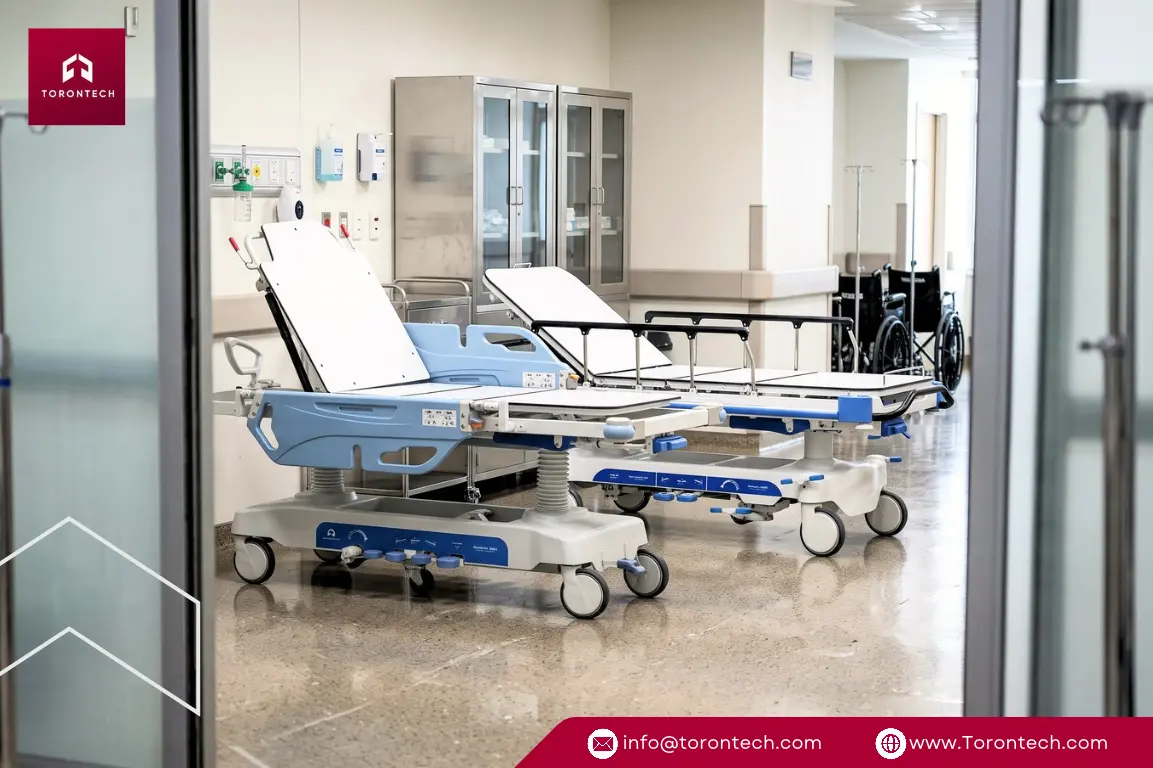
Hospital Stretcher Purchasing Guide & Specifications
Manual patient transfers place an unrelenting physical burden on frontline staff, and hospital operations stall whenever unreliable equipment fails mid-shift. Yet without objective evaluation criteria, facilities risk committing capital funds to hardware that clinicians ultimately reject.
This hospital stretcher RFP checklist delivers the practical engineering benchmarks your team needs to standardize capital fleets and secure dependable clinical assets.
Key Takeaways
- Musculoskeletal Risk Reduction: Hydraulic and electric height adjustments substantially reduce physical strain and spinal compression on frontline staff compared with unassisted manual handling.
- Facility Code Compliance: External trolley profiles must satisfy NFPA 101, FGI Guidelines, and CSA Z8000 dimensions to avoid striking doorframes, jamming elevators, or restricting emergency egress.
- Tissue Viability Protection: Multi-density foam cores with sealed, fluid-tight surfaces prevent hospital-acquired pressure injuries and withstand aggressive decontamination chemistries without degradation.
- Objective Sourcing Models: High-performing procurement teams prioritize structural longevity, spare parts availability, and straightforward maintenance over the lowest initial bid.
- Departmental Alignment: Fleet standardization requires matching mechanical architectures to actual clinical workflows, from sterile surgical handoffs to high-volume emergency trauma imaging.
Core Engineering and Technical Specifications
When compiling a technical request for proposal, procurement teams need to establish clear baselines for rolling friction, doorway clearance, patient positioning, biomechanical protection, and fluid barrier performance.
Mobility and Directional Systems
Castor Diameter and Rolling Resistance
Maneuvering heavy patient loads across varied flooring should never demand excessive physical exertion from transport staff. Standard 150 mm (5.9 in) sealed central-locking castors glide smoothly over expansion joints, threshold plates, and elevator entrances.
For specialized emergency platforms like the ToronCare 1180, an optional 200 mm wheel package lifts the chassis to clear floor obstacles with confidence.
Steering Precision and True Tracking
Published testing confirms that dedicated directional controls and reliable braking mechanisms are essential to avoid corridor collisions and satisfy transport safety regulations.
In our engineering view, a centrally mounted, retractable 5th wheel is a baseline operational necessity rather than an optional upgrade. It establishes a dedicated pivot axis so a single orderly can steer a fully loaded bed through tight turns without the rear chassis swinging out of control.
Dual-End Braking Controls
Positive-engagement brake pedals situated at both the head and foot ends allow staff to activate steer, neutral, or total-lock modes instantly from either end of the platform.
Spatial Dimensions and Code Compliance
Emergency evacuations and high-traffic transit push patient handling equipment to tight spatial boundaries. Technical evaluations of specialized emergency evacuation sledges and military field litters emphasize compact footprints under 60 cm wide for extreme spatial constraints, whereas inpatient hospital transport stretchers require broader platforms between 635 mm and 770 mm to balance corridor navigation with clinical stability.
In the United States, hospital facilities align with the Facility Guidelines Institute (FGI) Guidelines for Design and Construction of Hospitals and the NFPA 101 Life Safety Code, requiring 8-foot (2.44 m) clear corridors and compatibility with 4,000 lb to 5,000 lb service elevator cabs without obstructing emergency egress.
In Canada, CSA Z8000 establishes healthcare facility planning standards for corridor widths and room clearances, requiring procurement teams to verify that equipment profiles pass cleanly alongside wall-mounted clinical monitors, hand-hygiene fixtures, and mobile workstations in active hallways.
In our engineering assessment, evaluating perimeter bumper outlines while neglecting the usable mattress surface is an expensive procurement oversight. Typical acute-care transport stretchers measure approximately 1,900 mm to 2,120 mm in overall length and 640 mm to 815 mm in width.
Across our ToronCare portfolio, overall lengths range from 1,900 mm on the ToronCare 1150 up to 2,120 mm on the ToronCare 1160, with the ToronCare 1180 measuring 2,060 mm and the ToronCare 1190 hygiene platform at 2,045 mm. Usable bed boards include 1,906 mm x 510 mm on the 1150, 1,910 mm x 640 mm on the 1160, and 1,902 mm x 630 mm on the 1180, delivering essential patient stabilization and preventing limb displacement during extended boarding periods.
Load Capacity and Biomechanical Ergonomics
Biomechanical literature demonstrates that manual patient handling exposes clinical personnel to severe physical trauma, leading to debilitating lumbar damage and shoulder tears.
In biomechanical simulations evaluating emergency vehicle loading tasks, motorized lift-assist mechanisms decreased peak operator L4/L5 spinal compression by 13% to 62% and shear forces by 58% to 93% compared to unassisted manual lifting, demonstrating the acute physical relief provided by mechanical vertical elevation. Shoulder flexor moments fell by 16% to 95%, correlating with a 29% to 60% reduction in perceived physical exertion.
While researchers observed that motorized lifting cycles ran 1.5 to 3.4 times longer than sudden manual shifts, the underlying biomechanical principle directly translates to hospital corridors: utilizing hydraulic foot-pedals or electric drive assemblies to match transfer heights removes the dangerous vertical lifting component from staff, making mechanical height adjustment essential for high-volume clinical intake pathways.
In the United States, this data reinforces Occupational Safety and Health Administration (OSHA) Safe Patient Handling guidelines and NIOSH lifting limits. In Canada, provincial bodies like the Ontario Occupational Health and Safety Act (OHSA) and WorkSafeBC enforce clear operational responsibilities on healthcare facilities to implement engineering controls that mitigate manual handling injuries.
Patient ride stability and chassis rigidity are equally important. Field trials evaluating patient comfort during elevation demonstrated that motorized lifting assemblies lowered vertical root mean square accelerations to 0.29 m/s² compared to 0.73 m/s² on manual stretchers, providing a noticeably smoother patient ride.
Furthermore, clinical transport guidelines emphasize that acute handling equipment should meet defined institutional safe working loads, typically ranging from 200 kg to 272 kg (440 lb to 600 lb) for standard acute transport, which must be verified against certified manufacturer load-test data sheets prior to tender submission.
Dedicated bariatric pathways usually demand specialized platforms rated at 700 lb (318 kg) or higher with widened mattress decks. International safety benchmarks like BS EN 1865 state that a single handler must not lift more than half the combined weight of the cot and patient during manual maneuvers. Heavy-gauge steel scissor-lift frameworks and reinforced linkage bars prevent unsettling lateral sway during chest compressions and bed-to-bed transfers.
Surface Materials and Infection Control
Mattress decks must combine mechanical durability with documented skin protection. Multi-layered, high-resilience foam cores redistribute contact pressures over high-risk anatomical points like the sacrum, heels, and scapula. In the United States, Centers for Medicare and Medicaid Services (CMS) policies withhold reimbursement if a patient develops an avoidable Stage III or Stage IV pressure injury during emergency boarding.
Across Canada, Accreditation Canada Required Organizational Practices require clinical teams to screen patients for pressure injury risk and execute documented prevention plans, where pressure-redistributing support surfaces on stretchers used for extended boarding form a critical component of that intervention strategy.
Infection prevention depends directly on surface manufacturing quality. Technical reviews indicate that contact covers require high tear resistance, complete fluid-barrier integrity, antistatic properties, and wipe-clean finishes to resist fluid strike-through and endure constant decontamination cycles.
We consider radio-frequency welded seams a non-negotiable specification rather than a cosmetic upgrade, because standard needle perforations allow infectious fluids to penetrate the foam core. Seamless polypropylene (PP) surfaces and high-durability PVC covers resist deterioration from repeated washdowns with aggressive disinfectants, including quaternary ammonium, bleach, and hydrogen peroxide solutions.
Emergency Articulation and Positioning
Emergency CPR release handles on both sides let caregivers flatten the backrest instantly during resuscitation events. Mechanical height adjustments and articulating backrests ease caregiver strain while simplifying bedside clinical assessments and upright chest radiography.
In our view, dual-sided CPR releases should be mandatory across all acute transport platforms. Articulation ranges across our ToronCare platforms provide backrest tilt up to 85 degrees (or 89 degrees on specialized manual units), leg flexion up to 55 degrees, and Trendelenburg / reverse tilt up to 13 degrees.
Regulatory Standards and Evaluation Frameworks
Healthcare procurement research confirms that medical equipment tenders succeed when sourcing teams utilize multi-criteria decision-making (MCDM) scoring models, such as the Analytic Hierarchy Process (AHP), fuzzy TOPSIS, and fuzzy VIKOR.
While purchase price is always visible on the balance sheet, sophisticated evaluation models place structural build quality, clinical ergonomics, after-sales technical support, and reliable parts delivery far ahead of cut-rate upfront bids. We strongly endorse this multi-factor approach, as buying purely on initial unit cost routinely leads to unacceptable maintenance downtime.
United States Group Purchasing Organizations
High-volume capital sourcing in the U.S. commonly runs through major Group Purchasing Organizations (GPOs) such as Vizient, Premier, and HealthTrust, or through federal procurement channels like the Veterans Health Administration (VHA).
These entities use comprehensive scoring matrices to verify manufacturing quality, official FDA medical device listings, and guaranteed long-term replacement component availability. In the U.S., wheeled stretchers are classified under 21 CFR 880.6910 (Class II), so tenders should request the manufacturer's FDA establishment registration and device listing numbers.
Canadian Provincial Shared Services
In Canada, hospital equipment procurement is largely coordinated by provincial shared services and regional health syndicates like Supply Ontario, Shared Services West, Health Shared Services BC (PHSA), and Alberta Health Services (AHS). These public organizations demand verified compliance with Health Canada Medical Device Regulations and require dependable, regional field support across large geographic facility networks.
Technical and Electrical Safety Standards
Tender specifications must mandate full compliance with recognized engineering benchmarks, including ISO standards, CE/FDA medical device classifications, and safety recommendations from the Emergency Care Research Institute.
Electrically driven platforms must comply with IEC 60601-1 safety mandates for medical electrical equipment, while non-powered manual and hydraulic stretchers must be certified against applicable mechanical load-bearing and structural safety standards. Manufacturing facilities must maintain an active ISO 13485 certification to ensure quality management and batch traceability.
Drive motors, battery enclosures, and foot controls on electric models need splash-proof seals (rated IPX4 or higher) to prevent short circuits during clinical washdowns.
Clinical Usability and Validation
Engaging a cross-functional procurement team (including clinical engineers, emergency nurses, and transport orderlies) prevents investing in platforms that frustrate frontline caregivers. In our assessment, committees that exclude bedside staff risk purchasing hardware that obstructs daily ward pacing.
Sourcing teams should implement formal health technology assessments (HTA) and supervised clinical trials before finalizing purchase agreements, backed by complete Installation Qualification, Operational Qualification, and Performance Qualification (IQ/OQ/PQ) documentation.
Clinical Accessory Integration
Clinical literature highlights that integrating utility mounts directly into the stretcher chassis (such as IV drip poles, oxygen cylinder holders, and equipment trays) streamlines patient transit and prevents dangerous equipment tangles.
Accessory mounting points must also remain completely clear of side-rail travel paths and docking latches so that bed-to-stretcher and operating room table transfers remain unobstructed. From our manufacturing perspective, accessories should function as an integrated structural system rather than bolted-on compromises that rattle loose or snag against doorframes.
Hospital specifications should require a fully coordinated accessory package:
- Infusion Management: Telescoping stainless steel IV poles with two-prong or four-prong hooks that seat securely into dedicated sockets at all four corners, with secondary sockets integrated into push handles.
- Respiratory Support: Undercarriage tank holders that secure standard D-size and E-size cylinders horizontally beneath the frame, shielding pressure regulators from hallway impacts.
- Monitoring Trays: Fold-down or slide-in equipment shelves mounted at the foot end that accommodate transport monitors, defibrillators, or suction devices without occupying patient mattress space.
- Drainage and Restraint Mounts: Integrated side-rail attachment loops for patient restraints and low-slung hooks for urinary drainage bags that maintain gravity flow across all height positions.
Lifecycle Maintenance and Ownership Costs
The leading cause of premature equipment abandonment in healthcare facilities is the absence of preventive maintenance support, missing replacement parts, and poor life-cycle cost analysis. Multi-criteria sourcing studies show that factoring in structural longevity, guaranteed service agreements, and fast spare parts fulfillment substantially lowers total ownership costs.
When evaluating investments in motorized or hydraulic patient handling equipment, observational analyses in pre-hospital transit settings indicate that assisted lifting systems can offset capital investments over time by mitigating costly worker compensation claims and staff lost-time injuries.
In our view, preserving operating margins depends on mechanical accessibility and fleet-wide parts standardization. Sealed hydraulic systems (such as the dual-pump layout on the ToronCare 1180) eliminate battery replacements and electronic failures in demanding intake departments. Equipment built with accessible grease ports, self-contained hydraulic cylinders, and quick-disconnect gas struts keeps routine maintenance under 30 minutes per unit annually.
Standardizing an entire facility around common castor models, uniform gas struts, and interchangeable side-rail hardware prevents biomedical engineering departments from managing bloated, expensive parts inventories. Tenders should require a 3-year to 5-year frame warranty alongside 1-year to 2-year full coverage on hydraulic cylinders, gas struts, and electrical controls.
Hospital Stretcher RFP Checklist
Use this practical technical checklist when compiling your institutional tender documentation:
Section A: Structural and Dimensional Parameters
- Overall length and width verified against your facility's smallest service elevator cab and narrowest doorway opening (typical acute transport stretchers span 1,900 mm to 2,120 mm in length and 640 mm to 815 mm in width)
- Adequate diagonal cab clearance confirmed to accommodate attending staff at the head and foot ends during elevator transit
- Usable mattress deck sized to departmental patient acuity (standard platforms typically provide lengths from 1,880 mm to 1,910 mm and widths from 510 mm to 640 mm)
- Verified safe working load certified by manufacturer test sheets aligned with departmental protocols
- Elevation range aligned with the target clinical setting:
- Low-entry floor height: 281 mm minimum deck-to-floor height
- Extended operational reach: 1,110 mm maximum working height
- Standard acute travel: 500 to 860 mm operational window
Section B: Mobility, Steer, and Braking Systems
- Four 150 mm sealed swivel castors (optional 200 mm configuration available)
- Retractable 5th wheel directional steering mechanism activated via foot pedal
- Linked central-braking system accessible from both the head and foot ends
- Ergonomic, dual-caregiver push handles built into both ends of the chassis
Section C: Clinical Articulation and Patient Positioning
- Backrest articulation via gas strut or electric drive from 0 degrees up to 80 degrees (up to 89 degrees where specified)
- Dual-sided emergency manual CPR release handles for immediate flat positioning
- Trendelenburg and reverse tilt providing at least 12 to 13 degrees
- Vascular knee gatch elevation extending from 0 degrees up to 30, 40, or 55 degrees
- Instant upright cardiac chair positioning preset on acute procedural platforms
Section D: Diagnostic Imaging and Specialty Procedures
- Full-length, X-ray clear radiolucent bed deck compatible with mobile C-arm fluoroscopy units
- Sliding transfer deck travel (0 to 400 mm) for zero-lift surgical table transfers
- Automatic latching dock mechanism for sterile barrier separation in surgical suites
- Built-in digital scale option for precise patient weight monitoring at the bedside
Section E: Materials, Hygiene, and Infection Control
- Fluid-resistant patient contact surfaces compatible with quaternary ammonium, bleach, and hydrogen peroxide
- Seamless blow-molded PP base or radio-frequency welded, waterproof PVC/PE mattress construction
- Drop-down side barriers that collapse flush beneath the mattress surface for unobstructed transfers
- Non-marking, impact-absorbing corner roller bumpers to prevent architectural wall damage
Section F: Quality, Safety, and Compliance Verification
- ISO 13485 certified quality management system
- Compliance with IEC 60601-1 for electric platforms and recognized mechanical safety standards for manual and hydraulic platforms
- Full supply of IQ/OQ/PQ commissioning documentation and preventive maintenance manuals
- Clear warranty terms and guaranteed quick-ship replacement parts support
Departmental Stretcher Fleet Solutions
To help your sourcing team match technical criteria to specific clinical settings, our cost-effective ToronCare lineup provides purposeful engineering across four distinct functional tiers:
Tier 1: Operating Room Transfer Stretchers (Surgical Handoff)
For surgical suites, direct-sliding transfer decks and latching docks are the cleanest way to preserve sterile boundaries without exposing staff to severe lateral transfer strain.
| Model | Transfer Feature | Elevation | Articulation / Slide |
|---|---|---|---|
| ToronCare 1110 | Auto-dock mechanism, PP gas-spring rails | 660 to 910 mm | Backrest: 0 to 85° (Net Wt: 130 kg) |
| ToronCare 1110 B | Auto-dock mechanism, rotary arm-board rails | 665 to 913 mm | Backrest: 0 to 85° (Net Wt: 130 kg) |
| ToronCare 1120 | Crank-driven direct O.R. table transfer | 585 to 925 mm | Lateral Slide: 0 to 400 mm (Net Wt: 151 kg) |
Tier 2: Manual Transfer Stretchers (Crank-Adjust, General Transport)
For busy general wards and day clinics, mechanical reliability and durable polymer sub-frames provide outstanding uptime with negligible maintenance demands.
| Model | Key Features & Rail Design | Elevation | Backrest |
|---|---|---|---|
| ToronCare 1130 | Ultra-low entry, integrated PP utility tray, blow-molded deck | 281 to 509 mm | 0 to 89° (Net Wt: 67 kg) |
| ToronCare 1140 | 1-hand dampened drop-down rails, gap-free bed transfer | 560 to 862 mm | 0 to 85° (Net Wt: 75 kg) |
| ToronCare 1140 A | Bilateral angle indicators, gas-spring dampened PP rails | 505 to 860 mm | 0 to 85° (Net Wt: 75 kg) |
| ToronCare 1140 B | Extended elevation travel, integrated PP storage tray | 524 to 845 mm | 0 to 80° (Net Wt: 75 kg) |
| ToronCare 1140 C | 4 individually adjustable split rails (2 per side) | 560 to 862 mm | 0 to 85° (Net Wt: 77 kg) |
| ToronCare 1170 | Al-alloy rotary transfer rails, lead-screw crank | 590 to 850 mm | Lateral Slide: 0 to 400 mm (Net Wt: 92 kg) |
Tier 3: Hydraulic & Electric Acute Care Platforms (Imaging & Emergency)
In acute trauma and emergency intake environments, full-length X-ray transparency is essential for immediate bedside diagnostics without transferring vulnerable patients.
| Model | Actuation & Mechanism | Elevation | Key Articulation & Imaging Features |
|---|---|---|---|
| ToronCare 1150 | Hydraulic pedals (both sides), PP rails | 500 to 813 mm | Backrest 0 to 85°, Trendelenburg 0 to 12°, Radiolucent Deck |
| ToronCare 1150 A | Hydraulic lift, arm-board rails | 640 to 867 mm | Knee gatch 0 to 53°, cardiac chair position, Radiolucent Deck |
| ToronCare 1160 | Hydraulic hi-low, 4 corner bumpers | 575 to 1,110 mm | Backrest 0 to 85°, Trendelenburg 0 to 13°, Radiolucent Deck |
| ToronCare 1180 | Dual-hydraulic + crank, dual push handles | 630 to 860 mm | 6 functions, knee gatch 0 to 30°, Radiolucent Deck |
| ToronCare 1180 A | Advanced hydraulic, 6 functions | 660 to 885 mm | Knee gatch 0 to 55°, cardiac chair position, Radiolucent Deck |
| ToronCare 1180 E | Full electric platform, battery backup | 565 to 790 mm | 6 electric functions, chair position, optional scale, Radiolucent Deck |
Tier 4: Dedicated Patient Bathing Stretcher
Dedicating a purpose-built, rapid-draining platform to patient hygiene protects standard ward equipment from premature corrosion in wet environments.
| Model | Application & Actuation | Elevation | Drainage & Surface Specifications |
|---|---|---|---|
| ToronCare 1190 | Hydraulic bathing platform, bilateral pedals | 585 to 815 mm | Trendelenburg 0 to 13°, waterproof PVC with PE foam, 4 detachable rails |
Select Cost-Effective Hospital Stretchers at Torontech
Torontech equips healthcare networks throughout the United States and Canada with cost-effective, standards-compliant patient transfer stretchers engineered for unrelenting clinical use across demanding environments.
If your team is ready to evaluate complete engineering drawings, review volume fleet pricing, or request full IQ/OQ/PQ documentation for your next procurement tender, contact our technical sales specialists today.
References (Click to expand)
- Diaconu, K., Chen, Y.-F., Cummins, C., Moyao, G. J., Manaseki-Holland, S., & Lilford, R. (2017). Methods for medical device and equipment procurement and prioritization within low- and middle-income countries: findings of a systematic literature review. Globalization and Health, 13.
- Fattahipour, R., Teymouri, F., Sharififar, S., Khankeh, H. R., & Azizi, M. (2026). Challenges and opportunities in designing innovative emergency-evacuation equipment for bed-dependent hospital patients: a scoping review with a focus on evacuation mattresses and stretchers. BMC Emergency Medicine, 26.
- Hayden, M., Reichard, A. A., Lowe, B. D., Naber, S. J., & Wurzelbacher, S. (2025). Review of Powered, Safe Patient-Handling Equipment for Emergency Medical Services via an Insurance Safety Intervention Grant Program. Prehospital and Disaster Medicine, 40, 64-72.
- Hinrichs-Krapels, S., Ditewig, B., Boulding, H., Chalkidou, A., Erskine, J., & Shokraneh, F. (2022). Purchasing high-cost medical devices and equipment in hospitals: a systematic review. BMJ Open, 12.
- Jones, A., & Hignett, S. (2007). Safe access/egress systems for emergency ambulances. Emergency Medicine Journal, 24, 200-205.
- Kanojiya, M. T., Fande, A., Lokhande, P., Chokhandre, S., Mahalle, T., Sakhre, R., & Kewade, A. (2024). Design and Development of Multi-Featured Medical Stretcher. International Journal of Innovative Science and Research Technology.
- Lad, U., Oomen, N. M. C. W., Callaghan, J., & Fischer, S. (2018). Comparing the biomechanical and psychophysical demands imposed on paramedics when using manual and powered stretchers. Applied Ergonomics, 70, 167-174.
- Saleh, N., Gaber, M. N., Eldosoky, M., & Soliman, A. (2023). Vendor evaluation platform for acquisition of medical equipment based on multi-criteria decision-making approach. Scientific Reports, 13.
- Takei, Y., Toyama, G., Adachi, T., Nishi, T., Yasuda, Y., Ninomiya, S., & Ozaki, A. (2025). Comparison of Patient Comfort and Acceleration Exposure During Lifting and Loading Operations Using Manual and Powered Stretchers. Prehospital Emergency Care, 30, 38-46.
- Vanderwee, K., Demarre, L., Malfait, S., Kieckens, E., De Waegemaeker, P., Duprez, V., & Fraeyman, N. (2024). How to choose between single-use and reusable medical materials for sustainable nursing: Methodological lessons learned from a national study. Journal of Advanced Nursing.
