
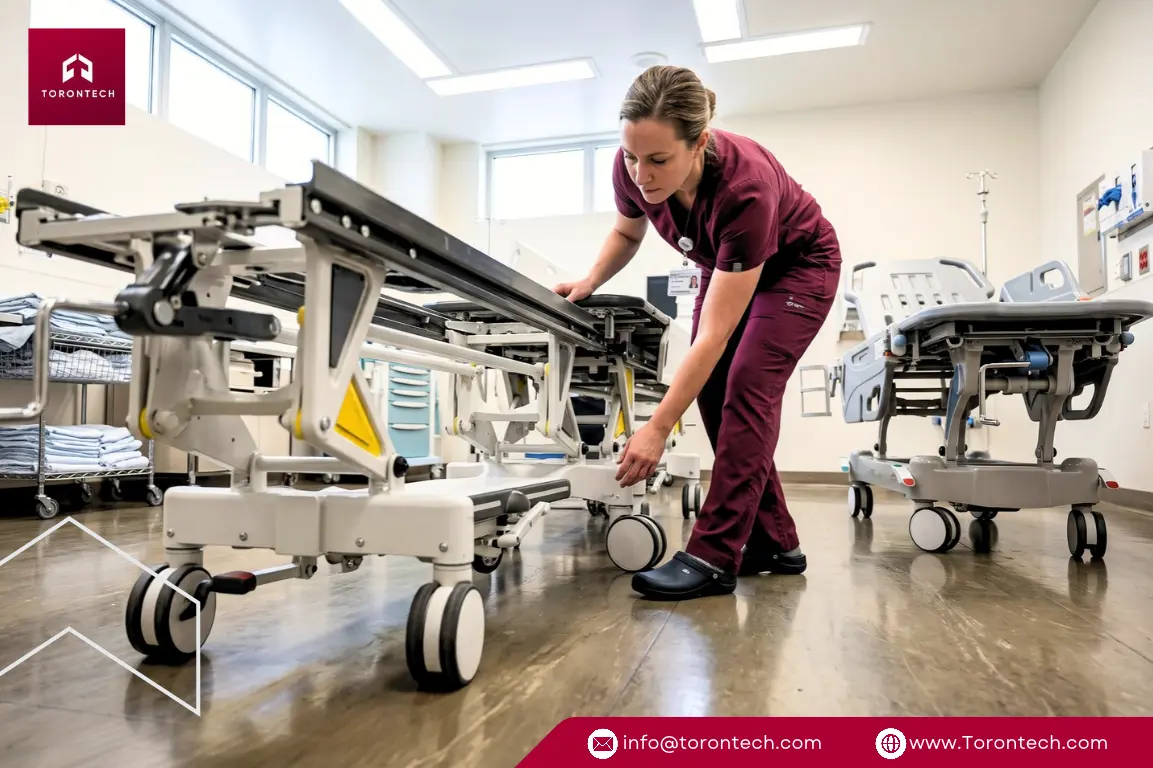
Docking Stretchers vs Slide Boards: Safe OR Transfers
Upgrading perioperative patient transfers protects clinical staff, speeds up room turnover, and safeguards sterile boundaries. For surgical leaders weighing a docking stretcher vs slide board strategy, selecting the right mechanical platform turns routine lateral moves into smooth, efficient transitions.
As a North American manufacturer based in the U.S. and Canada, we deliver cost-effective products that support hospital infrastructure while keeping staff ergonomics and patient dignity front and center.
Comparative Analysis: Docking Systems vs. Slide Boards
For clinical leadership and procurement committees reviewing patient relocation methods, the operational differences between conventional slide sheets or boards and dedicated mechanical transfer platforms center on labor allocation, ergonomics, and sterility boundaries:
| Operational Parameter | Traditional Slide Board Setup | Mechanical & Motorized Transfer Platforms (Literature Benchmarks) |
|---|---|---|
| Primary Transfer Mode | Manual pulling via draw sheet across a static plastic board | Crank-driven mechanical slide (0–400 mm slide) or auto-dock |
| Caregiver Staff Allocation | 3 to 4 staff members dedicated to manual pulling/pushing | 2 transfer operators across the boundary line (plus airway lead per OR protocol) |
| Caregiver Ergonomic Strain | High; pulling forces span 104 N to 359 N | Low; research on motorized transfer systems demonstrates external pull force reductions up to 180.4 N compared to manual pulling |
| Spinal & Postural Stress | Peak REBA scores and erector spinae loads exceed limits | Postural risk drops by 4.21 REBA points; muscle activity falls 25% to 55% |
| Patient Cutaneous Shear | High; dynamic friction exceeds tissue-injury limits of 14.5 N | Low; specialized motorized transfer studies demonstrate cutaneous shear values reduced to 1.4 N compared to static manual dragging |
| Sterile Field ("Red Line") | High risk; non-sterile corridor wheels frequently cross clean zones | Controlled; engineered sterile and non-sterile zone physical boundary separation |
| Medical Line & Tube Stability | Moderate to high risk; abrupt manual pulling impulses | Low risk; continuous, uniform mechanical displacement |
| Surface Decontamination | Board handled manually; frequent floor contact during placement | Integrated chemical-resistant PP/PVC surfaces sanitized in place |
Note on Literature Benchmarks: The quantitative force and shear reductions cited above reflect published clinical evaluations of active motorized and conveyor-assisted transfer systems. Mechanical crank stretchers (such as the ToronCare 1120 and 1170) utilize the same core engineering principle of translating the support surface rather than dragging the patient across friction points, though they were not the specific subjects of these laboratory trials.
Controlled laboratory trials and clinical evaluations comparing flat sliding boards demonstrate that while they serve as a widely accessible, low-cost baseline, the manual pulling forces required to reposition patients routinely exceed safe ergonomic thresholds.
In stark contrast, biomechanical research evaluating motorized patient transfer devices demonstrates a significant drop in physical workload, reducing perceived caregiver exertion on the NASA-TLX index by 68.7% compared to flat slide boards.
We will be candid: while flat slide boards look attractively inexpensive on an initial purchase order, they quietly transfer that financial burden onto staff workers' compensation claims, nurse absenteeism, and preventable room turnover friction.
Surgical Suite Protocols and Sterile Field Preservation
Transferring a surgical patient safely demands an organized operational routine long before wheels enter the room. Following verified operating room patient transfer protocols, including safe practice guidelines published by the Association of periOperative Registered Nurses (AORN), requires maintaining an uncompromised barrier between general transit zones and sanitized surgical suites.
Perioperative Workflow Protocols
Standardized transfer frameworks divide patient relocation into structured operational steps: pre-transfer equipment verification, surface alignment, coordinated lateral transfer, and structured verbal handoffs. Clinical evidence demonstrates that enforcing structured movement protocols significantly reduces patient falls, unexpected transfer drops, and procedural execution errors.
Handoff Checklists and the "Sterile Cockpit"
Unstructured surgical transitions introduce measurable clinical risk.
Intraoperative anesthesia handovers have been associated with a 40% higher risk of adverse patient outcomes, which is why surgical departments increasingly rely on structured checklists to prevent communication breakdowns during staff relief. Standardized handoff checklists significantly curb missed clinical details, lowering surgical reporting omissions from 26% down to 16% and reducing post-anesthesia transfer delays by 50%.
Enforcing a disciplined "sterile cockpit" protocol (where non-urgent conversation pauses entirely so staff can focus solely on critical physiological parameters) ensures hemodynamic stability before routine dialogue resumes.
Facility Architectural Standards and Bioburden Control
North American healthcare facilities enforce strict physical design standards to limit environmental contamination. In Canada, hospital planning aligns with the CSA Z8000 standard (Canadian Health Care Facilities), which establishes architectural zones separating unrestricted public corridors from semi-restricted and restricted surgical environments.
In the United States, surgical suite design is governed by the Facility Guidelines Institute (FGI) Guidelines for Design and Construction of Hospitals and Outpatient Facilities, working alongside The Joint Commission (TJC) environment of care standards regarding ventilation containment and infection prevention.
These architectural standards establish a critical demarcation line (frequently identified by a visible red boundary on the floor) separating general corridors from restricted operating rooms. Standard transport stretchers collect environmental dust, organic debris, and opportunistic microbes on their running gear while rolling through emergency bays and public corridors.
Rolling an entire hallway trolley directly across this threshold to execute a slide board transfer introduces significant bioburden into the clean surgical environment.
Aerosolized Bioburden and Airflow Disruption
Surgical air-sampling evaluations demonstrate that dropping or shaking transport linens increases airborne microorganisms by 18%, yielding a 3-fold higher contamination rate near airflow turbulence, with Staphylococcus skin colonizers comprising over 93% of recovered aerosolized bacteria. Shifting patients between platforms disrupts established ventilation currents, requiring unscrubbed personnel to remain hyper-vigilant regarding sterile borders and clean air curtains.
AORN infection prevention guidelines specify that unscrubbed personnel must face the sterile field when approaching, maintain appropriate physical clearance from sterile setups, and ensure back tables remain outside transit corridors between entry doors and operating tables.
Protective Draping and Aseptic Discipline
When scheduling holds or transfer bottlenecks delay surgical starts, covering established sterile setups with clean drapes provides a validated protective shield against airborne contamination (Z = 4.76, p < 0.00001), extending the time to detectable bacterial fallout from 2.8 hours out to 3.8 hours. Transparent adhesive field covers offer comparable protection during active intraoperative repositioning or diagnostic imaging.
Ultimately, preserving field asepsis during acute transfers requires strict passing mechanics, back-to-back transit protocols, and an institutional culture where team members are empowered to stop procedures to correct an aseptic breach.
In our view, expecting clinical staff to maintain flawless aseptic technique through behavioral vigilance alone during rushed patient transfers is fundamentally unrealistic. Mechanical hardware that physically prevents contaminated hallway chassis components from ever entering a clean suite provides a far more dependable safeguard.
Structural Zone Separation Systems
To resolve boundary conflicts when maintaining sterile field during patient transfer, our Connecting Transfer Stretcher family establishes an engineered physical barrier at the operating room threshold:
- ToronCare™ 1110: Operates as a paired two-stretcher assembly to enforce clean-zone boundaries: Stretcher A remains inside the sterile operating room while Stretcher B operates in the non-sterile corridor. Once both frames are set to the same elevation and pushed together, they lock automatically via a mechanical docking interface, allowing the patient to slide across on removable Bed Board C without manual lifting. It features an adjustable height range of 660–910 mm, backrest articulation of 0–85°, and a net weight of 130 kg.
- ToronCare™ 1110 B: Built on the same paired dual-zone architecture as the 1110 (Stretcher A in the surgical suite and Stretcher B in the corridor with lateral Bed Board C transfer), this enhanced model incorporates multifunctional rotary PP side rails that lay flat to serve as an arm board for IV administration during transit. It operates across a height range of 665–913 mm, backrest adjustment of 0–85°, and has a net weight of 130 kg.
- ToronCare™ 1120: Provides direct separation between zones using a crank-driven 0–400 mm slide mechanism that glides directly onto the surgical table, an adjustable height range of 585–925 mm, and a net weight of 151 kg.
All patient contact surfaces across these platforms are constructed from seamless PP and PVC that resist harsh chemicals and wipe down easily with hospital-grade disinfectants, simplifying infection control compliance. Direct bed-to-table transit models also eliminate redundant handling steps without increasing surgical site infection rates.
We firmly believe that hospital transfer equipment should actively enforce infection control protocols rather than forcing surgical nurses to improvise barrier workarounds at the Red Line threshold.
Mechanical Lateral Transfer vs. Slide Boards: Ergonomics and Staffing
Comparing mechanical lateral transfer vs slide boards highlights stark differences in staffing requirements and cumulative physical wear on healthcare personnel.
Safe Patient Handling Regulations and Biomechanical Risk
Occupational safety regulators in both the U.S. and Canada strictly scrutinize manual patient handling in acute settings.
In the United States, while federal OSHA enforces lifting hazards under the General Duty Clause rather than a dedicated healthcare ergonomic rule, an increasing number of states enforce strict statutory zero-lift mandates, including California's Cal/OSHA Section 5120 and Washington State safe patient handling laws.
In fast-paced Ambulatory Surgery Centers (ASCs) where case turnaround times dictate fiscal viability, assembling four clinical staff members for a single manual transfer creates severe scheduling friction.
Similarly, Canadian provincial compensation boards prioritize engineering controls over manual exertion. Agencies such as WorkSafeBC, the Ontario Ministry of Labour, Immigration, Training and Skills Development, and regional authorities like Alberta Health Services (AHS) emphasize mechanical transfer solutions to reduce lost-time compensation claims.
Clinical safety guidelines reinforce these legal requirements. Under AORN Ergonomic Tool 1, patient weight directly dictates the transfer method: for any patient weighing over 157 lb (approximately 71 kg), AORN guidelines state that manual slide transfers exceed safe physical limits, advising facilities to deploy assistive technology such as mechanical lateral transfer devices or air-assisted systems with a multi-person team.
In modern surgical settings where most adult patients exceed this 157 lb threshold, relying on manual slide boards routinely breaches safe perioperative handling standards through several recurring vulnerabilities:
- Staff Allocation Bottlenecks: Moving a patient across a flat board safely requires three to four healthcare professionals: two caregivers pulling the draw sheet from the receiving surface while one or two push and stabilize from the sending side. By contrast, executing a docking transfer across an architectural boundary line typically requires two operators (one stationed on the corridor trolley and one inside the surgical suite), plus the anesthesia provider managing the airway per standard perioperative protocols.
- Ergonomic Strain: Clinical evaluations indicate that while slippery plastic boards reduce pulling effort compared to pulling across standard bed linens, they still demand excessive physical exertion. Pulling an inert patient across a board generates hand forces ranging from 104 N to 359 N and elevated erector spinae activation, routinely exceeding established occupational lifting thresholds.
- Spinal Motion and Log-Rolling Hazards: Inserting a rigid board requires log-rolling the patient. In destabilized cervical and thoracolumbar spine models, log-roll maneuvers induce substantial axial rotation and displacement across injured spinal segments. Clinical trials confirm that multi-person lift-and-slide methods and mechanical assistive devices restrict cervical rotation, lateral flexion, and C5–C6 motion up to 50% better than rotational board insertion.
Controlled Mechanical Lateral Transfer
Mechanical lateral transfer platforms eliminate excessive physical strain by utilizing hardware-guided surface displacement, allowing transfer teams across the boundary to execute smooth handoffs without the manual hauling required by three or four staff on a slide board. Independent comparative trials show that motorized transfer devices reduce external pulling forces by 180.4 N and drop peak Rapid Entire Body Assessment (REBA) postural risk scores by 4.21 points.
Air-assisted systems similarly lower hand pull forces to 42 N (compared to 104 N on boards and 129 N on standard draw sheets), reduce shoulder moments from 31 Nm to 14 Nm, and dampen peak head acceleration during lateral movement. Furthermore, tilting surgical tables to utilize gravity reduces muscle exertion on EMG sensors by 18.4% to 72.3% compared to level transfers, while specialized low-friction polyurethane-nylon transfer sheets decrease staff strain and stabilize patient hemodynamics.
From a manufacturing perspective, we believe mechanical surface translation represents the most practical engineering baseline for acute care settings:
- ToronCare™ 1120 Connecting Transfer Stretcher: Eliminates manual dragging through its crank-driven mechanism and 0–400 mm slide stroke, guiding the platform directly across to the surgical table within its 585–925 mm height envelope (net weight: 151 kg).
- ToronCare™ 1170 Manual Transfer Stretcher: Features heavy-duty Al-alloy (aluminum alloy) rotary transfer rails and an integrated 0–400 mm slide mechanism across a 590–850 mm height range (net weight: 92 kg) for smooth, facility-wide patient movement.
- ToronCare™ 1140 Manual Transfer Stretcher: Provides a gap-free table transfer configuration, 1-hand dampened rail operation, an adjustable height range of 560–862 mm, backrest adjustment from 0–85°, and a net weight of 75 kg.
Shear Force Dynamics and Clinical Quality Metrics
The final phase of the transfer sequence involves moving the patient across the physical gap. Managing shear force lateral patient transfer operating room concerns is essential to protecting patient skin integrity and safeguarding critical monitoring lines.
Quality Benchmarks and Pressure Injury Prevention
In modern North American healthcare networks, acute patient skin breakdown during transfer carries severe financial and regulatory consequences. In the United States, the Centers for Medicare & Medicaid Services (CMS) Hospital-Acquired Condition (HAC) Reduction Program penalizes acute care hospitals for preventable complications, including hospital-acquired Stage 3 and Stage 4 pressure injuries.
Inadvertent skin tears and deep tissue injuries acquired during intraoperative repositioning directly impact hospital quality rankings and reimbursement. Across Canadian hospitals, surgical departments track adverse skin injury events through the Canadian Institute for Health Information (CIHI) Hospital Harm framework and must satisfy Accreditation Canada Required Organizational Practices (ROPs) regarding comprehensive skin integrity assessments and perioperative pressure injury mitigation.
We believe hospital risk managers must treat lateral patient transfers with the same proactive vigilance applied to pressure injury protocols in intensive care, because shear-induced tissue deformation during table repositioning can initiate immediate skin failure.
Cutaneous Shear Mechanics
During manual slide board transfers, frictional resistance between the patient's skin, bedding, and the board creates dynamic cutaneous shear forces. Dependent, paralyzed, and anesthetized surgical patients are exceptionally vulnerable to cutaneous shear trauma due to loss of protective muscle tone and lack of active repositioning capability.
Biomechanical sensor evaluations demonstrate a stark contrast between transfer modalities:
- Harmful Tissue Threshold: Dynamic friction of 14.5 N causes epidermal tears and acute tissue damage, with conventional sling maneuvers generating upward of 8 N across thigh regions.
- High Normal Force Spikes: Traditional sling lifting can induce normal force concentrations exceeding 300% of body weight.
- Controlled Mechanical Relief: In specialized evaluations of motorized conveyor-assisted lateral transfer systems, peak cutaneous shear forces remained at 1.4 N while limiting normal force increases to between 16% and 50%, demonstrating the clinical value of eliminating manual dragging against static surfaces.
Caregiver Spinal Loading
Pushing and pulling patients across transfer thresholds imposes severe biomechanical loads on healthcare personnel. Dual-motion capture analyses and digital ergonomic assessments document intense spinal stresses:
- Extreme Lumbar Shear and Compression: Anterior-posterior (A/P) shear forces on staff lumbar spines frequently exceed 720 N during manual pulling movements, accompanied by lumbar compressive forces surpassing 2700 N. In three-person lateral transfers across stretchers, lumbar A/P shear forces span 33.1 N to 912.3 N and compressive loads reach 581.0 N to 3589.1 N, spiking at the initiation of pulling and termination of pushing postures.
- Exceeded Biomechanical Thresholds: Musculoskeletal simulations using 3D static strength prediction indicate that L5/S1 compression and shear forces exceed safe occupational limits when manipulating external patient loads greater than 40 kgf. Forward trunk flexion, extended reaching, and uncoordinated lifting heavily amplify these spinal forces.
Surface Translation and Line Security
Mechanical transfer platforms minimize these risks by altering the physical dynamics of relocation. Rather than dragging a patient over a static plastic surface, mechanical sliding systems (such as the 0–400 mm slide on the ToronCare™ 1120 and ToronCare™ 1170) move the support surface itself across the gap. Because the patient remains stationary relative to their underlying mattress, relative surface friction and planar tissue distortion are minimized.
Independent clinical assessments demonstrate that mechanical transfer devices reduce overall transfer duration by approximately 5 minutes while significantly enhancing patient perceived comfort and security. Guided mechanical translation provides continuous, uniform displacement, preventing the sudden, uncoordinated pulling impulses that risk dislodging endotracheal tubes, central venous lines, arterial lines, peripheral IVs, and surgical drains.
In our perspective, adopting equipment that translates the support surface directly with the patient is one of the most cost-effective investments a department can make to protect vulnerable skin and indwelling monitoring lines simultaneously.
Standardizing Transfer Platforms Across the Facility
While operating room handoffs demand specialized boundary-separation platforms like the ToronCare 1110, 1110 B, and 1120, acute care networks also require reliable transfer mechanics across general recovery wards, emergency bays, and procedural suites.
For horizontal handoffs outside the sterile core, models like the ToronCare 1170 (featuring Al-alloy rotary transfer rails and a built-in 0 to 400 mm slide) and the ToronCare 1140 (featuring gap-free table transfer mechanics) apply the same principle of guided surface translation.
Across our entire lineup, Torontech standardizes core chassis engineering: central-lock 360-degree castors, a retractable fifth directional steering wheel, chemical-resistant seamless surfaces, and one-hand rail controls.
For facilities seeking enterprise-wide fleet consolidation, the broader ToronCare series also encompasses imaging-compatible stretchers with radiolucent bed boards, ultra-low floor units, and hydraulic hygiene tables, allowing health systems to streamline staff training and service protocols through a single manufacturing partner.
ToronCare™ Platform Architecture Reference
The following executive reference matrix outlines the primary functional tiers within the ToronCare™ series:
| Transfer System Tier | Core Models | Primary Transfer Mechanism | Height Range (Surface to Floor) | Key Clinical Integrations |
|---|---|---|---|---|
| Connecting Transfer Stretchers (O.R. Boundary Handoff) | ToronCare™ 1110 ToronCare™ 1110 B ToronCare™ 1120 | Automatic mechanical docking; Crank direct table transfer | 585–925 mm (1120) 660–910 mm (1110) 665–913 mm (1110 B) | Clean/dirty zone boundary separation; 0–400 mm slide stroke (1120); Rotary arm-board rails (1110 B); Backrest: 0–85° on 1110 and 1110 B (1120 backrest articulation is not documented) |
| Mechanical Slide Transfer Stretchers (Ward & Recovery) | ToronCare™ 1170 ToronCare™ 1140 | Al-alloy rotary transfer rails; Manual crank elevation | 560–862 mm (1140) 590–850 mm (1170) | 0–400 mm slide translation (1170); Gap-free table transfer design (1140); 1-hand dampened rail lowering |
| Facility-Wide Fleet Platforms (Imaging & Transport) | ToronCare™ Series (General Fleet) | Bilateral hydraulic foot pedals; Electric articulation; Manual crank | Lineup range: 281–509 mm (1130) to 575–1110 mm (1160) | Integrated radiolucent X-ray boards (6 models); Multi-position chair articulation; Trendelenburg (up to 13°); Central-lock 360° castors and 5th steering wheel |
Modernize Your Hospital Fleet with Torontech
Upgrading to dedicated mechanical transfer platforms protects clinical staff, speeds up room turnover, and strengthens infection control. At Torontech, we deliver cost-effective products built for demanding acute care workflows without compromising your capital budget.
Connect with our technical product specialists today to explore:
- Detailed quotation schedules and delivery lead times across the U.S., Canada, and international healthcare facilities
- Volume pricing tiers for department- or hospital-wide stretcher fleet modernizations
- Customized stretcher configurations aligned with your operating rooms, emergency departments, and imaging suites
- Complete technical submittal packages, including IQ/OQ/PQ documentation, preventative service plans, and staff training resources
References (Click to expand)
- Al-Qaisi, S. K., Younan, L. A., & Kaddoum, R. (2020). An ergonomic assessment of using laterally-tilting operating room tables and friction reducing devices for patient lateral transfers. Applied Ergonomics, 87, 103122.
- Boet, S., Djokhdem, H., Leir, S., Théberge, I., Mansour, F., & Etherington, N. (2020). Association of intraoperative anaesthesia handovers with patient morbidity and mortality: A systematic review and meta-analysis. British Journal of Anaesthesia.
- Hwang, J., Kuppam, V. A., Chodraju, S. S. R., Chen, J., & Kim, J. (2019). Commercially available friction-reducing patient-transfer devices reduce biomechanical stresses on caregivers' upper extremities and low back. Human Factors: The Journal of Human Factors and Ergonomics Society, 61, 1125-1140.
- Ibrahim, D. A., Frey, A., Hancock, J. U., Budny, B. G., Adams, J., Tomlinson, B., Shaw, L. N., & Lyons, S. T. (2025). Unfolding the risk: A pilot study of airborne contamination in the operating room during total joint arthroplasty. Journal of Orthopaedic Surgery and Research, 20.
- Ji, X., & Gao, X. (2026). Using dual motion capture to optimize patient transfer techniques and identify lower back injury risk factors in healthcare settings. Human Factors in Healthcare.
- Law, M. J. J., Ridzwan, M. I. Z., Ripin, Z. M., Hamid, I. A. J., Law, K. S., Karunagaran, J., & Cajee, Y. (2022a). REBA assessment of patient transfer work using sliding board and Motorized Patient Transfer Device. International Journal of Industrial Ergonomics.
- Masson, P., Larivière-Chartier, J., Forster, P., Ault, L., Wallace, B., & Sveistrup, H. (2024). Measurement of dynamic forces applied to skin during lateral patient transfers using the ALTA system. 2024 IEEE Sensors Applications Symposium (SAS), 1-6.
- Smith, A. P., & Loder, M. (2019). Safe patient handling: How many people do you need to safely lateral transfer patients? Global Journal on Quality and Safety in Healthcare, 2, 40-45.
- Speth, J. (2024b). Guidelines in practice: Sterile technique. AORN Journal, 120(4), 238-247.
- Waters, T., Baptiste, A. S., Short, M., Plante-Mallon, L., & Nelson, A. (2011). AORN ergonomic tool 1: Lateral transfer of a patient from a stretcher to an OR bed. AORN Journal, 93(3), 334-339.


