
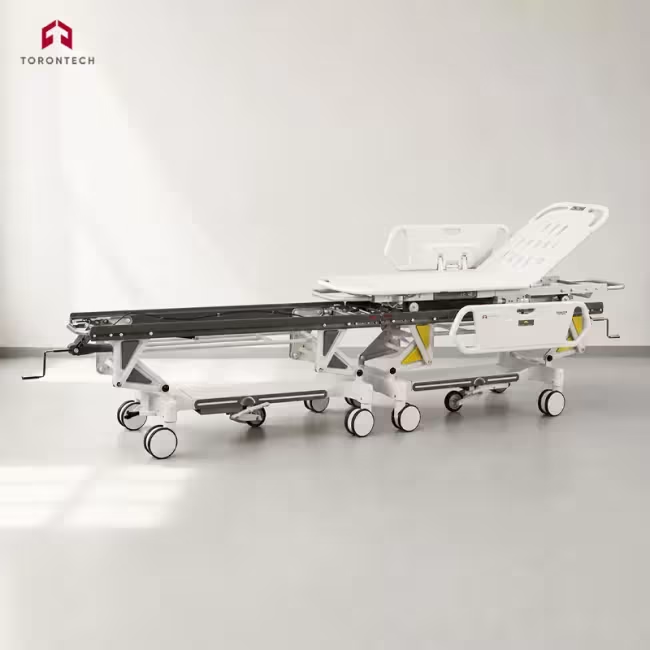
Transfer Stretcher — ToronCare™ 1110
Connecting Transfer Stretcher for Operation Room
ToronCare™ 1110 is a high-performance connecting transfer stretcher engineered specifically for seamless, infection-controlled patient transport between non-sterile and sterile areas within hospital and surgical settings. Designed to facilitate safe stretcher transport into the operating room without compromising sterile field integrity, the ToronCare™ 1110 is the definitive hospital stretcher for facilities that demand both clinical precision and operational efficiency.
The system operates as a two-stretcher assembly: Stretcher A (sterile, inside the O.R.) and Stretcher B (non-sterile, outside the O.R.). When aligned at the same height and docked, the two units connect and lock automatically, forming a continuous, gap-free surface. The patient, together with Bed Board C, can then slide laterally from Stretcher B onto Stretcher A — and vice versa — without any staff entering the sterile zone unnecessarily. This hospital emergency stretcher design is critical for high-risk surgical environments where cross-infection prevention is paramount.
As a purpose-built medical stretcher transport solution, the ToronCare™ 1110 features central-lockable 360° swivel castors, a retractable fifth wheel for directional control, and a gas-spring-controlled damping PP protective railing system that retracts flush with the bed board for seamless docking. The result is a stretcher hospital bed that serves equally well for routine transport and precision surgical patient transfer.
Transfer Stretcher — ToronCare™ 1110 Applications
The ToronCare™ 1110 connecting transfer stretcher is designed for use in the following clinical environments and workflows:
- Operating room (O.R.) patient transfer — separating sterile and non-sterile zones during patient handoff
- Pre-operative and post-operative patient transport along hospital corridors
- Surgical day-care units where rapid, clean patient movement between preparation and procedure rooms is required
- Hospital emergency stretcher workflows requiring docking and transfer without lifting the patient
- Infection control protocols in transplant, orthopedic, cardiac, and neurosurgical suites
- Any facility where stretcher transportation must comply with strict aseptic technique requirements
- Replacement or upgrade of conventional hospital bed stretcher systems with cross-infection prevention limitations
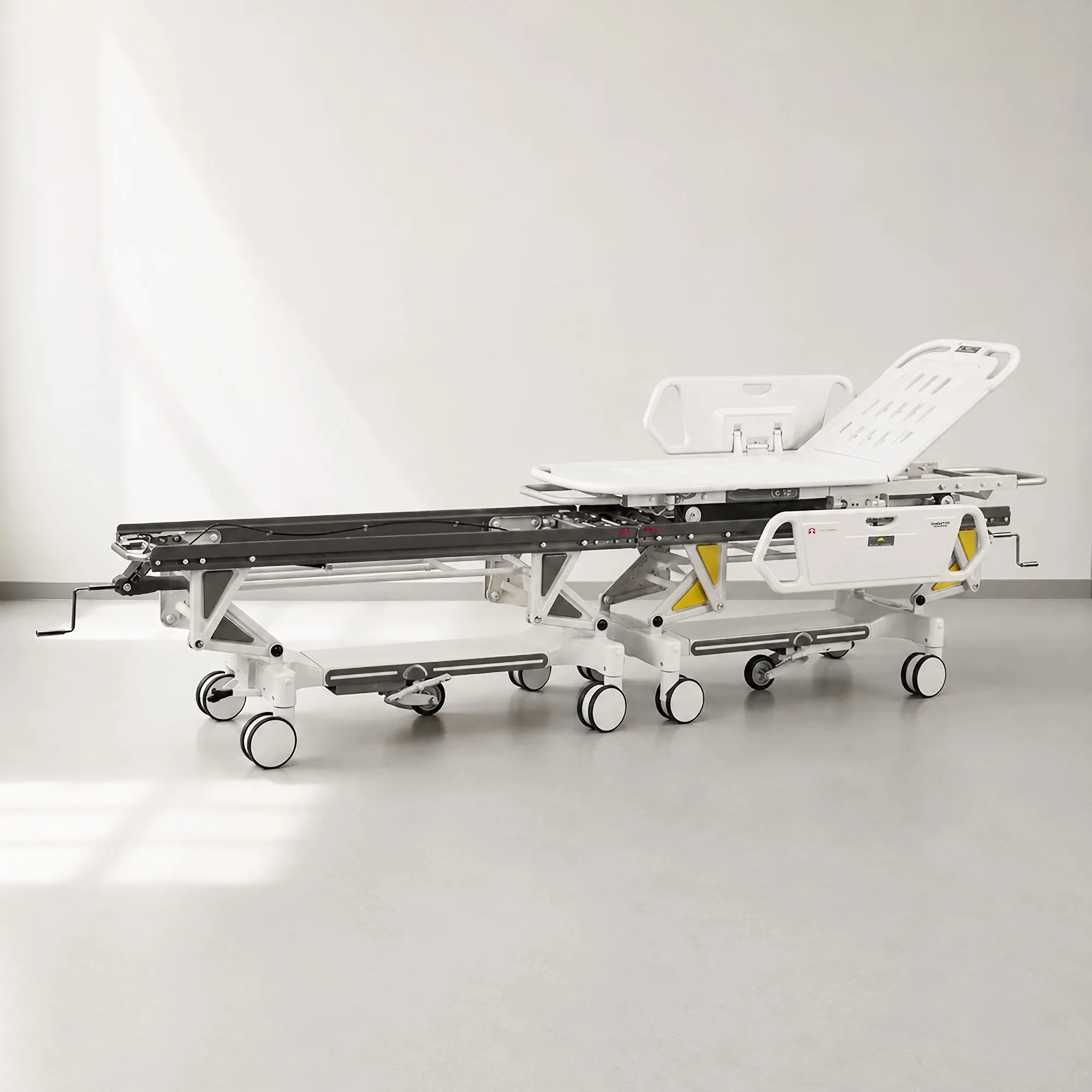
Transfer Stretcher — ToronCare™ 1110 Key Features
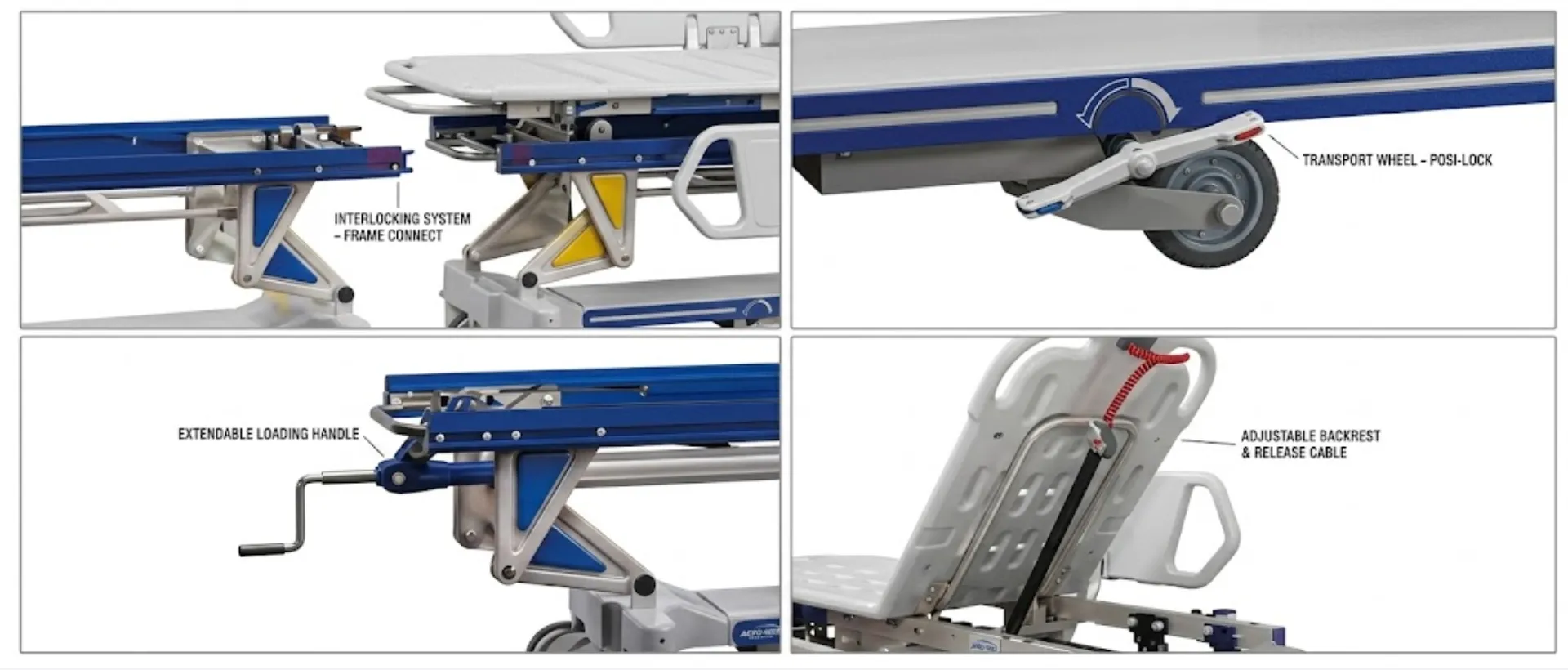
- Dual-zone infection control design: Stretcher A (sterile/O.R.) and Stretcher B (non-sterile/corridor) prevent cross-contamination during patient transfer
- Automatic mechanical docking: push the two stretchers together at equal height and they lock automatically — no manual latching required
- Seamless lateral patient transfer: patient slides on Bed Board C from stretcher to stretcher without lifting, reducing injury risk for both patient and staff
- Gas-spring damped retractable PP side railings: railings retract flush under the bed board for seamless docking and rise automatically after separation
- Central-lockable 360° swivel castors (Dia. 150 mm): a single pedal simultaneously locks all four wheels for safe stationary positioning
- Retractable 5th wheel for effortless directional control during stretcher transportation in long corridors
- Manual scissor-lift height adjustment via crank: smooth, stepless height range from 660 mm to 910 mm (bed board C to ground)
- Backrest adjustable from 0° to 85° to accommodate a range of patient conditions during transport
- Large removable Bed Board C (1906 × 610 mm) provides a generous patient surface for comfort and safety
- Standard accessories: mattress and IV pole
Theory and Method
The ToronCare™ 1110 operates on a zone-separation transfer principle. The operating room is divided into a sterile zone (Stretcher A) and a non-sterile zone (Stretcher B). Prior to patient transfer, both stretchers are adjusted to the same height using the manual crank mechanism, which drives a scissor-lift frame for precise and stable elevation control.
Once height-matched, the two stretchers are pushed together and lock automatically via a mechanical docking interface, creating a unified, gapless bed surface. The patient, lying on the removable Bed Board C, is then slid laterally from Stretcher B to Stretcher A without being lifted — eliminating fall risk and minimizing patient discomfort during stretcher transport.
The retractable side railings are spring-loaded with gas-spring damping: they lower and retract under the bed board surface during docking to ensure flush contact between the two stretchers, then rise automatically after separation to resume patient safety function. The central-lock castor system engages all four wheels simultaneously, preventing movement during the transfer phase. The retractable fifth wheel — deployed when needed — provides additional directional steering precision for stretcher transportation in narrow hospital corridors.
Transfer Stretcher — ToronCare™ 1110 Technical Specifications
| Parameter | Specification |
|---|---|
| Model | ToronCare™ 1110 |
| Type | Connecting Transfer Stretcher for Operation Room |
| Overall Dimension (Connected) | 3880 × 840 mm (L × W) |
| Height Range (Bed Board C to Ground) | 660 – 910 mm |
| Bed Board C Dimension | 1906 × 610 mm (L × W) |
| Backrest Angle | 0° – 85° |
| Castor Diameter | 150 mm, central-lockable 360° swivel |
| 5th Wheel | Retractable, for directional control |
| Side Railings | Damping PP, gas-spring controlled, retractable |
| Height Adjustment | Manual crank, scissor-lift frame |
| Net Weight | 130 kg |
| Standard Accessories | Mattress, IV pole |