
PCB Recycling Line - ToronEWR™ PCB
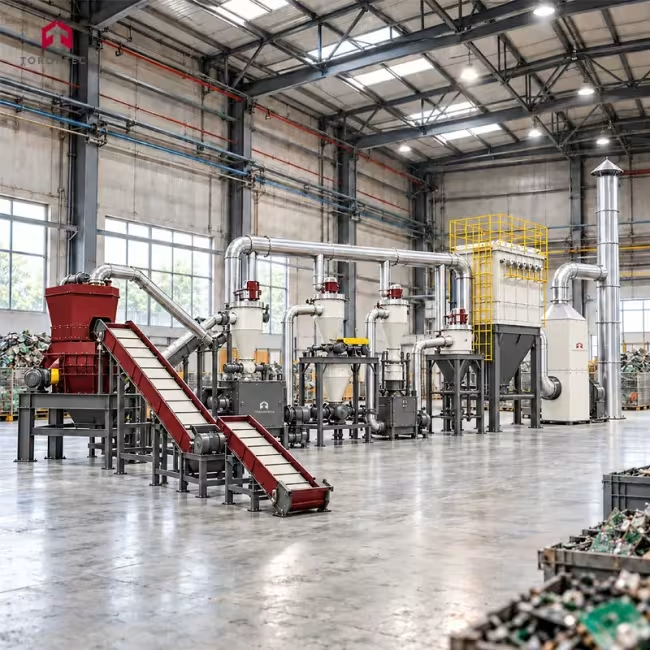
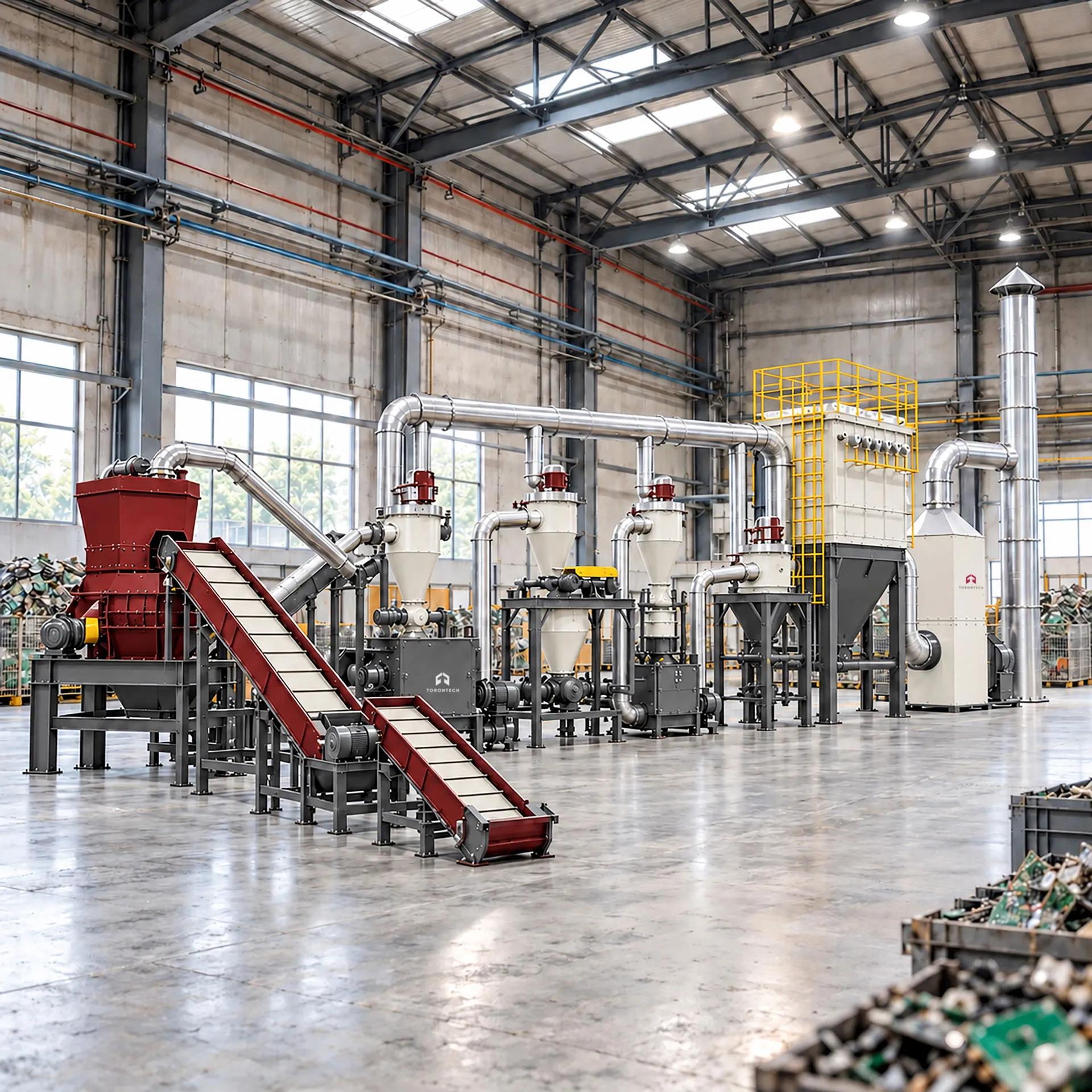
ToronEWR™ PCB recycling line separates copper from laminate in circuit board scrap, recovering 93 to 98 percent of the metal content as saleable powder. Staged crushing reduces boards to granulate, then air classification and vibrating gravity separation split the metal fraction from the non-metal fraction. Base configuration handles roughly 3,000 tons per year and scales to customer requirement. Residual metal in the recovered non-metal powder stays between 2 and 5 percent according to supplier data.
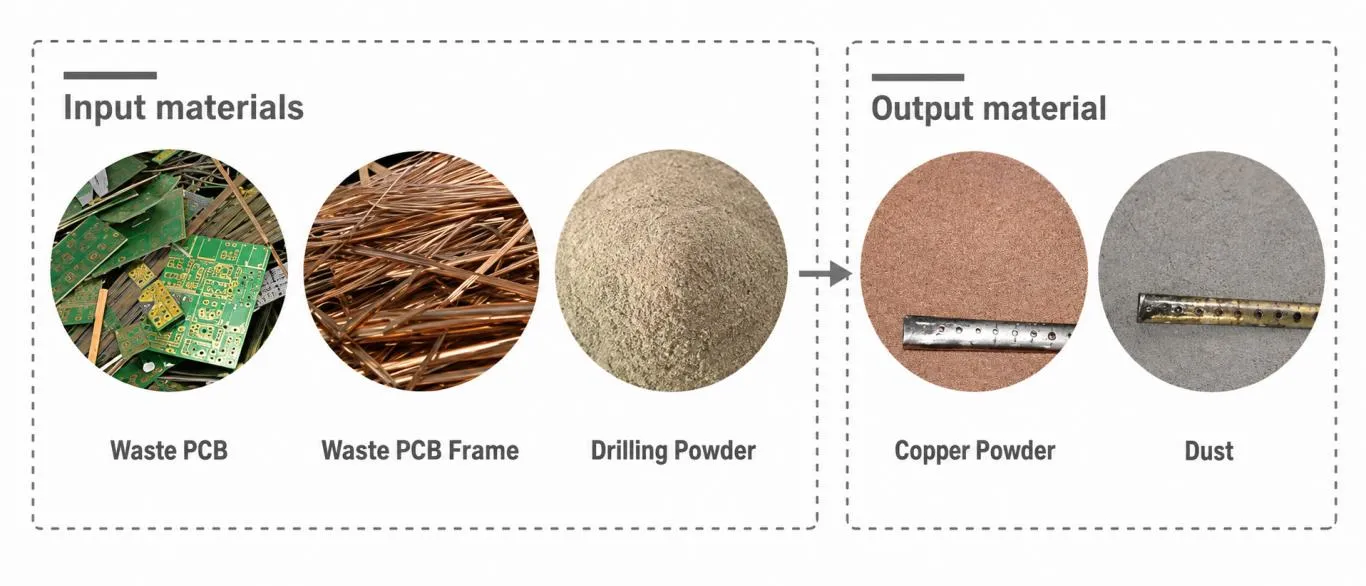
Circuit board manufacturers are the primary market. Production generates discarded boards, edge frames, and drilling powder in steady volume, and all three carry copper worth recovering rather than paying to dispose of. Electronic waste processors handling boards collected through disposal contracts run the same line. Feedstock arrives as bare laminate rather than as fully populated assemblies, which keeps the process mechanical throughout.
Enclosure is the design principle that shapes the whole line. Material travels sealed from infeed to discharge, so glass fiber, resin dust, and fine copper stay inside the system rather than reaching the workspace. A cyclone separator and pulse-jet dust collector capture that airborne fraction and return it to the product stream, which means dust control doubles as yield recovery. Exhaust passes through purification before discharge.
PCB Recycling Line - ToronEWR™ PCB Applications
The ToronEWR™ PCB line serves board manufacturers recovering their own scrap and processors treating boards as a purchased feedstock.
- PCB Manufacturing Plants: recovers copper from off-spec boards, trim, and rejects generated across etching, lamination, and finishing
- Drilling Powder Recovery: processes the copper-bearing powder that accumulates under drilling and routing operations
- Board Frame and Edge Trim Processing: treats the laminate frames left after panel depaneling, which carry recoverable copper at volume
- Electronic Waste Processors: handles circuit board scrap collected under disposal and takeback contracts
- Copper Refiners and Smelters: supplies concentrated copper powder as a feed material for downstream refining
- Electronics Contract Manufacturers: closes an internal loop on board scrap generated across multiple customer programs
- IT Asset Disposition Providers: adds board processing capability alongside device dismantling and data destruction
- Metal Recycling Operations: converts a low-value mixed input into a graded copper concentrate that commands a market price
- Laminate and Substrate Producers: recovers material from production waste in the substrate supply chain
- Automotive Electronics Suppliers: processes board scrap from control module and sensor manufacturing
- Telecommunications Equipment Makers: treats board waste generated during production and equipment refresh
- Environmental Service Contractors: brings circuit board treatment in house rather than routing material to a third party
PCB Recycling Line - ToronEWR™ PCB Key Features
The ToronEWR™ PCB line combines three-stage size reduction with two separation principles, inside an enclosure that keeps both the product and the workspace under control.
- Metal Recovery of 93 to 98 Percent: supplier data reports better than 93 percent of contained metal recovered into the copper powder fraction
- Low Residual Metal in Non-Metal Powder: the recovered laminate fraction carries 2 to 5 percent metal, which limits the value left behind
- Fully Enclosed Process: material stays sealed from infeed through discharge, so dust and fiber do not reach the operating environment
- Staged Size Reduction: three crushing steps take boards down progressively rather than in one pass, protecting copper from over-grinding
- Screenless Primary Shredder: the twin-shaft stage runs without a screen, which suits frames and hard laminate that would blind a screened chamber
- Dual Separation Principles: air classification and vibrating gravity separation work at different particle sizes rather than duplicating each other
- Cyclone and Baghouse Recovery: captured dust returns to the product stream, so dust control contributes directly to yield
- Pulse-Jet Filter Cleaning: reverse air pulses clear the filter bags during operation, which holds airflow steady without stopping the line
- Exhaust Purification Before Discharge: process air passes through treatment rather than venting directly from the building
- Reduced Noise and Vibration: the enclosed construction lowers both, which matters for a line running inside a manufacturing facility
- Handles Three Scrap Types: discarded boards, edge frames, and drilling powder all run through the same equipment set
- Dry Mechanical Process: recovery uses no leaching chemistry or wash water, so there is no effluent stream to treat
- High Automation: the line runs with limited manual intervention across the process sequence
- Straightforward Maintenance: the equipment set is built for accessible servicing and routine operation
- Configurable Capacity: the base line handles about 3,000 tons annually and can be sized to a different throughput target
Theory and Method
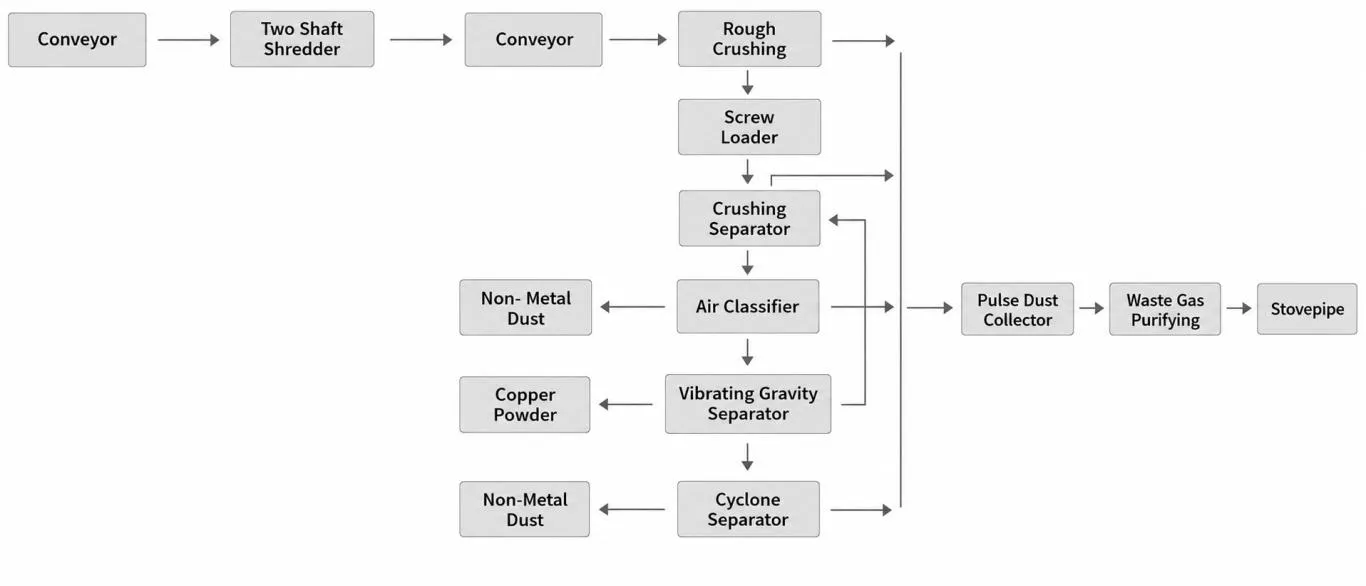
A circuit board is a laminate built for permanence. Copper foil bonds to woven glass fiber cured in epoxy resin, and the two resist separation because that bond is what the board was engineered to maintain. Mechanical recovery reduces the laminate until copper and substrate exist as independent particles. Staged crushing does this progressively, taking boards from 20 to 50 mm, then below 10 mm, then to granulate, which limits the over-grinding that would smear copper into unrecoverable fines.
Separation then relies on a density contrast of roughly four and a half to one. Copper sits near 8.96 grams per cubic centimeter against cured laminate around 1.8 to 2.0, and two methods exploit that gap at different particle sizes. The air classifier works on terminal velocity, lifting light non-metal fines away first. Vibrating gravity separation handles the sized material: an oscillating deck and rising air fluidize the bed, so denser copper stratifies downward and travels a different path than the laminate above.
Dust handling is part of the recovery process rather than an accessory. Grinding cured laminate releases respirable glass fiber and resin along with fine copper, so the air leaving each stage carries product as well as contamination. The cyclone separates solids from that airstream by spinning it: a tangential inlet forces the gas into a vortex, and particles carrying enough inertia strike the wall and spiral down. Filter bags capture what the cyclone passes, with reverse air pulses shaking the dust free.
PCB Recycling Line - ToronEWR™ PCB Technical Specifications
System Overview
| Parameter | Specification |
|---|---|
| System Type | Dry mechanical crushing and separation line for printed circuit board scrap |
| Annual Processing Capacity | Approximately 3,000 tons per year (base configuration) |
| Processable Feedstock | Waste PCBs, PCB edge frames, production drilling powder, circuit board electronic waste |
| Output Materials | Copper and metal powder, non-metal powder, collected dust |
| Metal Recovery Rate | 93 to 98 percent (supplier stated) |
| Metal Content in Non-Metal Powder | 2 to 5 percent (supplier stated) |
| Primary Shredder Output | 20 to 50 mm |
| Rough Crusher Output | Within 10 mm |
| Final Reduction | Granulate sized for separation |
| Process Enclosure | Fully sealed from infeed to discharge |
| Separation Methods | Air classification and vibrating gravity separation |
| Dust Control | Cyclone separator with pulse-jet bag filter |
| Exhaust Treatment | Purification before discharge |
| Process Type | Dry, without leaching chemistry or wash water |
| Automation Level | High, with limited manual intervention |
| Configuration | Line designed to customer throughput and layout requirement |
Machine Line-Up
The line is assembled from the modules below. Each stage is described with its function, working method, and available parameters.
1. Feeding System
Board scrap, frames, and drilling powder are charged into the infeed and metered into the primary shredder. Controlled feeding keeps the shredder within its torque band, which matters with rigid laminate that arrives in inconsistent sheet sizes.
| Parameter | Specification |
|---|---|
| Function | Meters board scrap into the primary shredding stage |
| Feed Material | Waste boards, edge frames, drilling powder |
| Discharge | Direct into twin-shaft shredder |
| Configuration | Sized to throughput and material format |
2. Twin-Shaft Shredder
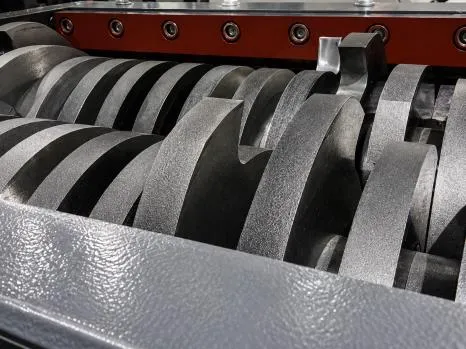 | The twin-shaft shredder performs primary size reduction on boards, frames, and other hard material, bringing them to 20 to 50 mm. This stage runs without a screen, so material passes through once rather than recirculating, which suits rigid laminate that would otherwise blind a screened chamber. |
| Parameter | Specification |
|---|---|
| Function | Primary size reduction of board and frame material |
| Shaft Arrangement | Twin shafts |
| Output Size | 20 to 50 mm |
| Screen | None fitted |
| Accepted Material | Waste PCBs, board frames, other hard laminate material |
| Discharge | To the rough crushing stage |
3. Rough Crusher
Material from the shredder passes into rough crushing, which brings particle size below 10 mm. This intermediate step prepares the stream for fine crushing, and reducing in stages rather than in one pass limits the heat and over-grinding that aggressive single-stage reduction produces.
| Parameter | Specification |
|---|---|
| Function | Intermediate size reduction ahead of fine crushing |
| Output Size | Within 10 mm |
| Feed Source | Twin-shaft shredder discharge |
| Process Purpose | Prepares material for the crushing separator |
4. Crushing Separator
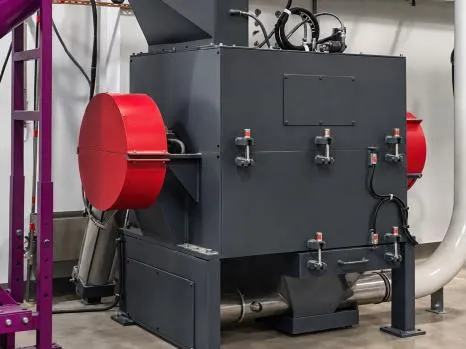 | The crushing separator completes reduction to granulate and begins the metal and non-metal split. Working the material to granulate size liberates copper from the surrounding laminate, and separation follows within the same stage before the stream moves to dedicated classification. |
| Parameter | Specification |
|---|---|
| Function | Final size reduction to granulate with initial metal separation |
| Output Form | Granulate with copper liberated from laminate |
| Separation Action | Initial split of metal from non-metal fraction |
| Feed Source | Rough crusher discharge |
| Process Purpose | Produces the particle size the classification stages require |
5. Air Classifier
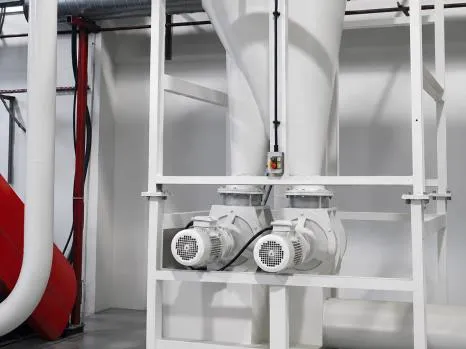 | The air classifier grades the powder by how each particle behaves in moving air. Light, fine non-metal powder separates first, since low-density laminate fines carry too little mass to resist the airstream. Removing this fraction early lightens the load on the gravity separator downstream. |
| Parameter | Specification |
|---|---|
| Function | Grade separation of fine non-metal powder from the material stream |
| Working Principle | Airflow and particle terminal velocity difference |
| Separated Fraction | Fine and light non-metal powder |
| Position | Ahead of vibrating gravity separation |
| Process Purpose | Reduces the volume of material reaching the gravity stage |
6. Vibrating Gravity Separator
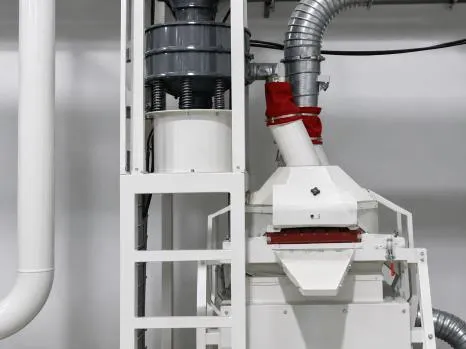 | The gravity separator handles the sized fraction where the density gap between copper and laminate can be used directly. An oscillating deck combined with rising air fluidizes the material bed, so denser copper particles stratify downward while lighter laminate rides above, and the two fractions travel different paths to separate discharge points. |
| Parameter | Specification |
|---|---|
| Function | Precise separation of metal powder from non-metal powder |
| Working Principle | Density stratification under vibration with air fluidization |
| Heavy Fraction | Copper and metal powder |
| Light Fraction | Non-metal laminate powder |
| Feed Source | Air classifier discharge |
| Process Purpose | Produces the final graded copper powder product |
7. Cyclone Separator
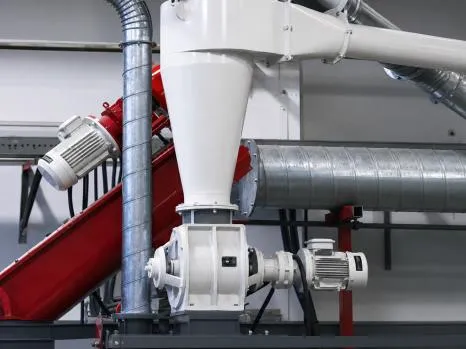 | The cyclone separates solids from the conveying air. Air enters tangentially and forms a vortex inside the body, and particles carrying enough inertia cannot follow the curving gas path, so they strike the wall and spiral down to the discharge. Cleaned air leaves through the top outlet. |
| Parameter | Specification |
|---|---|
| Function | Separation of solid particles from the conveying airstream |
| Working Principle | Tangential inlet creating vortex flow and inertial separation |
| Solids Discharge | Bottom outlet to product collection |
| Air Discharge | Top outlet to the dust collector |
| Process Benefit | Returns entrained product to the material stream |
8. Pulse-Jet Dust Collector
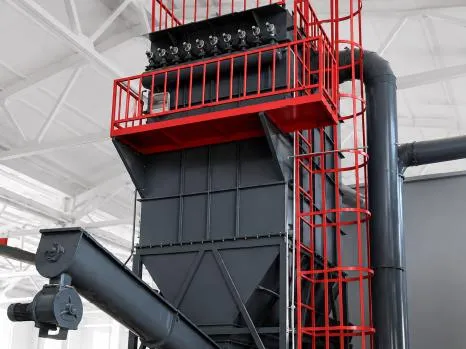 | The bag filter captures the fine dust the cyclone passes. Dusty air enters low in the housing and travels upward through filter bags, leaving particulate on the outside of the fabric. Reverse air pulses dislodge that accumulated layer so it drops to the hopper, and cleaned air discharges through the bags without interrupting the process. |
| Parameter | Specification |
|---|---|
| Function | Final capture of fine dust from process air |
| Filter Media | Fabric filter bags |
| Airflow Path | Bottom entry, upward through the bags |
| Cleaning Method | Pulse air jets dislodging collected dust |
| Dust Handling | Collected material drops to hopper for recovery |
| Air Discharge | Cleaned air released after filtration and exhaust treatment |