Automatic vs Manual Flash Point Tester Comparison
A single uncontained vapor ignition can halt plant operations and trigger severe regulatory penalties. Whether complying with EPA RCRA rules (the 140°F / 60°C ignitability threshold) or US DOT, Transport Canada, and OSHA safety mandates, lab directors face a critical crossroads: choosing between a manual vs automatic flash point tester.
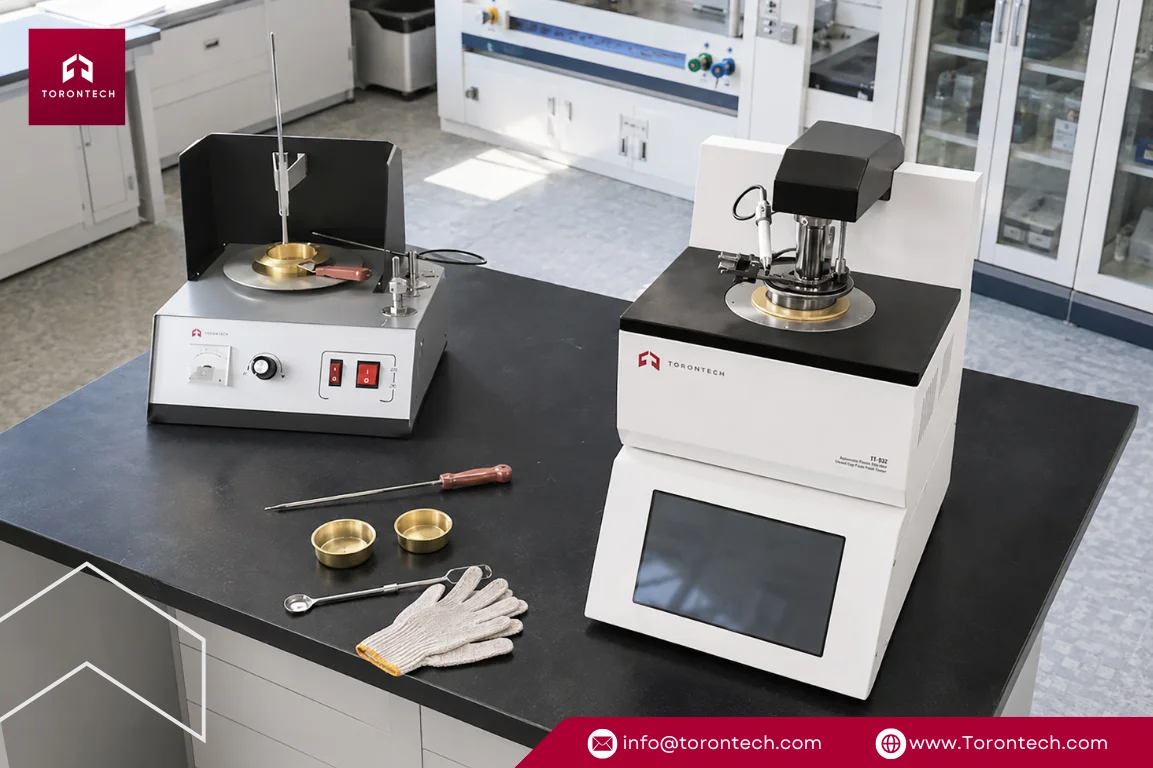
While manual units offer lower initial purchase prices, automated systems deliver statistically equivalent precision while cutting direct testing labor by up to 80%. This guide evaluates the automatic vs manual flash point tester dynamic to help you select the ideal hardware for your facility.
Statistical Equivalence and Interlaboratory Data
A common concern among laboratory directors is whether transitioning from traditional manual apparatuses to automated instruments will alter test results. Historically determined with manual hardware, flash point testing has steadily shifted toward automated instruments to maximize operational efficiency.
Extensive interlaboratory testing confirms that automatic instruments produce results statistically equivalent to manual apparatuses across major ASTM standard methods. Interlaboratory studies evaluating ASTM D 56 (Tag Closed Cup), ASTM D 92 (Cleveland Open Cup), and ASTM D 93 (Pensky-Martens Closed Cup) revealed no statistically significant differences between manual and automatic testing methods.
Related article: Closed Cup vs Open Cup Flash Point: Lab Selection Guide
Precision Comparison Across ASTM Standards
| ASTM Standard Method | Repeatability (Manual vs. Automatic) | Reproducibility (Manual vs. Automatic) |
|---|---|---|
| ASTM D 56 (<60°C) | 1.1°C vs. 1.2°C | 4.1°C vs. 4.3°C |
| ASTM D 56 (≥60°C) | 1.4°C vs. 1.6°C | 5.8°C vs. 5.1°C |
| ASTM D 92 (Open Cup) | 4.0°C vs. 8.0°C | 13.0°C vs. 18.0°C |
| ASTM D 93 (Closed Cup) | 0.032X °C vs. 0.035X °C | 0.073X °C vs. 0.078X °C |
(Note: For ASTM D 93, precision is value-dependent, where X represents the flash point temperature in °C.).
While open-cup testing (ASTM D 92) demonstrates a wider precision gap between manual and automatic hardware, closed-cup methods remain tightly matched. Although automatic precision is slightly broader in certain scenarios, variance remains well within allowable regulatory tolerances.
Read more: ASTM D92 vs D93 vs D56: Ultimate Flash Point Guide
It is worth noting that some multi-year interlaboratory comparisons detected minor systematic offsets between specific manual and automatic instrument pairs, deriving correlation equations to reconcile cross-lab data. However, for routine quality control and regulatory compliance, automatic instruments match manual accuracy while offering substantial operational gains.
ASTM and ISO Testing Standards Overview
To satisfy regulatory inspections, testing procedures must align directly with published protocol standards. In our view, matching the correct standard to your liquid sample is step number one before reviewing hardware features:
Standard Application and Hardware Matrix
| Standard / Method | Method Type | Typical Sample Applications | Torontech Hardware Options |
|---|---|---|---|
| ASTM D93 / ISO 2719 | Pensky-Martens Closed Cup | Diesel fuels, biodiesel, lube oils, fuel oils, liquids with floating particles | Manual TT-93 | Automatic TT-93Z |
| ASTM D92 | Cleveland Open Cup | Heavy lubricating oils, asphalt bitumen, thick base stocks | Manual TT-92 | Automatic TT-92Z / TT-92E |
| ASTM D56 | Tag Closed Cup | Thin liquids, solvents, aviation turbine fuels, liquid road asphalt | Automatic TT-56Z |
| ISO 13736 / IP 170 | Abel Closed Cup | Petroleum liquids, solvents, paint thinners (testing range: -30°C to 70°C) | Automatic TT-170Z |
Manual Flash Point Testers: Overview and Performance
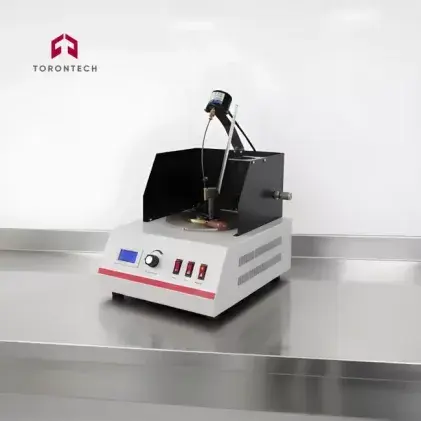
Manual units place complete operational responsibility on your human technician. The operator must regulate heat dials, continuously monitor glass thermometers, manually introduce a gas flame at exact intervals, and visually detect the ignition flash.
For academic classrooms or low-frequency facilities where manual procedures are preferred, straightforward mechanical units like our Manual Cleveland Open Cup Flash Point Tester (TT-92) or Manual Pensky-Martens Closed-Cup Flash Point Tester (TT-93) keep physical operations simple without requiring software programming.
Key Advantages
- Lower initial purchase cost: They feature basic mechanical structures, keeping day-one capital outlays modest.
- Straightforward mechanical upkeep: Servicing usually involves basic mechanical repairs rather than specialized software diagnostics.
- Great for academic demonstration: Perfect for educational institutions teaching fundamental thermodynamic principles without high-speed production demands.
Operational Limitations
- High skill requirement: Manual methods demand uninterrupted, highly skilled operator labor, which can inadvertently reduce testing efficiency and consistency.
- Labor-intensive demands: Your technician remains tied to the benchtop for 40 minutes straight per test cycle.
- Inherent fire hazards: Manually applying open gas flames near volatile, heated vapors introduces avoidable safety risks.
- Manual record keeping: Handwritten logbooks create opportunities for transcription errors and compliance delays during audits.
Our perspective: While manual units served as dependable industry workhorses in past decades, relying on them for routine daily testing in high-demand facilities is increasingly difficult to justify from a labor efficiency standpoint.
Automatic Flash Point Testers: Key Technologies
The historical evolution of flash point testing has progressed from purely manual devices through semi-automatic systems to modern automated instruments. Automatic units take full command of the process. Equipped with microprocessor controls, highly sensitive PT100 temperature sensors, automated ignition arms, and optical flash detectors, your technician simply loads the sample cup, selects the test method, and lets the system run.
Across the industry, modern automated systems deliver clear operational benefits: they require as little as 1 mL of sample to minimize solvent waste, feature integrated cooling systems that reduce test cycles to under 15 minutes, and achieve proven repeatability within strict standard tolerances.
Pensky-Martens Testing (TT-93Z): Viscous Fluids
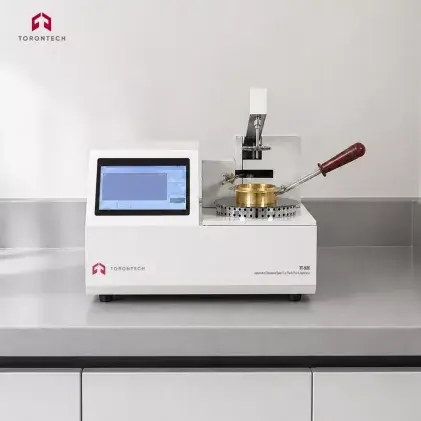
For liquids with higher kinematic viscosity (≥ 5.8 mm²/s at 37.8°C), suspended solids, or surface films, our Automatic Pensky-Martens Tester (TT-93Z) incorporates a color touchscreen interface, automatic cup lifting, and a precision stepper motor for consistent stirring across ASTM D93 Procedures A, B, and C. It also features a quick detection function that estimates flash points on unknown samples prior to running a full precision test, combined with automatic barometric pressure correction.
Crucially, ASTM D93 standards require automated Pensky-Martens apparatuses to include an integrated fire-extinguishing system. Modern instruments like the TT-93Z treat active fire suppression as a core compliance requirement rather than an optional add-on, safeguarding laboratory personnel and ensuring your equipment passes rigorous facility safety audits without issues.
Cleveland Open Cup Testing (TT-92Z): High-Temperature Oils
For lubricating oils, base stocks, and heavy industrial fluids requiring high-temperature open-cup testing (79°C to 400°C), our Automatic Cleveland Open Cup Tester (TT-92Z) manages automated heating sequences, auto-ignition sweeps, and post-test sample cooling.
Tag and Abel Closed Cup Testing (TT-56Z / TT-170Z): Volatile Solvents
For facilities operating in cold Northern US states and Western Canada, winter fuel blending (such as Ultra-Low Sulfur Diesel [ULSD], Arctic diesel, heating oils, and anti-icing additives) demands precise low-temperature testing down to -30°C to satisfy seasonal volatility rules. Systems like our Automatic Abel Tester (TT-170Z) (covering -30°C to 70°C) and Automatic Tag Tester (TT-56Z) provide automated closed-cup precision engineered for these volatile temperature ranges and for identifying subtle fuel contamination (such as gasoline traces in kerosene).
ToronFPT™ OC-DS: Dual Fire Suppression Safety
Where testing high-volatility materials presents extreme fire risks, specialized open-cup hardware like the ToronFPT™ OC-DS incorporates an integrated dual fire-suppression mechanism directly onto the bench unit.
Gas Flame vs. Electric Igniter Technology
Traditional units required running pressurized gas lines directly to the benchtop. Modern automated systems offer electric hot-wire igniters alongside gas options. From an environmental health and safety standpoint, we strongly advocate for electric ignition. Eliminating flammable gas cylinders from testing areas significantly reduces facility risk.
Emerging Low-Volume Automation Technology
Beyond standard automated instruments, emerging methods continue to redefine testing limits. Recent research demonstrates that pairing thermal imaging with computer-vision algorithms achieves 95% flash point detection accuracy at ±2°C precision using micro-sample volumes of just 15 to 300 μL. This confirms that the industry-wide drive toward automated, low-volume testing is continuing to advance.
Manual vs. Automatic Flash Point Tester Comparison
| Parameter | Manual Flash Point Tester | Automatic Flash Point Tester |
|---|---|---|
| Accuracy & Repeatability | Operator-dependent; relies on technician reaction speed. | Statistically equivalent to manual methods across major ASTM standards. |
| Sample Volume | Requires standard cup volumes (typically 50–70 mL). | Uses as little as 1 mL, reducing solvent waste. |
| Testing Duration | 35 to 45 minutes per cycle. | Under 15 minutes with integrated rapid cooling. |
| Labor Efficiency | Low; requires dedicated technician attention throughout. | High; "walk-away" operation frees personnel for other tasks. |
| Ignition Options | Manual gas flame application. | Gas flame or electric hot-wire igniter options. |
| Safety Features | Basic manual flame management. | Integrated fire detection, thermal cutoffs, auto fire lids, or dual fire suppression (ToronFPT™ OC-DS). |
| Data Integration | Manual logbooks; risk of recording errors. | Touchscreen memory, USB export, thermal printing, and LIMS sync (e.g., TT-93Z / TT-92Z). |
| Upfront Cost | Modest initial capital expense (e.g., TT-92 / TT-93). | Higher initial capital purchase. |
Maintenance, Calibration, and Reliability
A frequent concern among procurement directors is whether automated machinery will introduce complicated maintenance routines.
- Manual Hardware: Relies on traditional glass thermometers that can drift over time without immediate detection, quietly compromising data integrity across multiple batches.
- Automatic Systems: Feature built-in self-diagnostic protocols, modular temperature probes, and automatic atmospheric pressure compensation (such as the barometric auto-correction built into our TT-93Z). Calibration is simple: run a certified reference liquid, and the software automatically adjusts sensor offsets.
In our opinion, one of the greatest advantages of automated systems isn't just speed; it is the complete confidence that your hardware will flag sensor issues before inaccurate test reports reach a client.
Financial Analysis and Labor ROI
We often see procurement departments focus exclusively on initial equipment purchase prices. In our view, evaluating equipment without factoring in ongoing labor costs is a missed strategic opportunity. When analyzing total cost per test, automation proves far more economical over a multi-year operating window.
Practical ROI Calculation
- Labor Cost Benchmark: Skilled laboratory personnel in the US and Canada command fully loaded labor rates typically ranging between $45 and $65 USD/CAD per hour.
- Manual testing requires 35 to 45 minutes of direct, continuous technician labor per test.
- Automated testing requires 3 to 5 minutes for sample loading and setup. The system manages the remaining cycle while your technician attends to other duties.
- Automated testing requires 3 to 5 minutes for sample loading and setup. The system manages the remaining cycle while your technician attends to other duties.
- That yields 30 minutes of direct labor savings per sample.
- In 24/7 terminal operations running 10 tests daily, saving 5 hours of skilled labor every single day at a $50/hour loaded rate generates $250 in daily labor savings, totaling over $91,000 USD/CAD annually.
- We find that for most facilities running multiple tests daily, an automated system recovers its capital cost within 6 to 12 months.
Industry-Specific Applications
Across major North American industrial hubs, we observe distinct operational requirements:
Refineries & Pipeline Terminals
Major refining corridors (including the US Gulf Coast corridor, the Permian Basin, and the Western Canadian Sedimentary Basin / Alberta Oil Sands) handle high daily sample loads. Strict custody-transfer rules demand high-throughput automated units (such as the Automatic Pensky-Martens TT-93Z) to keep fuel shipments moving without delays.
Aviation Fuel & Commercial QA/QC Laboratories
Verifying commercial jet fuel compliance against FAA (US) and Transport Canada Jet-A / Jet-A1 specifications requires strict closed-cup testing. Automated cooling fans on units like the Automatic Cleveland TT-92Z or Tag TT-56Z quickly drop cup temperatures between runs to maintain tight turnaround schedules.
Biofuel & Renewable Diesel Processing
Facilities across the US Midwest (Iowa/Illinois) and Western Canada operating under EPA Renewable Fuel Standard (RFS) mandates rely on automated closed-cup systems (such as the TT-93Z or TT-56Z) to verify flash point thresholds for biodiesel blends and renewable diesel outputs.
Academic Classrooms & Fundamental Research
Lower sample frequency in educational laboratories makes manual apparatuses like the TT-92 or TT-93 a practical, budget-conscious choice for fundamental student training and physical property demonstrations.
How to Choose the Right Solution for Your Lab
Assess three core criteria:
- What is your daily test volume? (High volume = Select Automatic).
- Do quality auditors inspect your data trails? (Strict compliance = Select Automatic for digital logging).
- Do safety policies restrict open gas flames? (Strict risk management = Select Automatic with electric ignition or integrated fire suppression).
Torontech Flash Point Testing Solutions
Upgrading your laboratory shouldn't require inflated equipment budgets. At Torontech, we deliver cost-effective solutions and innovative technologies engineered to meet strict ASTM, ISO, and IP testing standards while maximizing your operational ROI.
Explore Torontech’s Flash Point Testing Lineup to view technical specifications across our catalog, or contact our team today for a competitive quotation.
References (Click to expand)
- Alexeev, S. (2025). THE SECOND PHASE DEVELOPMENT OF EXPERIMENTAL METHODS FOR DETERMINING FLASH POINT. PART 1. Problems of risk management in the technosphere, 3, 111-121.
- Alexeev, S. (2025). THE SECOND PHASE DEVELOPMENT OF EXPERIMENTAL METHODS FOR DETERMINING FLASH POINT. PART 2. Problems of risk management in the technosphere, 4, 89-103.
- Ding-Fu, X. (2011). Research and Fabrication of Automatic Instrument for Flash Point Determination. Instrumentation Technology.
- Montemayor, R., Collier, M., & Lazarczyk, G. (2002). Precision and Equivalence of Automatic and Manual Flash Point Apparatus. Journal of Testing and Evaluation, 30(1), 74-84.
- St-Antoine, C., Paradis, M.-C. M., Gonnel, P., Foran, G. Y., Therrien, F., Prébé, A., & Dollé, M. (2025). Novel method to automatize flash point detection in small volumes of liquid by computer vision using thermal images. Measurement, 117629.
- White, E. W., & Montemayor, R. G. (2013). The Practice of Flash Point Determination: A Laboratory Resource. ASTM International.
- Zi-Fan, C. (2012). Factors Analysis and Improvement of Automatic Flash Point Tester. Guangzhou Chemical Industry.
- Zucchini, R., & Antonoff, H. B. (1999). Comparative Analysis of Flash Points Obtained by Manual and Automatic Instruments. SAE Technical Paper, 1999-01-3055.