ASTM D92 vs D93 vs D56: Ultimate Flash Point Guide
A misclassified flash point measurement can halt fuel shipments and compromise workplace safety. Selecting between test methods often creates confusion because cup geometries, heating profiles, and viscosity limits vary significantly.
Matching the right standard to your liquid sample ensures accurate flammability ratings and compliant shipping documentation. This guide comparing ASTM D93 vs D92 vs D56 breaks down their core technical differences and applications so you can configure your testing bench with confidence.
Quick Comparison of Core Standards
| Feature / Parameter | ASTM D92 (Cleveland) | ASTM D93 (Pensky-Martens) | ASTM D56 (Tag) |
|---|---|---|---|
| Cup Type | Open Cup | Closed Cup | Closed Cup |
| Stirring Mechanism | No | Yes (90 to 250 rpm) | No |
| Typical Temp Range | 79°C to 400°C | 40°C to 370°C | Below 93°C |
| Sample Viscosity | Medium to High | Low, Medium, or High | Low (< 5.5 cSt @ 40°C) |
| Key Procedures | Standard | Procedure A, B, and C | Standard |
| Fire Point Capability | Yes | No | No |
| Global Equivalents | ISO 2592, IP 36 | ISO 2719, IP 34 | ISO 1523, IP 492 |
| Primary Industry Focus | Heavy Lubricants, Asphalt, Bitumen | Diesel, Kerosene, Biodiesel, Residual Oils | Volatile Solvents, Aviation Fuels, Light Chemicals |
Deep Dive into the Three Main Standards
1. ASTM D92: Cleveland Open Cup (COC) Method
ASTM D92 specifies the standard test method for determining flash point and fire point values using a Cleveland Open Cup apparatus.
- How it works: Open cup configuration! The sample cup remains entirely open to the surrounding room air, allowing lighter volatile vapors to disperse into the atmosphere as heating progresses.
- Thermal Range: Intended for materials flashing anywhere from 79°C (175°F) up to a high-temp 400°C (752°F).
- Ideal Sample Profile: Heavy, viscous fluids such as motor lubricants, industrial gear oils, base oils, asphalt binders, and bitumen. Across North American industrial hubs, this setup sees widespread use in Western Canadian oil sands processing for bitumen characterization, as well as in US Rust Belt manufacturing plants testing heavy lubricants.
- Thermal Analysis Correlation: Research demonstrates that flash point values measured via ASTM D92 correlate closely with thermogravimetric analysis (TGA) data for lubricant and base oils. Specifically, the TGA temperature at which 17.5% weight loss occurs matches the ASTM D92 flash point within +/- 10 °C, showing a minimal deviation percentage ranging from -0.8% to 3.6%.
- Standout Feature: ASTM D92 does not stop at the initial flash point; it continues heating until reaching the fire point (the exact temperature where sample vapors sustain continuous burning for at least five seconds).
- International Equivalents: ISO 2592, IP 36, and DIN 51376.
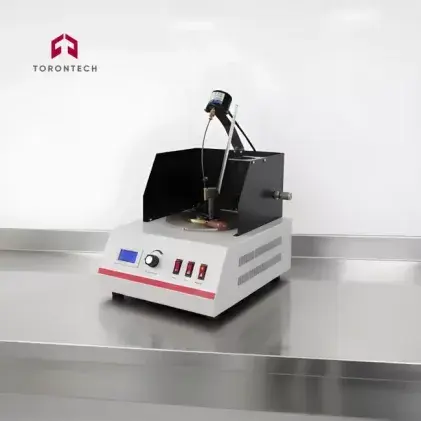
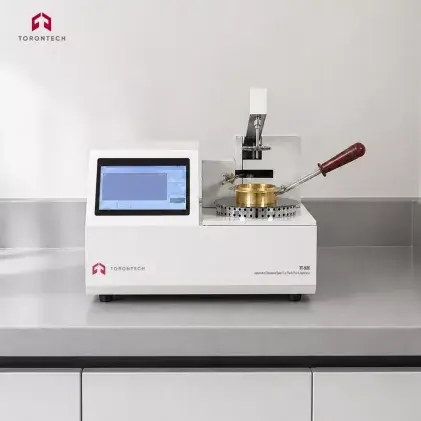
Our Take: While the Cleveland setup appears simple because there is no top lid to operate, ambient air currents across the room can sweep away volatile vapors and distort your measurements. Automated systems like our Torontech TT-92Z eliminate this variability through automated flame sweeping, optical flash detection, and rapid cooling systems.
For high-temperature oil and bitumen testing requiring maximum safety, the ToronFPT™ OC-DS adds integrated dual fire suppression mechanisms. For lower-volume field testing, manual units like the TT-92 provide a practical alternative.
Related article: Automatic vs Manual Flash Point Tester Comparison
2. ASTM D93: Pensky-Martens Closed Cup (PMCC) Method
ASTM D93 stands as the premier standard across fuel terminals and refinery quality control labs, utilizing a Pensky-Martens Closed Cup analyzer.
- How it works: Closed cup with an integrated motor-driven stirrer! The sealed cup retains volatile vapors until the shutter opens briefly to introduce the test flame.
- Thermal Range: Spans from 40°C (104°F) up to 370°C (698°F).
- Ideal Sample Profile: Distillate fuels including diesel, kerosene, heating oil, biodiesel blends, in-service motor oils, and heavy residual fuels. In regional fuel distribution networks, such as US Gulf Coast pipeline terminals running ultra-low sulfur diesel, ASTM D93 provides the baseline measurement for product specification.
- Correlation with Modern Standards: ASTM D93 demonstrates strong correlation with newer continuous closed-cup methods such as ASTM D6450 and ASTM D7094. These newer methods offer improved repeatability while maintaining consistent flash point results across traditional closed-cup datasets.
- International Equivalents: ISO 2719, IP 34, and DIN 51758.
Breaking Down ASTM D93 Procedures A, B, and C
To accommodate varying physical sample behaviors, ASTM D93 provides three distinct operational procedures:
Procedure A: Standard Hydrocarbon Distillates
Intended for clean, homogeneous liquids such as distillate fuels, fresh lubricating oils, paints, and varnishes, Procedure A operates at a heating rate of 5 to 6°C per minute with a stirrer speed of 90 to 120 rpm.
Procedure B: Heavy & Film-Forming Residuals
Formulated for heavy residual fuel oils, cutback bitumens, used motor oils, and liquids containing suspended solids or surface films, Procedure B dials the heating rate down to 1.0 to 1.6°C per minute while increasing stirrer speed to 250 rpm to maintain uniform thermal distribution throughout thick fluids.
Procedure C: Pure Biodiesel (B100 / FAME)
Built specifically for pure biodiesel (B100 / FAME), Procedure C operates at 5 to 6°C per minute to identify residual methanol contamination prior to commercial fuel distribution. Processing plants across the US Midwest agricultural belt rely on Procedure C to satisfy ASTM D6751 standards and EPA regulatory limits.
Our Take: Hands down, ASTM D93 is the most versatile standard in hydrocarbon testing. In used engine oil monitoring, flash point drops often indicate fuel dilution, which degrades lubrication quality and risks engine wear.
To streamline testing across all three procedures, our Torontech TT-93Z utilizes precision stepper motors to maintain exact stirring speeds automatically. It also includes a Quick Detection Function that performs an initial scan to estimate flash points for unknown samples before running full precision cycles. Lower-volume facilities can also utilize manual benchtop models like the TT-93.
3. ASTM D56: Tag Closed Cup (TCC) Method
ASTM D56 covers low-temperature flash point determination inside a Tag Closed Cup device.
- How it works: Sealed closed cup without an internal stirrer.
- Thermal Range: Strictly intended for materials flashing below 93°C (199.4°F).
- Ideal Sample Profile: Low-viscosity, highly volatile liquids such as aviation turbine fuels, liquid pesticide formulations, paint solvents, gasoline blends, and liquid chemical mixtures. Commercial aviation supply chains across North America utilize ASTM D56 to verify Jet A fuel compliance under FAA and Transport Canada guidelines.
- Viscosity Speed Limit: Restricted to non-viscous liquids (below 5.5 cSt at 40°C). Because there is no mechanical stirrer inside the cup, thick liquids will not heat evenly.
- Fire Safety & Pesticide Applications: NFPA flammability classification for liquid pesticide formulations relies heavily on ASTM D56 test results. Studies show that flash points of complex chemical mixtures cannot be assumed to match the lowest-flash component alone; for example, formulations containing significant water content alongside small amounts of aromatic solvent still exhibit flash points close to that of the pure solvent.
- Related International Standards: ISO 1523, ISO 1516, and IP 492 (closed cup equilibrium methods). (Note: For facilities requiring European and international aviation compliance under the distinct Abel closed cup method, automated systems like our Torontech TT-170Z comply with ISO 13736 and IP 170 for samples flashing between -30°C and 70°C.)
(Note on Related ASTM Standards: Adjacent standards in the D56 numerical sequence address entirely different properties. For instance, ASTM D5619 measures tapping torque for metalworking lubricants, ASTM D5623 evaluates sulfur speciation in crude oil, and ASTM D5656 tests aerospace adhesive shear strength.)
Our Take: We strongly advise against placing viscous liquids into a Tag tester. Without a mechanical paddle to circulate the sample, thermal gradients develop along the cup bottom, yielding skewed readings. Automated Tag units like our Torontech TT-56Z maintain precise heating rate control and optical vapor sensing to preserve testing accuracy for volatile chemicals and jet fuels.
Direct Comparisons & Technical Differences
ASTM D92 vs D93: Open Cup vs. Closed Cup Dynamics
When evaluating ASTM D92 vs D93, the principal difference centers on vapor containment:
Vapor Retention and Enclosure Dynamics
Because ASTM D92 allows lighter volatile components to escape into the air, ASTM D92 consistently yields higher flash point values than ASTM D93 for the same fluid sample.
Empirical Variance Across Testing Methods
Research evaluating pure xylene isomers across ASTM D92, ASTM D93, ASTM D3278 (Setaflash), and ASTM D1310 (Tag open cup) revealed notable differences between measured flash points, literature values, and standard MSDS reference data. Open-cup and closed-cup methods yield distinct results for identical substances, proving that empirical testing is essential rather than relying solely on generic datasheet estimates.
Safety Data Sheet (SDS) Compliance
For official safety data sheets (SDS) and transport compliance, closed-cup values from ASTM D93 are the preferred standard because they reflect conditions inside sealed storage containers.
Fire Point Capabilities
When product specifications require establishing the temperature at which a liquid sustains continuous burning, ASTM D92 is the necessary standard.
Related article: Closed Cup vs Open Cup Flash Point: Lab Selection Guide
ASTM D56 vs ASTM D93: Low-Viscosity Solvents vs. Heavy Hydrocarbons
Evaluating ASTM D56 vs ASTM D93, both methods utilize closed cups to capture volatile vapors, yet they accommodate distinctly different liquid profiles:
Viscosity Boundaries and Stirring Limits
In an ASTM D56 vs ASTM D93 analysis, the 5.5 cSt viscosity limit serves as a strict technical threshold. Any fluid exceeding this limit requires a Pensky-Martens tester equipped with mechanical stirring.
Correlation Profile with Continuous Closed-Cup Methods
Both ASTM D56 and ASTM D93 align closely with newer continuous closed-cup standard ASTM D7094, which offers improved repeatability and versatility across gasoline, diesel, fresh oil, and asphalt.
Temperature Operating Limits
Tag cups are limited to samples flashing below 93°C, whereas Pensky-Martens units operate up to 370°C for heavy oil fractions.
Industry Sector Application
Chemical processing plants and industrial coating facilities rely on ASTM D56, while petroleum refineries and marine fuel terminals utilize ASTM D93.
ASTM D56 vs ASTM D92: Low-Temperature Solvents vs. Heavy Lubricants
Comparing ASTM D56 vs ASTM D92 presents the most distinct contrast in flash point testing:
Vapor Containment and Temperature Extremes
ASTM D56 uses a sealed Tag closed cup engineered specifically for low-temperature volatile liquids flashing below 93°C (199.4°F). Conversely, ASTM D92 uses a Cleveland open cup built for high-temperature testing spanning from 79°C up to 400°C. Because ASTM D92 leaves the liquid surface exposed to ambient air while ASTM D56 traps volatile vapors, test results between these two standards cannot be directly converted or interchanged.
Viscosity Limits and Fluid Dynamics
Sample viscosity creates another strict boundary between these methods. ASTM D56 is restricted to non-viscous, water-thin fluids with kinematic viscosity under 5.5 cSt at 40°C, such as jet fuel, naphtha, and organic solvents. Pouring viscous fluids into a Tag cup causes severe localized heating because the apparatus lacks an internal stirrer. In contrast, ASTM D92 handles thick, heavy petroleum products including motor oils, gear lubricants, asphalt binders, and bitumen.
Analytical Data and Regulatory Functions
ASTM D56 evaluates closed-cup flash points primarily for hazardous materials transport classification, pesticide safety ratings, and volatile solvent purity checks. Meanwhile, ASTM D92 measures both flash point and fire point, providing essential thermal breakdown data for heavy industrial lubricants and high-temperature oils.
Simple Decision Matrix: Selecting Your Standard
Use this reference matrix to select the appropriate standard method based on sample viscosity and operational requirements:
| Sample Viscosity | Target Flash Point | Key Sample Condition | Recommended Standard | Typical Materials |
|---|---|---|---|---|
| Low (< 5.5 cSt @ 40°C) | Below 93°C | Non-viscous, Homogeneous Liquid | ASTM D56 (Tag Closed Cup) | Aviation fuels, solvents, naphtha, liquid chemicals |
| Low / Medium | 40°C to 370°C | Homogeneous Fuel or Lubricant | ASTM D93 (Procedure A) | Diesel, kerosene, new lubricating oils, turbine fuel |
| Medium / High | 40°C to 370°C | Suspended Solids / Film-Forming | ASTM D93 (Procedure B) | Residual fuel oils, used oils, cutback bitumens |
| Low / Medium | Standard Range | Pure Biodiesel (B100 / FAME) | ASTM D93 (Procedure C) | Biodiesel fuels and bio-blends |
| High | 79°C to 400°C | Fire Point Determination Required | ASTM D92 (Cleveland Open Cup) | Heavy lubricants, asphalt binders, bitumen, flux oils |
Regulatory Frameworks & Compliance Requirements
Flash point determination serves as a foundational metric for regulatory compliance across international transport networks and cross-border trade:
US DOT Regulations (49 CFR 173.120): The United States Department of Transportation classifies liquids with closed-cup flash points at or below 60°C (140°F) as Flammable Liquids (Class 3), mandating specific hazardous materials packaging, placarding, and manifest documentation.
Transport Canada TDG Regulations: Under the Transportation of Dangerous Goods (TDG) framework, Transport Canada enforces strict flash point criteria for rail tank cars and highway tankers transporting petroleum fractions across provincial lines and US-Canada border crossings.
UN & OSHA Safety Classifications: Workplace hazard categories under GHS and OSHA range from Category 1 (flash point below 23°C and initial boiling point at or below 35°C) down to Category 4 (flash point between 60°C and 93°C).
We always emphasize keeping testing protocols aligned with these regulatory transport frameworks. Incorrectly classifying a bulk liquid shipment can result in substantial regulatory penalties and transport delays.
Upgrade Your Flash Point Testing with Torontech
Selecting the correct standard between ASTM D93 vs D92 vs D56 depends on sample viscosity, temperature profiles, and regulatory requirements. Executing these testing standards with consistent accuracy requires reliable laboratory equipment.
Based in North America, Torontech delivers cost-effective solutions featuring innovative technologies that streamline testing workflows, protect personnel, and maintain repeatable compliance across open-cup and closed-cup protocols.
Our automated flash point analyzer lineup supports these exact standard demands:
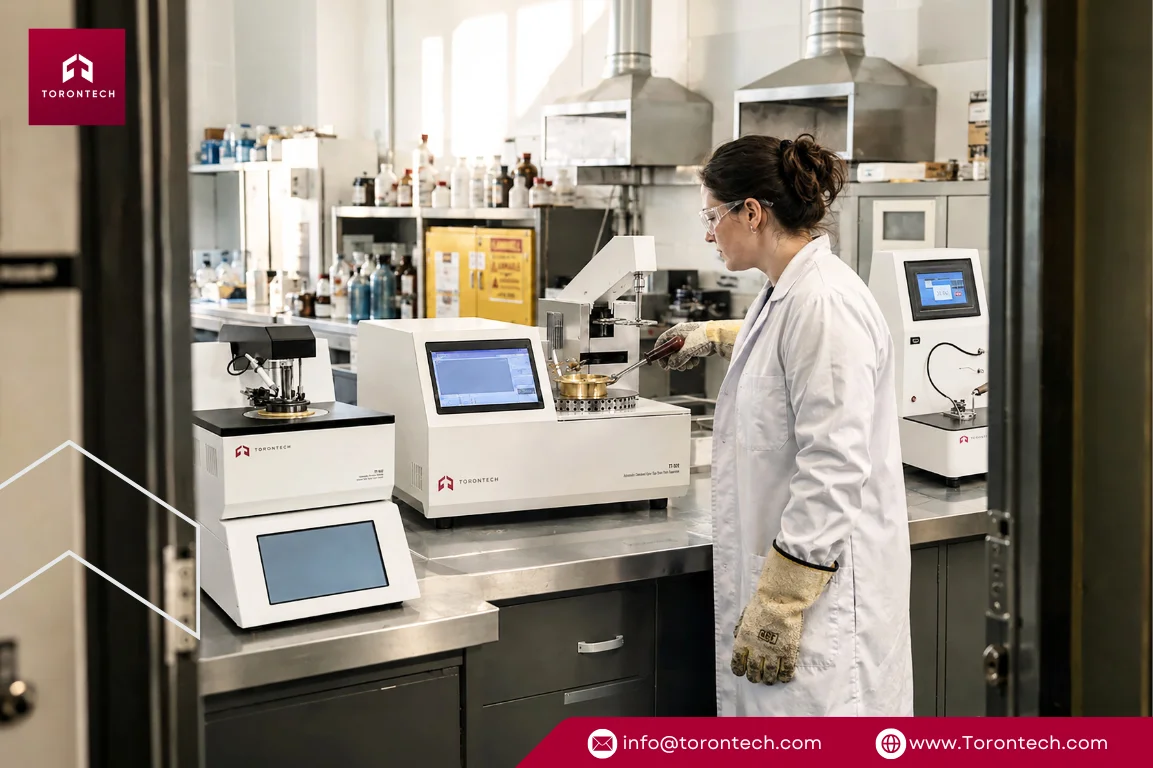
- Automatic Pensky-Martens Closed Cup Flash Point Tester (TT-93Z): Multi-procedure automation for ASTM D93 (Procedures A, B, and C) featuring dual gas/electric ignition, quick-detection pre-scanning, and automated barometric pressure compensation that continuously adjusts readings to the standard 101.3 kPa baseline to prevent altitude and weather-induced temperature drift.
- Automatic Cleveland Open Cup Flash Point Tester (TT-92Z): Optical flash and fire point detection according to ASTM D92 and ISO 2592, complete with over-temperature protection and rapid cooling.
- Automatic Tag Closed Cup Flash Point Tester (TT-56Z): Temperature control and vapor sensing engineered specifically for low-viscosity fuels and solvents under ASTM D56.
- Open Cup Flash Point Tester with Dual Fire Suppression (ToronFPT™ OC-DS): High-temperature open-cup testing with integrated dual fire suppression for enhanced lab safety.
Bring enhanced accuracy to your testing bench. Explore our complete range of Torontech Flash Point Testing Solutions or contact our technical team today to request a quotation.
References (Click to expand)
- Abdelkhalik, A., Elsayed, H., Hassan, M., Nour, M., Shehata, A., & Helmy, M. L. (2017). Using thermal analysis techniques for identifying the flash point temperatures of some lubricant and base oils. Egyptian Journal of Petroleum, 27(2), 131-136.
- Demmerling, A. L., & Söffker, D. (2020). Improved examination and test procedure of tapping torque tests according to ASTM D5619 using coated forming taps and water-mixed metalworking fluids. Tribology International, 145, 106151.
- Ha, D. M., & Lee, S. J. (2009). Measurement of flash point and autoignition temperature of xylene isomers. Journal of the Korean Institute of Gas, 13(4), 26-31.
- Heshka, N., Choy, J. M., & Chen, J. (2017). Gas chromatographic sulphur speciation in heavy crude oil using a modified standard D5623 method and microfluidic Deans switching. Journal of Chromatography A, 1530, 241-246.
- Karny, M. (2019). On the aerospace-grade adhesives shear strength testing with ASTM D5656 test as an example. Transactions on Aerospace Research, 2019(4), 27-37.
- Liaw, H. (2024). Prediction of the influence of pressure on flash points of liquid fuels at sub-atmospheric pressure. Journal of Loss Prevention in the Process Industries, 88, 105373.
- Namnath, J. (1993). Characterizing the fire safety of liquid pesticide formulations by using ASTM D56 Tag Closed Cup flash point method. Pesticide Formulations and Application Systems: 13th Volume, ASTM STP 1183, 172-181.
- Niculescu, R., Iorga-Simăn, V., Trică, A., & Clenci, A. (2016). Study on the engine oil's wear based on the flash point. IOP Conference Series: Materials Science and Engineering, 147, 012124.