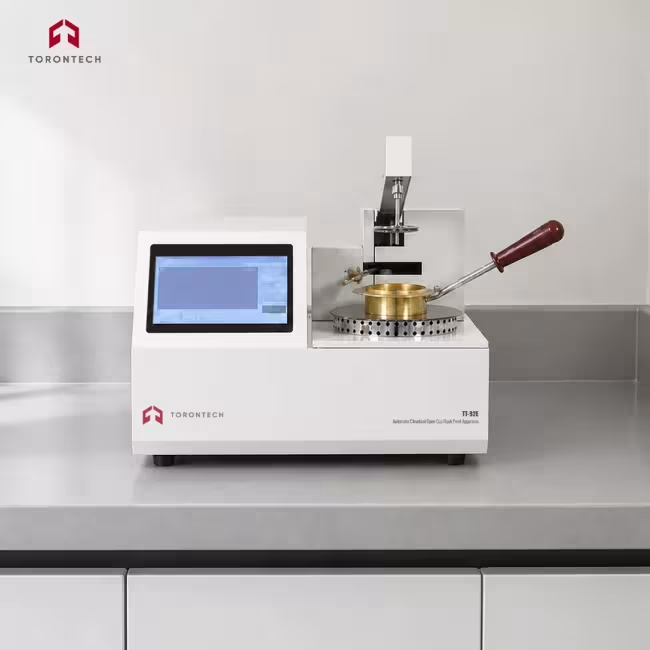
Cleveland Open Cup Flash Point Testers
Cleveland Open Cup Flash Point Testers | ASTM D92 & ISO 2592 Flash and Fire Point Determination
Cleveland open cup flash point testers determine the flash point and fire point of petroleum products under ASTM D92 and ISO 2592. Lubricant producers, refineries, and reliability labs use the results for product specifications and safety data sheets. The method covers materials that flash above 79 °C, with fuel oils excluded. Torontech offers manual and automatic configurations.
Sample sits in an open brass cup while a test flame sweeps across the surface at set intervals. Operators watch for the first flash, then keep heating until the sample sustains a flame for five seconds. Automatic models handle the sweep, the detection, and the barometric correction without operator judgment. That single difference drives most buying decisions in this category.
Why Choose Torontech for Your Cleveland Open Cup Flash Point Tester
Torontech supplies testing and measurement equipment to laboratories and manufacturers across North America and worldwide, backed by responsive technical support and calibration service. The Cleveland open cup flash point tester range is built for reliable, standards-driven results, so you can standardize on one supplier as your testing needs grow. Our team helps you match the right configuration to your samples, applicable standards, and throughput, then supports you through installation and beyond.
Request a Quote
Tell us the products you test, your expected flash point range, and your daily sample volume, and we will point you to the right configuration. Contact the Torontech team for pricing and lead times.
Applications
Flash point and fire point data governs how a petroleum product is specified, labeled, stored, and shipped.
- Lubricant Manufacturing: confirms flash and fire points for engine, gear, and industrial oil datasheets before release.
- Petroleum Refining: characterizes base oils and heavier fractions against specification during blending and quality control.
- In-Service Oil Analysis: detects fuel or solvent contamination in used lubricants, where a dropped flash point signals a developing equipment fault.
- Asphalt and Bitumen: verifies flash point on dark, high-boiling products that closed cup methods handle poorly.
- Transport and Storage Compliance: supplies the flash point figure required on safety data sheets and hazard classification documents.
Cleveland Open Cup Flash Point Tester Range
Three configurations cover the range from occasional verification to automated routine testing.
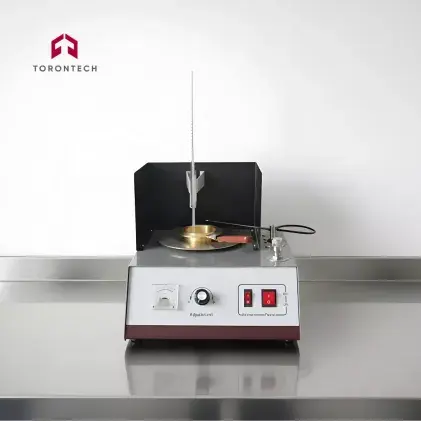
Manual Cleveland Open Cup Flash Point Tester TT-92
A manual bench unit for labs that run flash point tests occasionally or teach the method. A stepless voltage regulator holds a steady heating rate up to 1000 W, and the upper cover carries a standard fireball comparer so the operator can judge the flash against a fixed reference. Gas ignition is operator controlled, with a measurement range of 90 to 400 °C.
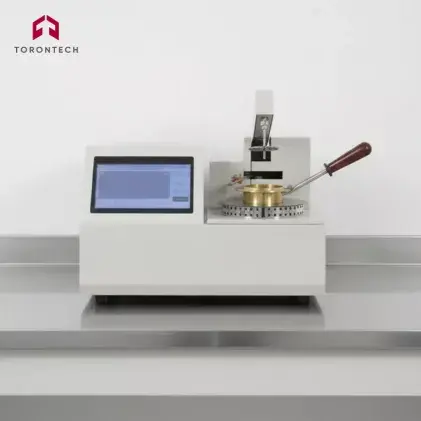
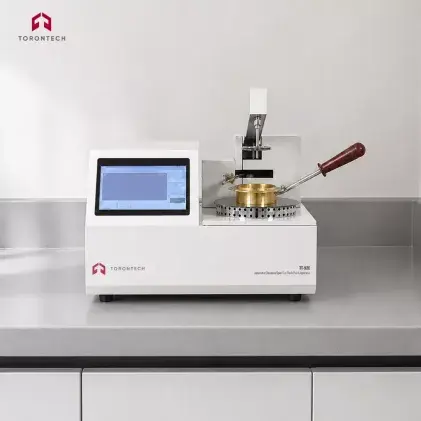
Automatic Cleveland Open Cup Flash Point Tester TT-92Z
A fully automatic model for routine quality control. Preset the expected flash point and the instrument runs the programmed heating rate, sweeps, detects the flash, lifts the detection head, air cools, and prints. A Pt100 sensor reads 79 to 400 °C at 0.1 °C resolution, automatic barometric detection corrects the result, and memory holds the last 100 analyses with an optional RS232 interface. The compact 15 kg frame suits labs working with limited bench space.
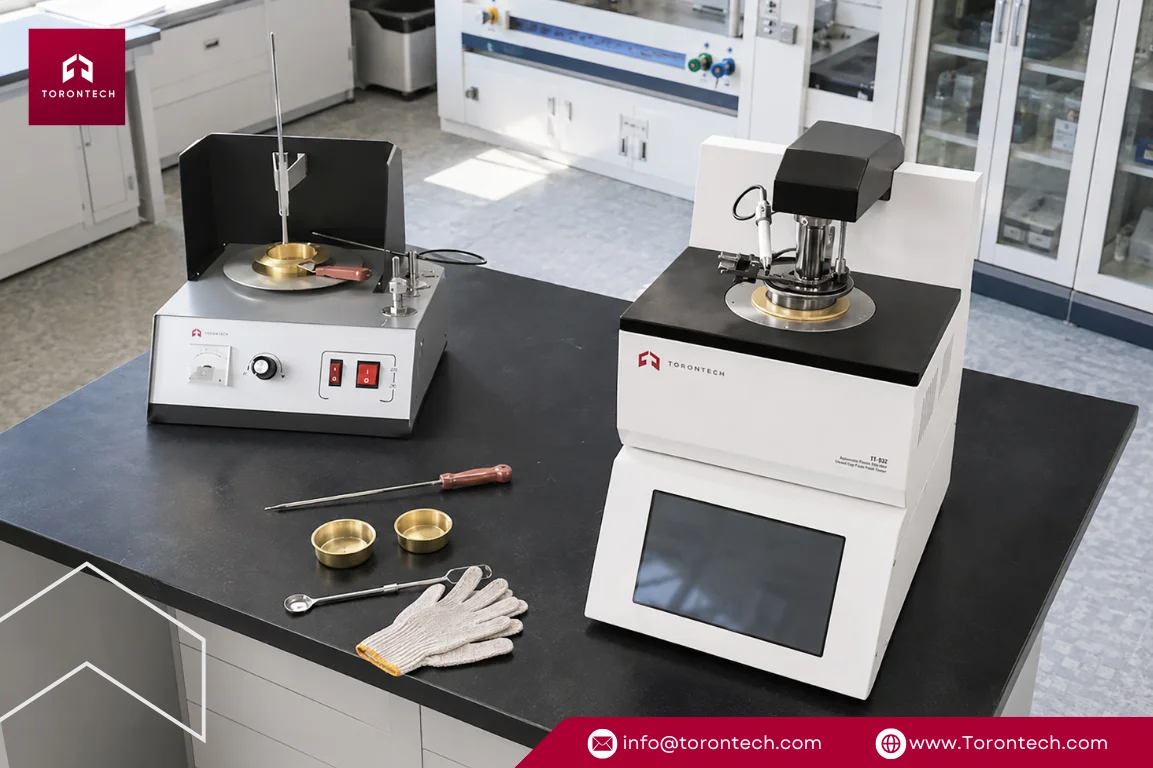
Automatic Cleveland Open Cup Flash Point Apparatus TT-92E
A fully automatic model built around an ionization ring sensor for flash detection, with programmed heating that follows the ASTM D92 profile. A built-in barometric sensor applies pressure and temperature correction, and a micro printer ships as part of the standard configuration. A fast detection mode lets you raise the heating rate to bracket an unknown sample quickly, while a settable maximum temperature and ignition count stop heating automatically.
How to Choose the Right Cleveland Open Cup Flash Point Tester
- For occasional testing, teaching labs, or a tight budget: choose the manual TT-92 and accept operator-dependent timing and visual flash judgment.
- For routine QC with traceable records: choose the automatic TT-92Z for its result memory, digital resolution, and optional computer interface.
- For screening unknown samples: choose the TT-92E, where fast detection mode brackets an unfamiliar material before you run the qualifying test.
- For labs above sea level: choose either automatic model, since both correct the reported result for actual barometric pressure.
- For samples that flash below 79 °C: a Cleveland open cup tester is outside its scope, so use a Pensky-Martens closed cup instrument instead.
- For limited bench space: the TT-92Z carries the smaller footprint of the two automatic models.