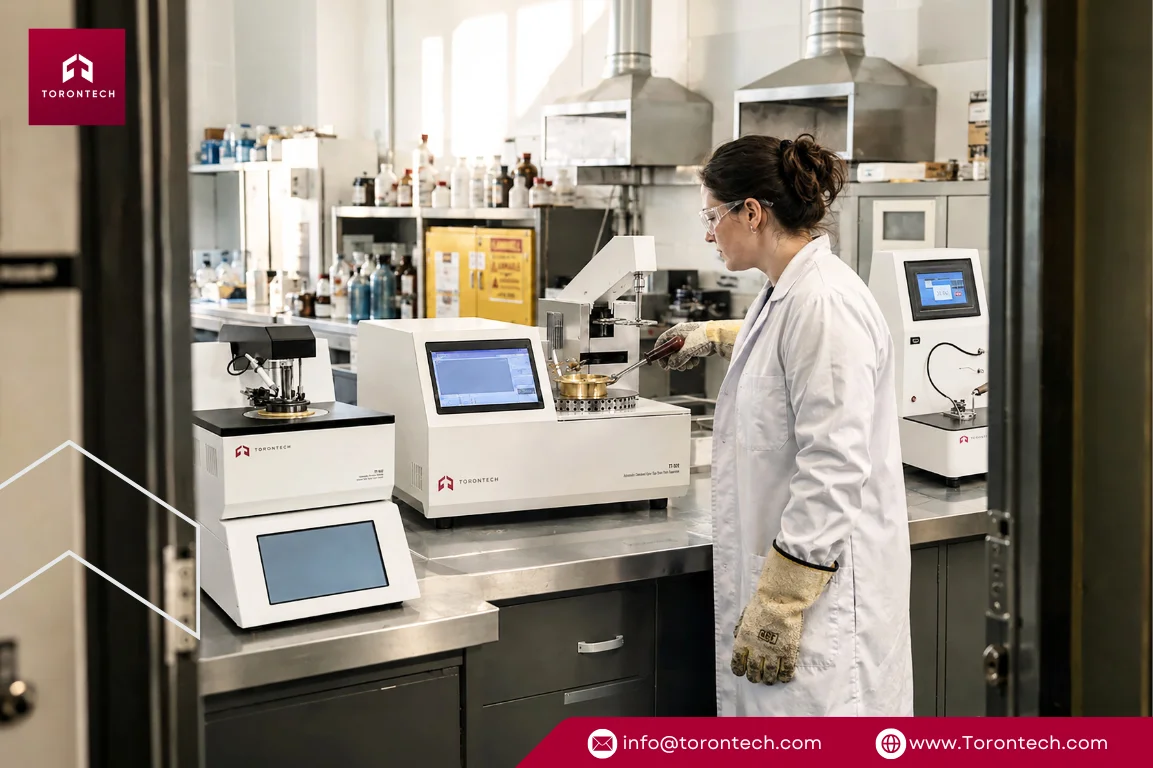
Manual Pensky-Martens Closed-Cup Flash Point Tester
Manual Pensky-Martens Closed-Cup Flash Point Tester TT-93
Manual Pensky-Martens Closed-Cup Flash Point Tester TT-93 tester complies with the ASTM D93 Standard Test Methods for Flash Point by Pensky-Martens Closed Cup Tester.
Manual Pensky-Martens Closed-Cup Flash Point Tester TT-93 is utilized to test liquids with a kinematic viscosity of 5.8 mm^2/s (cSt) or higher at 37.8°C, or 9.5 mm^2/s (cSt) or higher at 25°C (77°F), or those containing suspended solids, or exhibiting a tendency to form a surface film during testing. These test methods have established various classification flash points for liquids as determined by these departments.
The primary application of this tester is to determine the flash point of specific types of liquids in compliance with the ASTM D93 standard.
It is specifically utilized for testing liquids that have:
- A kinematic viscosity of 5.8 mm²/s or higher at 37.8°C.
- A kinematic viscosity of 9.5 mm²/s or higher at 25°C.
- Suspended solids.
- A tendency to form a surface film during testing.
The results are used to establish classification flash points for these liquids for safety and regulatory purposes.
- The upper cover features a standard fireball comparer, supporting easy operation.
- Heating is facilitated by a stepless voltage regulator, supporting uniform heating rate.
- The heater is made of stainless steel, guaranteeing safety and reliability.
- An electrical motor is used to agitate the oil sample, supporting uniform temperature distribution.
- The apparatus is designed with a rational layout, featuring an attractive appearance and easy operation.
- Equipped with silicone tube.
- Includes a speed conversion switch.
The flash point is the lowest temperature at which a liquid gives off enough vapor to form a mixture that ignites in air. It is a core safety property for fuels, solvents, and oils, because it defines how the product must be stored, labeled, and transported.
The Closed-Cup Method
A Pensky-Martens tester heats a sample inside a sealed cup fitted with a stirrer. As the temperature rises at a controlled rate, an ignition source is introduced into the cup at regular intervals. The closed cup keeps vapor concentrated above the liquid, which gives a reliable, repeatable reading.
Detecting the Flash
At first the vapor is too lean to ignite. As heating continues, a point is reached where the vapor flashes when the ignition source is applied. The temperature at that moment is recorded as the flash point. The method follows ASTM D93 and ISO 2719, which fix the heating rate and test conditions so results are consistent and defensible.
1. Rated voltage: AC220V±10%, 50Hz (110V also available)
2. Temperature range: 40~300°C
3. Heating power: 0~1000W (Continuously adjustable)
4. Agitation method: Motor stirrer, 90~120 r/m, 250±10 r/m
5. Ignition gas: Pipeline coal gas, Liquid gas, and gas pressure less than 10Kpa
6. Ignition method: Ignition is controlled manually
7. Ambient requirements: Temperature: 10~40°C; Humidity≤85%