RDE-OES Rotating Disc Electrode Optical Emission Spectrometers
Fast, Reliable Used-Oil Elemental Analysis
RDE-OES (Rotating Disc Electrode Optical Emission Spectrometry) is the gold-standard for rapid, multi-element analysis of new and used lubricants, hydraulic oils, fuels, coolants, and related fluids. By exciting a tiny oil aliquot on a rotating graphite disc and reading the emitted spectra, RDE-OES quantifies wear metals, contaminants, and additive elements in ~30 seconds—with sub-ppm detection limits and no sample pretreatment or reagent gases required.
Torontech’s ToronEA-Series RDE-OES Rotating Disc Electrode Optical Emission Spectrometer lineup brings laboratory-grade performance into easy-to-operate, production-ready instruments designed for condition monitoring, predictive maintenance, and QA/QC in power generation, mining, transportation, marine, defense, and commercial oil labs. All models support the core petroleum oil analysis methods ASTM D6595 and ASTM D6728, with additional method alignment to NB/SH/T0865 and HB20094.1.
Why RDE-OES Rotating Disc Electrode Optical Emission Spectrometry for Oil Analysis?
- Speed & throughput: Typical cycle time ≤30 s, ideal for high-volume labs and in-service oil monitoring.
- Low sample volume: Analyze < 2 mL per run; great for critical assets and field sampling.
- Minimal prep: No digestion, no argon, and no chemical reagents—just pour and test.
- Broad element coverage: Simultaneous readout of 24 standard elements, expandable to 32 (wear, contaminants, additives).
- Wide ranges & sensitivity: Typical ranges 0–1,000 ppm for most wear metals and 0–6,000 ppm for additive package elements (e.g., Ca, P, Zn); LOD <1 ppm.
Engineered for Accuracy & Uptime
- Stable optics: Paschen-Runge/Rowland circle spectrometers with 400–500 mm focal length and 190–800 nm spectral window deliver robust, repeatable results.
- Thermal control: 38 °C ± 0.1 °C optical temperature control helps lock precision over long runs.
- Integrated workflow: Built-in graphite electrode grinder and optional printer streamline on-bench operation; Windows® software covers instrument control, data management, and reporting.
RDE-OES Rotating Disc Electrode Optical Emission Spectrometers - ToronEA-Series
We’ve organized the range so you can pick the right balance of portability, capacity, and features. Detailed specs live on each model page.
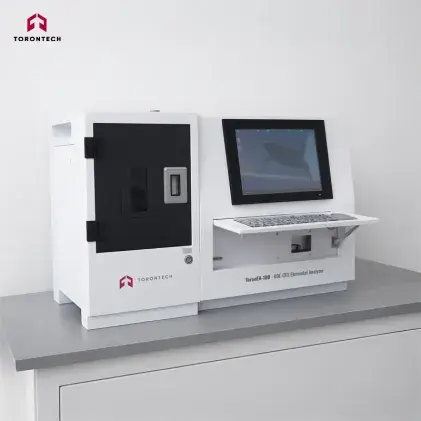
- ToronEA-100 (Compact Bench RDE-OES)
- Entry bench platform with 500 mm optics, 190–800 nm coverage, <1 ppm detection, and ~30 s test time. Ideal for fleet depots and satellite labs.
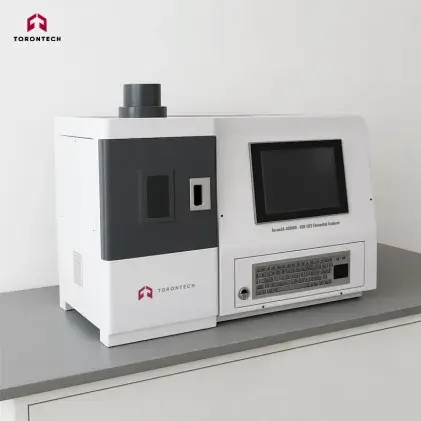
- ToronEA-200 (Bench RDE-OES with Integrated Print)
- Adds integrated printer and the same 500 mm/190–800 nm optical engine and 38 °C thermal control for routine QA/QC.
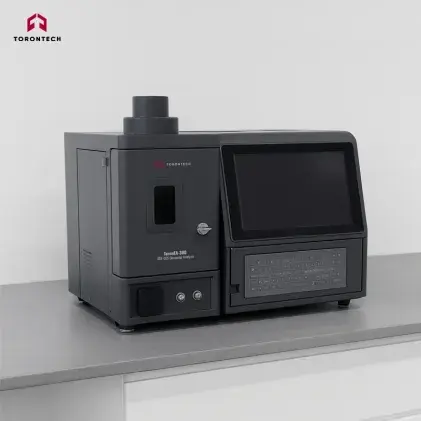
- ToronEA-300 (Ultra-Compact RDE-OES)
- Our most compact footprint featuring 400 mm focal length, 190–800 nm range, and ≤30 s cycle with <1 ppm LOD—perfect for mobile or space-restricted labs.
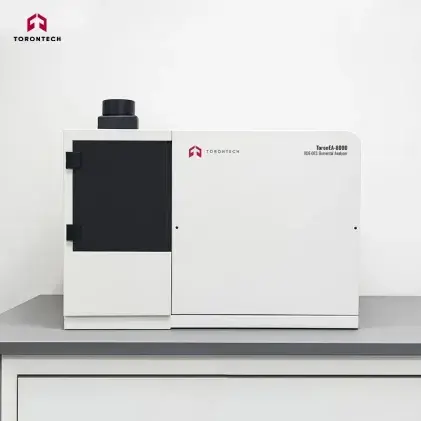
- ToronEA-8000 (High-Throughput Lab RDE-OES)
- 500 mm, 190–800 nm system with high-resolution grating and rapid USB data pipeline; supports 24–32 elements with typical 0–6,000 ppm max ranges for additive elements.
- ToronEA-8000H (High-Stability, 32-Element RDE-OES)
- Adds tight thermal control (38 °C ± 0.1 °C) and simultaneous 32-element capability for advanced trending and compliance programs; ~30 s per test.
All ToronEA RDE-OES Rotating Disc Electrode Optical Emission Spectrometer models align with ASTM D6595/D6728 and related industry practices for used-oil elemental analysis.
Typical Elements & Ranges (at a Glance)
- Wear metals: Fe, Cu, Al, Cr, Ni, Pb, Sn, Mn, Mo, Ti, Ag (typically 0–1,000 ppm)
- Additives/contaminants: Ca, Mg, Zn, P, Ba (0–6,000 ppm); Si, Na, K, B, Li (typically 0–1,000 ppm)
- Detection limit: <1 ppm (matrix-dependent)
These ranges mirror the standard RDE-OES oil analysis panel and are supported across ToronEA-Series RDE-OES Rotating Disc Electrode Optical Emission Spectrometer models.
Choose Your RDE-OES Rotating Disc Electrode Optical Emission Spectrometer ToronEA Model
- Need the smallest footprint? Start with ToronEA-300.
- Want integrated printing & grinder? ToronEA-200 streamlines on-bench workflow.
- High-throughput lab with 32-element panel? Select ToronEA-8000H.
Get Specs & Pricing
Torontech’s applications team can help map the RDE-OES Rotating Disc Electrode Optical Emission Spectrometer ToronEA-Series to your asset mix, sample volume, and reporting workflow (LIMS/ERP). Request the detailed datasheets or quotation today.
- Predictive maintenance: Engines, gearboxes, turbines, hydraulics—trend wear metals to catch faults early.
- QA/QC & R&D: Additive package verification, cleanliness checks, and formulation studies.
- Commercial oil labs & onsite programs: High-throughput screening with minimal operator training.
Key Specifications (Series-Level)
- Optics: Paschen-Runge/Rowland circle; 190–800 nm; 400/500 mm focal length (model-dependent)
- Thermal management: 38 °C ± 0.1 °C optical bay control
- Analysis time: ≈30 s per sample
- Elements: 24 standard, expandable to 32
- LOD: <1 ppm; typical ranges 0–1,000 ppm (wear) and 0–6,000 ppm (additives)
- Utilities: No reagent gases; minimal bench requirements