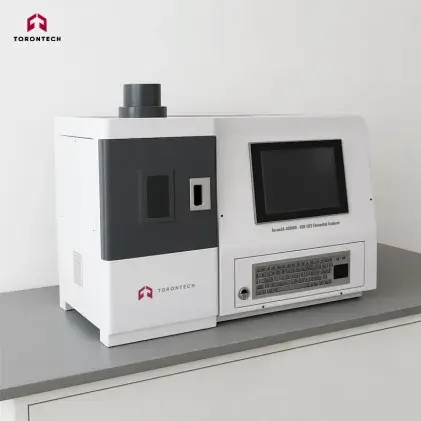
RDE-OES vs. ICP-OES: The Clear Choice for Oil Analysis
We are going to make a clear statement: for the practical, day-to-day reality of monitoring machine health, RDE-OES is a better operational choice than ICP-OES.
We’ve spent years in this industry, and we believe it’s time to settle the ICP-OES vs RDE-OES discussion on which technology truly serves the needs of maintenance and reliability teams.
When your goal is to understand what is happening inside your critical equipment, analyzing the oil is the most effective method available. For businesses that depend on their equipment to stay in service, making the right choice in the RDE-OES vs. ICP-OES debate is a critical financial decision.
A Look at the Competing Technologies
At a high level, both systems function by reading the elemental signature of an oil sample. The story of how they get there, however, reveals two completely different operational philosophies at the heart of the ICP-OES vs RDE-OES comparison.
The ICP-OES Method: A Laboratory Approach
ICP-OES is a technology born from the pristine, controlled environment of a research laboratory.
It demands a multi-step procedure where the oil sample is first carefully measured and diluted. This mixture is then nebulized and injected into a stream of argon gas that has been energized into a plasma.
It is recognized as a powerful and versatile technique across many industries due to its high accuracy and ability to analyze multiple elements at once (Șenilă, 2024; Khan et al., 2021). However, this complexity and reliance on consumables make it a high-maintenance process.
The RDE-OES Method: A Direct-to-Analysis Tool
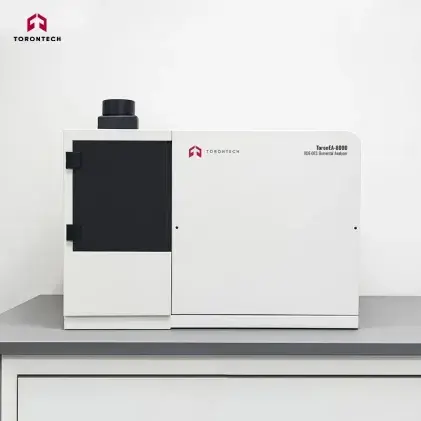
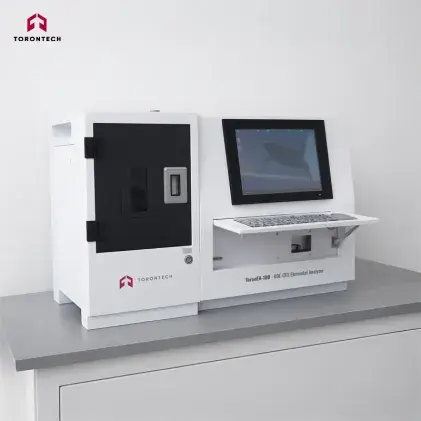
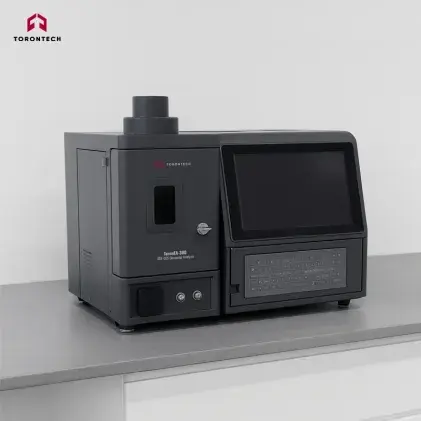
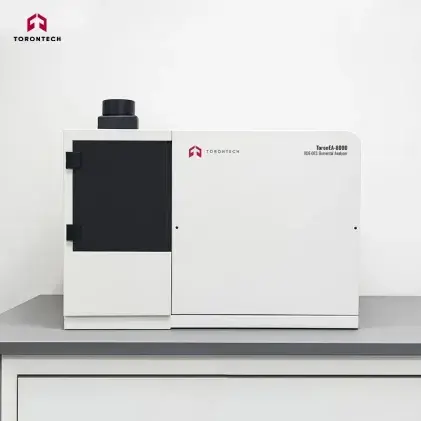
RDE-OES, by contrast, is refreshingly direct and engineered for the workshop floor. It operates on a much simpler principle, which we’ve perfected in our ToronEA-Series instruments.
It takes the oil sample as-is, with no dilution required. It then dips a continuously spinning graphite disc electrode into the oil, carrying a fresh film of the sample directly into the analysis zone. A controlled electric arc is generated, creating a contained plasma spark that gives the reading. It’s a direct-to-the-point industrial tool.
The Bottom-Line Comparison: ICP-OES vs RDE-OES
For managers who need to make quick, informed decisions based on operational realities like cost, speed, and staffing, this chart clarifies the ICP-OES vs RDE-OES matchup.
| Feature | RDE-OES | ICP-OES |
|---|---|---|
| Large Particle Detection | Excellent (up to 10µm) | Limited (< 5µm) |
| Sample Preparation | None Required | A full dilution process |
| Analysis Time | ~30 seconds per sample | Several minutes per sample |
| Ongoing Consumables | Graphite electrodes | Argon gas, chemical reagents |
| Operator Skill Level | Can be run by any trained operator | Requires a skilled lab technician |
| Total Cost of Ownership | Significantly lower | Higher due to consumables & labor |
Acknowledging the Trade-Offs: Where Each Technology Fits
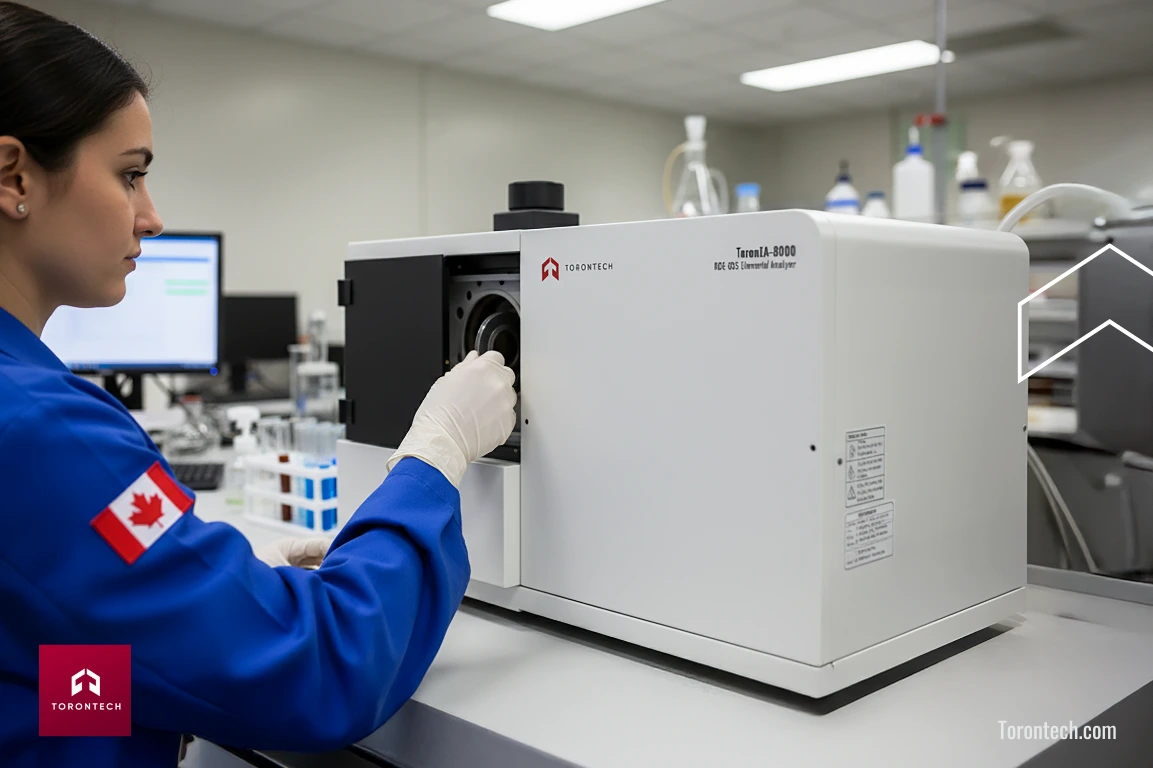
To make an honest assessment, it's important to acknowledge that the choice depends on specific analytical requirements.
Research confirms that ICP-OES is an exceptional tool when the goal is to detect trace elements at the lowest possible levels, as it consistently achieves lower limits of detection (LODs) (Rohbogner & Fischer, 2023; Șenilă, 2024; Khan et al., 2021). This high sensitivity, however, comes at the cost of being blind to the larger, more destructive wear particles critical for predictive maintenance.
Likewise, RDE-OES has its own trade-off. It generally has higher detection limits, meaning if your goal is academic research requiring the absolute lowest detection capabilities, this is not the instrument for you (Rohbogner & Fischer, 2023).
However, for the specific and crucial task of tracking machine wear trends—where metals appear in the parts-per-million (ppm) range—its sensitivity is perfectly optimized. This distinction is critical in the RDE-OES vs. ICP-OES debate.
It isn't about which is "better" in a vacuum, but which is the correct tool for the job at hand.
Our Perspective on the Real-World Advantage
With those trade-offs understood, the advantage of RDE-OES for its intended purpose becomes even clearer.
The elimination of sample preparation is the key benefit, a strength often valued in routine industrial settings for its operational simplicity and speed (Rohbogner & Fischer, 2023). This cascades throughout the entire operation.
There is not a trace of time wasted on the tedious, multi-step process of dilution. This doesn't just make the process faster; it makes it more reliable. You can also forget about managing an inventory of expensive argon gas and the associated fees and safety protocols. Every part of that traditional prep work adds time, cost, and complexity to your operation.
With RDE-OES, you simply introduce the sample and begin the analysis. A definitive result in 30 seconds is a fundamental shift in lab throughput. High-volume labs using our ToronEA-8000 can clear a backlog of hundreds of samples in one shift, providing immediate, actionable feedback to maintenance teams.
Related article: How to Interpret Oil Analysis Results Like a Pro
Industries That See the Greatest Benefit
The strategic decision between ICP-OES vs RDE-OES becomes even clearer when we look at specific industry applications where uptime is the most critical metric.
Fleet Maintenance Operations
A fleet’s profitability hinges on asset utilization. For example, a technician using a ToronEA-200 can get a reading with an integrated printout flagging a coolant leak in Engine #503 just 30 seconds after the sample arrives. The fleet manager can then immediately ground the other 15 trucks with the same engine spec, find the same faulty gasket, and prevent 15 potential roadside breakdowns.
Mining and Heavy Construction
This equipment operates under extreme stress. The key advantage here is detecting larger particles. Consider a haul truck's gearbox oil. An ICP analysis might miss the more sinister 8µm steel shards. A high-stability instrument like our ToronEA-8000H, which analyzes up to 32 elements, catches those particles, triggering an alert that saves a $300,000 gearbox from turning into scrap metal.
Read more: A Guide to Mining Equipment Oil Analysis
Power Generation Facilities
The reliability of turbines is paramount. For a power plant, an unexpected spike in bearing-related metals is a critical alert. Getting that data in minutes from a reliable benchtop unit is the difference between a planned component swap during off-peak hours and a catastrophic failure that causes an unscheduled, peak-demand outage.
Industrial Manufacturing
A single failure can shut down an entire production line. Imagine a technician pulling a sample from a critical gearbox. An analysis from a compact benchtop unit like the ToronEA-100 shows a rapid increase in iron and chromium. This allows maintenance to schedule an overnight replacement, preventing a multi-day shutdown that would have cost six figures in lost production.
Commercial Aviation
In the airline industry, Aircraft on Ground (AOG) situations are financially devastating. When a plane lands, a maintenance crew can pull an engine oil sample and get a pass/fail result from an on-site RDE-OES unit in under a minute. This rapid verification is crucial for the maintenance logs, allowing for faster turnaround times.
Military and Field Operations
In remote situations, you need equipment that is straightforward and dependable. Think of a forward operating base where ordering argon gas is a major logistical challenge. The ability of an ultra-compact model like our ToronEA-300 to run thousands of samples with just a box of electrodes isn’t a convenience; it’s a mission-critical capability.
Torontech: A More Efficient Operational Model
While ICP-OES certainly has its applications in a pure research environment, we believe that for the business of predictive maintenance, RDE-OES offers a more intelligent and efficient operational model. It delivers the critical data you need without the high overhead of consumables and labor.
Seriously, what kind of asset-dependent business couldn't benefit from that?
At Torontech, our focus is on providing these kinds of cost-effective, high-performance solutions. Our ToronEA-Series instruments are built to give you the analytical results you need without the associated high operating costs. If you are looking to improve your oil analysis program and your bottom line at the same time, we should talk.
Contact us today to discuss how a Torontech solution can lead to a lower total cost of ownership and a faster return on your investment.
References:
- Rohbogner, C., & Fischer, T. (2023). Die Analyse von Abrieb- und Additiv elementen in Schmierfetten: XRF, RDE-OES oder ICP-OES?. Tribologie und Schmierungstechnik.
- Șenilă, M. (2024). Recent Advances in the Determination of Major and Trace Elements in Plants Using Inductively Coupled Plasma Optical Emission Spectrometry. Molecules, 29.
- Khan, S., Sharma, B., Chawla, P., & Bhatia, R. (2021). Inductively Coupled Plasma Optical Emission Spectrometry (ICP-OES): a Powerful Analytical Technique for Elemental Analysis. Food Analytical Methods, 15, 666 - 688.