Optical Light Blocking vs Pore Blockage: Which is Best?
Are you getting the full story on your fluid contamination? For years, reliability teams have relied on two main technologies.
On one side is the traditional pore blockage particle counting method. On the other is the modern optical method using light-based detection principles such as light extinction.
If your team is considering a pore blockage particle counter, it is critical to understand the differences. We believe one method provides a guess while the other delivers the certainty you need to prevent catastrophic failures.
Key Takeaways
- Accuracy Over Estimation: Pore blockage counters provide a rough estimate based on flow restriction, whereas optical light blocking technology detects and sizes individual particles for precise data.
- Solving the Air Bubble Issue: Torontech optical counters utilize integrated de-aeration systems to remove air bubbles before analysis, eliminating the false readings often associated with laser-based methods.
- Meeting Industry Standards: Optical counting is the superior choice for strict compliance with international standards like ISO 4406 and NAS 1638, which require detailed particle distribution reports.
- Cost-Effective Solutions: Torontech provides affordable, laboratory-grade instruments that bring high-end optical precision to demanding environments like mining, marine, and aviation.
- Detecting the Invisible Threat: Unlike blockage screens that may miss microscopic silt, optical counters identify contaminants under 4 microns to prevent failure in sensitive hydraulic components.
So, What Exactly is a Pore Blockage Particle Counter?
Think of it as a highly specialized filter test. A pore blockage particle counter measures particles by detecting when they physically block a pore or aperture. This causes changes in flow or electrical signals as the particles pass through or obstruct the pore.
The instrument measures this rate of blockage to generate an estimate of the fluid’s contamination level.
What’s Good About It?
To be fair, the pore blockage particle counting method has its advantages in certain situations.
- It handles dark fluids: Because it relies on mechanical or electrical changes rather than light transmission, it can assess opaque or dark fluids without issue.
- It isn’t fooled by air or water: It generally ignores entrained air bubbles and water droplets since it focuses on physical obstruction.
The limitation is that this method is semi-quantitative. It provides an educated guess based on flow decay rather than a direct count of every particle. While useful, pore blockage methods can be more sensitive to clogging or overlapping signals. For professionals who require absolute certainty, a guess is often not enough.
Optical Light Blocking vs Pore Blockage: A Direct Comparison
For any reliability team that needs to report precise ISO cleanliness codes, the optical light blocking vs pore blockage discussion is critical.
The key difference lies in their detection principles. Optical counters use changes in light transmission caused by particles, while pore blockage counters detect the physical obstruction of an aperture.
The optical light blocking technology inside our Liquid and Oil Particle Counters detects the reduction in light intensity as particles pass through a light beam. This allows for rapid and accurate sizing of particles.
Related article: Liquid & Oil Particle Counters: Lab vs Portable vs Online?
Here is a clear look at how they stack up:
| Feature | Pore Blockage Particle Counting | Optical Light Blocking (The Torontech Way) |
|---|---|---|
| Detection Method | Physical obstruction of a pore or aperture | Reduction in light intensity (Light Extinction) |
| Data Quality | An extrapolated estimate or approximation | Precise Data: A direct count of individual particles |
| Standards Compliance | Limited application for official reporting | Fully Compliant: Meets ISO 4406, NAS 1638, SAE AS4059 |
| Analysis Speed | Slower; requires time for pressure to change | Immediate: Provides results in real-time |
| Level of Detail | A general indication of cleanliness | A full particle distribution report (4µm, 6µm, 14µm+) |
| Air/Water Interference | Low sensitivity; ignores them | Managed: Our units use a de-aeration system to remove them first |
To illustrate why this matters, consider a scenario involving a sensitive servo-valve. A pore blockage particle counter might give the oil a "pass" because there are no large particles clogging the screen.
However, an optical count could reveal a high concentration of 3-micron silt. This is the exact contaminant that causes valves to stick and fail. One method suggests safety while the other highlights a critical risk before the machine stops working.
Solving an Old Problem with New Technology
For years, we saw teams stick with the seemingly safer pore blockage particle counting method. This was often because early optical systems could produce false readings from air bubbles or struggled with measurement noise if only signal amplitude was considered.
However, improvements in optical blockage counters now include integral analysis methods. These better handle noise and overlapping particle signals to enhance the accuracy of particle size distribution.
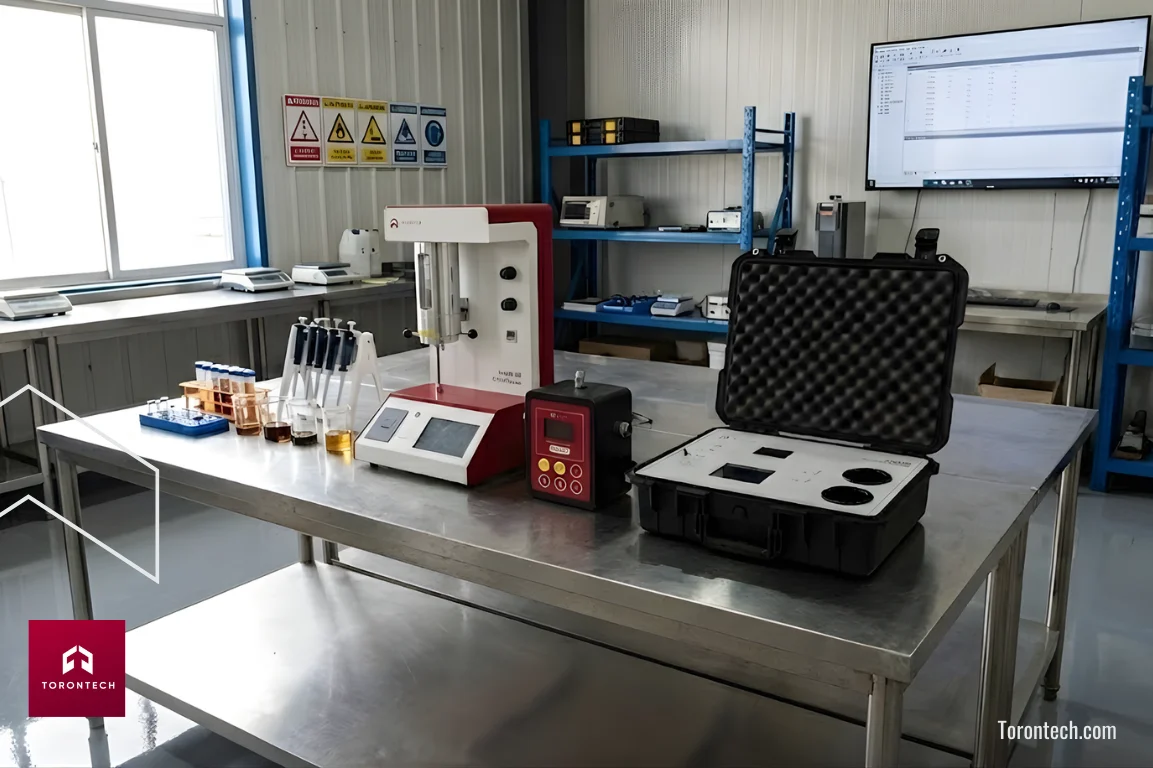
That is why we engineered our ToronOPC™ series to eliminate those old trade-offs. We knew the industry needed the precision of lasers without the historic drawbacks.
You shouldn’t have to choose between accuracy and practicality. Our cost-effective counters include smart features to solve these issues:
- Integrated De-aeration: Many of our models, such as the laboratory-grade ToronOPC™ 100, feature a built-in vacuum system. This removes entrained air from the sample before analysis to ensure laser accuracy without interference.
- Water Sensor Options: Instead of just ignoring water, our portable workhorses like the ToronOPC™ 300W can detect and report on its presence. This gives you a more complete picture of fluid health in the field.
- High-Pressure Online Analysis: Specialized models like the ToronOPC™-OL1 are built for direct connection to high-pressure lines. This provides a live stream of data that a single, static lab sample cannot replicate.
Where This Technology Delivers: Real-World Applications
With those technical challenges solved, here is where our approach makes a tangible difference in the field.
1. Mining and Heavy Equipment
In the high-particulate environment of mining, a simple blockage test will confirm that oil is dirty. What is more valuable, however, is knowing the rate of particle ingress.
For instance, if a wiper seal on a haul truck cylinder begins to fail, dust ingress starts immediately. A rugged portable unit like the ToronOPC™ 300 tracking trends would likely spike long before the oil becomes "sludgy" enough for a pore blockage particle counter to register a significant change.
2. Marine and Shipping
Marine engines rely on heavy, dark gear oils. While optical counters often require transparent fluids, modern dilution techniques and specialized setups allow us to provide marine engineers with the same ISO-certified accuracy they expect for any other fluid.
Take the case of a stern tube system where water contamination is a major threat. While a pore blockage particle counter might let water pass through undetected, our sensors would flag the rise in moisture content immediately. This alerts the crew before the oil loses its film strength.
3. Injection Molding and Manufacturing
In precision manufacturing, hydraulic servo-valves are extremely sensitive to microscopic "silt" particles. A standard pore blockage particle counter is often blind to this type of contamination. Our laser counters detect these threats instantly to protect equipment and ensure product quality.
4. Aerospace and Aviation Ground Support
In aviation, hydraulic failure is simply not an option. Here, the optical light blocking vs pore blockage debate is settled by strict safety standards. A "rough estimate" from a blockage counter rarely satisfies these requirements.
Imagine a ground support unit testing a landing gear system. An optical counter provides the verifiable, digital proof of cleanliness required for safety certification. A blockage counter might leave compliance open to interpretation.
5. Wind Energy and Power Generation
Wind turbine gearboxes are often located in remote places. This makes maintenance extremely expensive, so early detection is everything.
Consider an offshore turbine where a bearing starts to shed microscopic metal particles. An online monitoring system like the ToronOPC™ 550 can catch this early wear pattern months before a failure occurs. A pore blockage particle counter might not catch the issue until the gearbox is already destroying itself.
Torontech: Choose Precision, Not Estimates
While a pore blockage particle counter has its place, the debate over optical light blocking vs pore blockage ends when precision is non-negotiable. Overall, optical light blocking is a widely used and versatile technique for particle counting.
At Torontech, our innovative and cost-effective solutions bring this laboratory-grade accuracy to your facility. Stop settling for estimates when you can have the exact ISO cleanliness codes needed to extend machine life.
View Our Full Range of Particle Counters Here
Contact us today to discuss which Torontech solution is right for your application, and see the difference our North American approach can make in your reliability program.
References
- Carver, L. (1969). LIGHT BLOCKAGE BY PARTICLES AS A MEASUREMENT TOOL. Annals of the New York Academy of Sciences, 158.
- Krogsøe, K., Henneberg, M., & Eriksen, R. (2018). Model of a Light Extinction Sensor for Assessing Wear Particle Distribution in a Lubricated Oil System. Sensors (Basel, Switzerland), 18.
- Shao-Ming, Z. (2003). Research on Particle Size Analysis by Optical Blockage Integral Method.