The Root Cause of Hydraulic Failure & How to Stop It
Achieving consistent uptime is easier than most people think.
We believe that reliability isn't a matter of luck. It is a strategic choice. For any facility manager, the goal is to create an operation where a catastrophic hydraulic failure is a rare exception rather than the rule.
We’ve seen firsthand that the difference between a struggling plant and a profitable one often comes down to how they handle their hydraulic health. Let’s look at the invisible factors that lead to hydraulic failure and the smart technology that puts you in the driver’s seat.
Key Takeaways
- Contamination is the primary culprit: The vast majority of hydraulic system failures are not caused by component defects, but by fluid contamination that wears parts down from the inside.
- Watch for physical symptoms: Abnormal noise, high fluid temperatures, and sluggish operation are early warnings that your system needs immediate attention.
- Measure to manage: The ISO 4406 cleanliness code provides a concrete health score for your oil that helps predict and prevent component wear.
- Shift to proactive maintenance: Moving from calendar-based oil changes to condition-based monitoring significantly lowers operational costs.
- Data drives reliability: Tools like the ToronOPC™ series provide the precise, real-time data needed to stop invisible particles from halting production.
The True Source of Hydraulic Failure: Fluid Contamination
Ask a seasoned engineer to perform a failure analysis on a hydraulic pump, and their findings will likely point to the fluid. Research consistently links hydraulic failure to contamination by solid particles, which causes severe wear and damage to system components.
This is, from our perspective, a critical blind spot in many maintenance programs.
Think of hydraulic fluid as a key component of your system. When its integrity is compromised, the entire system is at risk. The primary issues include:
- Particulate Contamination: Microscopic particles of metal, silica, and other debris that introduce a constant abrasive force on internal components. Studies indicate that contaminants like wear particles and test dust significantly degrade component performance and reduce efficiency.
- Water Contamination: Moisture that promotes oxidation, depletes additives, and contributes to fluid breakdown.
- Aeration and Cavitation: Entrained air bubbles that collapse under pressure, causing surface pitting and audible signs of distress.
The most damaging particles are often completely invisible. Debris in the 4- to 14-micron range is notorious for lodging in critical clearances. This leads to valve sticking and sudden, complete component failure.
3 Early Indicators of Impending Hydraulic Failure
A reactive maintenance strategy is the most inefficient and costly approach. Your equipment will almost always provide signals of distress long before a total hydraulic failure occurs.
1. A Change in Operating Sound
A healthy hydraulic system produces a consistent, low-level hum. Any deviation, such as a whine or a knocking sound, indicates a problem.
- A high-frequency whine often points to aeration or a starved pump inlet.
- A sharp banging noise is a classic symptom of cavitation, which actively erodes internal metal surfaces.
2. Elevated Fluid Temperature
Excessive heat is a direct indicator of inefficiency. If your system is running significantly above its normal temperature baseline, it is often due to internal leakage from worn components. This heat further degrades the oil and reduces its lubricating properties.
3. Sluggish or Erratic Performance
When actuators become slow to respond or move with a jerky motion, it points to a loss of hydraulic flow. This is frequently caused by a buildup of fine silt in control valves or significant internal leakage in the main pump.
The Secret Code to Reliability: ISO 4406
You can’t manage what you don’t measure. This is where the ISO 4406 cleanliness code comes into play. It acts as a definitive health score for your fluid, consisting of three numbers (e.g., 18/16/13) that tell you exactly how many microscopic particles are circulating in your system.
We won't break down the entire mathematical formula here, but understanding this code is the single most effective way to extend the life of your pumps and valves to avoid premature hydraulic failure. You can read more here: The Full ISO 4406 Chart & Cleanliness Guide
Which Industries See the Highest Stakes?
While contamination is a universal issue, the operational and financial consequences of a hydraulic failure are most acute in sectors where uptime and precision are paramount.
Mining & Construction
Equipment operates in high-particulate environments where a single failure can halt a multi-million-dollar project. If a hydraulic shovel’s main pump fails due to silica dust ingress, that downtime can bottleneck the entire haul fleet.
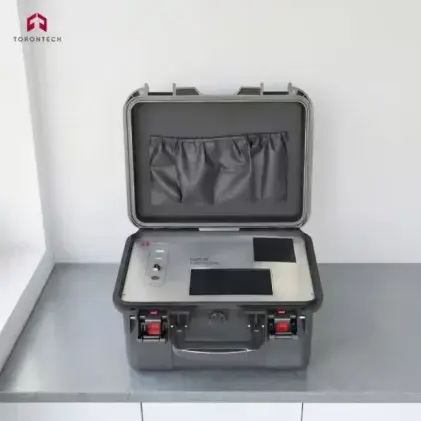
In these remote conditions, sending samples to a lab is too slow. This is where portable units like the ToronOPC™ 300W become essential for immediate, on-site decision-making.
Aerospace & Defense
Systems like landing gear and flight controls have zero tolerance for failure. A contaminated actuator here is a critical safety risk that could lead to catastrophic hydraulic failure. Advanced identification of particulate pollutants is essential for fault diagnosis and ensuring system longevity.
Injection Molding
Servo-valve performance is critical. Consider a scenario where microscopic silt causes a valve to stick slightly. This might not stop the machine, but it could lead to thousands of molded parts being rejected for inconsistent dimensions. High-volume facilities often rely on the ToronOPC™-OL1 to monitor these sensitive lines continuously.
Power Generation
Hydraulic control systems in turbines demand exceptionally clean fluid. A governor valve seizing due to varnish or debris can trip a turbine offline, disrupting energy output and incurring massive restart costs. Understanding particle behavior in these reservoirs is key to minimizing contamination effects.
Manufacturing & Metal Stamping
In a high-speed production line, the hydraulic press is the heart of the operation. A single unplanned stop due to a faulty proportional valve can halt the entire line. This jeopardizes just-in-time delivery schedules and causes a cascade of production delays downstream.
Marine & Offshore
On a vessel or an oil rig, hydraulic systems for cranes, winches, and steering are mission-critical. Hydraulic failure in these harsh, corrosive environments is not only costly but can also create significant safety hazards far from any support infrastructure.
A Modern Technology for Proactive Control
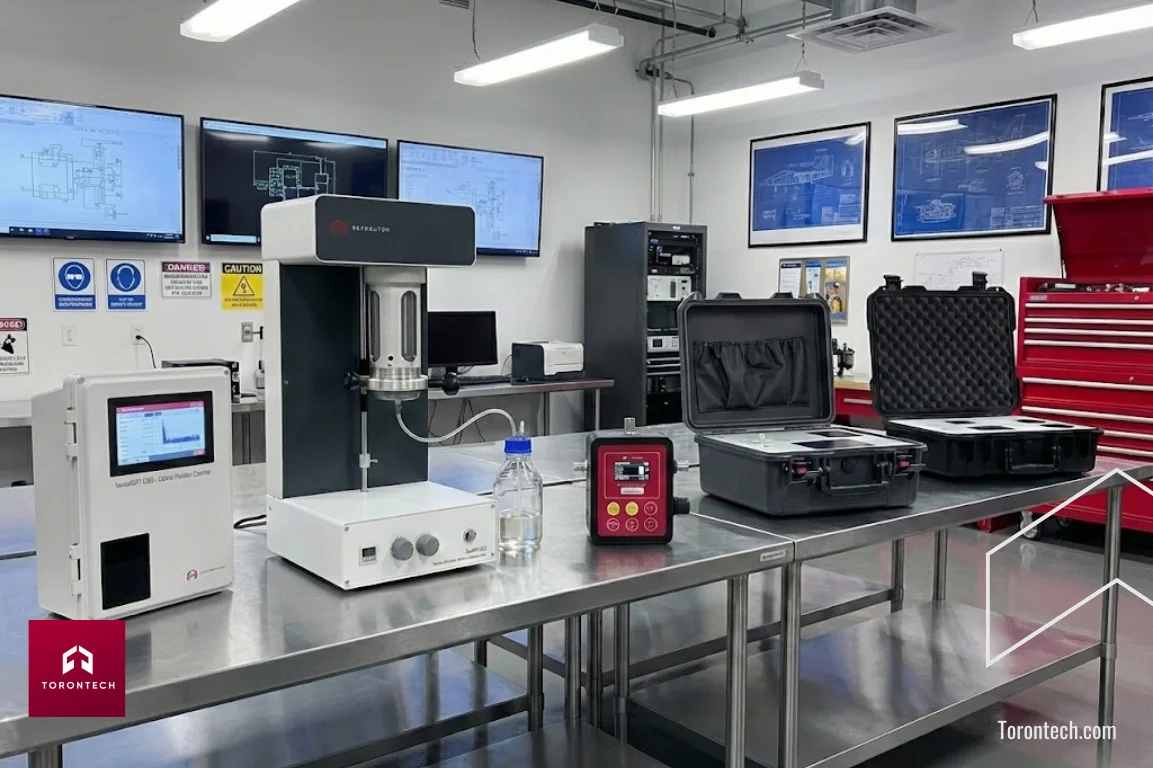
At Torontech, we advocate for a maintenance philosophy built on real data rather than guesswork. This is the role of Liquid and Oil Particle Counters. Automatic Particle Counters (APCs) are widely used for real-time monitoring to provide early warnings when contamination exceeds limits.
These sensors often use light-blockage principles, though newer designs identify different particle types using CMOS or microfluidic technology to enhance precision.
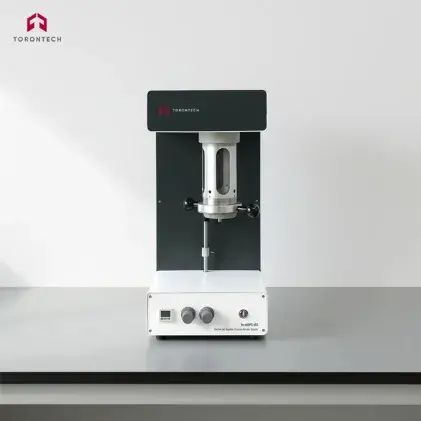
Consider the financial logic of this approach. A typical mid-sized plant might routinely discard hundreds of gallons of hydraulic fluid annually just to be "safe." By using a device like the ToronOPC™ VES to analyze viscosity and particle count in the lab, that same facility could hypothetically extend the fluid's life by two or three years.
This shift saves significant capital on procurement and hazardous waste disposal fees, often paying for the equipment in the first year.
Why This Is an Essential Tool for Any Reliability Program:
- Optimize Fluid Change Intervals: Replace expensive hydraulic fluid based on its actual condition instead of an arbitrary schedule.
- Gain Predictive Insight: A rising particle count is a clear leading indicator of component wear. It often appears long before vibration analysis detects a problem.
- Verify Fluid Cleanliness: Confirm that new oil from a supplier meets the cleanliness requirements of your equipment before you introduce it to the system.
Take Control with the ToronOPC™ Series
Hydraulic failure is expensive, but it is largely preventable. Scientific consensus confirms that managing oil cleanliness is critical to preventing failures and prolonging equipment life. The most successful organizations equip their teams with the right data to make informed maintenance decisions.
This is where Torontech steps in. We’ve designed our series to give you accessible, lab-grade precision right where you need it.
- Field Flexibility: For technicians who need to walk the floor, the ToronOPC™ 300 and 300W offer rugged portability without sacrificing accuracy.
- Continuous Vigilance: For critical assets that run 24/7, the ToronOPC™ 550 and OL1 install directly onto the system to provide real-time trend data.
- Lab Precision: For deep-dive diagnostics, the ToronOPC™ VES remains the industry benchmark for comprehensive fluid analysis.
Don't let invisible debris dictate your production schedule. By switching to data-driven monitoring, you secure your operations and your profits.
Ready to upgrade your reliability strategy? Explore the full range of ToronOPC™ Liquid and Oil Particle Counters here or contact our team today to discuss a cost-effective contamination control plan for your facility.
References
- Dușa, P., Purice, E., Lupașcu, R., Ripanu, I., & Fandarac, G. (2018). Configuring a system for hydraulic oil contamination management. MATEC Web of Conferences, 178, 04008.
- Erdani, Y., & Gumadi, R. (2024). Implementation of Automatic Particle Counter for Hydraulic Oil Condition Monitoring. Jurnal Otomasi Kontrol dan Instrumentasi.
- Kornilin, D., Kudryavtsev, I., McMillan, A., Osanlou, A., & Ratcliffe, I. (2017). Estimation of the particle concentration in hydraulic liquid by the in-line automatic particle counter based on the CMOS image sensor. Proceedings of SPIE, 10329.
- Muttenthaler, L., & Manhartsgruber, B. (2020). Euler–Lagrange CFD simulation and experiments on accumulation and resuspension of particles in hydraulic reservoirs. Journal of the Brazilian Society of Mechanical Sciences and Engineering, 42, 1-17.
- Novak, N., Trajkovski, A., Kalin, M., & Majdič, F. (2023). Degradation of Hydraulic System due to Wear Particles or Medium Test Dust. Applied Sciences.
- Shi, H., Zhang, H., L., Sun, Y., Chen, H., Zhao, X., Bai, C., & Zhang, Y. (2021). Inductive-Capacitive Coulter Counting: Detection and Differentiation of Multi-Contaminants in Hydraulic Oil Using a Microfluidic Sensor. IEEE Sensors Journal, 21, 2067-2076.
- Tič, V. (2016). MONITORING SOLID CONTAMINATION IN HYDRAULIC SYSTEMS. X. International Conference Heavy Machinery-HM 2021.
- Wang, C., Yang, C., Zhang, H., Wang, S., Yang, Z., Fu, J., & Sun, Y. (2022). Marine-Hydraulic-Oil-Particle Contaminant Identification Study Based on OpenCV. Journal of Marine Science and Engineering.
- Wang, Y., Zhang, M., & Liu, D. (2011). A Compact on-Line Particle Counter Sensor for Hydraulic Oil Contamination Detection. Applied Mechanics and Materials, 130-134, 4198 - 4201.