

Online Particle Counter
Online Particle Counter ToronOPC™ 550 provides continuous monitoring of hydraulic and lubricant oils with real-time particle analysis and automated cleanliness assessment.
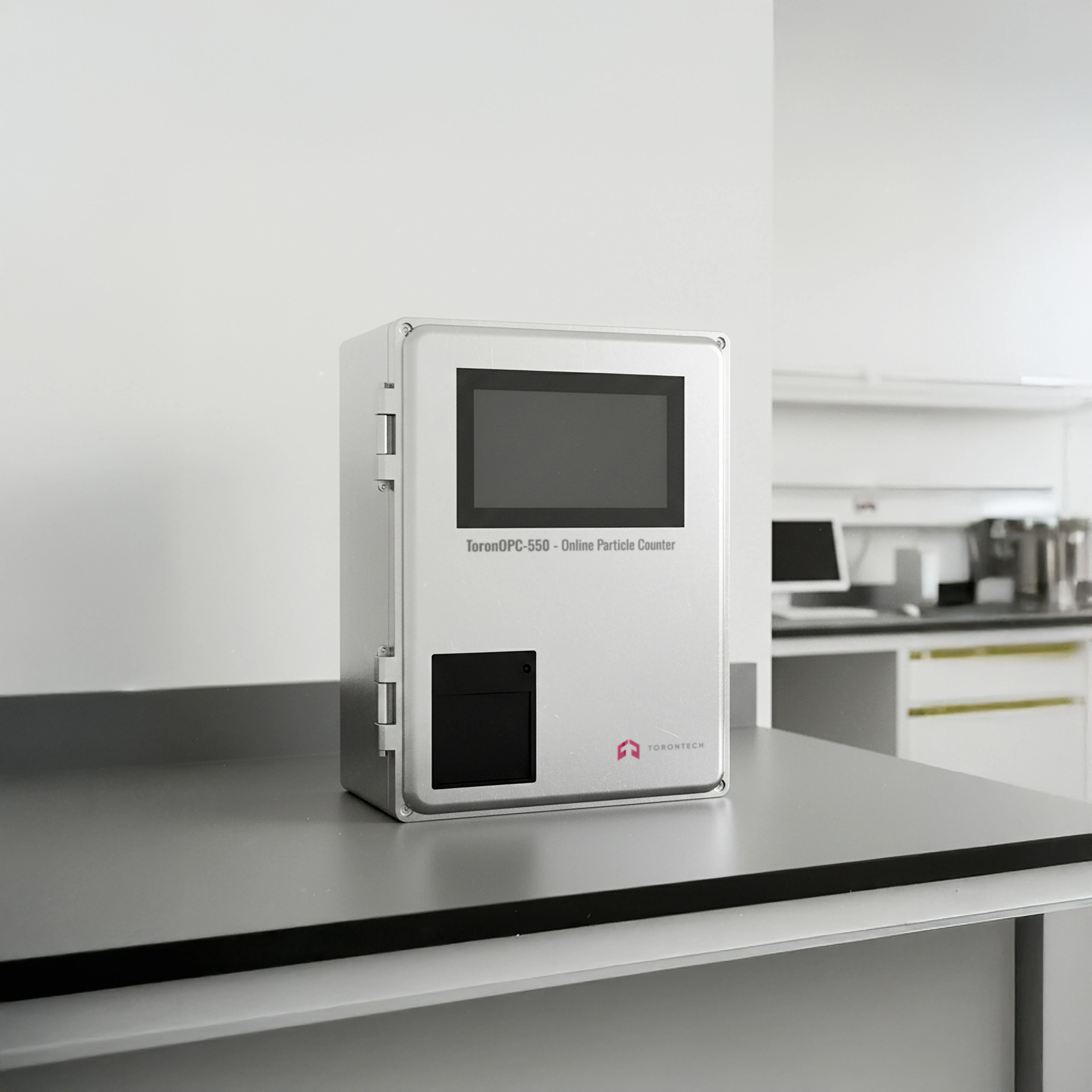
Online Particle Counter - ToronOPC™ 550
Online Particle Counter – ToronOPC™ 550 is a high-precision Oil Particle Counter engineered to provide real-time monitoring of particulate contamination in hydraulic oil, lubricants, and other industrial fluids while equipment is in operation. Designed for continuous online service, this system delivers automatic particle counting and fluid cleanliness assessment without interrupting normal machine function. Its robust hardware and intelligent software combine to provide instantaneous particle size distribution, enabling users to make timely maintenance decisions and reduce downtime.
Application
The Online Particle Counter – ToronOPC™ 550 is ideal for:
- Hydraulic System Monitoring – Continuous online cleanliness analysis in mobile and fixed hydraulic systems to prevent wear and failure.
- Lubrication Systems – Real-time detection of particulate contamination in gear, compressor, and turbine lubricants for predictive maintenance.
- Industrial Machinery Monitoring – Online fluid cleanliness tracking within presses, injection molding machines, and industrial presses.
- Energy & Power Generation – Monitoring of hydraulic and lubrication systems in turbines, gas compressors, and generator systems.
- Manufacturing Process Control – Inline contamination monitoring to ensure fluid quality during production processes.
- Heavy Equipment Maintenance – For construction, mining, and transportation equipment to optimize service intervals and improve system reliability.
Standards
The ToronOPC™ 550 supports major international and industry cleanliness standards for fluid particulate monitoring:
- ISO 4406 (International Organization for Standardization) – Cleanliness codes based on particle count at multiple micron thresholds.
- NAS 1638 (National Aerospace Standard) – Aerospace fluid cleanliness classification.
- SAE AS4059 (Society of Automotive Engineers) – Fluid cleanliness standards aligned with modern particle counting methods.
- ISO 11218 / ISO 11500 – Hydraulic fluid cleanliness standards based on online particle counting.
Online Particle Counter - ToronOPC™ 550 Key Features
- Continuous Online Particle Monitoring
- Provides live fluid cleanliness data without interrupting normal equipment operation, making it ideal for predictive maintenance and condition monitoring.
- Wide Particle Detection Range
- Detects and counts particles across a broad size range to deliver detailed particle size distribution and contamination level insights.
- Real-Time Cleanliness Reporting
- Displays instantaneous data and fluid cleanliness status, enabling immediate response to contamination events.
- Intelligent Software & Alarms
- Built-in software supports threshold alarms, trend logging, and historical data review to assist with condition-based maintenance strategies.
- Robust Industrial Design
- Engineered for harsh industrial environments with stable hardware and reliable online performance.
- Standard Compliance
- Outputs cleanliness results in formats compatible with ISO, NAS, and SAE standards to fit global maintenance and quality programs.
- Flexible Communication Interfaces
- Supports common industrial protocols (e.g., 4–20 mA, RS-485, Ethernet) for integration with plant monitoring systems and data historians.
- Low Maintenance Operation
- Designed for long-term online use with minimal intervention, reducing downtime and operational cost.
Online Particle Counter - ToronOPC™ 550 Technical Specifications
| Parameter | ToronOPC™ 500 |
|---|---|
| Product Name | Online Particle Counter |
| Model | ToronOPC™ 500 |
| Light Source | Semiconductor laser |
| Detection Method | Light-blocking / shading method |
| Operation Mode | Online or offline |
| Online Monitoring Interval | 1 second to 24 hours |
| Online Test Pressure | 0.1 to 0.6 MPa, optional pressure-reducing device up to 40 MPa |
| Sample Temperature | 0°C to 80°C |
| Particle Size Range | 1 μm to 500 μm |
| Sensitivity | 1 μm (ISO 4402) or 4 μm(c) (ISO 11171 reference) |
| Detection Channels | 32 channels, particle size can be set in 0.1 μm intervals |
| Sampling Volume | 10 to 100 mL |
| Sampling Volume Relative Error | Better than ±3% |
| Detection Speed | 5 to 60 mL/min, default 25 mL/min |
| Cleaning Speed | 5 to 60 mL/min |
| Resolution | Better than 10% |
| Coincidence Error Limit | 12,000 to 40,000 particles/mL |
| Counting Repeatability | RSD < 2% |
| Particle Count Relative Error | ±10% |
| Communication | RS485 or RS232 |
| Display / Control | 7-inch industrial display, Android system |
| Operating Temperature | -20°C to 60°C |
| Storage Temperature | -30°C to 80°C |
| Dimensions | 380 × 280 × 170 mm |
| Weight | 5.5 kg |
| Voltage | 110 to 240 VAC or 24 VDC |
| Optional Feature | Water-content sensor |

