Liquid & Oil Particle Counters: Lab vs Portable vs Online?
Microscopic contaminants in your industrial fluids are a primary cause of premature equipment failure. A proactive maintenance strategy requires knowing the precise condition of your fluids before a breakdown occurs, and that means choosing the right tool for the job.
You have three main options: a laboratory-grade machine, a grab-and-go portable unit, or a permanently installed online sensor. The choice among these systems ultimately depends on the application context, balancing accuracy, portability, and real-time monitoring needs.
Here is a straightforward comparison to help you determine which approach makes sense for your goals.
Key Takeaways
- Laboratory counters deliver the highest precision required for strict quality control and ISO compliance.
- Portable units empower field technicians to get immediate cleanliness readings and make on-the-spot maintenance decisions.
- Online sensors offer 24/7 real-time monitoring to catch sudden contamination spikes in critical machinery.
- Effective reliability programs typically combine these technologies to balance accuracy with speed and continuous protection.
- Torontech offers innovative and cost-effective solutions across all three categories to help optimize your maintenance budget.
1. The Lab Counter: For Definitive Answers
This is the central authority for fluid analysis. You typically find these instruments in clean-room environments, isolated from the temperature and vibration variables of the factory floor.
These systems are designed for controlled testing environments to evaluate particulate matter with high precision. They often employ optical or microscopic imaging techniques to detect and size particles accurately. Because the environment is controlled, external factors do not skew the data, making the results the benchmark for accuracy.
Consider this scenario: An aerospace component manufacturer needs to certify that a landing gear actuator meets strict ISO cleanliness codes before shipment. Using a field unit might introduce air bubbles that skew the count. In this case, a lab counter provides the certified, error-free report required for the paperwork to clear.
The Torontech Angle:
We understand that sending samples to a lab creates a delay. However, when you need indisputable data for a warranty claim or a quality audit, a report from our benchtop units is the industry standard. Models like the Oil Particle Counter - ToronOPC™ 100 and the ToronOPC™ VES are built to be reliable workhorses, designed to deliver consistent results across fluids with different viscosities.
2. The Portable Counter: For On-the-Spot Decisions
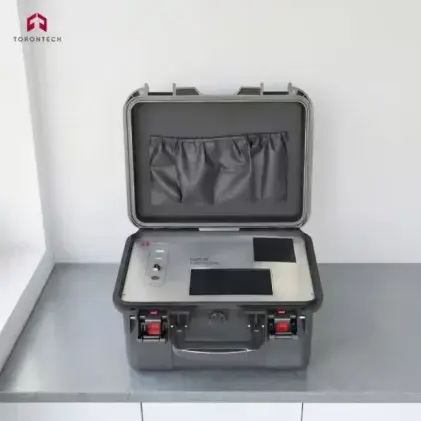
This instrument brings the diagnostic capabilities of the lab directly to the equipment's side. As compact, often handheld devices designed for field use, they enable on-site monitoring of particle contamination.
With an internal pump and battery, a technician can connect the unit to a machine's sample port and obtain a cleanliness reading in minutes. Some modern iterations even incorporate IoT capabilities for real-time data transmission and analysis to enhance maintenance decision-making. It is the practical choice for routine condition monitoring.
Picture a typical maintenance route: A service technician at a remote mining site approaches a hydraulic excavator. Instead of bottling a sample and waiting a week for results, they attach a portable counter. Within minutes, they confirm the fluid is clean enough for another 500 hours of operation, saving the cost of an unnecessary oil change right then and there.
The Torontech Angle:
We developed our portable units, such as the ToronOPC™ 300 and ToronOPC™ 300W, for the realities of field work. They are built to be durable and feature clear interfaces that provide essential data without complexity, allowing for instant report generation on the spot.
3. The Online Counter: For Constant Protection
Unlike the others, this sensor is permanently integrated with a specific piece of equipment to provide a continuous stream of data.
It is plumbed directly into the fluid line to sample the oil around the clock using technologies like laser extinction, microfluidics, or machine vision to detect particle size and density. By detecting wear particles early, these systems support condition monitoring and fault diagnosis, potentially preventing severe failures.
Think of a critical production asset: In a high-volume plastic injection molding plant, a hydraulic pump filter might rupture unexpectedly at 2 AM. A monthly oil sample would miss this entirely. An online counter, however, would detect the spike in particles immediately and trigger an alarm, allowing the system to shut down before the pump destroys itself.
The Torontech Angle:
We view continuous monitoring not as a luxury, but as an essential strategy for high-value machinery. Our online sensors—like the ToronOPC™-OL1 and ToronOPC™ 550—are engineered for simple integration and long-term reliability, alerting you to a problem the moment it begins.
Quick Comparison: The Breakdown
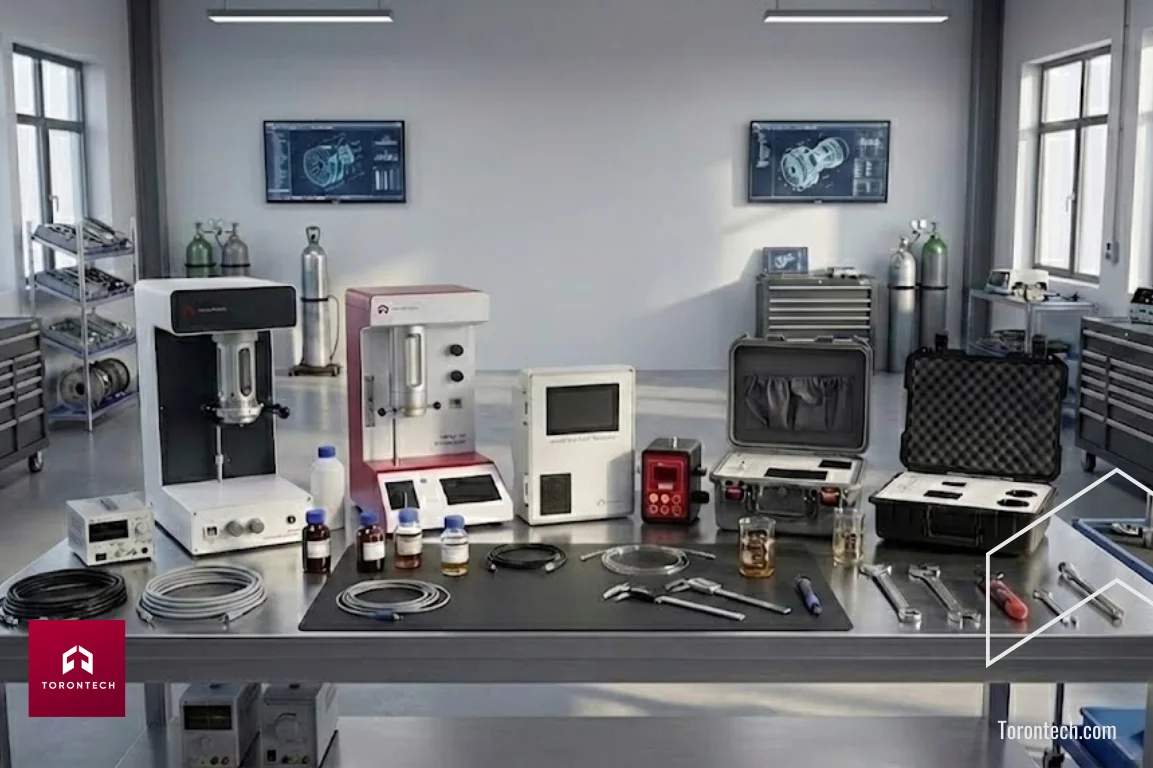
For those needing a fast decision, here is how the three technologies stack up against one another:
| Feature | Laboratory Counter | Portable Counter | Online Counter |
|---|---|---|---|
| Primary Goal | Deep Analysis & QC Compliance | Field Checks & Troubleshooting | 24/7 Asset Protection |
| Sampling Method | Bottle Sample (Offline) | Hose connection (At-Line) | Plumbed Inline (Real-Time) |
| Time to Result | Slower (Batch Processing) | Immediate | Instant / Continuous |
| Key Strength | Highest Precision | Mobility & Versatility | Catching Sudden Failures |
| Best For | Quality Managers & Lab Techs | Maintenance Routes | Reliability Engineers |
Common Applications
We support a wide variety of sectors across North America. Here is how we typically see these tools applied in the real world:
- Hydraulics & Heavy Machinery: Verifying fluid cleanliness in construction equipment to prevent valve stiction that leads to sluggish operation.
- Power Generation & Transformers: Monitoring insulating oils in transformers where particulate buildup could lead to catastrophic electrical arcs or outages.
- Automotive & Aerospace: conducting "technical cleanliness" audits (VDA 19) on washing lines to ensure fuel injectors or brake components are free of manufacturing debris.
- Petrochemical, Mining & Steel: Analyzing gearbox oils in rock crushers or drilling rigs where heavy dust loads make robust, frequent monitoring mandatory to prevent seizing.
- Pharmaceutical & Medical: Confirming the purity of Water for Injection (WFI) systems, ensuring that no particulate matter compromises the sterility of a drug batch.
- Filter Manufacturing: Performing Multipass testing to validate that a new filter design actually traps the particle sizes it claims to on the datasheet.
- Marine & Offshore: Monitoring the hydraulic steering gear on a vessel mid-voyage, where a system failure could mean drifting without control in open water.
Making Data Accessible and Useful
A particle count has limited value if the data is difficult to access and use. We believe that if you can’t act on the information easily, the tool is not delivering its full potential.
- System Integration: Our online sensors are built to communicate with plant-wide control systems (like SCADA or a PLC) via Modbus RS-485 or 4-20mA analog signals, enabling automated alerts.
- Simple Reporting: Our lab and portable units feature built-in thermal printers and USB interfaces to move data directly to your computer. This simplifies trend analysis and compliance reporting.
Choose the Right Counter with Torontech
The right particle counter depends on your maintenance objectives, and the most effective programs often use a combination of all three types. At Torontech, our goal is to supply North American industries with technology that provides a clear return on investment for any of these strategies.
Ready to improve your contamination control program? Explore our full range of Liquid and Oil Particle Counters.
Contact us to discuss how our cost-effective and innovative technologies can help you extend equipment life and reduce operational costs.
References
- Du, S., Li, W., & Yang, M. (2019). Research and Development of On-line Detection System for Oil Pollution Degree. 2019 Chinese Automation Congress (CAC), 990-994.
- Haiden, C., Wopelka, T., Jech, M., Keplinger, F., & Vellekoop, M. (2016). A Microfluidic Chip and Dark-Field Imaging System for Size Measurement of Metal Wear Particles in Oil. IEEE Sensors Journal, 16, 1182-1189.
- Hansen, D., Jespersen, S., Bram, M., & Yang, Z. (2021). Offshore Online Measurements of Total Suspended Solids Using Microscopy Analyzers. Sensors (Basel, Switzerland), 21.
- Liu, Z., Zuo, H., Liu, Y., Li, X., & Chen, Z. (2023). Research on Wear Particle Online Monitoring Using Machine Vision for Rotating Machinery. IEEE Transactions on Instrumentation and Measurement, 72, 1-11.
- Rodić, G., Karanović, V., & Oros, D. (2022). Development of Portable IoT Diagnostic Device for Particle Contamination Monitoring. Machine and Industrial Design in Mechanical Engineering.
- Sousan, S., Regmi, S., & Park, Y. (2021). Laboratory Evaluation of Low-Cost Optical Particle Counters for Environmental and Occupational Exposures. Sensors (Basel, Switzerland), 21.
- Yun-Bai, L. (2009). Liquid Particle Counting On-line Measuring Instrument. Instrument Technique and Sensor.
- Zhonghui, C., Shen, B., Fu, D., Zhong, S., Xuan, Y., Zhang, T., & Yanqing, Q. (2019). Design of Compact Oil Particle Counter System Based on Microscopic Imaging. Lecture Notes in Electrical Engineering.
- Zhu, J., Yoon, J., He, D., & Bechhoefer, E. (2015). Online particle-contaminated lubrication oil condition monitoring and remaining useful life prediction for wind turbines. Wind Energy, 18, 1131-1149.