FID vs TCD: Complete Gas Chromatography Detector Guide
Purchasing an unconfigured gas chromatograph and building standard fuel methods from scratch is an expensive operational trap. While columns separate volatile compounds, the detector dictates your measurement accuracy, detection limits, and regulatory compliance. Choosing incorrectly among the diverse types of gas chromatography detectors risks baseline drift and wasted testing hours.
We believe analytical laboratories deserve pre-configured systems that eliminate integration friction and deliver compliant data immediately. Review our technical comparison below to identify the optimal configuration for your testing facility.
Key Takeaways
- In published chromatographic literature, Flame Ionization Detectors (FID) provide roughly three orders of magnitude greater mass sensitivity for hydrocarbons than Thermal Conductivity Detectors (TCD), while our factory-tested TT-3612 system achieves detection limits of <5 pg C/s on the FID and <800 pg propane/mL on the TCD.
- TCD functions as a non-destructive, universal sensor, making it essential for permanent gases (H2, O2, N2, CO, CO2) and moisture where an FID produces no analytical signal.
- Analytical literature demonstrates that coupling a TCD, a catalytic methanizer, and an FID allows linear measurement of carbon oxides and hydrocarbons across a wide concentration span from 0.1 ppm to 100%.
- Reliable detection requires electronic pneumatic control (EPC) to compensate for ambient temperature and barometric shifts, stabilizing carrier gas velocity and retention times.
- Turnkey, method-specific analyzers eliminate months of internal method development, providing documented compliance with ASTM, EN, and IEC standards while lowering overall operating expenses.
Overview of Gas Chromatography Detectors
To make a smart capital investment, laboratory directors need a clear assessment of the different types of detectors used in gas chromatography. From our viewpoint, while exotic research sensors look impressive on academic posters, industrial quality control teams are almost always better served by sticking to proven, highly dependable sensors rather than chasing temperamental specialty units.
The standard industry baselines begin with the Flame Ionization Detector (FID) and the Thermal Conductivity Detector (TCD). The FID serves as the primary workhorse for volatile hydrocarbons and organic carbon compounds, detecting analytes by ionizing them in a hydrogen-air flame. It delivers razor-sharp sensitivity that detects tiny sub-ppm traces and features a broad linear measurement span that stays straight as an arrow.
Complementing this, the TCD provides a non-destructive, universal sensing unit that tracks shifts in heat conduction across a heated filament circuit caused by eluting analytes. As an alternative ionization option, published evaluations show that the Pulsed Discharge Helium Ionization Detector (PDHID) is at least three orders of magnitude more sensitive than TCD and as sensitive as FID for fast separations.
For specialized regulatory matrices, laboratories deploy selective sensors tuned to specific heteroatoms or chemical structures. The Electron Capture Detector (ECD) uses a radioactive beta-particle emitter (such as Nickel-63) to sustain a steady ionization current.
Analytes packed with electronegative halogens absorb those free electrons and depress the signal, yielding sensitivity down to 10^-15 g/s. This makes it widely applied alongside TCD and FID systems for specialized environmental profiling, such as monitoring soil greenhouse emissions and N2O. The Flame Photometric Detector (FPD / PFPD) decomposes column effluent in a hydrogen-rich flame to form chemiluminescent sulfur (S2*) or phosphorus (HPO*) species, using optical filters to monitor trace sulfur compounds in fuel streams.
For aromatic rings like benzene, toluene, ethylbenzene, and xylenes (BTEX), the Photoionization Detector (PID) ionizes compounds with high-energy ultraviolet lamps while leaving samples intact. Finally, the Mass Spectrometric Detector (MSD / GC-MS) fragments eluting compounds into charged particles using Electron Ionization (EI) or Chemical Ionization (CI), sorting ions by mass-to-charge ratios (m/z) to deliver definitive structural fingerprints alongside library matching.
While surveying these specialized types of gas chromatography detectors is valuable for unique compound classes, we consider FID and TCD to be the true backbone of routine petroleum and petrochemical testing.
Technical Comparison: FID vs TCD
We will say this plainly: the ongoing industry dispute over FID vs TCD is often framed incorrectly. Buyers treat GC TCD vs FID as if one detector must make the other obsolete, but we see them as two distinct tools built for entirely different analytical responsibilities. The two units differ fundamentally in detection principle, sensitivity, and analyte compatibility.
| Analytical Property | Flame Ionization Detector (FID) | Thermal Conductivity Detector (TCD) |
|---|---|---|
| Operating Mechanism | Ionization in a hydrogen-air flame with current collection | Differential thermal conductivity across a Wheatstone bridge |
| Detects Organic Compounds | Yes, nearly all organics with high sensitivity | Yes, but with significantly lower sensitivity |
| Detects Permanent Gases (O2, N2, CO, CO2) | No for standalone FID; detects CO and CO2 at sub-ppm levels only when paired with a catalytic methanizer | Yes, directly detects O2, N2, CO, and CO2 without hardware accessories |
| Detects Moisture / Water | No | Yes |
| Sample Preservation | Destructive, sample is consumed | Non-destructive, sample remains intact |
| Gas Supplies Required | Hydrogen, Air, and Carrier Gas | Carrier gas only |
| Literature Detection Limits (LOD) | ~10 ppb (~10^-12 g/s) | ~100 ppm (~10^-9 g/s) |
| Linear Dynamic Range | Wide span (~10^7), low baseline noise | Moderate span (~10^4 to 10^5) |
Sensitivity and Detection Limits
As outlined in the table above, a standalone FID is completely blind to permanent gases and carbon oxides. However, analytical systems frequently overcome this limitation by inserting a catalytic methanizer upstream of the flame, converting non-flammable CO and CO2 into methane so the FID can quantify them down to sub-ppm levels.
Hydrocarbon Sensitivity Benchmarks
General Literature Baselines: An FID typically demonstrates roughly three orders of magnitude greater mass sensitivity for hydrocarbons than a TCD, with research detection baselines near 10^-12 g/s compared to approximately 10^-9 g/s or g/mL for a standard TCD cell. In direct propane comparisons, researchers recorded 66 times higher response on an FID along with a wider linear range (0.161 to 2.18% mol/mol versus 0.242 to 2.18% mol/mol for TCD) and greater analytical precision.
Torontech TT-3612 Factory Ratings: Our equipment specifications directly reflect this performance difference. On our TT-3612 analyzer, the Flame Ionization Detector achieves a minimum detection limit of <5 pg C/s (tested with n-hexadecane) with a linear dynamic range (LDR) of 10^7 (±10%).
Operating alongside it, the Thermal Conductivity Detector achieves a minimum detection limit of <800 pg propane/mL (using helium carrier gas) with an LDR of 10^5 (±10%) for reliable trace organic identification.
Column Compatibility and Universal Response
A TCD incorporates a larger cell dead volume, which makes it less suitable for high-resolution narrow-bore capillary columns. However, its universal response makes it indispensable across diverse sample types. In pharmaceutical quality workflows, for example, headspace GC-TCD accomplishes simultaneous quantitation of water and residual organic solvents in a single 7.5-minute run, replacing separate FID and Karl Fischer titrations.
Operational Safety and Gas Infrastructure
Facility safety guidelines and gas utility logistics also influence detector selection. In hazardous or ATEX-classified process areas, an FID cannot operate as an unshielded bench unit because the combustion flame and hydrogen supply require certified flameproof or purged enclosures. This requirement leads many remote, field-mounted pipeline installations to favor TCD or solid-state sensors that operate without flammable fuel gas lines.
In central testing laboratories and quality control benches, facilities safely run high-sensitivity FIDs for custody transfer verification by operating in standard ventilated environments and utilizing on-site hydrogen generators that eliminate high-pressure gas cylinder storage.
Tandem Detector Configurations: Resolving GC TCD vs FID
Because an FID cannot see permanent gases and a TCD lacks sensitivity for trace volatile hydrocarbons, choosing between them on a single sample stream is often counterproductive. In catalytic process testing, an FID alone suffices when reaction products are purely hydrocarbons; however, combining TCD and FID is mandatory whenever hydrogen and carbon oxides accompany the hydrocarbon product stream.
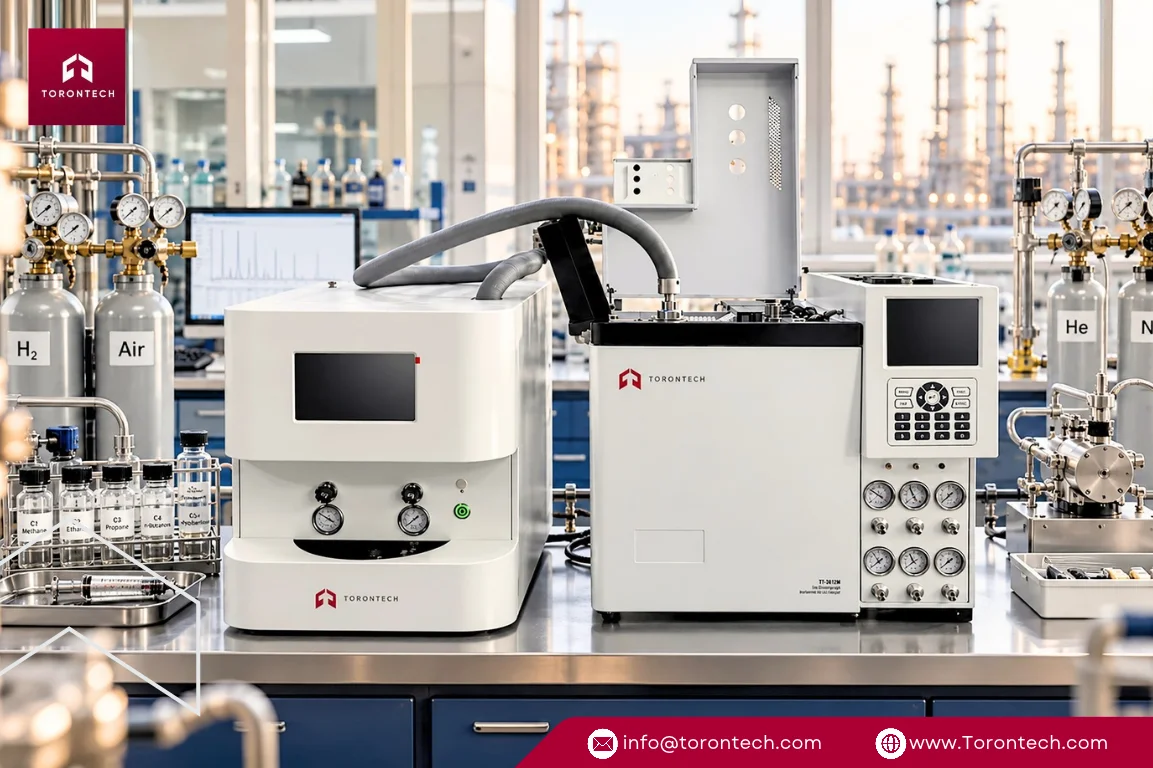
Many analytical setups resolve this by coupling both detectors in series: the effluent passes through a non-destructive TCD first to quantify permanent gases (H2, O2, N2, CO, CO2), and then flows into an FID for sensitive hydrocarbon detection.
In standard analytical practice, a catalytic methanizer unit can be placed between the column and the FID to reduce CO and CO2 to methane, extending FID sensitivity for carbon oxides down to sub-ppm levels. Research demonstrates that this combined TCD-methanizer-FID layout enables linear measurement of CO and CO2 across a wide concentration span from 0.1 ppm up to 100%, an analytical capability far beyond what either detector achieves on its own.
Comparative Stream Analysis Scenarios
To see why this distinction matters in everyday industrial testing, consider two typical processing streams:
Case Scenario: Refinery Fuel Gas and Syngas Profiling. Consider a process stream carrying 40% hydrogen, 15% carbon dioxide, and 2% ethylene. Directing this sample exclusively into an FID leaves the laboratory completely blind to the hydrogen and carbon dioxide fractions, making calorific calculation impossible.
Conversely, routing it solely into a standard TCD often leads to baseline separation struggles when trying to quantify lower-concentration alkene components. Deploying a non-destructive TCD ahead of an FID allows the TCD to record the fixed gases, while the downstream FID quantifies the hydrocarbons without sample loss.
Case Scenario: Custody Transfer and Heating Value Verification. In pipeline natural gas delivery, operators must determine bulk British Thermal Unit (BTU) energy content while ensuring heavy hydrocarbon drop-out will not condense in transit.
A TCD reliably measures bulk methane, nitrogen, and carbon dioxide (often down to 0.01%), but it lacks the sensitivity needed to capture trace C6+ heavy ends down in the low parts-per-million range. Pairing the two sensors allows the TCD to handle bulk billing calculations while an FID monitors heavy hydrocarbon dew points.
Limitations of Standalone Detector Sourcing
In our assessment, purchasing an unconfigured, bare GC frame and attempting to build an ASTM fuel method internally is an unnecessary commercial gamble.
Setting up an unconfigured chromatograph for official ASTM or EN methods demands extensive bench hours. Senior chemists get pulled into selecting stationary phases, calibrating multi-port switching valves, calculating backflush intervals, balancing split vent flows, and verifying detector linearity through repetitive trials.
In our view, a minor timing discrepancy in valve switching or zone temperature regulation produces co-eluting peaks, fouled columns, and uncertified data.
Consider an analytical facility attempting to configure an unconfigured GC chassis for ASTM D4815 (measuring oxygenates in gasoline). The chemist must manually calibrate a 10-port rotary valve to backflush heavy gasoline hydrocarbons out to vent while steering oxygenates onto a polar TCEP column.
If the timed valve actuation is miscalculated by just two or three seconds, heavy aromatics wash into the polar stationary phase. In standard laboratory operations, this error strips column performance, causes irreversible phase bleeding, and forces the laboratory to scrap the column and restart weeks of validation trials.
Seriously, which lab manager wants to commit weeks of high-value staff time to troubleshooting pipe unions and leak checks? (Nobody with stringent quarterly testing targets, that is certain).
Our engineering philosophy resolves that friction. Rather than treating detectors as loose add-ons, we build complete, application-specific analytical solutions. Every assembly, from automated injection valves and digital pneumatics to the primary detector, arrives pre-plumbed, benchmarked, and factory-calibrated for its dedicated testing role.
System Architecture: Pneumatics, Valves, and Software
We believe procurement teams often focus heavily on peak detector sensitivity while underestimating the flow regulation hardware. A detector can offer extraordinary sensitivity, but if carrier gas delivery fluctuates, retention times drift across your run series:
- Digital Pneumatics and Flow Stability (EPC / PPC): We view stable pneumatics as the true foundation of dependable chromatography. Electronic pneumatic control (EPC) air-circuit technology continuously compensates for ambient temperature shifts and barometric fluctuations, maintaining stable carrier gas velocities and repeatable peak retention times across long analytical sequences.
- Automated Sample Introduction via Closed-Vial Headspace: In systems like our TT-3612H transformer oil analyzer, an automated static headspace sampler extracts dissolved volatile fault gases directly from crimp-sealed vials. This automated headspace configuration eliminates manual syringe extraction errors and atmospheric contamination, ensuring reliable compliance with ASTM D3612 Method C.
- Timed Rotary Valve Switching and Stationary Phase Protection: Our analyzers incorporate automated 10-port switching and backflush valves. We consider timed backflushing essential for high-throughput labs; purging heavy, high-boiling hydrocarbon fractions through a vent line while steering target components onto the analytical column protects capillary phases, cuts cycle times, and prevents baseline drift on sensitive FIDs.
- Cold On-Column (COC) Inlets for Thermally Fragile Analytes: Hot split/splitless vaporizing injectors can degrade thermally sensitive compounds. In our view, processing biodiesel through an overheated vaporization chamber is an avoidable technical misstep. Our dedicated biodiesel systems use direct cold on-column injection, depositing liquid samples gently into the column bore to prevent thermal breakdown.
- Chromatography Data Systems (CDS) and LIMS Interfacing: Our platforms include dedicated workstation software pre-loaded with method-specific calculation templates. Whether generating diagnostic ratios for transformer condition assessment (IEC 60567) or running calculations for oxygenate mass percentages in motor fuel (ASTM D4815), the software processes data automatically and exports directly to your Laboratory Information Management System (LIMS).
Application-Specific Turnkey GC Systems
By matching the right different types of detectors used in gas chromatography with pre-configured hardware platforms, our 7 specialized systems deliver turnkey compliance across key testing sectors.
TT-3612 TOGA GC: Transformer Oil Dissolved Gas Analysis
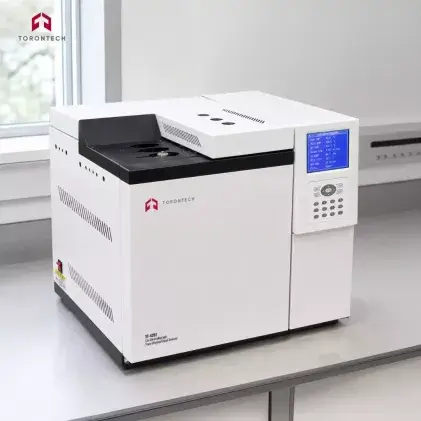
Designed to conform to ASTM D3612 and to support transformer condition monitoring per IEC 60567, this system quantifies dissolved fault gases in transformer insulating oils with a viscosity of 20 cSt or less at 40°C. For laboratories requiring unattended automation, the TT-3612H configuration integrates an automated Headspace Sampler specifically suited to ASTM D3612 Method C, while the base TT-3612 configuration supports manual or syringe injection.
In high-voltage electrical utility networks, detecting trace dissolved acetylene (C2H2) on an FID warns technicians of localized, high-energy electrical arcing within the transformer tank, giving asset managers time to schedule maintenance before catastrophic dielectric failure occurs.
The instrument incorporates a dual-detector configuration pairing a TCD and an FID to separate and quantify hydrogen, oxygen, nitrogen, carbon monoxide, carbon dioxide, methane, ethane, ethylene, and acetylene, the full set of nine gases specified in ASTM D3612, in a single 7-minute cycle.
In the TT-3612H setup, the automated headspace sampler extracts these gas species directly from sealed vials without manual vacuum degassing errors, providing dependable compositional data for transformer diagnostics.
TT-4815 GC: Oxygenate Profiling in Motor Gasoline
Engineered strictly for ASTM D4815, EN 13132, and ASTM D5580, this analyzer provides quantitative determination of ether and alcohol additives (MTBE, ETBE, TAME, ethanol) in finished pump gasoline. At commercial terminal blending racks, fuel distributors must certify that ethanol blending levels stay strictly within regulatory limits (such as 9.5% to 10.2% by volume) before tanker offloading. Rapid, compliant GC verification ensures batches meet regional clean-fuel mandates and protects distributors from costly off-spec penalties.
The instrument incorporates a high-sensitivity Flame Ionization Detector mounted on a stable dual-channel flow path accommodating up to 3 detectors simultaneously. The sample passes through a polar TCEP precolumn tied to an automated 10-port backflush valve, 6 independently controlled thermal zones, and 7-stage programmed temperature ramping to strip heavy hydrocarbons before directing oxygenates forward for measurement.
The package includes dedicated on-site hydrogen and air generators, calibration standards, and workstation software.
TT-5134 Naphtha GC: Detailed Hydrocarbon Analysis
Validated against ASTM D5134 and ASTM D6733, the TT-5134 delivers individual hydrocarbon speciation across petroleum naphthas, reformer feeds, and petrochemical blending stocks. Precise component fingerprinting allows refinery engineers to optimize catalytic reforming yields and monitor benzene precursors with extreme confidence.
The analytical engine pairs a fast-response Capillary FID with a 50-meter methyl silicone bonded capillary column using pure helium carrier gas and electronic pressure control air-circuit technology. This high-efficiency separation resolves paraffinic, isoparaffinic, aromatic, naphthenic, and olefinic (PIANO) compounds through n-nonane (C9), preserving sharp peak symmetry across the entire distillation range.
TT-1945 GC: Pipeline Natural Gas Composition
Designed around ASTM D1945 and ISO 6974, the TT-1945 establishes heating values, relative density, and full chemical makeup for sales-grade and process natural gas. Pipeline operators depend on this setup for accurate custody transfer billing and pipeline integrity monitoring.
The system relies on a multi-channel TCD and FID engine to separate methane, ethane, propane, C4+, CO2, and N2. A timed carrier gas reversal backflushes heavy hydrocarbon fractions (C6+) into an irregular composite peak, shortening cycle duration while keeping light-end peaks completely resolved.
TT-2163 LPG Analyzer: Hydrocarbon Speciation in Liquefied Gas
Compliant with ASTM D2163, GB10410.3, and GPA 2186 / ISO 7941, the TT-2163 manages quality checks and custody transfer analysis for commercial liquefied petroleum gas mixtures. It gives processing plants reliable verification of commercial propane and butane purity specifications.
The analyzer employs a quantitative FID/TCD setup to measure gaseous hydrocarbons from C1 to C5 across concentrations from 0.01 to 100 volume percent (100 ppm to 100%). The hardware accurately resolves propane, propene, butane isomers, and 1,3-butadiene, providing certified compositional data for global transport.
TT-Biodiesel GC Plus: Biofuel Purity Verification
Aligned with EN 14103, ASTM D6584, EN 14105, and EN 14110, this platform delivers purity validation and quality assurance for clean-burning alternative biodiesel fuels. It verifies that transesterification reactions have gone to completion by measuring free and bound glycerin.
The analyzer couples a true Cold On-Column (COC) inlet directly to an FID. By depositing liquid samples into the column bore without flash vaporization, it avoids thermal degradation of heavy triglycerides, quantifying free glycerol, total glycerol, fatty acid methyl esters (FAME), and residual methanol with dependable recovery.
TT-4291 Glycol Analyzer: Engine Condition Monitoring
Dedicated to ASTM D4291, this analyzer identifies internal coolant leaks entering crankcase lubricants on heavy transport, rail, and marine machinery. In commercial fleet maintenance programs, detecting trace ethylene glycol across the expected concentration range of 5 to 200 ppm mass fraction flags a weeping cylinder head gasket long before engine oil shows visible milky emulsion. Catching this early prevents glycol from breaking down into corrosive organic acids that strip soft copper-lead journal bearings.
The platform utilizes a dedicated trace Flame Ionization Detector calibrated for selective trace identification of ethylene glycol contamination in used engine oils, protecting heavy capital equipment from bearing damage and unexpected engine failure.
Commercial ROI and Operational Economics
Let us address the economic reality directly: opting for an empty, unconfigured GC chassis is a classic false economy. In our view, saving a small percentage on initial capital expenditure evaporates the moment your senior analysts spend hundreds of billable hours configuring an unvalidated instrument. Opting for our pre-engineered, cost-effective products delivers measurable financial and operational advantages:
- Eliminating Commissioning and Method Setup Delays: Commissioning an unconfigured chromatograph for intricate methods like ASTM D4815 or IEC 60567 consumes weeks of technical labor. Our systems arrive pre-plumbed, pre-tested, and factory-validated, getting you to certified results right out of the crate.
- Turnkey Operational Bundling: To prevent unplanned capital additions, our setups can come packaged complete with on-site hydrogen and zero-air generators, analytical columns, calibration standards, and pre-loaded software workstations.
- Lowering Gas and Maintenance Overhead: Controlled EPC pneumatics curb consumption of expensive helium carrier gas, while multi-zone thermal programming protects analytical columns and keeps maintenance downtime to a minimum.
Simplify GC TCD vs FID Testing with Torontech
Resolving the practical trade-offs of FID vs TCD should never burden your technical staff with custom engineering challenges. Torontech supplies cost-effective gas chromatography analyzers factory-configured strictly around international test standards.
Contact the Torontech engineering team today to review your target sample matrices, evaluate technical specifications, and receive a quotation for your testing facility.
References (Click to expand)
- Analysis of Gas Products from Carbon Dioxide Use Technologies by Gas Chromatography. (2022).
- Badhe, P. V., Trupti, W., Kajal, S., & Ravi, K. (2022). Review on Current Trends of Gas Chromatography in Pharmaceutical Industry. International Journal of Science and Research (IJSR).
- Bucha, M., Lewicka-Szczebak, D., & Wójtowicz, P. (2025). Simultaneous measurement of greenhouse gases (CH4, CO2 and N2O) using a simplified gas chromatography system. Atmospheric Measurement Techniques.
- Budiman, H., N., & Zuas, O. (2015). Comparison between GC-TCD and GC-FID for the determination of propane in gas mixture. Procedia Chemistry, 16, 465-472.
- CLASSICAL DETECTORS. (2019). Basic Gas Chromatography.
- Ferraz‐Almeida, R., Spokas, K., & De Oliveira, R. C. (2020). Columns and Detectors Recommended in Gas Chromatography to Measure Greenhouse Emission and O2 Uptake in Soil: A Review. Communications in Soil Science and Plant Analysis, 51, 582-594.
- Gao, Y., Cao, Y.-Q., Chen, S.-L., Wang, Y., Zhu, R., Sun, W., Zhang, Q., & Fan, Y. (2017). Differences in Product Distribution Measured with Flame Ionization Detector Gas Chromatography and Thermal Conductivity Detector Gas Chromatography during the Dimethyl Ether-to-Olefins and Methanol-to-Olefins Processes. Energy & Fuels, 31, 13266-13272.
- Kay, J., Thomas, R., Gruenhagen, J., & Venkatramani, C. (2020). Simultaneous quantitation of water and residual solvents in pharmaceuticals by rapid headspace gas chromatography with thermal conductivity detection (GC-TCD). Journal of Pharmaceutical and Biomedical Analysis, 113796.
- Maniquet, A., Sobrado, L. A., Collell, J., Colinet, É., & Loriau, M. (2023). On-Line Full Molecular Characterization of Flashed Gases with a New Generation of NGD Detectors for Micro-GC. SPE Annual Technical Conference and Exhibition.
- Nyerges, G., Szieberth, D., Mátyási, J., & Balla, J. (2021). Cave Air Analysis with Gas Chromatography Mass Spectrometry. Periodica Polytechnica Chemical Engineering, 65, 416-423.
- Roberge, M., Finley, J., Lukaski, H., & Borgerding, A. (2004). Evaluation of the pulsed discharge helium ionization detector for the analysis of hydrogen and methane in breath. Journal of Chromatography A, 1027(1-2), 19-23.
- Rodrigues, L. F., Fs, G., L., Lv, L., Heemann, R., & Jmm, K. (2014). An Alternative Gas Chromatography Setting for Geochemical Analysis. Journal of Chemical Engineering & Process Technology, 5, 1-4.
- Sandoval-Bohórquez, V. S., Rozo, E. A. V., & Baldovino-Medrano, V. (2020). A method for the highly accurate quantification of gas streams by on-line chromatography. Journal of Chromatography A, 1626, 461355.
- Sugiharto, Y., Natania, E., Febriyanti, S. A., & Krisbianto, O. (2022). Comparison of gas chromatography detectors and its application in food analysis. Journal of Food and Agricultural Product, 2(1).
- Takahashi, Y., Nagata, Y., Miyahara, H., Okino, A., Fujita, O., & Toyoura, Y. (2010). Measurements of plasma parameters in atmospheric helium plasma detectors for gas chromatograph. 2010 Abstracts IEEE International Conference on Plasma Science, 1-1.