Petroleum Naphtha Gas Chromatograph (DHA)
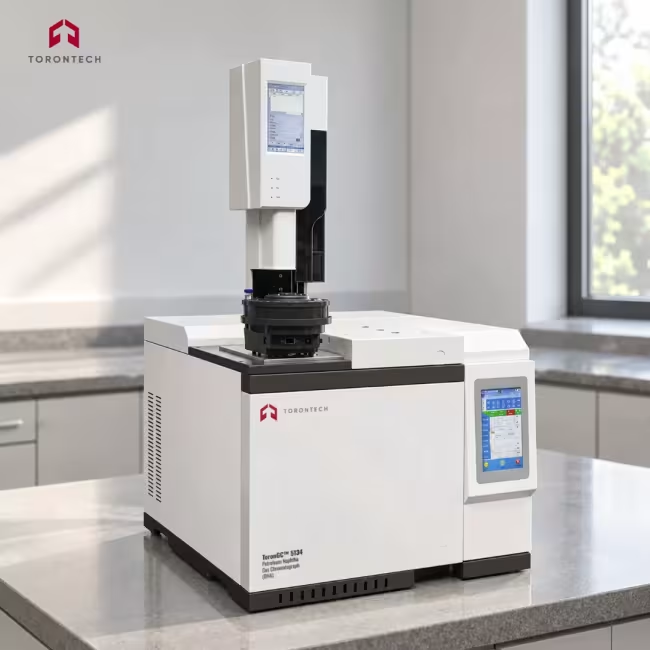
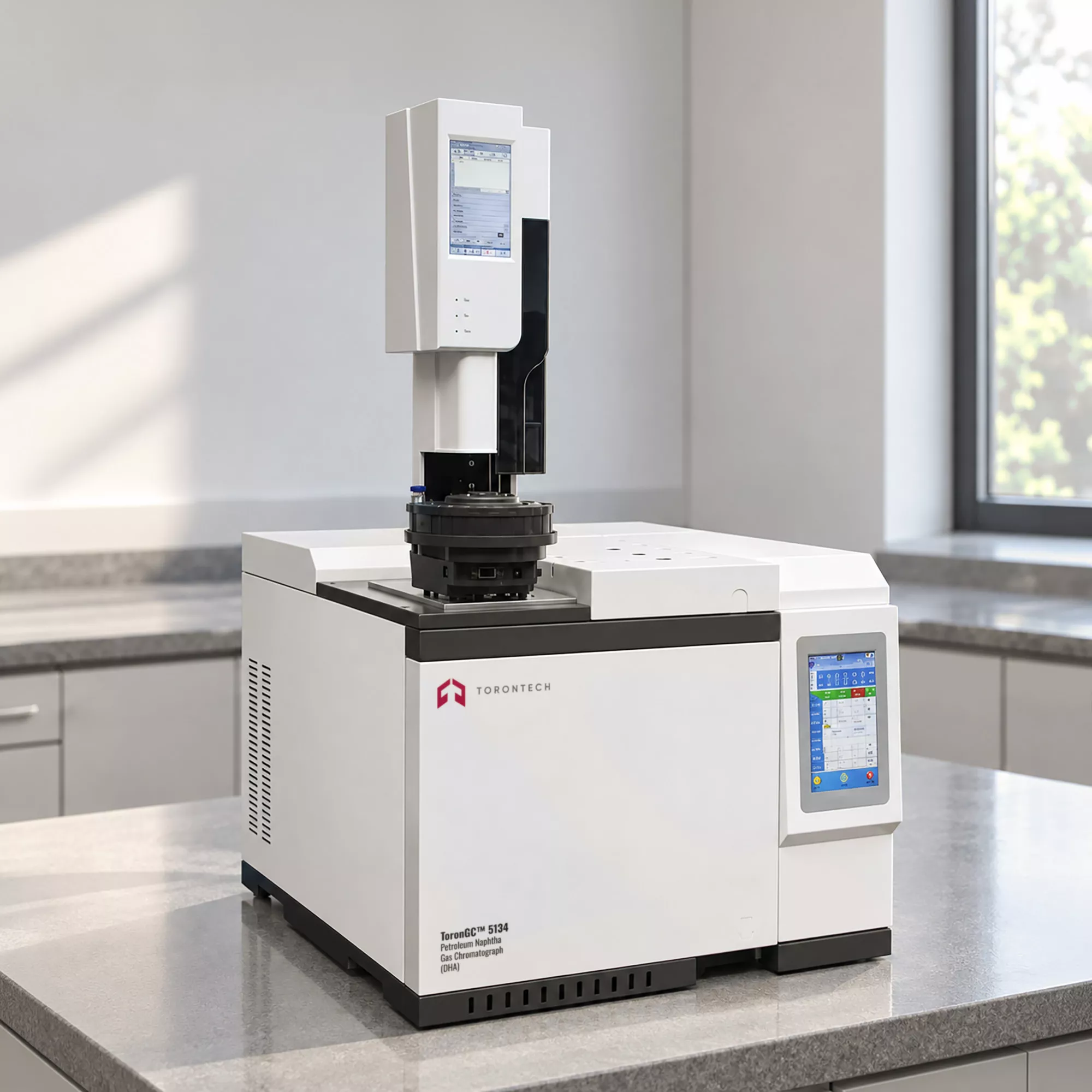
Petroleum Naphtha Gas Chromatograph (DHA) - ToronGC™ 5134
Detailed Hydrocarbon Analyzer for Petroleum Naphthas through n-Nonane
The ToronGC™ 5134 Petroleum Naphtha Gas Chromatograph identifies and quantifies the individual hydrocarbons in naphtha and gasoline for refineries, petrochemical plants, and fuel laboratories. It follows the detailed hydrocarbon analysis (DHA) method in ASTM D5134 for naphthas through n-nonane. It also supports ASTM D6733 for individual components in spark ignition engine fuels. Each run delivers a peak-by-peak breakdown of the sample. Analysts use that breakdown to group results into paraffins, olefins, naphthenes, and aromatics (PONA).
Torontech builds the ToronGC™ 5134 around a methyl silicone bonded-phase fused silica capillary column, helium carrier gas, and a flame ionization detector (FID). The long capillary column resolves hundreds of closely eluting compounds that a packed column would merge. Electronic pressure control (EPC) holds carrier flow steady for stable retention times. PONA3000 software matches each peak against a retention index library. The result is a full composition report suited to process control and product certification.
A 7-inch color touchscreen with an English interface handles daily operation. A 10/100M Ethernet port on the instrument links it to the laboratory network. The IBrainChrom workstation adds a Modbus RTU server that passes results to a plant distributed control system (DCS). The modular design accepts optional TCD, ECD, FPD, and NPD detectors, so the platform can grow with new test requirements. Torontech supplies the ToronGC™ 5134 to refining and fuel laboratories across the United States and Canada.
Petroleum Naphtha Gas Chromatograph (DHA) - ToronGC™ 5134 Applications
The ToronGC™ 5134 serves any operation that needs individual component data for light petroleum streams. Typical users include the following industries and laboratories.
- Catalytic Reforming Control: tracks naphthene conversion and aromatic yield in reformer feed and reformate to tune unit severity
- Isomerization Unit Monitoring: measures branched and normal paraffin ratios to confirm isomerization performance
- Gasoline Blending: provides component data that blend models use for octane, volatility, and regulatory specifications
- Steam Cracker Feedstock Evaluation: assesses naphtha composition to predict ethylene and propylene yields before purchase
- Crude and Condensate Assay Work: characterizes light naphtha cuts to support crude valuation and refinery planning
- Fuel Certification and Compliance: delivers ASTM D6733 component reports for spark ignition fuel quality programs
- Third-Party Testing Laboratories: supplies DHA results for customer certificates, troubleshooting, and dispute resolution
- Catalyst and Process Research: compares product slates when evaluating new catalysts or operating conditions
Standards
The ToronGC™ 5134 is designed to align with ASTM capillary gas chromatography methods for detailed hydrocarbon analysis of naphthas and spark ignition fuels. Laboratories should confirm conformance against the current edition of each standard during installation and validation.
- ASTM D5134 - Standard Test Method for Detailed Analysis of Petroleum Naphthas through n-Nonane by Capillary Gas Chromatography
- ASTM D6733 - Standard Test Method for Determination of Individual Components in Spark Ignition Engine Fuels by 50-Metre Capillary High Resolution Gas Chromatography
Petroleum Naphtha Gas Chromatograph (DHA) - ToronGC™ 5134 Key Features
The ToronGC™ 5134 pairs a high-resolution capillary method with network-ready controls and dedicated DHA software. Each feature below supports accurate, repeatable naphtha composition analysis.
- 7-inch color touch screen, with the option for resistive touch, featuring an all-English interface.
- Utilizes an advanced 10/100M adaptive Ethernet communication interface and built-in IP protocol stack, facilitating easy formation of a local area network for long-distance data transmission.
- Equipped with IBrainChrom workstation, supporting simultaneous operation of multiple chromatographs (up to 253) for data processing and counter-control. The built-in ModbusRTU server in the IBrainChrom workstation enables seamless connection of analysis results to DCS (distributed control system).
- Features a modular design for easy upgrades. Offers optional high-performance detectors including FID, TCD, ECD, FPD, and NPD detectors to meet the demands of complex sample analysis. Traditional pointer pressure gauges are completely replaced with EPC technology for air circuit control, ensuring self-protection against gas circuit failure, automatic ignition, focus on flameout, and automatic opening of the gas circuit, enabling one-key start.
- The timing startup program enables easy online analysis of gas and liquid samples when equipped with sampling components.


Software features:
- The gasoline PONA analysis method is used to analyze the composition of gasoline components, where P represents paraffins, O represents olefins, N represents naphthenic hydrocarbons, and A represents aromatics, as well as individual hydrocarbon compounds.
- The relative retention index method is commonly utilized for the qualitative determination of each component of gasoline.
- Each instrument independently calculates and retains the standard library index.
- The PONA3000 gasoline analysis software presents the standard graph and the sample graph on the same coordinate system. The upper and lower chromatographic peaks correspond to each other, providing clear qualitative analysis at a glance. It is simple and easy to learn.
Theory and Method
Detailed hydrocarbon analysis relies on high-resolution capillary gas chromatography. The injector vaporizes a small naphtha sample, and helium carries it into a long fused silica column coated with a methyl silicone stationary phase. This nonpolar phase separates compounds mainly by boiling point, with molecular shape adding finer selectivity. Isomers with nearly identical boiling points still elute at slightly different times. The narrow column bore and thin, uniform coating keep each peak sharp enough to resolve them.
The flame ionization detector burns the column effluent in a hydrogen and air flame. Hydrocarbon molecules form ions in the flame, and a collector electrode measures the resulting current. FID response scales closely with carbon content, so analysts can convert peak areas to mass percent with simple response factors. That near-uniform response makes the FID well suited to samples containing hundreds of hydrocarbons. The electronic data system records the signal and integrates every peak.
Identification uses relative retention indices instead of raw retention times. The software references each peak against n-paraffins in the same run, which corrects for small shifts in flow or column condition. Each instrument builds and stores its own standard index library during setup. PONA3000 overlays the reference and sample chromatograms on one axis, with matched peaks displayed above and below. The analyst can then review assignments and report individual components and PONA group totals.
Petroleum Naphtha Gas Chromatograph (DHA) - ToronGC™ 5134 Technical Specifications
Parameter | ToronGC™ 5134 |
Test Methods | ASTM D5134, ASTM D6733 |
Sample Type | Petroleum naphthas and spark ignition engine fuels |
Analysis Scope | Individual hydrocarbons through n-nonane; PONA group totals |
Column Type | Methyl silicone bonded-phase fused silica capillary column |
Carrier Gas | Helium |
Standard Detector | Flame ionization detector (FID) |
Optional Detectors | TCD, ECD, FPD, NPD |
Gas Control | Electronic pressure control (EPC) with gas circuit protection |
Ignition | Automatic, with flameout protection and one-key start |
Display | 7-inch color touchscreen (resistive option), English interface |
Instrument Communication | 10/100M adaptive Ethernet, built-in IP protocol stack |
DCS Interface | Modbus RTU server via IBrainChrom workstation |
Workstation | IBrainChrom, up to 253 chromatographs at once, with built-in Modbus RTU server |
DHA Software | PONA3000 with relative retention index identification and chromatogram overlay |
Startup | Timed startup program for online analysis (sampling components optional) |
Configuration:
| Item | Unit | Qty. |
| Main Unit | set | 1 |
| Fuse Ф5×20 10A | piece | 1 |
| Micro printer | set | 1 |
| Test cup | piece | 1 |
| igniter | piece | 1 |