GC Determining Oxygenates in Gasoline
GC Determining Oxygenates in Gasoline TT-4815
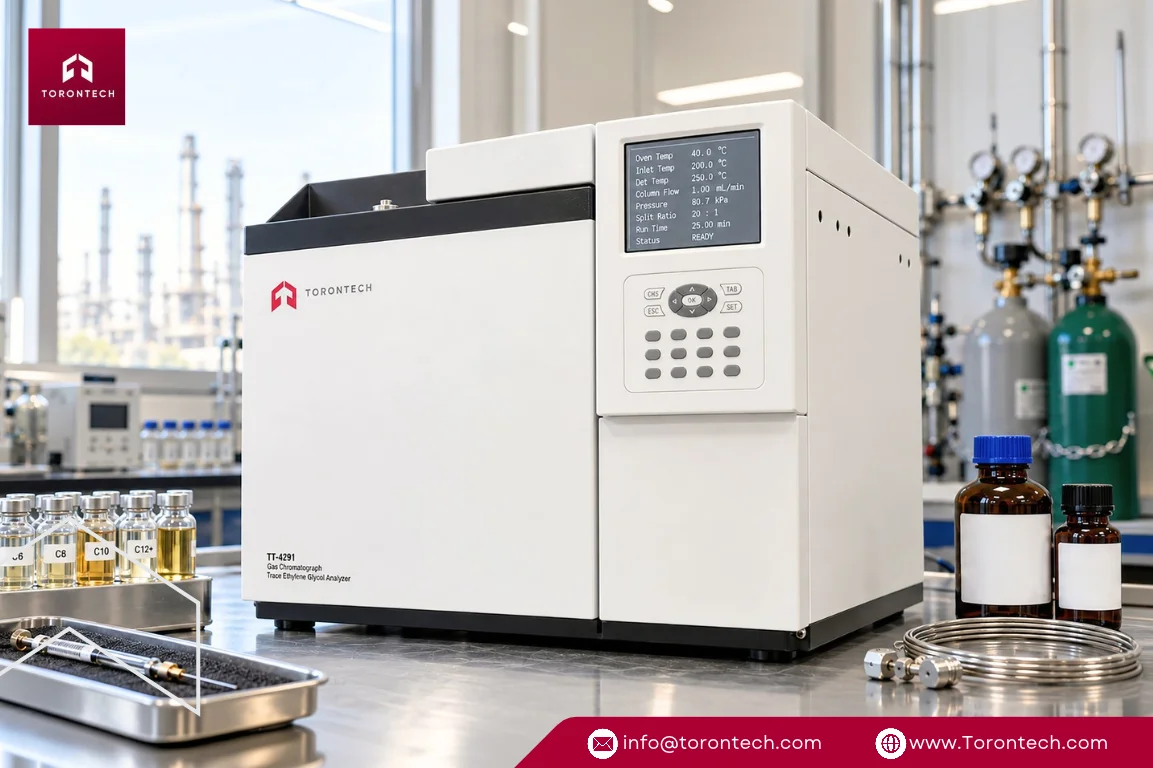
The TT-4815 gas chromatograph for oxygenates in gasoline gives refinery and laboratory teams a dedicated instrument for quantifying ethers and alcohols in commercial motor fuel. Ethers and alcohols raise octane number and reduce tailpipe emissions when blended into gasoline. Regulators and fuel producers track oxygenate type and concentration closely to maintain acceptable fuel quality. Drivability, vapor pressure, phase separation, and evaporative emissions all shift with oxygenate content. The TT-4815 handles this analysis with a configuration purpose-built for oxygenate separation.
A polar TCEP precolumn and a ten-port backflush valve separate light hydrocarbons from the target oxygenates before the sample reaches the analytical column. Six independently controlled temperature zones and seven-stage programmed heating let operators tune the separation for gasoline blends with different oxygenate packages. A flame ionization detector quantifies each eluting compound, and the injector accepts packed-column, glass-liner, or capillary split/splitless formats depending on the sample. The dual-stable gas path supports up to three simultaneously installed detectors for labs that need expanded method coverage.
Qualitest configures the TT-4815 GC Determining Oxygenates in Gasoline for labs that need ASTM D4815 and ASTM D5580 results from one platform. The system ships with a calibration standard, workstation software, and dedicated hydrogen and air generators for on-site startup. Engineers, QC managers, and fuel technologists use the instrument for routine batch release testing and for method development on new oxygenate blends. A single bench covers both oxygenate and aromatic testing instead of running two separate gas chromatographs.
Applications
The TT-4815 serves any laboratory responsible for verifying oxygenate content or aromatic composition in motor gasoline. Typical users span refinery quality control to independent compliance testing.
- Refinery Quality Control: verifies ether and alcohol content in gasoline blend streams before release to distribution, confirming oxygen content meets reformulated gasoline specifications
- Fuel Terminal and Blending Operations: checks ethanol, MTBE, and other oxygenate blend ratios at the point of splash blending or in-line injection
- Independent Petroleum Testing Laboratories: runs ASTM D4815 and ASTM D5580 analyses for third-party certificates of analysis requested by fuel marketers and regulators
- Regulatory Compliance and Environmental Monitoring: supports laboratories reporting oxygenate and benzene content under reformulated gasoline programs
- Fuel Additive and Oxygenate Manufacturing: confirms MTBE, ETBE, TAME, and alcohol purity and concentration during production of blending components
- Petrochemical Research and Development: characterizes experimental gasoline formulations and alternative oxygenate packages during fuel development work
- Import and Export Cargo Inspection: verifies oxygenate and aromatic content of gasoline cargoes against contract specifications before loading or discharge
Standards
The TT-4815 is configured to run two ASTM test methods central to gasoline oxygenate and aromatic compliance testing. Both methods share a similar polar precolumn and backflush valve architecture, letting one instrument cover both analyses.
- ASTM D4815 - Standard Test Method for Determination of MTBE, ETBE, TAME, DIPE, tertiary-Amyl Alcohol and C1 to C4 Alcohols in Gasoline by Gas Chromatography
- ASTM D5580 - Standard Test Method for Determination of Benzene, Toluene, Ethylbenzene, p/m-Xylene, o-Xylene, C9 and Heavier Aromatics, and Total Aromatics in Finished Gasoline by Gas Chromatography
Key Features
The TT-4815 combines oxygenate-specific hardware with the operating conveniences expected of a modern laboratory GC. The following features address both analytical performance and day-to-day usability.
- Full English LCD Display: shows real-time temperature and status data for every zone in clear, English-language text, simplifying monitoring and operation
- Automatic Self-Diagnostics: runs a power-on self-test and continuous fault monitoring that pinpoints the failure location and triggers an alarm, cutting troubleshooting time
- Six-Zone Independent Temperature Control: manages the vaporization chamber and capillary vaporization chamber separately, with seven-stage programmed heating for method flexibility across different oxygenate blends
- Over-Temperature Protection: shuts the instrument down and alarms automatically if any heated zone exceeds its set point, protecting the column and the sample run
- Vertical Vaporization Chamber Design: limits heat radiation into the column oven, keeping oven temperature deviation to a minimum for more repeatable retention times
- Fuzzy-Logic Cooling Door: tracks oven temperature and adjusts the rear door angle automatically, delivering faster cool-down and a true near-ambient starting temperature between runs
- Multi-Format Injection Ports: accepts packed-column, glass-liner, and capillary split/splitless injection with septum cleaning, and can accommodate an optional gas sampling valve
- Dual-Stable Gas Path: supplies stable carrier and detector gas flow to as many as three simultaneously installed detectors for expanded or multi-method configurations
Theory and Method
Gasoline carries a small fraction of polar oxygenates inside a much larger volume of nonpolar hydrocarbons, and the two groups behave very differently on a chromatographic column. The TT-4815 routes each sample through a TCEP precolumn first, a polar packed phase that holds back alcohols and ethers while nonpolar hydrocarbons pass through quickly. A ten-port valve then switches carrier gas flow at a precisely timed point, sending the light hydrocarbon fraction to vent while the oxygenates transfer intact to the analytical column.
Once transferred, the oxygenates separate again on a nonpolar capillary column that resolves methanol, ethanol, the propanol and butanol isomers, and ethers such as MTBE, ETBE, TAME, and DIPE by boiling point and polarity differences. The same two-column, backflush principle underlies ASTM D5580, except the target compounds are benzene, toluene, and the xylene isomers rather than oxygenates. Ethers and light alcohols elute to vent along with the nonaromatic hydrocarbons during a D5580 run, so oxygenate content does not interfere with the aromatic result.
A flame ionization detector burns the column effluent in a hydrogen and air flame, generating ions in proportion to the number of carbon atoms in each eluting compound. The resulting ion current becomes an electrical signal that the workstation converts into a chromatographic peak, with peak area proportional to concentration. The TT-4815 pairs its FID with a dedicated hydrogen generator and air generator, keeping flame composition consistent from run to run for repeatable quantitation.
Technical Specifications
Parameter | Specification |
External Dimensions | 500 × 480 × 470 mm (L × H × W) |
Column Oven Dimensions | 240 × 250 × 155 mm (L × H × D) |
Column Installation Spacing | 152.4 mm (6-inch standard interface) |
Instrument Weight | 40 kg |
Column Oven Temperature Range | Ambient +8°C to 400°C, programmable in 1°C increments* |
Temperature Control Zones | 6 independent zones, 7-stage programmed heating* |
Programmed Heating Rate | 0.1°C to 50°C/min, 0.1°C increments |
Programmed Hold Time | User-programmable |
Temperature Fluctuation | ≤ ±0.1°C (under 10°C ambient change or 10% supply voltage change) |
Temperature Gradient | ±1% (within 100°C to 350°C) |
Detector | FID; detection limit Mf ≤ 1×10⁻¹¹ g/s (benzene); noise ≤0.02 mV; drift ≤0.1 mV/h |
Injection System | Split/splitless capillary injector (SPL) |
Backflush Switching Valve | High-temperature ten-port valve (VICI) |
Precolumn | TCEP precolumn (Restek column hardware) |
Analytical Column | Capillary column, 50 m × 0.53 mm × 3.0 µm |
Ambient Operating Temperature | 5°C to 35°C |
Relative Humidity | ≤85% |
Power Supply | 220 V AC ±10%, 50 Hz ±0.5 Hz |
Maximum Power Consumption | 2000 W |
Configuration
Item | Quantity | Description |
Gas Chromatograph Main Unit | 1 | Full English LCD display, automatic parameter memory with power-loss protection, self-diagnostic fault detection, over-temperature protection and alarm, automatic rear-door cooling for near-ambient operation |
Detector | 1 | Flame Ionization Detector (FID); detection limit Mf ≤1×10⁻¹¹ g/s (benzene); noise ≤0.02 mV; drift ≤0.1 mV/h |
Injection System | 1 | Split/splitless capillary injector (SPL) |
Backflush Switching System | 1 | High-temperature ten-port valve (VICI) |
Precolumn | 1 | TCEP precolumn |
Chromatographic Column | 1 | Capillary analytical column, 50 m × 0.53 mm × 3.0 µm |
Standard Sample | 1 | Oxygenates-in-gasoline calibration standard |
Workstation | 1 | Chromatography data acquisition and processing software |
Hydrogen Generator | 1 | High-purity hydrogen generator, 99.995% purity |
Air Generator | 1 | Zero air generator, dry and oil-free |