Natural Gas Chromatograph
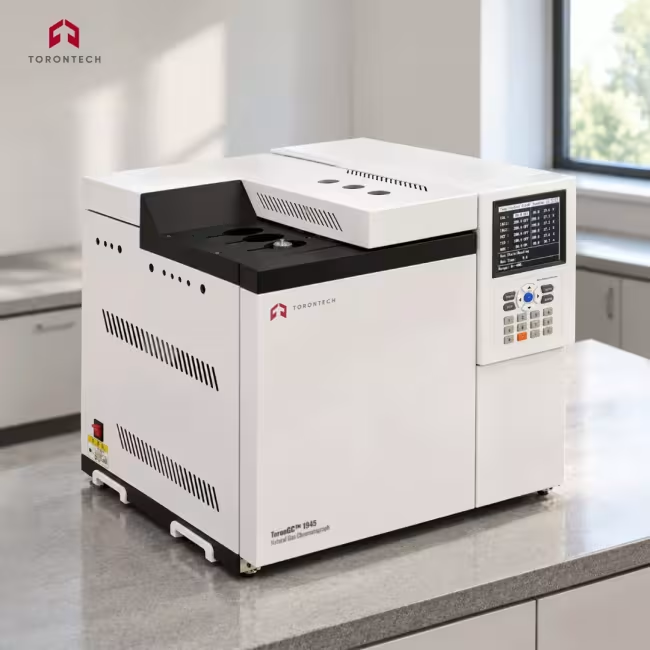
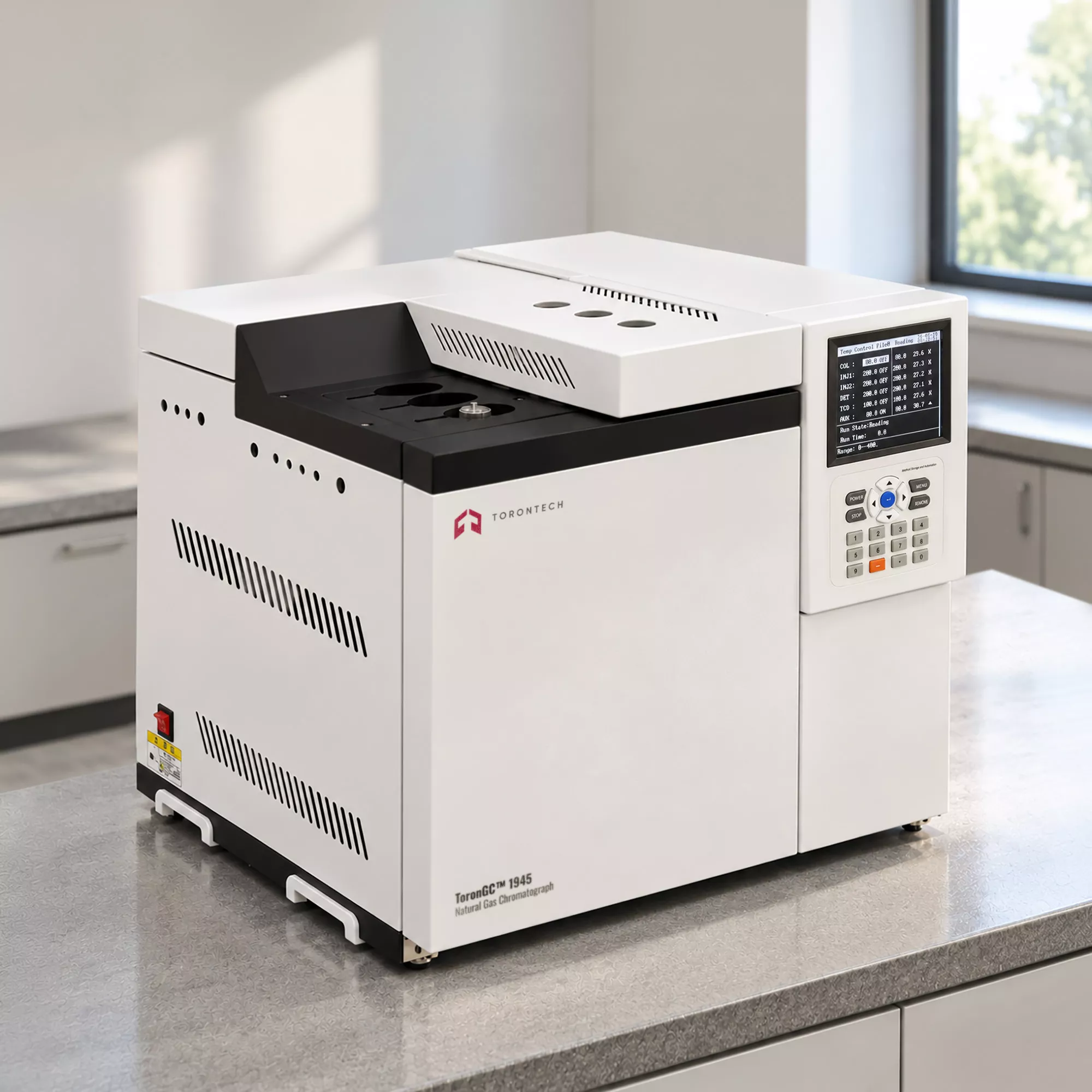
Natural Gas Chromatograph - ToronGC™ 1945
The ToronGC™ 1945 as a dedicated natural gas analyzer for utilities and pipeline operators determines the chemical composition of natural gas and similar gaseous mixtures for utilities, pipeline operators, and petrochemical laboratories. It follows the test method described in ASTM D1945. Each component separates on packed columns and is quantified against a reference gas of known composition. Laboratories use the resulting mole percent data to calculate heating value and relative density. This makes the instrument a practical tool for custody transfer, quality control, and process monitoring.
Torontech configures the ToronGC™ 1945 with six switching valves, two packed columns, and a thermal conductivity detector (TCD). Valve timing reverses the carrier gas flow at a set point in the run, which groups heavy hydrocarbons into a single backflush peak. Operators can report these heavy ends as C5+, C6+, or C7+, depending on the gas they analyze. This approach shortens run time and keeps late-eluting compounds off the analytical column. Detection limits reach 100 ppm for most components.
The system resolves eleven components, with argon and oxygen reported as a single composite peak. Hydrogen sulfide is part of the component list, so sour gas samples fall within the analysis scope. The TCD responds to both hydrocarbons and permanent gases, which lets one detector cover the full component list. Torontech supplies the ToronGC™ 1945 to laboratories across the United States and Canada.
Natural Gas Chromatograph - ToronGC™ 1945 Applications
The ToronGC™ 1945 serves any operation that buys, sells, processes, or certifies natural gas based on its composition. Typical users include the following industries and laboratories.
- Natural Gas Custody Transfer: composition data feeds heating value and relative density calculations used to price gas at metering stations and sales points
- Pipeline Gas Quality Control: verifies that methane, inert gas, and carbon dioxide levels meet tariff specifications before gas enters transmission lines
- Gas Processing Plants: monitors inlet and residue gas streams to track NGL recovery and treating unit performance
- Upstream Exploration and Production: characterizes wellhead and separator gas samples for reservoir evaluation and production allocation
- Sour Gas Screening: measures hydrogen sulfide down to 500 ppm, for screening high-H2S raw gas streams
- LNG and Fuel Gas Facilities: checks feed gas and fuel gas composition for liquefaction planning and burner tuning
- Contract and Third-Party Testing Laboratories: produces ASTM D1945 composition reports for producers, utilities, and regulators
- Research and Calibration Gas Development: supports method development and verification of reference gas blends
Standards
The ToronGC™ 1945 is designed to align with the ASTM test method for natural gas composition analysis by gas chromatography. Laboratories should verify method conformance against the current edition of the standard during installation and calibration.
- ASTM D1945 - Standard Test Method for Analysis of Natural Gas by Gas Chromatography
Natural Gas Chromatograph - ToronGC™ 1945 Key Features
The ToronGC™ 1945 packages a proven packed column method into a dedicated configuration for natural gas. Each feature below supports fast, repeatable composition analysis.
- Six-Valve, Dual Packed Column Layout: switches the sample between columns so permanent gases, carbon dioxide, and hydrocarbons each separate on a suitable packing
- Thermal Conductivity Detection: one universal detector covers hydrocarbons, permanent gases, and hydrogen sulfide without additional detector channels
- Configurable Heavy-End Backflush: groups heavy components as C5+, C6+, or C7+ to match the reporting format your contract or method requires
- Eleven-Component Separation: resolves isobutane, n-butane, isopentane, n-pentane, carbon dioxide, ethane, hydrogen sulfide, propane, argon/oxygen, nitrogen, and methane in one analysis
- Low Detection Limits: reaches 100 ppm for most components, 400 ppm for propane, and 500 ppm for hydrogen sulfide
- Reference Gas Calibration: quantifies the sample against a known standard run under identical conditions for traceable, repeatable results
- Physical Property Support: composition output supports calculation of heating value and relative density for gas sales and quality reporting
- Hydrogen Sulfide Capability: lets the lab run sour gas samples in the same workflow as sweet pipeline gas
Theory and Method
Gas chromatography separates a gas mixture by partitioning its components between a moving carrier gas and a stationary phase packed inside a column. Each compound interacts with the packing to a different degree, so it travels through the column at its own speed. Light permanent gases such as nitrogen and methane elute early. Heavier hydrocarbons such as butane and pentane spend longer in the stationary phase. The result is a series of discrete peaks, and each retention time identifies a specific component.
The thermal conductivity detector measures the difference in heat transfer between pure carrier gas and carrier gas that contains an eluting component. A heated filament sits in the gas stream, and its resistance changes as the gas composition shifts its thermal conductivity. The detector converts that change into an electrical signal that rises and falls with each peak. Almost every gas conducts heat differently from the carrier, so the TCD responds to hydrocarbons, carbon dioxide, nitrogen, and hydrogen sulfide alike.
ASTM D1945 quantifies each component by comparison with a reference standard. The operator runs a gas mixture of known composition under identical conditions, then runs the sample. The data system compares peak heights, peak areas, or both against the reference values to calculate composition. The six-valve layout of the ToronGC™ 1945 also performs a backflush, reversing carrier flow so heavy ends return to the detector as one grouped peak. This step keeps the run short and protects the separation column.
Chromatogram

Natural Gas Chromatograph - ToronGC™ 1945 Technical Specifications
Parameter | ToronGC™ 1945 |
Configuration | 6-valve, 2-column (packed), TCD |
Switching Valves | 6 |
Columns | 2, packed |
Detector | Thermal conductivity detector (TCD) |
Test Method | ASTM D1945 |
Sample Type | Natural gas |
Components Separated | Isobutane, n-butane, isopentane, n-pentane, carbon dioxide, ethane, hydrogen sulfide, n-propane, argon/oxygen composite, nitrogen, methane |
Heavy-End Grouping | C5 and heavier, C6 and heavier, or C7 and heavier, by carrier gas backflush |
Lower Detection Limit (most components) | 100 ppm |
Lower Detection Limit (propane) | 400 ppm |
Lower Detection Limit (hydrogen sulfide) | 500 ppm |
Quantification | Peak height, peak area, or both, compared with a reference standard of known composition |