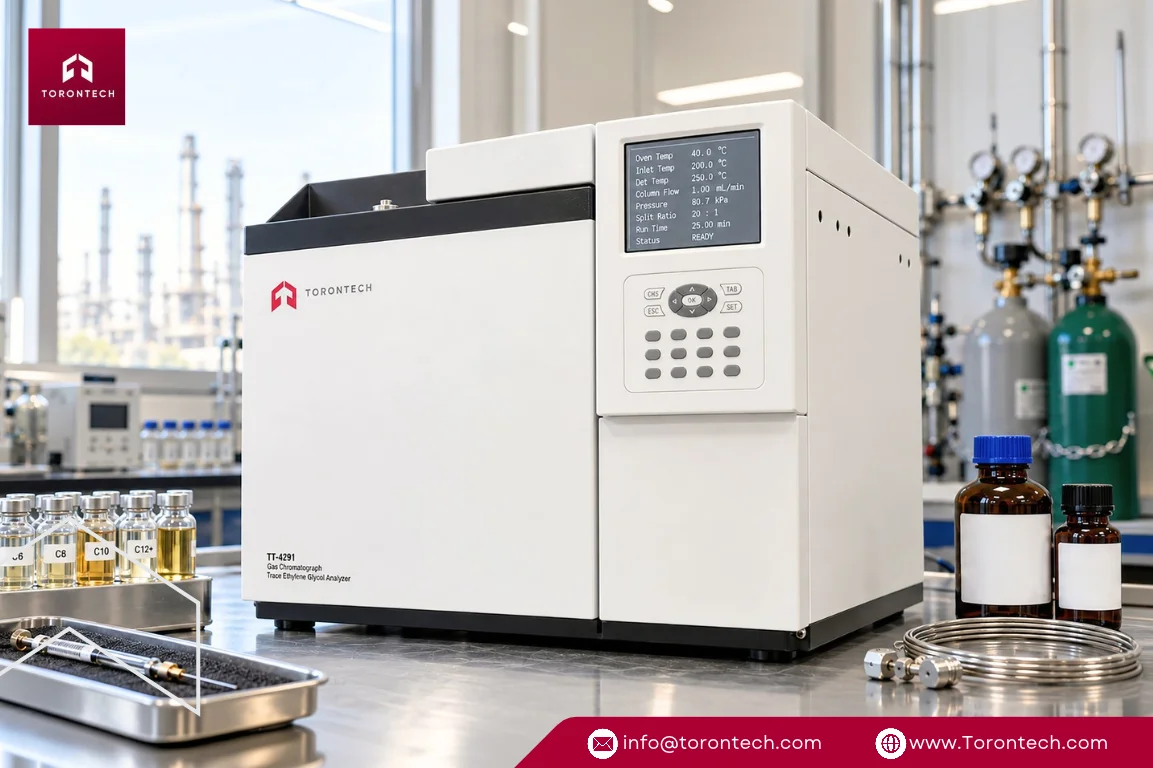
Biodiesel GC Plus Gas Chromatograph
TT-Biodiesel GC Plus Gas Chromatograph
Biodiesel GC Plus Gas Chromatograph - Interest in biodiesel as a clean-burning alternative fuel derived from renewable sources like vegetable oils has surged in recent years.
This surge is primarily due to its reduced environmental impact compared to conventional petro-diesel. Biodiesel can be used as a pure fuel or blended with petroleum diesel at any level. For biodiesel to be commercialized as a pure biofuel or blending stock for heating and diesel fuels, it must meet a set of requirements outlined in ASTM D6751 and EN 14214 standard specifications. These standards specify the maximum allowable concentrations of contaminants in the pure (B100) finished product, along with other chemical and physical properties necessary for safe and satisfactory engine operation.
The primary application of the TT-Biodiesel GC Plus Gas Chromatograph is the detailed compositional analysis of pure biodiesel (B100) to ensure it meets the strict quality requirements for commercial use, as specified by standards such as ASTM D6751 and EN 14214.
Key Industries
- Biodiesel Production: This is the core industry for this instrument. Producers rely on it for comprehensive quality control to certify that every batch of B100 fuel meets the mandatory specifications before it can be sold or used for blending.
- Petroleum Refining & Fuel Blending: Refineries and fuel terminals that blend biodiesel with petroleum diesel use this GC to verify the quality of the incoming B100 stock. Contaminants like glycerin can cause storage instability and engine problems in the final blended product (e.g., B5, B20).
- Third-Party Testing Laboratories: These independent labs are essential for the biofuel ecosystem, providing accredited analysis and certification for producers, distributors, regulatory bodies, and large-scale consumers. This specialized GC is a fundamental tool for their biodiesel testing services.
- ASTM D6584: Standard Test Method for Determination of Total Monoglyceride, Total Diglyceride, Total Triglyceride, and Free and Total Glycerin in B-100 Biodiesel Methyl Esters by Gas Chromatography
- EN14103: Fat and Oil Derivatives - Fatty Acid Methyl Esters (FAME) - Determination of Ester and Linolenic Acid Methyl Ester Contents
- EN14110: Fat and Oil Derivatives - Fatty Acid Methyl Esters (FAME) - Determination of Methanol Content
Instrumentation and Reagents
The analysis of glycerin, mono-, di-, and triglycerides by gas chromatography (GC) necessitates a non-discriminative injection system capable of transferring both volatile and heavy compounds without discrimination or degradation. For this purpose, a TRACE GC Ultra equipped with a true cold On-column inlet and a flame ionization detector (FID), automated by a TriPlus Autosampler for liquids, was utilized and controlled through the Thermo Scientific Chrom-Card data system. The true cold On-column injector, available on the TRACE GC Ultra, is a permanently cold system designed to prevent discrimination of the heavier fraction and eliminate any risk of degradation of labile components like triglycerides, thereby ensuring excellent recovery and proven sample integrity.
The analytical column used is a non-polar Thermo Scientific TRACE™ TR-BIODIESEL(G), 10 m long with a 0.32 mm inner diameter and a 0.1 μm film thickness. This column is specifically designed to deliver excellent performance for high-temperature GC methods, featuring enhanced mechanical robustness at high oven temperatures and thus prolonged lifetime. A 1 m long, 0.53 mm inner diameter pre-column is used, connected to the analytical column via a leak-free high T purged connection.
A low dead volume leak-free metal tee has been specially designed to provide a reliable connection between the guard column and the analytical column during high-temperature operation, thereby eliminating the need for normal glass press-fit unions. This connector has demonstrated its leak-free performance even under extremely large and frequent oven temperature variations.
Calibration is achieved using two internal standards – 1,2,4-butanetriol (IS1) for glycerine and tricaprin (IS2) for mono-, di-, and triglycerides, along with four reference compounds – glycerol, mono-olein, di-olein, and tri-olein.
Because glycerin, mono-, and di-glycerides are polar and high boiling components, they must be derivatized to increase their volatility and reduce activity before injection into the GC. The method requires derivatization with MSTFA (N-methyl-N-trimethylsilyltrifluoroacetamide) in pyridine, which transforms these compounds into more volatile silylated derivatives. Below is a list of required reagents:
- MSTFA (N-methyl-N-trimethylsilyltrifluoroacetamide)
- n-Heptane
- Pyridine
- 1,2,4-Butanetriol – internal standard solution 1,1 mg/mL in pyridine (IS1)
- 1,2,3-Tricaproylglycerol (tricaprin) - internal standard solution 2, 8 mg/mL in pyridine (IS2)
- Reference materials: glycerol (glycerin), 1-monooleoylglycerol (monoolein), 1,3-di-oleolglycerol (diolein), 1,2,3-tri-oleoylglycerol (triolein)
- Mono-glycerides check mix (monopalmitin, monostearin, and monoolein), in pyridine
| LOD | |
| Compound | Max % m/m (EN 14214) |
| Glycerin | 0.02 |
| Mono-glycerides | 0.8 |
| Di-glycerides | 0.2 |
| Tri-glycerides | 0.2 |
| Total Glycerin | 0.25 |