Choosing Electromechanical vs Hydraulic Tensile Testers
Choosing between electromechanical and hydraulic testing systems is a classic fork in the road. At Torontech, we see professionals wrestle with this constantly. While both measure strength, the mechanics inside dictate performance and ROI.
We often see labs overspending on unnecessary precision or underinvesting in durability. Finding the right Universal Testing Machine (UTM) isn't about spec sheets. It is about matching the tool to your workload without draining the budget. Here is our candid take on the differences to help you decide.
1. Electromechanical Tensile Testers: The Precision Experts
Let’s look at the Electromechanical units first. You likely know them as "screw-driven" testers. These systems use servo-driven electric motors to apply controlled tensile loads and measure material properties (Ghadhban et al., 2021).
These machines give you absolute command over test speeds and positioning. We view them as the standard for testing that needs complicated strain rates or cyclic testing at lower forces. Studies indicate they are particularly effective for precise data acquisition on various substances, including soft and stretchable conductive materials (Wiranata et al., 2022).
Plus, there are no fluids to manage here. They run quiet and stay clean, making them perfect for R&D labs where a grease spot is a problem. You also get a generous range of travel. This is exactly what you need when stretching rubbery materials that elongate significantly before failure.
Our Take:
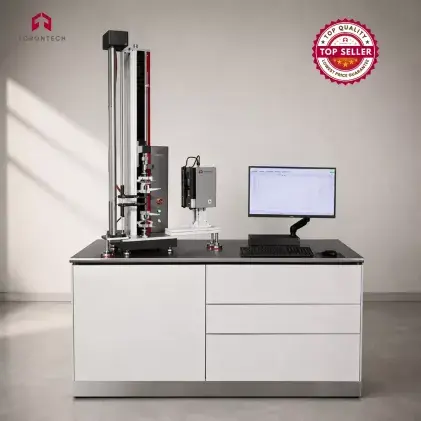
If you are testing anything generally under 300 kN (67,000 lbf), choosing this option is the clear winner. For lighter loads, our single-column Tensi-10 Series is often the go-to for its compact footprint.
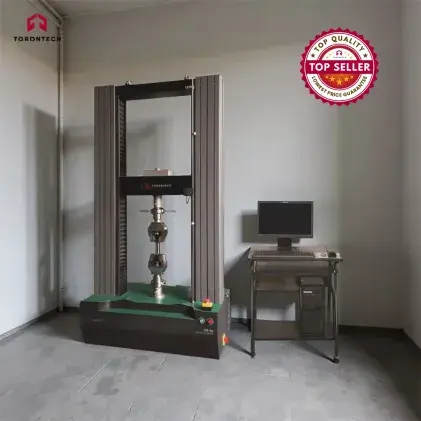
For mid-range general testing, the TTM-Series (like the TTM-200) offers the rigidity you need without the bulk of a hydraulic system. Research supports the use of these electromechanical systems for high-temperature testing up to 500°C as well (Ghadhban et al., 2021).
Honestly, using a massive hydraulic press for plastic strips or thin wires is overkill. It is the wrong tool for the job.
Best For: Plastics, textiles, medical devices, wires, and soft tissues.
Related article: Single Column vs Dual Column Tensile Tester: The Best Choice
2. Hydraulic Tensile Testers: The Industrial Workhorses
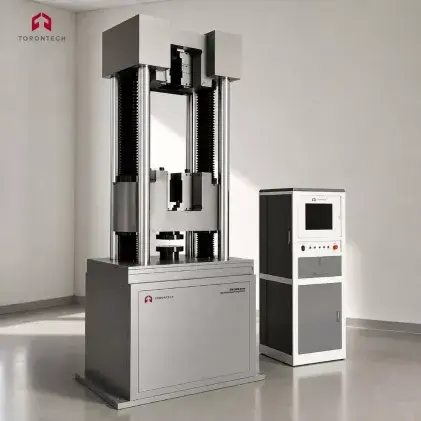
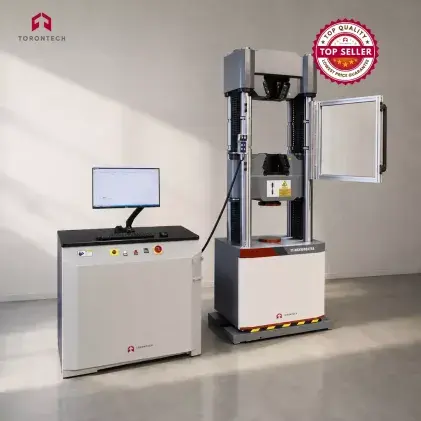
Then you have the Hydraulic testers. These rely on a piston-cylinder system driven by hydraulic fluid pressure to generate tensile forces (Aonuma & Murakami, 1974). People used to think of these as bulky and loud, but modern "Servo-Hydraulic" units like our TT-MSH Series are a different breed.
Here is the reality. Once you need to test heavy items (think rebar and concrete), electric motors get incredibly expensive. Hydraulic systems give you massive force for a price that fits the budget. These frames are solid. We mean really solid. They can take the violent shock of high-strength metal snapping without flinching.
Academic literature confirms that hydraulic testers are widely used for dynamic and static testing of materials, including plastics and metals, with superior capabilities for high load and speed ranges (Xiao, 2008; Zeng et al., 2020). If you maintain the hydraulic unit, we have seen frames like the high-capacity TTM-3000 operate reliably for decades in some of the most demanding industrial environments.
Our Take:
Ignore the old notion that hydraulics are messy or imprecise. That is outdated thinking. Modern servo-hydraulic systems are surprisingly tidy and offer digital accuracy that competes with electric units.
If you need to break high-strength steel, don’t let the hydraulics deter you. It is the most reliable method to generate that kind of force.
Best For: Steel mills, construction materials (concrete/rebar), aerospace fasteners, and automotive casting.
Real-World Scenarios: What We Recommend
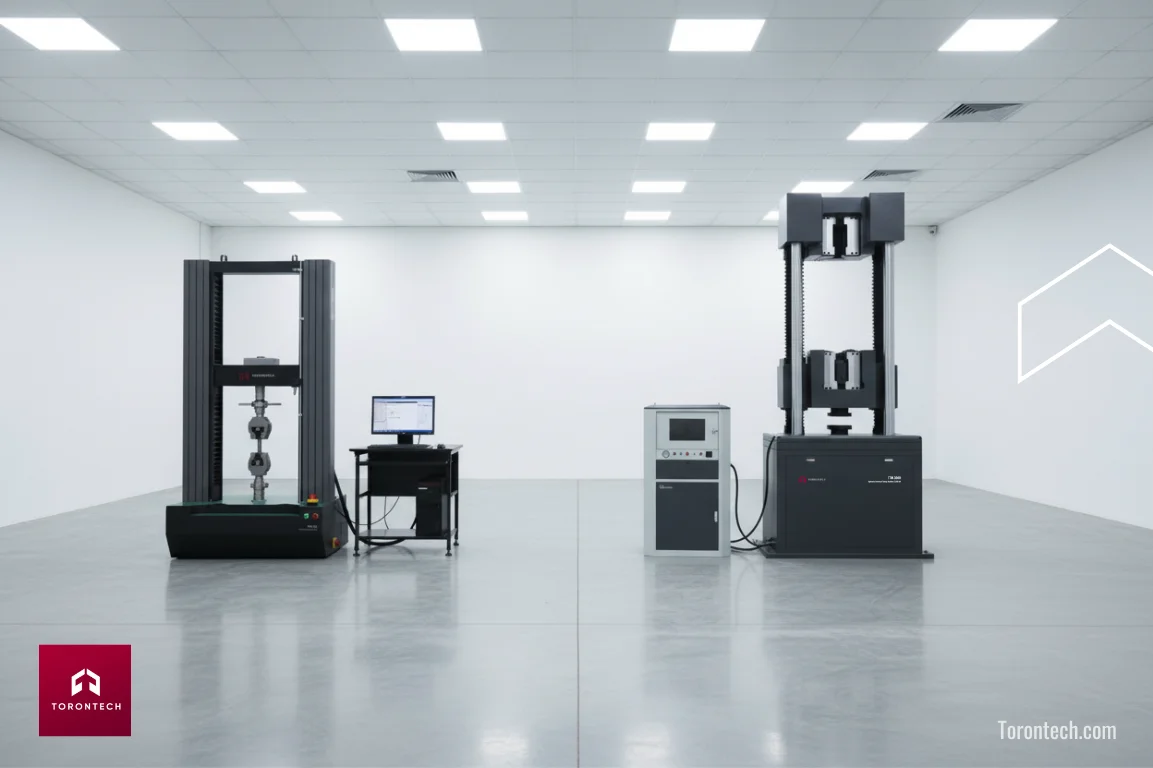
To illustrate the difference, let’s look at two distinct testing environments based on common industry requirements (Gfrerrer et al., 2023).
Imagine you are running quality control for a medical device manufacturer. You are testing delicate catheter tubes or surgical sutures. In this case, you can’t afford any background noise in your data.
Electromechanical testers generally offer lower noise during acoustic emission measurements and are suitable for applications requiring fine displacement control (Gfrerrer et al., 2023). The electromechanical drive of a Tensi-10 or TTM-Series unit is the only logical choice here because it provides that fine-tuned sensitivity you need.
On the flip side, picture a construction supplier testing number-8 steel rebar or long industrial chains. When that steel snaps, it releases a massive amount of energy. It is a violent event that shakes the entire floor. If you ran that test on a screw-driven frame, that shock would eventually hammer the bearings and gears to pieces.
A hydraulic system, like the TT-MSH or the horizontal TT-HTTM Series (for those long chains), excels in this high-force, high-speed dynamic testing (Homon et al., 2021). If you are breaking heavy metal all day, the hydraulic machine is simply going to survive longer.
Related article: How to Choose Grips for Tensile Test: Complete Guide
The Cheat Sheet: Which One Fits?
Studies comparing the two indicate that electromechanical systems are preferred for static and quasi-static tests due to accuracy, whereas hydraulic systems are favored for dynamic tests due to capacity (Gfrerrer et al., 2023; Zeng et al., 2020).
Here is how we see them comparing:
| Feature | Electromechanical | Hydraulic |
|---|---|---|
| Force | Ideal for Light to Medium (<300 kN) | Superior for Heavy Loads (>300 kN) |
| Upkeep | Minimal (grease the screws) | Moderate (oil changes, seal checks) |
| Accuracy | Pin-point at low loads | Strong, but excels at high loads |
| Investment | Lower for small machines | The best value for high-capacity |
| Footprint | Compact, often fits on a table | Needs floor space for the pump |
Following the Standards
Reviewing ASTM standards isn't usually the highlight of the day, but compliance is the foundation of the job. Whether you go with the electric or the oil-driven route, our equipment is ready to handle strict international requirements.
- For Electric Systems (TTM-Series): We align perfectly with standards like ASTM D638 (Plastics), ASTM D412 (Rubber), and ISO 527.
- For Hydraulic Systems (TT-MSH): We cover the heavy hitters like ASTM A370 (Steel Products), ASTM E8 (Metals), and ISO 6892.
We preload the software with these test methods so your team doesn't have to spend hours setting parameters.
The Intelligence Inside: Torontech’s Software
A testing machine is only as valuable as the data it produces. Both systems can be integrated with advanced software for automated testing and data analysis (Wiranata et al., 2022). Frankly, we see too many labs with solid hardware hampered by software that looks decades old. It frustrates operators and slows down production.
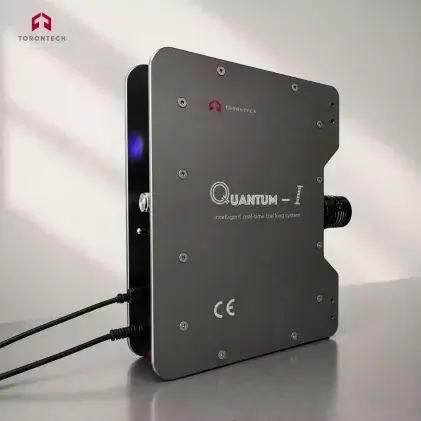
At Torontech, we pair our cost-effective hardware—and advanced options like our Quantum Series video extensometers—with an interface that is logical and modern. Electromechanical testers often provide easier integration for specialized materials like soft robotics sensors, and our software simplifies this process (Homon et al., 2021).
- Live Charts: Watch the stress-strain curves generate in real-time.
- Automatic Calculations: It handles the math for Yield Strength and Elongation automatically, so you don’t have to worry about calculation errors.
- Simple Reporting: Send the data straight to your lab network or export it to Excel with a single click.
The Torontech Edge: Innovation Meets Value
You don’t have to settle for subpar equipment just to save money.
The choice between electromechanical and hydraulic tensile testers depends on specific requirements such as load capacity, speed, and noise sensitivity (Gfrerrer et al., 2023). At Torontech, we bridge the gap between price and performance.
For precision, our TTM Electromechanical Series delivers the control you need. For raw power, our TT-MSH Servo-Hydraulic Series offers smooth, quiet strength—even at 2,000 kN. We ensure you get smart, efficient technology without straining your capital expenditure.
Ready to upgrade your capabilities? Explore our full lineup of Universal Testing Machines here or contact us today. Let’s ensure your quality control is as solid as the materials you test.
References
- Aonuma, S., & Murakami, T. (1974). Studies on an Electro-Hydraulic Load Input Tester for Fabrics. Journal of the Textile Machinery Society of Japan, 20, 90-100. doi.org/10.4188/jte1955.20.90
- Gfrerrer, M., Wiener, J., Brunner, A., & Pinter, G. (2023). Investigation of background noise affecting ae data acquisition during tensile loading of frps. e-Journal of Nondestructive Testing. doi.org/10.58286/27631
- Ghadhban, T., Al-Alkawi, H., & Reja, A. (2021). Design, Fabrication, and Testing of an Electromechanical High-Temperature Tensile Test Machine. Engineering and Technology Journal. doi.org/10.30684/etj.v39i4a.1911
- Homon, S., Dovbenko, T., Matviiuk, O., Vereshko, O., Kulakovskyi, L., & Chornomaz, N. (2021). ANALYSIS OF TEST EQUIPMENT FOR INVESTIGATION OF MATERIALS UNDER A STRONG LOAD APPLICATION. Urban development and spatial planning. doi.org/10.32347/2076-815x.2021.78.166-172
- Wiranata, A., Ohsugi, Y., Minaminosono, A., Kuwajima, Y., & Maeda, S. (2022). Electromechanical tensile test equipment for stretchable conductive materials. HardwareX, 11. doi.org/10.1016/j.ohx.2022.e00287
- Xiao, X. (2008). Dynamic tensile testing of plastic materials. Polymer Testing, 27, 164-178. doi.org/10.1016/j.polymertesting.2007.09.010
- Zeng, X., Huo, J., Wang, H., Wang, Z., & Elchalakani, M. (2020). Dynamic Tensile Behavior of Steel HRB500E Reinforcing Bar at Low, Medium, and High Strain Rates. Materials, 13. doi.org/10.3390/ma13010185