
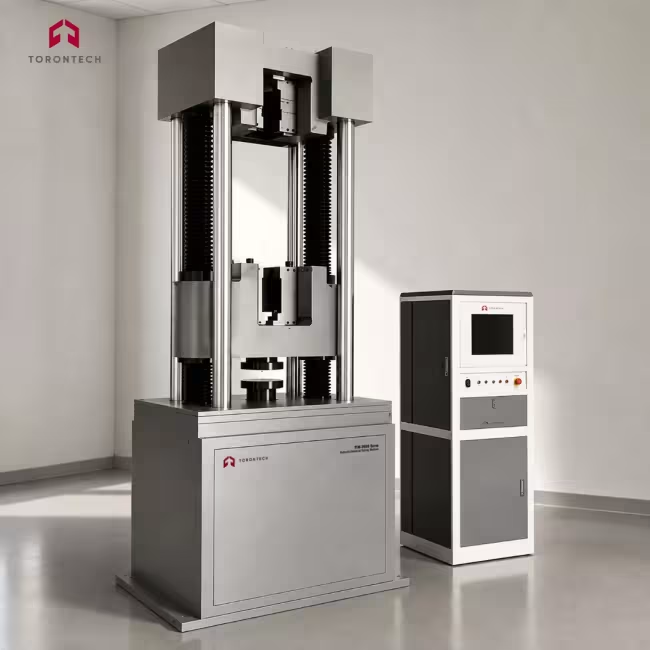
Hydraulic Universal Testing Machine 3,000 kN – TTM-3000
TTM-3000 Servo - Hydraulic Universal Testing Machine
TTM-3000 is a high capacity universal testing machine designed with a hydraulic unit located in the lower section of the frame.
It is primarily used for tensile, compression, bending, and shear testing of both metallic and non-metallic materials. The machine's operations and data processing comply with global "Metallic Materials Tensile Testing" standards including ASTM E-8, ISO and others. This machine is ideal for applications in metallurgy, construction, light industry, aviation, aerospace, educational institutions, and research centers.
The Torontech TTM-3000 Universal Testing Machine is a foundational instrument for determining the definitive mechanical properties of a wide range of materials. By performing precise tensile, compression, bending, and shear tests in compliance with key global standards like ASTM E-8, it provides the essential data required for material certification, design validation, and fundamental research, ensuring that materials meet their specified performance and safety criteria.
This critical mechanical analysis is indispensable for quality and safety assurance in:
- Primary Metals & Manufacturing: For the essential quality control and certification of raw materials such as steel rebar, structural beams, and metal plates, ensuring they meet the required grade, strength, and ductility specifications.
- Aerospace & Automotive: To conduct rigorous testing on high-strength alloys, composites, and fasteners, validating their mechanical properties to ensure the safety, reliability, and structural integrity of critical components.
- Civil Engineering & Construction: For qualifying the tensile strength of reinforcing steel, bolts, and structural components, providing the necessary verification to comply with building codes and ensure the safety of bridges, buildings, and infrastructure.
- Materials Research & Academia: As a cornerstone of materials science, used for the development of new alloys and advanced materials, and for providing the fundamental data needed to characterize material behavior under load.
Mechanical Process Structure
- Load Frame: The Load Frame features a cylinder located at the lower section with chain transmission and hydraulic clamping. The tensile test area is located in the upper part of the frame, while compression, bending, and shear test area is below the moving crosshead.
- Material and Construction: The test surface and columns are made from cast steel materials. The pillar and screw are made from Cr40, which is quenched and tempered for rigidity.
- Cylinder: The cylinder uses a special process, with strong gap seals for a long service life.
- Hydraulic Pump: European-made high-pressure hydraulic pump ensures low noise and smooth operation.
- Hydraulic Source: The hydraulic source uses steel plate forming with surface plastic spraying processing. The design allows for clean placement of computers and printers, saving space.
Control and Measurement System
- The system integrates advanced control and uses a full-digital electro-hydraulic servo closed-loop control and measurement system. This enables functions like constant velocity stress, strain, test force, displacement, and maintaining control.
- Safety Features: The system includes multiple protection layers such as overload, overcurrent, overvoltage, undervoltage, overspeed, and limit protections.
- Software: Equipped with dedicated monitoring and control software, it handles statistical processing of test data, automatically detects lower yield points, tensile strength, elastic modulus, elongation, and more. The computer displays force, displacement, strain, and other parameters in real-time, with dynamic test curve displays and multiple output options for test curves and reports.
- User Management: Features hierarchical management of user rights with secure login.
- Data Processing: Utilizes advanced multi-threading technology for data collection and sensor data processing to prevent control failures.
- Report Editing: Powerful report editing capabilities allow customization and output of desired test results. Data can be saved in Word format for easy editing.
- Database Management: Automatically saves all test data and curves, supports curve enlargement, comparison, and provides a robust foundation for laboratory networking.
Maximum Test Force | 3000kN / 675,000 lb.f |
Test Force Measuring Range | 60-3000kN (13,500 – 675,000 lb.f) |
Accuracy Level | ±1% |
Piston Maximum Speed Range | 50mm/min |
Piston Stroke | 250mm |
Displacement Resolution | 0.01mm |
Displacement Measuring Accuracy | ±1% |
Maximum Tensile Test Space | 950mm (37.5 inch) |
Round Sample Clamping Diameter | φ25-φ100mm (1-4 inch) |
Flat Specimen Clamping Thickness | 10-90mm (0.4-3.5 inch) |
Distance Between Columns | 880mm (35 inch) |
Mainframe Dimensions (L × W × H) | Approx. (1573 × 1160 × 3850 mm / 62 x 46 x 152 inch) |
Power Supply | 380V, 50Hz |
Standard Configuration
1. Machine load frame 3000kN
2. Electro-hydraulic servo source
3. Electro-hydraulic servo valve (German VOITH)
4. High pressure oil pump
5. Load Cell: 3,000 kN
6. Manual control box
7. High pressure oil pipe
8. Extensometer (50mm Gauge Length and 10mm Deformation)
9. Dedicated data acquisition card
10. Special measurement and control software
11. Computer
12. Printer
13. Test fixtures
| - Round jaw | 1 set | Φ25-Φ50mm |
| - Round jaw | 1 set | Φ50-Φ80mm |
| - Round jaw | 1 set | Φ80-Φ100mm |
| - Flat jaw | 1 set | 10-45mm |
| - Flat jaw | 1 set | 45-90mm |
| - Compression fixture | 1 set | Φ280mm |
14. Foundation bolt 4 pieces
