
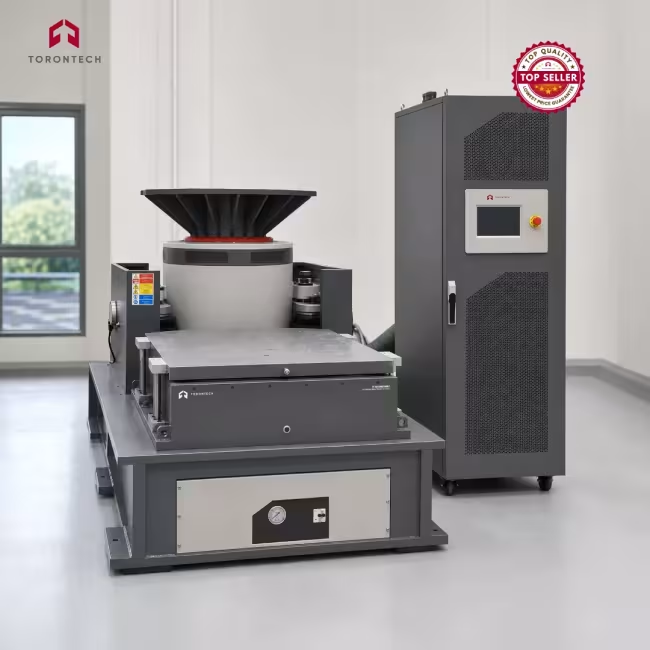
Electrodynamic Shaker Vibration Test System
TTEV series of Electrodynamic Shaker Vibration Test System simulate the vibration environment under the laboratory condition, and test the impact strength as well as reliability of various vibration test applications.
- Automotive Industry – Simulates road conditions, vibration fatigue, and transport stress on vehicle components.
- Aerospace and Defense – Tests aircraft parts, satellites, and military equipment for vibration resistance under extreme conditions.
- Electronics and Consumer Products – Validates durability of circuit boards, devices, and assemblies against sinusoidal and random vibrations.
- Telecommunication Equipment – Ensures reliability of sensitive fiber optic and electronic systems under mechanical stress.
- Packaging and Transport Simulation – Reproduces shipping vibrations to confirm product integrity during transit.
- Industrial Machinery and Components – Evaluates vibration tolerance of heavy-duty mechanical systems and structural parts.
- Research and Development – Supports new product design validation with simulations of shock, resonance, and fatigue.
- Quality Assurance and Certification – Provides compliance testing with MIL-STD, DIN, ISO, ASTM, IEC, ISTA, GB, JIS, and other international standards.
- Rugged suspension system and linear motion guiding, strong carrying capacity, good guiding functions, high stability.
- Load center airbag with high static stiffness and low dynamic stiffness, strong carrying capacity, perfect performance on amplitude variation.
- High efficiency D class power switching, 3-sigma peak current, low power consumption and minimum harmonic distortion.
- Quick self-diagnosis with safety interlock, high safety reliability.
- Airbag shock isolation device for vibration platform without the need of additional. foundation, perfect reproduction of vibrational wave and reduction in vibration transmittance.
- Horizontal and vertical expansion platforms for different applications.
- Simple controller operation.
TTEV series of electromagnetic vibration testing system simulate the vibration environment under the laboratory condition, and test the impact strength as well as reliability of various vibration test applications. In the laboratory, with the aid of vibration testing system, simulations of reproduction of sinusoidal, random, resonant search and dwell, classical shock and road models, etc. can be achieved. It is essential for product quality assurance, new product research and development.
TTEV series of electromagnetic vibration testing system is specially designed to meet the need for long time operation. Vertical and horizontal vibrations can be achieved by the installation of vibration resistant base. The standard platform is equipped with high efficiency airbag shock isolation device, so that the vibration transmitted to the building can be minimized. There is no need for additional foundation in most of the cases.
A complete set of vibration testing system is composed of shaker, power amplifier and vibration measuring control system, in accordance with the relevant national and international standards (such as: MIL-STD, DIN, ISO, ASTM, IEC, ISTA, GB, GJB, JIS, BS, etc.) to provide technical support for establishing product quality inspection.
| Model | EV203 | EV206 | EV210 | EV220 | EV232 | EV240 | EV250 | EV260 |
Frequency Range (Hz) | 1-2500 | 1-3000 | 1-3000 | 1-3000 | 1-3000 | 2-2500 | 1-2500 | 1-2700 |
Max. Sine Force (lbs) | 300(2.94) | 600(5.88) | 1000(9.8) | 2200(21.56) | 3200(31.36) | 4000(39.2) | 5000(49) | 6000(58.8) |
Max. Displacement (mmp-p) | 40 | 50.8 | 50.8 | 50.8 | 50.8 | 50.8 | 50.8 | 50.8 |
| Max. Acceleration(g) | 100 | 100 | 100 | 100 | 100 | 100 | 100 | 100 |
| Max. Velocity (cm/s) | 180 | 200 | 200 | 200 | 200 | 200 | 200 | 200 |
| Max. Load (kg) | 120 | 200 | 200 | 300 | 500 | 500 | 800 | 1000 |
| Model | EV320 | EV330 | EV340 | EV350 | EV360 | EV420 | EV430 | EV440 | EV450 | EV460 |
Frequency Range (Hz) | 1-3000 | 1-2700 | 1-2700 | 1-2500 | 1-2500 | 1-3000 | 1-2500 | 1-2500 | 1-2500 | 1-2500 |
Max. Sine Force | 2000(19.6) | 3000(29.4) | 4000(39.2) | 5000(49) | 6000(58.8) | 2000(19.6) | 3200/(31.36) | 4000(39.2) | 5000(49) | 6000(58.8) |
Max. Displacement (mmp-p) | 76.2 | 76.2 | 76.2 | 76.2 | 76.2 | 101.6 | 101.6 | 101.6 | 101.6 | 101.6 |
Max. Acceleration(g) | 80 | 85 | 200 | 200 | 200 | 200 | 250 | 250 | 250 | 200 |
Max. Load (kg) | 400 | 500 | 500 | 800 | 1000 | 400 | 500 | 500 | 800 | 1000 |


