Choosing Electrodynamic vs Mechanical Vibration Testers
Selecting the right vibration testing systems is less about the technical specifications on paper and more about preventing a costly mismatch for your application down the line.
You have two primary classes of machine to consider: the high-frequency electrodynamic shakers and the high-endurance mechanical ones. While both are designed to simulate vibration, how they get there and what they can achieve are fundamentally different.
Making the wrong choice means you’ve either over-invested in capabilities you won’t use, or you’ve acquired a system that falls short of the testing standards required to ship your product. We've seen both scenarios play out. So, here is our straightforward perspective on how to choose the correct system for your facility.
Key Takeaways
- Electrodynamic shakers function like powerful loudspeakers to deliver high-frequency precision which is essential for testing electronics and aerospace components.
- Mechanical testers act as the workhorses for packaging and transport simulation because they handle heavy loads with significantly lower operating costs.
- Your choice depends on the standard you must meet, with electrodynamic systems handling complex random vibration while mechanical units manage repetitive fixed displacement.
- Torontech provides cost-effective solutions for both needs, ranging from the precise TTEV Series for design validation to our robust Transportation Simulators for endurance testing.
How They Generate Vibration
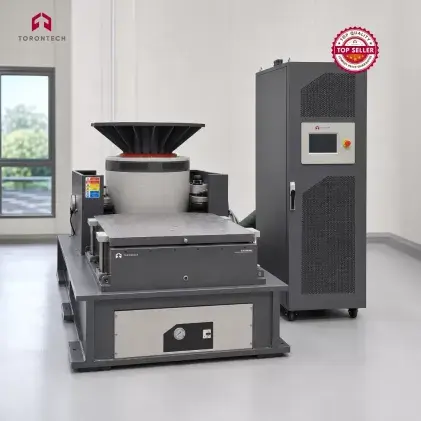
Think of an Electrodynamic shaker as an industrial-scale, precision-controlled loudspeaker.
These devices use electromagnetic forces to induce controlled vibrations in test objects (Lang & Snyder, 2001). Their performance is influenced by critical engineering factors like vibration modes, power amplifier capacity, stroke, and moving mass (Khan & Iqbal, 2016; Unni, 2023). This allows them to replicate almost any service environment you can imagine.
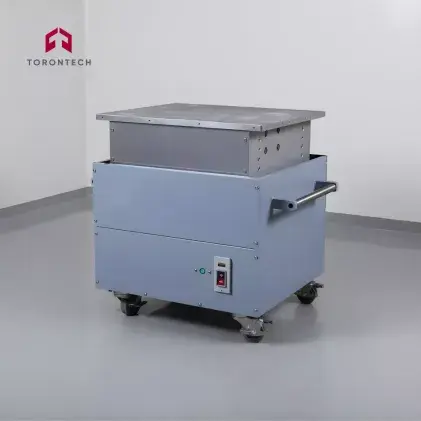
Then there are the Mechanical shakers. These are the heavy-lifters of the industry.
Their design is beautifully straightforward, utilizing direct mechanical action from motors and cams to produce intense, sustained vibration. As noted in the literature, these systems are simpler and less expensive, but they typically provide fixed displacement and single-frequency sinusoidal vibrations (Khan & Iqbal, 2016). This makes them systems built for endurance and simplicity rather than nuanced control.
Electrodynamic Shakers: The Standard for Precision Control
When your product contains sensitive electronics or you need to provide proof of survival against specific, complex vibration profiles, this is the system you need.
Research indicates that electrodynamic shakers are generally more reliable and accurate for handling complex vibration profiles (Khan & Iqbal, 2016; Lang, 2003). For the industry's most demanding qualification tests, there is no viable alternative.
Meeting Demanding Certification Standards
These are the shakers required to pass the stringent standards that are often the final gate before a product can go to market. This includes:
- MIL-STD-810: The benchmark for military and defense hardware.
- ASTM D4728: A key standard for random vibration testing of shipping containers.
- IEC 60068: A foundational set of rules for environmental testing of electronics.
Key Performance Attributes
- Broad Frequency Spectrum: They can operate from a low-end rumble to a high-frequency buzz with complete control.
- Replicates Complex Environments: These systems can blend sine, random, and shock vibrations (Lang & Snyder, 2001). Modeling and characterizing these systems often involves electro-mechanical system identification to optimize performance and predict nonlinear effects (Shishkovski et al., 2024; Saraswat & Tiwari, 2017).
- Highly Repeatable Results: You can program a test profile and expect the exact same output, every single time.
Hypothetical Use Case
To put this in perspective, imagine you are validating a navigation sensor for an autonomous drone. You aren't just dealing with a simple bump. You need to survive a mix of high-pitched motor hum and sudden wind turbulence.
An electrodynamic system, like our TTEV Series, is the only tool that can mimic that specific "cocktail" of forces to ensure a solder joint doesn't crack mid-flight.
Our TTEV Series Electrodynamic Shaker Vibration Test Systems
We operate on the principle that finding a product’s weakness in your lab is far more efficient than having a customer discover it. Our TTEV Series is designed to provide that clear, detailed data you need to validate your engineering, handling everything from sine waves to random vibration with ease.
View Our Electrodynamic Shaker Vibration Test Systems
Mechanical Shakers: The Practical Choice for Durability
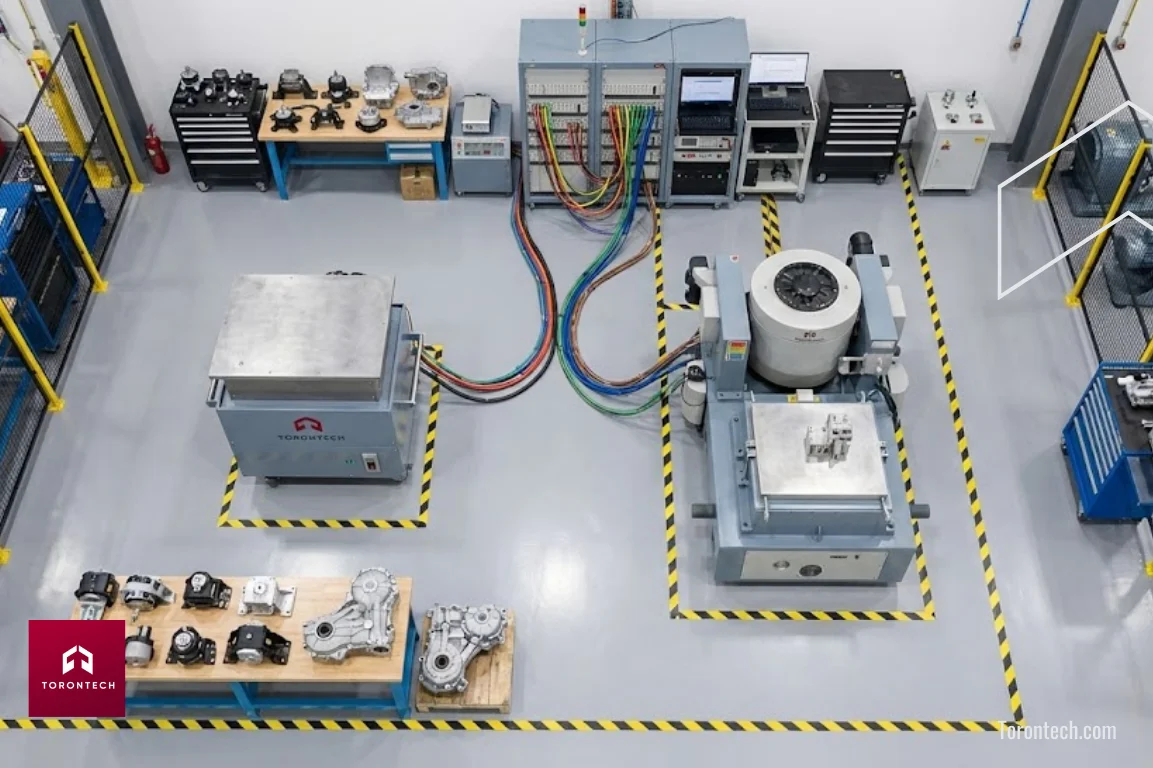
We often advise clients to avoid over-specifying their equipment.
If your main objective is confirming general product toughness or transport survivability, a standard Mechanical Vibration Tester is a smart, practical investment. While they are more robust, they are less flexible and typically limited compared to electrodynamic shakers (Khan & Iqbal, 2016).
Built for Transportation and Endurance Testing
These systems are the workhorses for some of the most common logistics and packaging standards:
- ISTA Series: The core certification for packaging performance.
- ASTM D999: A foundational test method for vibration in shipping containers.
Key Performance Attributes
- High Payload Capacity: These machines are built like tanks and can manage heavy loads without requiring complex setup. They are often favored for heavy samples or simpler vibration tests (Lang, 2003).
- Lower Total Cost of Ownership: This is a critical point. With a simpler mechanism and fewer sensitive components, the long-term operating and maintenance expenses for these machines are significantly lower.
Hypothetical Use Case
Consider a scenario where you are shipping a pallet of heavy industrial valves across the country. You don’t need to know if the valves resonate at 2000Hz.
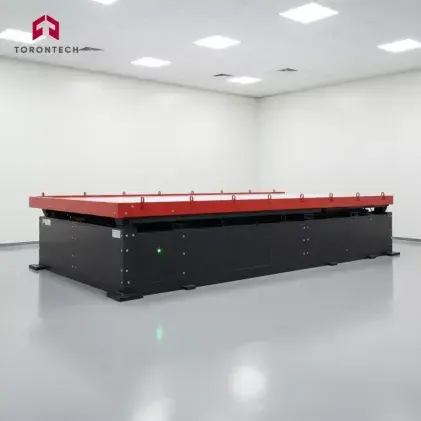
You simply need to confirm the wooden crate won't disintegrate after eight hours of highway bumps. A dedicated Transportation Simulator handles that sort of repetitive abuse perfectly.
Our Mechanical Solutions
We see machines like our Transportation Simulator as the "marathon runners" of the testing world. They aren’t designed for nuanced sprints, but they will operate consistently for hours on end to give you the confidence that your packaging is built to last.
View Our Transportation Simulator
A Practical Checklist for Your Application
Answer these questions to determine the most logical direction for your lab.
- What is your required frequency range?
- High-frequency (above 100Hz)? You will need an Electrodynamic system. (e.g., testing printed circuit boards for resonance).
- Low-frequency (below 100Hz)? A Mechanical system is likely sufficient. (e.g., simulating a truck suspension).
- What test profile do you need to run?
- Random vibration or specific shock pulses? This requires an Electrodynamic shaker. (e.g., simulating actual recorded road data).
- A repetitive, fixed displacement or bounce test? Mechanical is the cost-effective solution. (e.g., a "loose cargo" bounce test).
What is your typical payload?
For very heavy products on a defined budget, Mechanical Vibration Testers often provide a better price-to-payload ratio. (e.g., large automotive castings).
How important are long-term operating costs?
If minimal maintenance and operational simplicity are high priorities, the direct nature of a Mechanical shaker is a major advantage.
Head-to-Head Comparison
| Feature | Electrodynamic Shakers (TTEV Series) | Mechanical Vibration Testers |
|---|---|---|
| Operating Principle | Electromagnetic Force | Direct Mechanical Action |
| Common Standards | MIL-STD-810, ASTM D4728, IEC 60068 | ISTA, ASTM D999 |
| Test Capabilities | Sine, Random, Shock | Fixed Displacement, Repetitive Shock |
| Maintenance Profile | Requires skilled operation | Simple mechanical upkeep |
| Primary Application | Design Validation & Certification | Production Screening & Transport Simulation |
| Investment Level | Higher Initial Investment | Lower Initial Investment |
Torontech: The Right Technology for Your Application
Here at Torontech, our goal is to equip labs with technology that solves challenges, not create new ones. We have focused our product lines on offering cost-effective solutions that deliver performance without unnecessary complexity. We believe in helping you find the right tool for the job.
Whether you need the high-fidelity output of our TTEV Electrodynamic Series to meet demanding industry standards, or the simple endurance of our Transportation Simulators for packaging verification, we have the technology to support your quality program.
Ready to find the right system for your lab? Explore our complete line of Vibration Testing Equipment and see how our innovative technologies can help you deliver more reliable products to your customers.
References
- Khan, F., & Iqbal, M. (2016). Development of a testing rig for vibration and wind based energy harvesters. Journal of Engineering and Applied Sciences , University of Engineering and Technology, Peshawar, 35, 101-110.
- Lang, G. (2003). Shock'n on Shakers. Sound and Vibration, 37, 12-20.
- Lang, G., & Snyder, D. (2001). Understanding the physics of electrodynamic shaker performance. Sound and Vibration, 35, 24-33.
- Saraswat, A., & Tiwari, N. (2017). Modeling and study of nonlinear effects in electrodynamic shakers. Mechanical Systems and Signal Processing, 85, 162-176.
- Shishkovski, D., Pecioski, D., Ignjatovska, A., Anachkova, M., & Petreski, Z. (2024). Modeling and Characterizing of Electrodynamic Shaker ESE 211. 2024 13th Mediterranean Conference on Embedded Computing (MECO), 1-4.
- Unni, V. (2023). Indigenous Development of a High Force Rating Electrodynamic Shaker System. Journal of Aerospace Sciences and Technologies.