Guide to Vibration Test Systems & Standards
Releasing a product without thorough vibration testing is a significant business risk. A minor, undiscovered weakness from vibration can spiral into a costly, brand-damaging problem like a stress fracture, a loose connection, or a package that fails in transit.
Vibration testing is a technique that evaluates how products respond to these forces, simulating real-world conditions to detect faults before they reach your customers (Chu et al., 2024; Mcconnell & Varoto, 1995).
This guide explains how to use these systems as the final checkpoint for product integrity, ensuring your designs perform as well in the real world as they do on paper.
Key Takeaways
- Bringing vibration testing in-house reduces reliance on third-party labs and allows you to catch design flaws early in the R&D process.
- Torontech offers specialized solutions for every application, ranging from the high-frequency TTEV Series Electrodynamic Shaker to robust Mechanical Vibration Testers.
- Our systems are engineered to help you meet critical industry standards including ISO 16750, MIL-STD-810, and ASTM D4169.
- We recommend selecting a machine with a force rating 20% higher than your calculated requirement to ensure long-term operational reliability.
- Torontech shakers feature internal airbag isolation, which eliminates the need for expensive seismic concrete foundations during installation.
Why In-House Vibration Testing is a Sound Business Decision
Using a third-party lab for testing is a viable option, but bringing that capability in-house fundamentally changes your quality assurance process. You gain control. Here is why we believe it is a smart investment.
1. Identify Design Flaws Before They Enter Production
Waiting for customer complaints to learn about a product’s weakness is the most expensive form of feedback.
We are strong proponents of using Resonance Search tests during the R&D cycle. This methodical process finds the exact frequency that causes fatigue or failure, allowing you to engineer a solution long before your company commits to expensive manufacturing tooling.
For example, an automotive supplier can find the exact engine RPM that makes a dashboard display vibrate excessively, allowing them to add a damper before the car ever goes to production.
2. Satisfy the Demands of International Compliance
This testing is crucial for businesses because it ensures product reliability and safety, which is vital in industries like aerospace, automotive, and manufacturing where mechanical failures can have serious consequences (Aerospace Testing International, 2025; Baldogi et al., 2021).
You cannot become a supplier to the automotive industry without passing ISO tests, nor can you secure a defense contract without meeting MIL-STD requirements. When you have your own equipment, you control the validation schedule. This means no more waiting for lab availability when a critical deadline is approaching.
Related article: Future-Proof Your Automotive NVH Testing Strategy
3. Avoid the High Cost of Warranty Claims and Recalls
A new shaker system is a capital expense, but a product recall can impact a company's bottom line for years. Additionally, in-house testing supports quality control by detecting internal defects not visible to the naked eye, thus helping companies deliver defect-free products and maintain customer trust (Multani, 2021).
It helps reduce maintenance costs, prevent unexpected downtime, and extend the lifespan of machinery by enabling timely repairs or replacements (Chu et al., 2024; Senapaty & Rao, 2018).
An Overview of Torontech’s Vibration Systems
We provide a full range of vibration equipment, and our philosophy is to match the right tool to the specific application. Over-specifying a machine is an inefficient use of budget, while an under-powered machine will only lead to operational issues.
Electrodynamic Shaker Systems (For High-Precision Analysis)
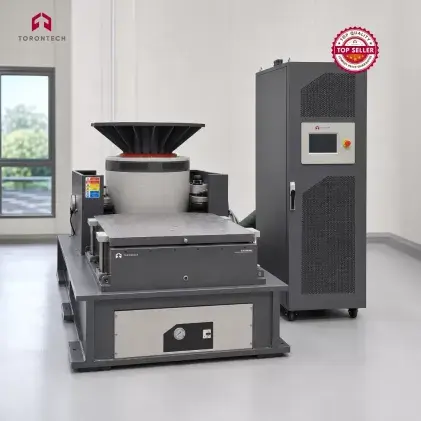
For complex R&D that requires a high degree of frequency accuracy (up to 2,000+ Hz), our Electrodynamic Shaker Vibration Test System is the industry standard. The TTEV series, for example, is essential for validating the performance of sensitive satellite components that must withstand the intense, high-frequency vibrations of a rocket launch.
Our Engineering Philosophy: We integrated airbag isolation into these systems. This means you do not need to construct a special seismic foundation. We believe advanced testing capabilities shouldn't require expensive facility modifications.
Mechanical Vibration Testers (For Heavy-Duty Durability)
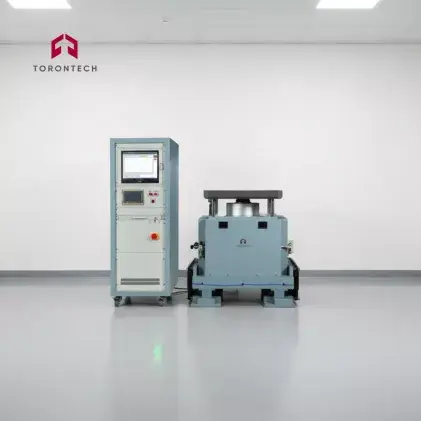
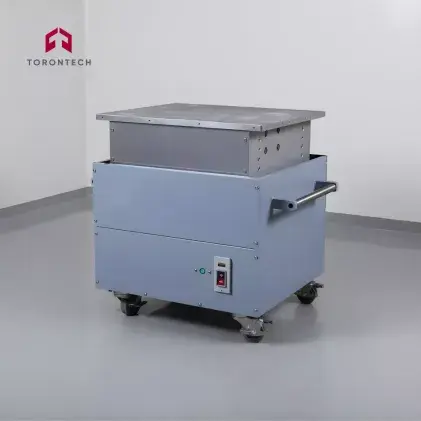
When the main objective is confirming structural integrity against heavy loads and low-frequency transport vibration, our Mechanical Vibration Tester is the recommended workhorse. A great use case is testing a large, crated industrial motor to ensure its mounting brackets won't crack during a long and bumpy rail shipment.
Our Recommendation: If your testing does not require high-frequency analysis, this is the more economical and direct solution for industrial parts and packaging.
Shock & Bump Test Machines
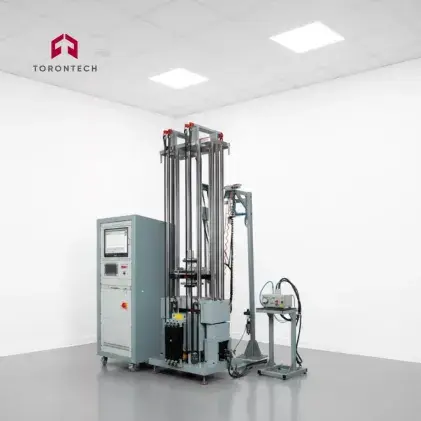
These systems are for testing a product's response to sudden, sharp impacts. A manufacturer of handheld scanners for warehouse use could use a Shock Test System or Bump Test Machine to simulate the device being dropped onto concrete from five feet to ensure the screen and internal electronics survive.
Transportation Simulators
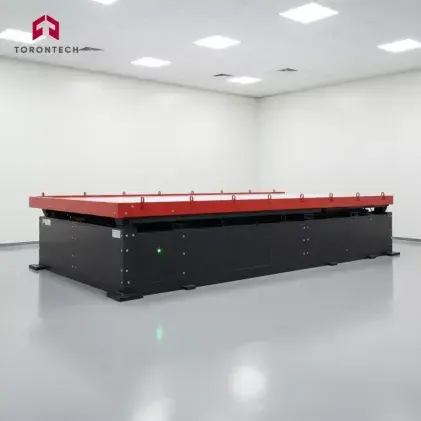
Damage that occurs during shipping is a common and preventable expense. Our Transportation Simulator is ideal for a company that bottles a premium beverage, as it can be used to confirm that a pallet's worth of product will survive a cross-country truck journey without the bottles clanking together and breaking.
The Key Industry Standards We Help You Meet
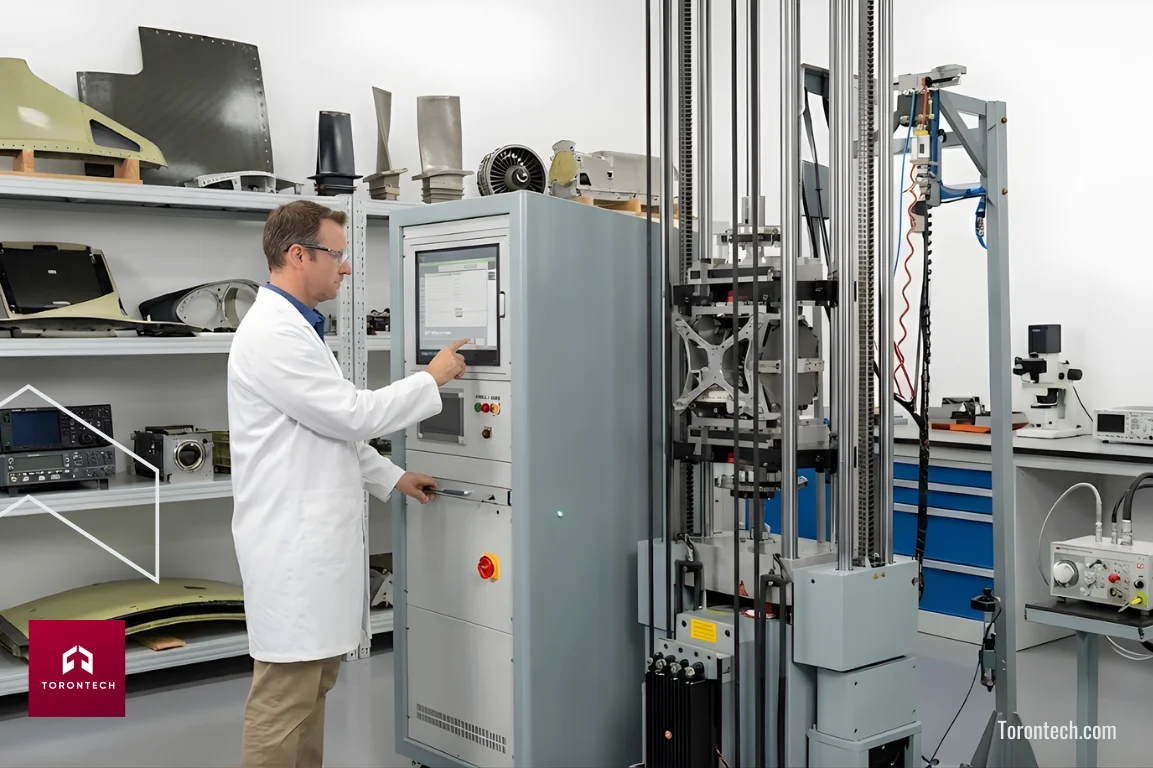
Your equipment must be able to perform the tests mandated by your industry. Overall, vibration testing is an essential part of the validation and reliability assurance process that helps businesses optimize performance and reduce operational risks (Baldogi et al., 2021; Jia & Wang, 2020). We ensure our systems are configured to run profiles for these major standards:
- For Automotive: ISO 16750-3 and SAE J1455 (to verify that an in-dash navigation system can handle a decade of road vibration without its screen flickering).
- For Aerospace & Defense: MIL-STD-810 (for instance, ensuring a military-grade laptop's hard drive can survive the intense, multi-frequency vibration inside a helicopter cockpit).
- For Packaging & Shipping: ASTM D4169, the ISTA series, and UN/DOT 38.3 (this is critical for testing the packaging of lithium-ion batteries to prevent short circuits during transit).
- For Electronics & Consumer Goods: IEC 60068 (a good example is making sure the delicate solder joints on a circuit board won't crack under the stress of daily use).
Related article: A Complete Guide to Random Vibration Testing
How to Choose the Right Vibration Testing Equipment
Customers often ask for guidance when choosing between an Electrodynamic and a Mechanical system. Here is the framework we use.
Read more: Choosing Electrodynamic vs Mechanical Vibration Testers
1. Calculating the Force (And Our "20% Margin" Rule)
First, you must calculate the required force (Force = Mass x Acceleration).
Our Professional Advice: Take your result and add a 20% margin. Then, select a machine that meets that higher number. It is our experience that running equipment at its absolute maximum capacity for long periods shortens its operational life. That buffer is key to long-term reliability.
2. Determining Your Frequency Needs
If you are simulating product transport (up to 300 Hz), we will recommend a Mechanical Vibration Tester or Transportation Simulator. It is the most direct path to your goal.
If you need to find high-frequency resonance points within the product itself (up to 2,000 Hz or higher), you will require an Electrodynamic Shaker Vibration Test System.
3. The System's Control Software
The shaker provides the force, but the software delivers the actionable data. We have prioritized intuitive, Windows-based control interfaces because you should not need a specialist to get a simple report.
Our systems provide pre-programmed test profiles, real-time data monitoring, and automated reports for your quality audits.
Why Companies Partner with Torontech
Our role extends beyond simply supplying equipment. We act as a technical resource for manufacturers in North America and across the globe.
- Custom Fixturing Support: We know that most products are not simple cubes. We work with our clients to configure the correct head expanders and slip tables needed to properly test uniquely shaped components.
- No Hidden Facility Costs: As we mentioned, our shakers are engineered to operate without special foundations. This is a significant cost-saving factor that is often overlooked in competitors' initial quotes.
- Operator Training and Support: Advanced equipment is only effective if your team can use it with confidence. We provide thorough installation and training to make sure your engineers are ready to run tests from day one.
Request a Consultation
Stop leaving product quality to chance or depending on third-party lab schedules. Bring your product validation in-house and take control of your development process.
Unsure which force rating or standard applies to your product? Contact our team for a complimentary consultation. Or feel free to browse our full range of Vibration Testing Equipment.
References
- Baldogi, T., Diudea, H., & Balan, R. (2021). Improving the vibration reliability testing process. 2021 9th International Conference on Modern Power Systems (MPS), 1-4.
- Chu, T., Nguyen, T., Yoo, H., & Wang, J. (2024). A review of vibration analysis and its applications. Heliyon, 10.
- (2025). Shaker Testing Ensures Reliability And Safety. Aerospace Testing International.
- Jia, F., & Wang, D. (2020). Research on Computer Vibration Test System of Rotating Machinery Based on Wavelet Transform in Auto Parts Inspection. Journal of Physics: Conference Series, 1648.
- Mcconnell, K., & Varoto, P. (1995). Vibration Testing: Theory and Practice.
- Multani, N. (2021). Design and Development of Low Cost Compact Vibration Stimulator - An Experimental Approach. International Journal for Research in Applied Science and Engineering Technology, 9, 297-304.
- Senapaty, G., & Rao, S. (2018). Vibration based condition monitoring of rotating machinery. MATEC Web of Conferences, 144, 01021.