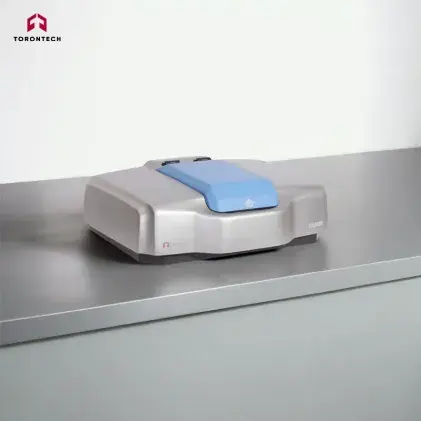
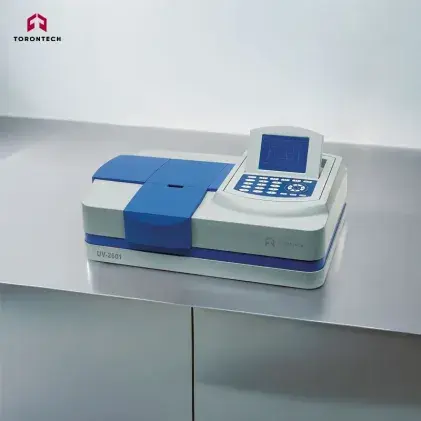
What is a UV-Vis Spectrophotometer & How It Works
We believe many labs are equipped with instruments that are far more complicated and expensive than they need to be.
The UV-Vis spectrophotometer is the antidote to that. It's a foundational piece of equipment that performs its function with exceptional reliability, valued for being an inexpensive, simple, flexible, and non-destructive method of analysis (Rocha et al., 2018; Amekura, 2021).
Our philosophy is that access to precise analytical technology shouldn't strain your budget. So, let's discuss this instrument and how it can clarify the composition of your samples.
What is a UV-Vis Spectrophotometer, Exactly?
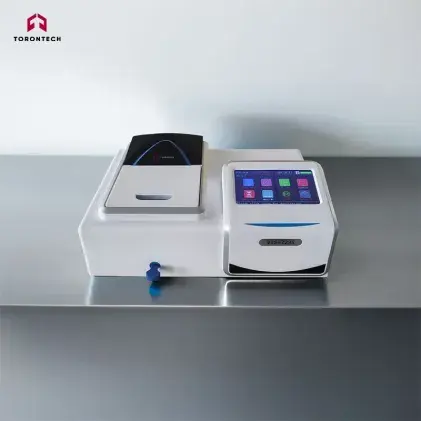
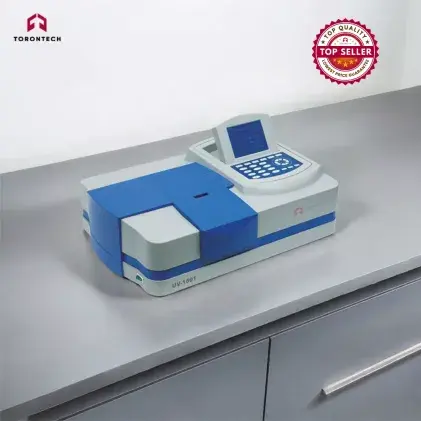
To answer what is a UV-Vis spectrophotometer, it's an intelligent analytical instrument that directs a focused beam of light through a liquid sample to measure light absorption. The technique provides detailed information about a sample’s chemical composition and concentration by measuring the absorbance of ultraviolet and visible light as it passes through (Rocha et al., 2018; Amekura, 2021).
Think of it as a way to see a sample's "chemical fingerprint."
The entire UV-Vis spectrophotometer principle is governed by the Beer-Lambert law, a concept that is refreshingly straightforward. It states that the amount of light absorbed is directly proportional to the concentration of the substance and the distance the light travels through the sample. The spectrophotometer quantifies this effect with extreme precision, giving you a reliable number you can act on.
A Closer Look: How Does a UV-Vis Spectrophotometer Work?
Understanding how does a UV-Vis spectrophotometer work is best done by following the path of light through the instrument's well-engineered system. The instrument directs a beam of light at specific wavelengths through a sample and detects how much is absorbed, with the resulting spectrum reflecting the electronic transitions of the molecules within (Rocha et al., 2018; Amekura, 2021).
It begins with a Light Source, which has to cover the full UV and visible spectrum. This usually means a combination of two lamps: a deuterium lamp for the ultraviolet region and a tungsten lamp for the visible region.
From there, the light enters a Monochromator. This is the heart of the instrument's precision. It uses a diffraction grating to split the white light into its constituent colors, like a rainbow. It then isolates one very narrow, specific wavelength and sends only that slice of light forward.
This single-wavelength beam then passes through the Sample Compartment, where your sample is held in a small, transparent container called a cuvette.
Finally, any light that isn't absorbed by the sample hits the Detector. This electronic sensor converts the incoming light into an electrical signal. The instrument then calculates the final absorbance value by comparing this signal to the light's original intensity.
A Key Distinction: Single-Beam vs. Double-Beam Designs
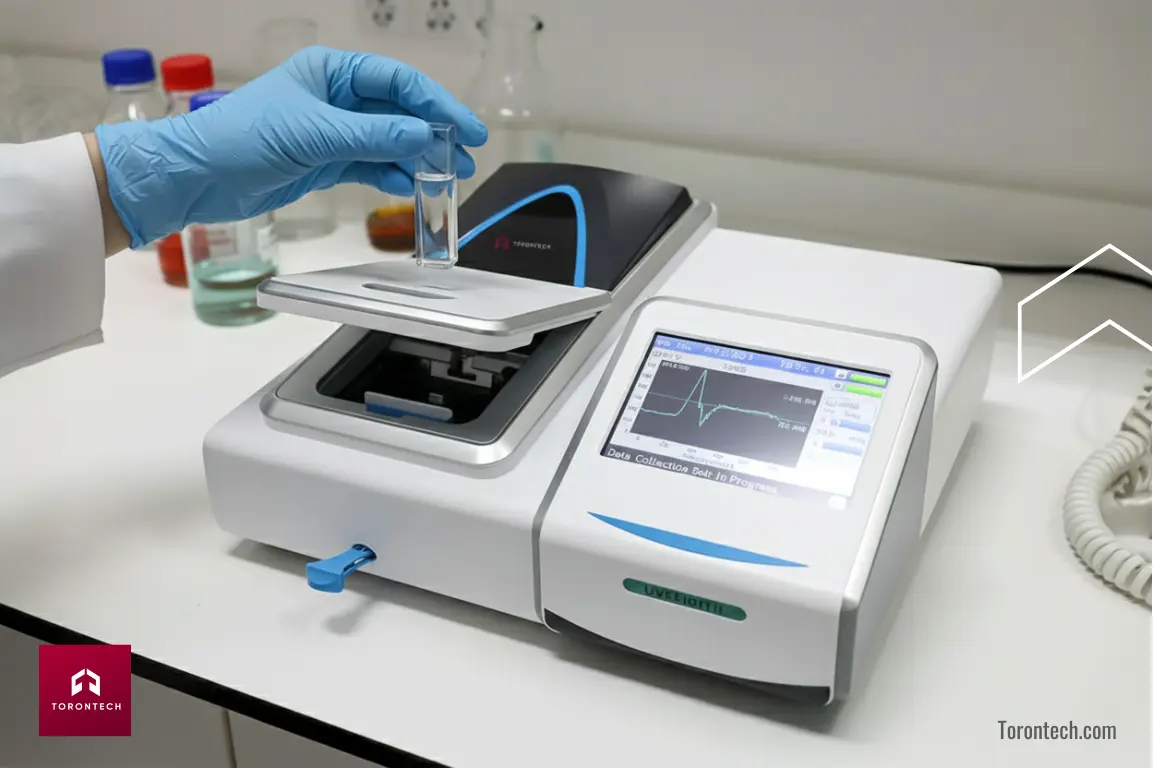
The choice between a single-beam and double-beam spectrophotometer is fundamental, with each design philosophy tailored for different analytical demands.
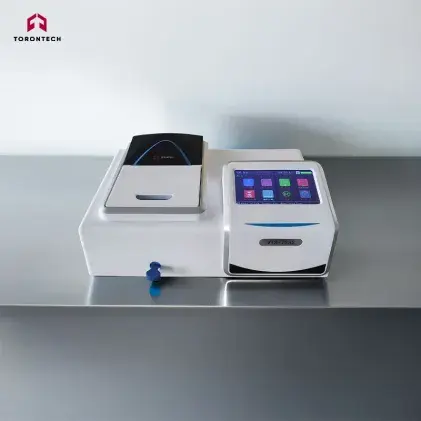
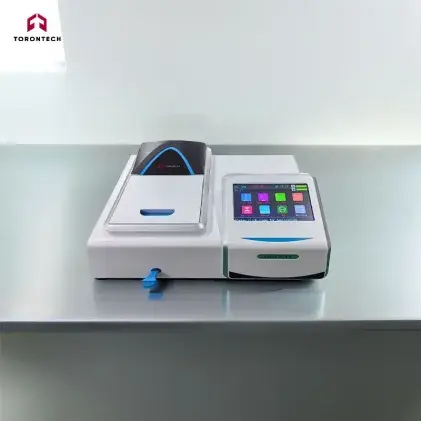
Single-beam architecture, found in our ToronUV-1601 and Toronvis-723S, is the proven workhorse for straightforward, routine quality control. For more complex research where the highest level of stability is paramount, the advanced double-beam design of our ToronUV-2200 and ToronUV-2601 is engineered to deliver.
Understanding which architecture best suits your specific application is a critical first step in selecting the right instrument.
Read more: Spectrophotometer: Single Beam vs Double Beam Explained
Key Applications and UV-Vis Spectrophotometer Uses
The value of this technology is demonstrated daily across a wide range of industries. UV-Vis spectrophotometers are widely used for the quantitative analysis of both organic and inorganic compounds and for monitoring reaction kinetics (Rocha et al., 2018). The following are some of the most common UV-Vis spectrophotometer uses.
- Pharmaceutical Quality Assurance: A key application of a UV-Vis spectrophotometer is in pharmaceutical analysis (Shi et al., 2022). For example, the high stability of a double-beam system like the ToronUV-2601 is essential when performing dissolution testing to determine the rate at which a tablet releases its active ingredient.
- Biotechnology and Life Sciences: In a research setting, it's the standard method for determining the concentration and purity of DNA or protein in a sample before proceeding with more complex procedures.
- Environmental Analysis: These instruments are critical for environmental testing and water quality monitoring, used to measure dissolved organic carbon, nitrate, and turbidity (Shi et al., 2022; Lepot et al., 2016).
- Clinical Diagnostics: In a clinical lab, these machines are used for countless routine tests, like analyzing a blood serum sample to measure bilirubin levels to help doctors assess liver function.
- Food and Beverage Quality Control: Here, it serves as a guardian of product consistency. A winery using a straightforward instrument like the Toronvis-723S to measure color and ensure consistency is a classic application.
- Materials Science and Manufacturing: It's used to check the properties of finished goods, such as verifying the UV-blocking properties of a new coating for eyeglasses.
- Petrochemical Analysis: In this industry, it performs vital quality checks, such as quickly detecting the concentration of aromatic compounds in gasoline.
How to Select the Right Spectrophotometer
Choosing the correct instrument involves matching its technical capabilities to the specific demands of your work. The decision goes far beyond just choosing a single-beam or double-beam setup.
Getting it right means considering performance variables like wavelength range, spectral bandwidth, and photometric accuracy. We find that a brief consultation can often clarify the best path forward.
Our ToronUV Spectrophotometer line, from the workhorse ToronUV-1601 to the high-performance double-beam ToronUV-2601, offers a range of options developed with wide wavelength capabilities and selectable bandwidths.
Read more: A Guide to Choosing a UV-VIs Spectrophotometer
Torontech: Your Partner for Cost-Effective Analytical Instruments
At Torontech, our goal is to provide our customers with effective, reliable technology that also makes good business sense.
Our line of spectrophotometers combines high-performance features with a user-friendly design and a cost-effective price point. While recent developments have focused on portable and online systems for real-time monitoring, our benchtop instruments remain the gold standard for accuracy in the laboratory.
If you are looking for a UV-Vis spectrophotometer that operates dependably and delivers exceptional value, we encourage you to review our product line. Contact our sales team today for a quote, and let us help you find the ideal solution for your laboratory's needs.
References:
- Shi, Z., Chow, C., Fabris, R., Liu, J., & Jin, B. (2022). Applications of Online UV-Vis Spectrophotometer for Drinking Water Quality Monitoring and Process Control: A Review. Sensors (Basel, Switzerland), 22.
- Rocha, F., Gomes, A., Lunardi, C., Kaliaguine, S., & Patience, G. (2018). Experimental methods in chemical engineering: Ultraviolet visible spectroscopy-UV-Vis. The Canadian Journal of Chemical Engineering.
- Lepot, M., Torres, A., Hofer, T., Caradot, N., Gruber, G., Aubin, J., & Bertrand-Krajewski, J. (2016). Calibration of UV/Vis spectrophotometers: A review and comparison of different methods to estimate TSS and total and dissolved COD concentrations in sewers, WWTPs and rivers. Water research, 101, 519-534.
- Wan, F., & Feng, F. (2017). Key Techniques on Development of Portable UV-Vis Spectrophotometer. DEStech Transactions on Social Science, Education and Human Science.
- Zhu, X., Chen, L., Pumpanen, J., Keinänen, M., Laudon, H., Ojala, A., Palviainen, M., Kiirikki, M., Neitola, K., & Berninger, F. (2020). Assessment of a portable UV-Vis spectrophotometer's performance for stream water DOC and Fe content monitoring in remote areas. Talanta, 224, 121919.
- Zhang, S., Ran, D., Wan, F., & Li, C. (2009). Construction of a portable UV-VIS spectrophotometer. **, 7282.
- Amekura, H. (2021). Ultraviolet-Visible Spectrophotometry. Encyclopedic Dictionary of Archaeology.