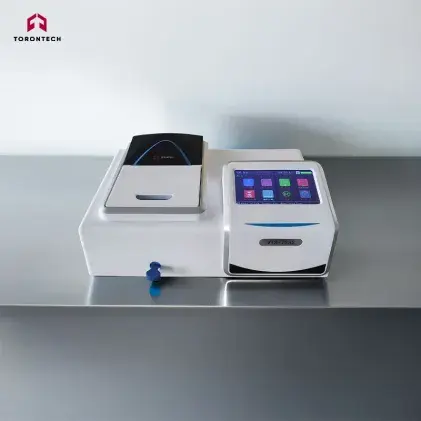
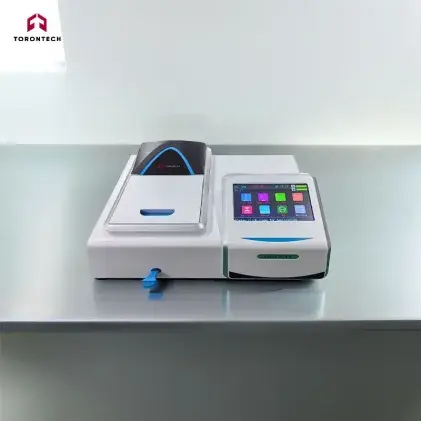
Spectrophotometer: Single Beam vs Double Beam Explained
When it's time to equip your lab with a new UV-Vis spectrophotometer, you’ll face the critical single beam vs. double beam spectrophotometer choice early on.
From our experience, this is more than a technical detail—it’s a decision that directly impacts your workflow, budget, and data quality. A frequent question we encounter is about the real-world difference between single and double beam spectrophotometer models, so let’s make sure you make the right call.
The Difference Between Single and Double Beam Spectrophotometers
At their core, the major distinction between these two platforms is how they manage the light path used to analyze your samples.
A single beam spectrophotometer uses a very direct process. A single line of light is sent through your sample, and a sensor on the other side measures what comes through. It's straightforward, but it requires a preliminary step: you must first run a "blank" solution to give the machine a baseline reference (Purbaningtias et al., 2020).
A double beam spectrophotometer operates on a more sophisticated principle. It takes the initial light source and splits it into two separate paths. One beam goes through your sample, while the second goes through your blank solution at the same time. The instrument is constantly comparing the two, making real-time adjustments for any source fluctuations, which improves stability and reproducibility, especially under varying temperature conditions (Chen et al., 2023; King, 1953).
Related article: What is a UV-Vis Spectrophotometer & How It Works
Practical Advantages: Finding the Right Fit for Your Lab
Neither system is inherently superior; instead, they offer different strengths. The choice depends entirely on your lab’s specific priorities.
Why a Single Beam System Remains a Strong Choice
- Cost-Effectiveness and Accessibility
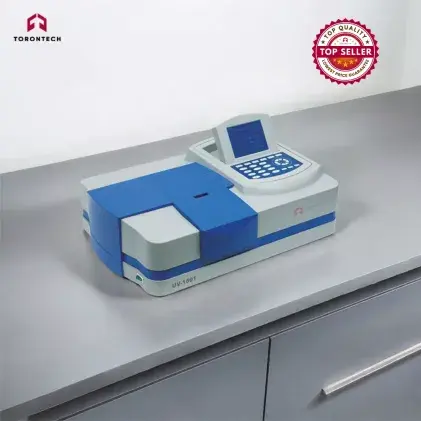
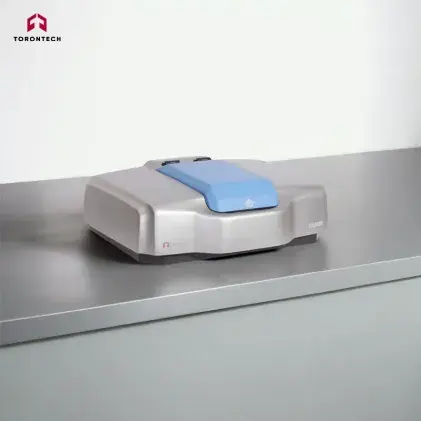
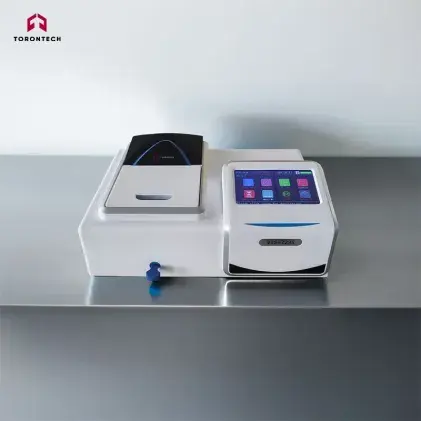
Let's be direct: the most compelling advantage here is the lower initial investment. With fewer optical parts, instruments like our ToronVis-723S or ToronUV-1601 are simpler and more affordable, making them an excellent choice for educational facilities or labs working within a tight budget (Van Williams, 1958).
- Durability and Low Maintenance
Our experience shows these instruments are exceptionally durable. The simpler internal mechanics mean there are fewer components that can fail, often leading to a long service life with minimal need for maintenance.
- Compact Design for Modern Labs
The streamlined design results in a smaller physical footprint. In a busy lab where bench space is a valuable commodity, this is a significant operational advantage.
- High-Energy Light Throughput
A noteworthy technical point is that because the light isn't divided, the beam that reaches the detector is more intense. For certain fixed-wavelength analyses, this can result in a very strong and clean signal.
The Performance Advantages of a Double Beam Spectrophotometer Over a Single Beam
- Exceptional Stability and Data Integrity
This is a core advantage of double beam models like the ToronUV-2200. By continuously referencing itself, a double beam instrument virtually eliminates drift, which is essential for producing data with improved reproducibility and accuracy (Chen et al., 2023; Purbaningtias et al., 2020).
- Efficiency in Spectral Scanning
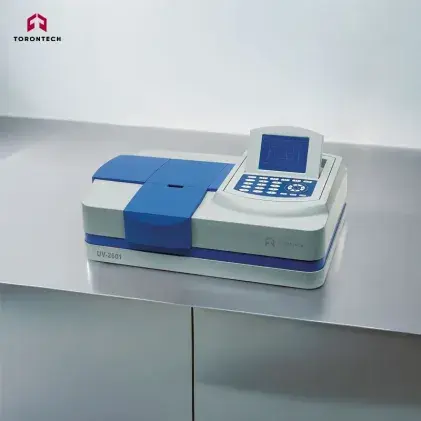
When you need to analyze a sample across a full spectrum, the double beam design is a significant time-saver. Instruments like the ToronUV-2601 produce a smooth, accurate baseline in real-time, removing the need to run a separate blank scan beforehand.
- Improved Workflow for Complex Analyses
For time-sensitive kinetic studies or measurements of samples with very low absorbance, the system's stability means less need for operator oversight. This leads to more reliable data and allows your team to focus on other critical tasks (Chen et al., 2023; Kao & Davies, 1968).
Matching the Instrument to Your Application

The debate of single beam vs double beam spectrophotometer often comes down to the specific tasks you perform daily. Here is a straightforward guide to which applications are best suited for each platform:
We typically recommend a Single Beam Spectrophotometer for:
- Quantitative analysis and routine concentration checks. For example, using a ToronUV-1801S to quickly determine the concentration of a DNA or protein sample at a fixed wavelength.
- Standardized quality control procedures. A perfect example is a beverage company using a ToronVis-723S to verify that each batch of its product has the correct color consistency.
- Water quality testing. For instance, measuring nitrate or phosphate levels in environmental water samples using established colorimetric methods that rely on a single absorbance reading (Purbaningtias et al., 2020).
- Simple clinical assays. A common use is in a medical lab for determining the concentration of substances like glucose or cholesterol in patient samples via a color-changing reaction (Anderson, 1962).
- Educational settings. This includes demonstrating fundamental principles like Beer's Law to undergraduate chemistry students with an affordable model like the ToronUV-1601.
A Double Beam Spectrophotometer is the superior choice for:
- Kinetic studies that track changes in absorbance over time. For instance, monitoring an enzyme's reaction rate with the stability of a ToronUV-2200.
- Full-spectrum analysis to identify unknown compounds. This would be like a researcher using the scanning power of a ToronUV-2601 to identify an unknown organic contaminant by its unique absorbance peak.
- Pharmaceutical purity and dissolution testing. For example, scanning a newly synthesized drug to confirm its purity against a reference standard or monitoring how quickly a pill dissolves.
- High-precision transmission measurements. Double beam systems are ideal for accurately measuring the transmission properties of optical materials (Akinay et al., 2012).
- High-stakes research and development. An example is when a biotech lab needs the precision of a double beam instrument to compare subtle spectral differences between two very similar protein formulations.
Considering the Operational Trade-Offs
To make a fully informed decision, it’s important to understand the practical limitations of each platform.
- Limitations of Single-Beam: The main consideration is the potential for drift over extended periods. Because they require manual calibration and can be more susceptible to errors from light source fluctuations, they are less suited for high-accuracy applications (Van Williams, 1958).
Limitations of Double-Beam: The primary trade-off is that they are generally more complex and expensive due to their advanced design (Chen et al., 2023; Purbaningtias et al., 2020; King, 1953).
Related article: A Guide to Choosing a UV-Vis Spectrophotometer
Making a Strategic Investment for Your Lab with Torontech
Ultimately, the choice in the single beam vs double beam spectrophotometer debate is a strategic decision that depends on the required accuracy, application complexity, and budget considerations (Purbaningtias et al., 2020; Van Williams, 1958).
If your daily work consists of routine measurements where budget is a key driver, the value and reliability of a single-beam instrument like our ToronUV-1801S are hard to beat. However, for research applications that demand the highest degree of accuracy, the advantages of a double beam spectrophotometer over a single beam spectrophotometer are a necessary investment.
At Torontech, our entire philosophy is built on providing cost-effective, high-performance solutions. We ensure you don't have to compromise between capability and price.
Ready to equip your lab with the right analytical solution? We invite you to explore our full range of UV-Vis Spectrophotometers or contact our team of experts today for a personalized quote. We're here to help you find the perfect instrument to meet your objectives.
References:
- Chen, X., Yuan, K., Wang, J., & Wu, Y. (2023). Spectrophotometer Design Using Single-Grating, Single-Sensor, Double-Beam Spectroscope. IEEE Transactions on Instrumentation and Measurement, 72, 1-12.
- Purbaningtias, T., Larasati, M., Kurniawati, P., & Wiyantoko, B. (2020). The performance study of a single and double beam UV-Vis spectrophotometer on nitrite determination in groundwater. **, 2229, 030007.
- Akinay, A., Ong, M., Choi, M., & Karakelle, M. (2012). Measuring ultraviolet-visible light transmission of intraocular lenses: double-beam mode versus integrating-sphere mode. Journal of Biomedical Optics, 17.
- Kao, K., & Davies, T. (1968). Spectrophotometric studies of ultra low loss optical glasses. I. Single beam method. Journal of scientific instruments, 1 11, 1063-72.
- Van Williams, Z. (1958). An Infrared Spectrophotometer for the Organic Chemist. Applied Spectroscopy, 12, 1 - 5.
- King, W. (1953). A Ratio Recording Double-Beam Ultraviolet Spectrophotometer. Journal of the Optical Society of America, 43, 866-869.
- Anderson, N. (1962). Analytical techniques for cell fractions. II. A spectrophotometric column monitoring system. Analytical biochemistry, 4, 269-83.