

UV/VIS Spectrophotometer ToronUV™-1801P/1801S
Parent Product
UV/VIS Spectrophotometer ToronUV™-1801P/1801S offers a single-beam scan with a broad wavelength range and customizable spectral bandwidth options. It features manual and automatic cell holders, advanced measurement methods, and PC-controlled operation via USB for precision and flexibility. Optimized optics and high-quality components ensure reliable performance across various applications.
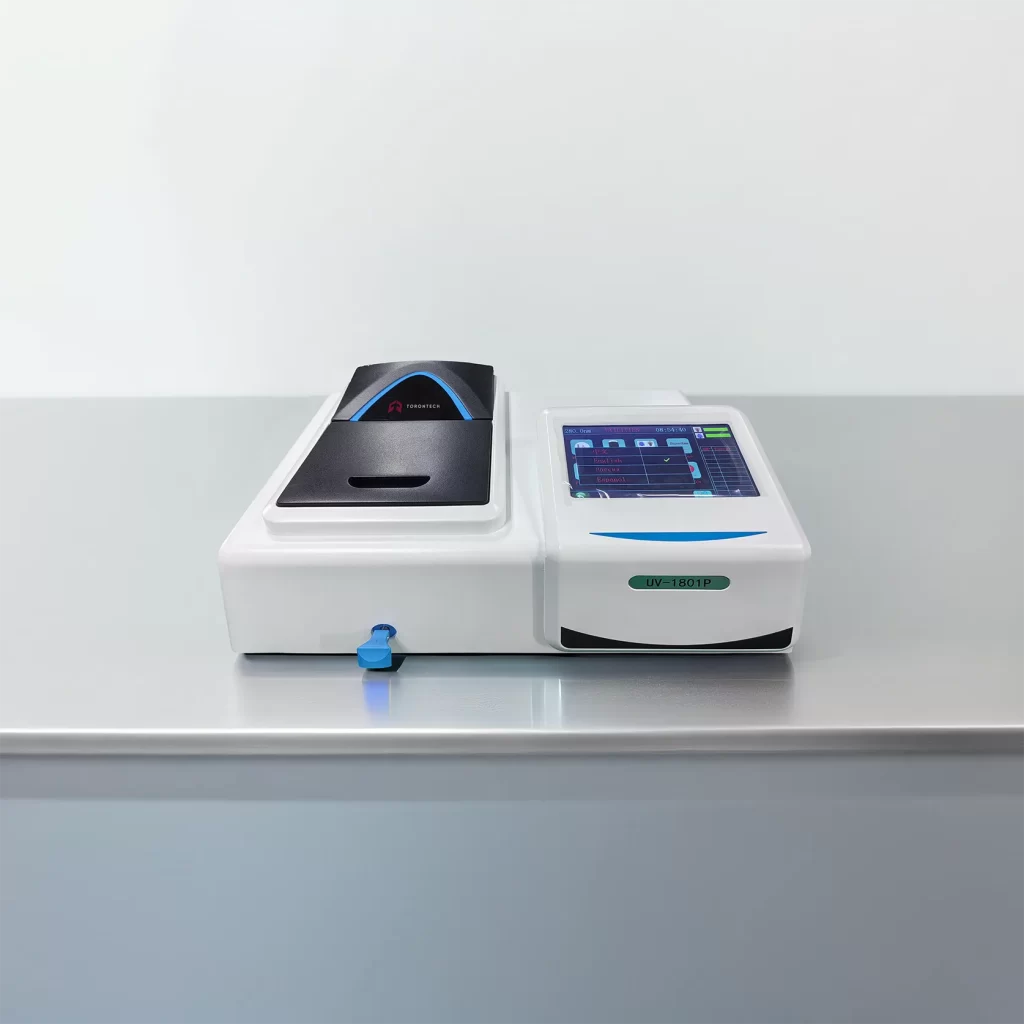
Standard
- Biochemical & Life Sciences - Protein and nucleic acid quantification, enzymatic studies, and kinetic assays.
- Pharmaceutical Industry - Routine quality control, raw material analysis, and compliance with pharmacopoeia standards.
- Academic & Research Institutions - A versatile platform for teaching, training, and scientific investigations.
- Environmental Monitoring - Testing of water quality, detection of pollutants, and chemical analysis.
- Food & Agriculture - Quality testing, additive detection, and nutritional content analysis.
- Clinical & Public Health - Diagnostic method development, absorbance assays, and research applications
- Single-beam scan type with a broad wavelength range, meeting diverse industry needs.
- Five selectable spectral bandwidth options: 5nm, 4nm, 2nm, 1nm, and 0.5nm - customizable to user requirements and compliant with pharmacopoeia standards.
- Standard manual 4-cell holder accommodates 5 - 50mm cells and can be adapted for a 100mm long-path cell holder.
- Automatic 4-cell holder supports 5 – 50mm cells and can be upgraded to an 8-cell holder for 10mm cells (UV-1801P model only).
- Optional accessories include a peristaltic pump, automatic sampler, water temperature-controlled sample holder, Peltier temperature control sample holder, single-slot test tube holder, and film sample holder.
- Optimized optical and electronic design, featuring a high-quality light source and detector from a globally recognized manufacturer for superior performance and reliability.
- Comprehensive measurement options: wavelength scan, time scan, multi-wavelength determination, multi-order derivative determination, double-wavelength, and triple-wavelength methods to support various testing needs.
- Data output available via a printer port.
- Power failure protection ensures parameters and data are retained for user convenience.
- PC-controlled operation via USB for enhanced precision and flexibility.
| Specification | Details |
|---|---|
| Wavelength Range | 190-1100nm |
| Spectral Bandwidth | 2nm (5nm, 4nm, 1nm, 0.5nm optional) |
| Wavelength Accuracy | ±0.3nm (for UV-1081P), ±0.5nm (for UV-1081S) |
| Wavelength Reproducibility | ≤0.2nm |
| Monochromator | Single beam, plane grating of 1200L/mm |
| Photometric Accuracy | ±0.3%T (0-100%T) |
| Photometric Reproducibility | ≤0.2%T |
| Working Mode | T, A (-0.301-3A), C, E |
| Stray Light | ≤0.1%T (NaI, 220nm; NaNO2, 340nm) |
| Baseline Flatness | ±0.003A |
| Stability | ≤0.002A/h (at 500nm, after warming up) |
| Noise | ≤0.2%T/3min (0% line) |
| Detector | Silicon photo-diode |
| Display | 7 inches colorful touch screen |
| Power | AC: 90-250V, 50V/60Hz |
| Dimensions | 470mm×325mm×220mm |
| Weight | 9kg |


