Cryostats vs. Mechanical Cooling for Impact Testing
Ready to eliminate the high costs and safety hazards of liquid nitrogen from your testing workflow? Migrating to an automated, compressor-driven cooling chamber dramatically improves laboratory throughput while preventing temperature drift.
These systems maintain exceptional temperature stability, meeting strict ASTM and ISO standards without recurring gas expenses. Compare our mechanical cooling options below to find the right configuration for your facility.
Key Takeaways
- Financial and Safety Savings: Transitioning from liquid nitrogen to mechanical chilling chambers removes high recurring gas expenses, tank rental fees, and workplace frostbite or oxygen displacement hazards.
- Guaranteed Standard Compliance: Automated low-temperature chambers effortlessly maintain the precise ±0.5 °C temperature uniformity and the strict five-second transfer window mandated by ASTM E23 and ISO 148-1.
- North American Certification: These chilling solutions assist labs in satisfying the stringent quality audits enforced by the US Department of Transportation and Transport Canada, alongside regional pipeline and structural steel codes.
- Tailored Chilling Muscle: Choosing specific target temperature configurations, ranging from standard sub-zero to extreme cryogenic cooling, guarantees that facilities only invest in the exact capabilities they require.
Temperature Control in Charpy and Izod Testing
In impact testing, temperature is just as important as the physical force of the pendulum itself. Materials that bend easily at room temperature can break like glass when they get too cold. To replicate the harsh conditions of freezing pipelines or aircraft flying miles above the earth, you have to chill your test blocks completely and evenly.
In the past, facilities did this by dropping specimens into manual immersion baths of dry ice or liquid nitrogen, which is still a default practical choice for testing around −196 °C. We believe that while those manual baths did the job back in the day, they simply cannot keep up with today's need for strict accuracy and large volumes of test samples. The main engineering problem is limiting temperature drift during transfer, because specimen temperatures can change quickly once removed from the conditioning medium.
Today, we achieve that rock-solid thermal control by using specialized freezing chambers. These machines make sure every single V-notch or U-notch sample reaches the exact coldness you need, holding it steady right up until the pendulum strikes.
Related article: Choosing the Right Low-Temp Chamber for Impact Test
Industrial Applications and Temperature Requirements
Even though the basic way you strike these test bars does not change, different industries have completely different temperature targets. In our view, these requirements are highly dependent on local infrastructure standards:
Gas & Oil Pipelines
Checking steel pipes built for frozen tundras usually means dropping down to anywhere from −20 °C to −80 °C. For major pipeline networks running across the US and Canada, this testing must align strictly with API 5L and CSA Z662 specifications.
This frequently involves Drop-Weight Tear Testing (DWTT) alongside Charpy tests. For these massive steel sections, specialized units like the DWTT-LTC80 are entirely necessary, as they can accurately chill 22 large 305 × 76.2mm plates simultaneously down to −80 °C.
Related article: Comparing DWTT vs Charpy Cooling Chambers for Labs
Aerospace and Automotive Components
Checking metals and tough plastics that have to survive high-altitude flights or freezing winters, often needing a deep freeze down to −80 °C or −100 °C. Standard ASTM-style open-air transfer is routine down to 77 K, but becomes highly impractical below that point.
Structural Metallurgy and Construction
Basic testing for structural steel to make sure building components will not suffer sudden, catastrophic cracks in the winter cold, usually testing around −30 °C or −40 °C. Here, we frequently see labs testing structural steels conforming to ASTM A709 (US) or CSA G40.21 (Canada) for bridges and high-rises engineered to withstand brutal winters in Northern Ontario, Quebec, or the US Rust Belt.
We think that picking your target temperature range first is the best way to avoid buying a machine that is far more complex than what you actually need.
ASTM E23 and ISO 148-1 Temperature Compliance
Whether you are hitting −20 °C for pipeline steel or dropping all the way down to a freezing −100 °C for rocket parts, keeping those temperatures steady is absolutely required by the industry rulebooks.
In our business, standards are everything. International guidelines like ASTM E23 and ISO 148-1 lay down strict instructions for freezing your test samples. In fact, newer ISO 148-1 setups using direct liquid-helium injection have successfully stabilized specimen cores near 4 K in just 45 seconds. For standard testing, the rules require:
- Zero Temperature Drift: Samples must sit at the exact target temperature within tiny margins, often just ±1 °C or even ±0.5 °C, for a specific soak time.
- The 5-Second Dash: ASTM E23 explicitly requires you to grab the sample out of the cold, place it on the test stand, and strike it with the pendulum in under five seconds. If you miss this window, the whole test is ruined.
In our opinion, that 5-second transfer is one of the toughest parts of the job for any technician. We think that making the chamber easy and fast to use is just as important as the strength of the cooling motor itself.
For North American facilities, this is also a major compliance issue. Testing labs regularly face stringent quality audits from domestic oversight bodies, including the US Department of Transportation (DOT) and Transport Canada, which means there is zero room for error when verifying material toughness.
Our compressor-cooled impact testing chambers are built from the ground up to help you meet these rules using two clever design choices:
1. Chilled Liquid Bath
Even though the chilling drive comes from a heavy-duty compressor, the metal samples actually sit in a liquid bath. We highly recommend absolute ethyl alcohol for this. Research shows that basic water conditioning can distort true specimen temperatures through evaporative cooling, whereas proper alcohol or cold nitrogen gas mixtures do not.
We use a specialized magnetic induction stirring motor that keeps the liquid moving constantly, even in high-humidity conditions. This ensures that the cold is spread completely evenly, making it incredibly easy to hit the tight ≤±0.5 °C accuracy standard, all managed seamlessly by a single-chip microcomputer with automatic PID adjustment.
2. Quick-Grab Sample Baskets
Custom sample baskets let technicians scoop the specimens out of the liquid in a flash. Across the CHARPY-LTC series, you can fit 60 standard 10 × 10 × 55mm test pieces divided into three separate baskets, helping your team beat that 5-second countdown every single time without bottlenecking your workflow.
Equipment Comparison: Liquid Nitrogen vs. Mechanical Chilling
With those strict rules hanging over your head, you have to think carefully about how you cool your samples. To help you weigh your options at a glance, we have laid out the core differences between old-school liquid nitrogen tanks and modern compressor-driven chambers below:
| Evaluation Criteria | Traditional LN2 Cryostats | Compressor-Cooled Chambers (CHARPY-LTC) |
|---|---|---|
| Cooling Mechanism | Liquid Nitrogen / Dry Ice | Multi-stage Compressor Refrigeration |
| Operating Costs | High (constant bills for liquid gas) | Low (just plugs into the wall, drawing only 1.8kW to 3.2kW) |
| Safety Risks | High (frostbite, oxygen depletion) | Low (closed system, no gas leaks) |
| Temperature Stability | Hard to control without costly control valves | Highly precise digital PID control |
| Payback Period (ROI) | None (just a continuous expense) | High (typically 12 - 18 months) |
Financial and Safety Limitations of Liquid Nitrogen
Old-style cryostats need a constant, endless supply of liquid nitrogen to get cold. While LN2 can certainly reach ultra-low temperatures, it comes with some massive headaches for daily lab work. The open-transfer step is a major weakness because the transfer window is critically short, often less than 5 seconds before warming ruins the sample.
- Non-Stop Delivery Bills: Buying, hauling, and storing liquid nitrogen is a constant drain on your budget.
- Significant Workplace Safety Hazards: Spilling LN2 can cause instant, severe frostbite. Even worse, if you use it in a small, closed room, the escaping gas can quickly push out the oxygen. We think these safety dangers are too often overlooked when labs plan their workspaces.
- The Real Cost-Saving Math: For labs running tests every day, the price of a mechanical cooling chamber is usually completely covered by the savings in just 12 to 18 months. From our perspective, when you stop paying for weekly nitrogen truck deliveries, tank rental fees, and special safety training, making the switch is an incredibly easy decision.
Operational Benefits of Compressor-Driven Chambers
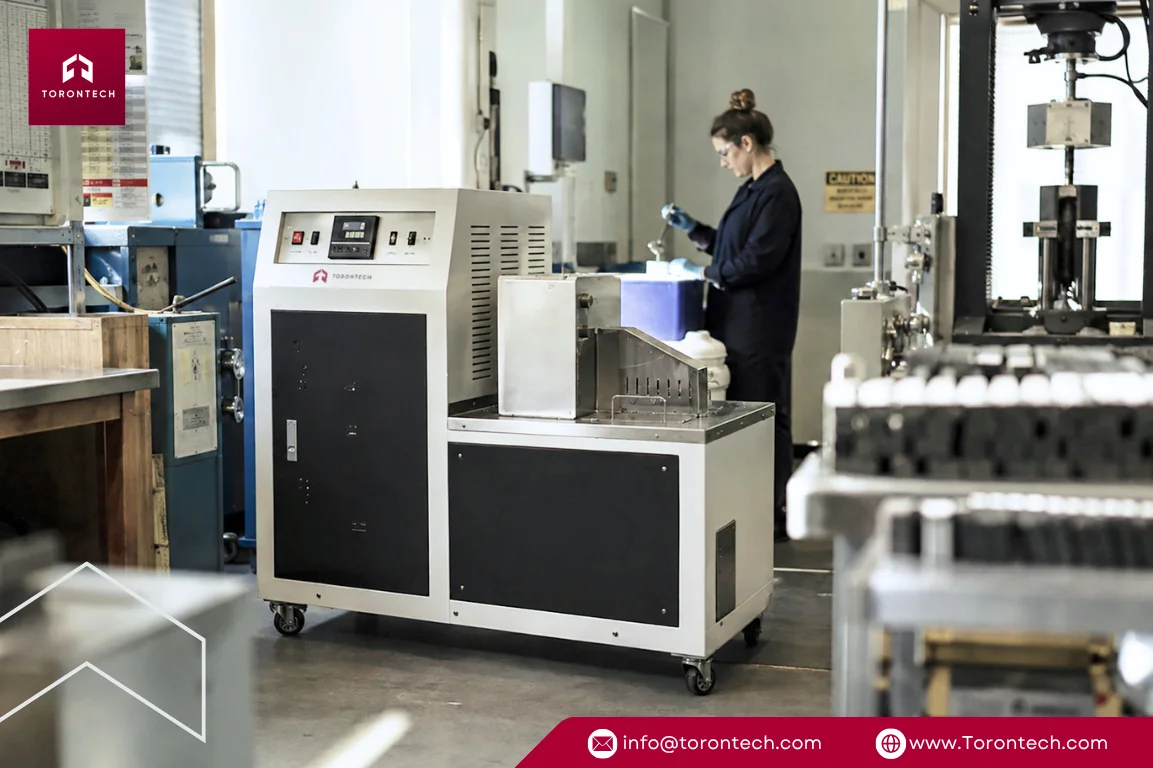
To ditch the safety risks and endless bills of liquid nitrogen, modern labs are shifting to closed-loop, compressor-run setups. These mechanical chambers provide a better enclosure, a dry atmosphere, and highly superior controllability compared to open baths. They run purely on electricity, giving you a plug-and-play machine with some major operational perks:
- Massive Load Capacity: Built for busy labs, these chambers easily hold dozens of standard test samples all at once, which we think is absolutely essential for keeping your testing line moving.
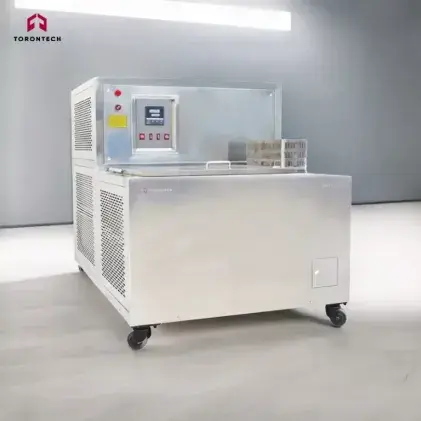
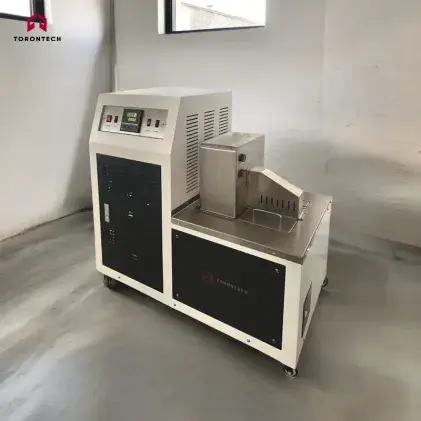
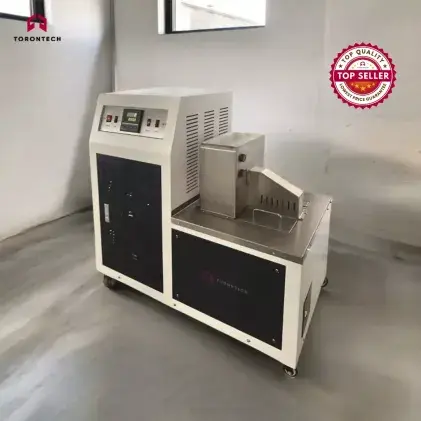
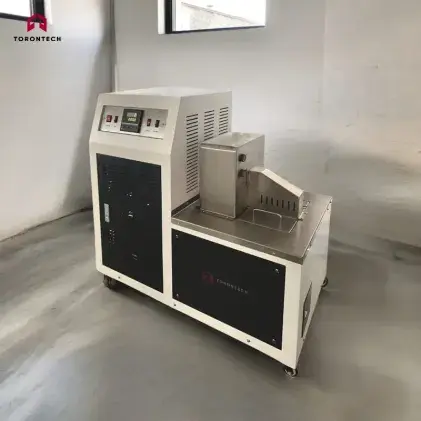
- Space-Saving Setup & Simple Hookups: Lab space is always incredibly tight. These compressor chambers feature a functional split "L" shape structure that sits neatly on universal casters, allowing you to roll them right up to your pendulum tester. They plug straight into standard wall outlets, so you do not have to pay for expensive facility upgrades or custom exhaust fans.
Selection Guide: Torontech CHARPY-LTC Product Line
To help you choose the correct setup for your laboratory operations at a glance, we have outlined how our specialized CHARPY-LTC models align with standard testing limits and regional requirements:
| Model | Temperature Range | Compressor Configuration | Ideal Regional / Industry Application |
|---|---|---|---|
| CHARPY-LTC30 | +30 °C to −30 °C | Single-stage, fully enclosed | Structural steel baseline (US Midwest & Southern Canada) |
| CHARPY-LTC40 | +30 °C to −40 °C | Single-stage, fully enclosed | Bridge and high-rise construction (ASTM A709 / CSA G40.21) |
| CHARPY-LTC60 | +30 °C to −60 °C | Dual-stage cascade setup | Mid-range pipelines and automotive components |
| CHARPY-LTC80 | +30 °C to −80 °C | Dual-stage cascade setup | Extreme northern infrastructure (Alaska, API 5L / CSA Z662) |
| CHARPY-LTC100 | +30 °C to −100 °C | Triple-stage fully enclosed | Ultra-low cryogenic applications and advanced aerospace testing |
Standard Low-Temperature Testing (−30 °C to −40 °C)
Great for basic metal shops, car parts, and building steel. We see this temperature range as the standard baseline for infrastructure projects in regions like the US Midwest and Southern Canada (such as Chicago, Toronto, or Montreal), where winter temperatures regularly drop below freezing. The CHARPY-LTC30 and CHARPY-LTC40 models use a highly reliable single-stage fully enclosed compressor.
Drawing under 2kW of energy, they keep things chilly and rock-steady without any of the mess of dry ice or nitrogen gas. Operating in a standard 25 °C room, these units pull heat away efficiently, achieving cooling speeds of 1.5 °C/min down to 0 °C, and maintaining a steady 1.0 °C/min as they reach −30 °C.
Medium-Cryogenic Testing (−60 °C to −80 °C)
Usually required for aerospace parts and high-pressure oil pipelines. We find that this temperature range serves as the necessary benchmark for steel destined for Alaska, Northern Ontario, or the Northwest Territories, where extreme northern winter operations demand severe cryogenic validation.
The CHARPY-LTC60 and CHARPY-LTC80 use two sets of fully enclosed compressors paired with high-efficiency finned condensers. This dual-stage cascade system ensures high-volume labs minimize wait times between batches. Starting from a 25 °C room, they deliver a rapid 1.5 °C/min initial drop, sustain 1.0 °C/min past the −20 °C mark, and stabilize at 0.8 °C/min as they approach the deep freeze of −80 °C.
Ultra-Low Temperature Chilling (Down to −100 °C)
For the most extreme testing jobs, the CHARPY-LTC100 is the ultimate electric cooling unit. Driven by three fully enclosed compressors and dual stainless steel plate heat exchangers, it replaces the need for liquid nitrogen in almost every deep-freeze application, giving you total safety and simple digital controls. It offers exceptional chilling momentum, starting with a rapid 2.0 °C/min drop to 0 °C, holding a strong 1.3 °C/min through −80 °C, and finishing at 0.8 °C/min until it hits the final −100 °C target.
Choose Torontech for Reliable Low-Temp Testing
We believe that relying on liquid nitrogen or dry ice simply slows down your throughput, risks staff safety, and drains your budget. Switching to a mechanical chilling unit secures seamless compliance with ASTM E23 and ISO 148-1 while keeping your operational costs low.
Ready to optimize your testing? View the technical specifications and request a custom quote for Torontech’s CHARPY-LTC Series Cooling Chambers today.
References (Click to expand)
- Nanstad, R., Swain, R. L., & Berggren, R. (1990). Influence of Thermal Conditioning Media on Charpy Specimen Test Temperature. ASTM International.
- Vaught, L. O., Tsigkis, V., & Polycarpou, A. (2022). Development of a controlled-atmosphere, rapid-cooling cryogenic chamber for tribological and mechanical testing. The Review of Scientific Instruments, 93(8), 083911.
- On, H., Yoon, J., Kwon, J.-Y., Lee, G.-H., & Oh, S. (2025). Feasibility Analysis and Verification of 4K Cryogenic Charpy Impact Test Method Using Liquid Helium. Korean Journal of Metals and Materials.
- Wang, Y., Zhang, Y., Godfrey, A., Kang, J., Peng, Y., Wang, T., Hansen, N., & Huang, X. (2021). Cryogenic toughness in a low-cost austenitic steel. Communications Materials, 2.
- Lukianenko, K., Zarazovskii, M., Shukayev, S., & Iasnii, V. (2024). Determination of metal crack resistance on half-size Charpy specimens at cryogenic temperatures. Mechanics and Advanced Technologies.
- Jin, S., Horwood, W. A., Morris, J., & Zackay, V. F. (1995). A Simple Method for Charpy Impact Testing below 6K. Springer, 373-378.
- Wolfenden, A., Tobler, R., Reed, R., Hwang, I., Morra, M., Ballinger, R., Nakajima, H., & Shimamoto, S. (1991). Charpy impact tests near absolute zero. Journal of Testing and Evaluation, 19, 34-40.