Charpy Impact Test Specimen Low Temperature Chamber - CHARPY-LTC30
Charpy Impact Test Specimen Low Temperature Chamber - The CHARPY-LTC30 is an advanced compressor refrigeration system designed to meet low-temperature requirements for Charpy pendulum impact testing of metallic materials, following standards such as ASTM E23-2018, ISO 148, and European EN10045
This equipment uses compressor refrigeration technology, heat balance principles, and a circulation stirring method to ensure uniform, automatic cooling and constant temperatures for test specimens.
Equipped with microcomputer technology, the system provides precise control with a digital temperature display, automatic temperature management, timing, and alerts. Featuring rapid cooling, a large chamber capacity, and high temperature accuracy, the CHARPY-LTC30 is ideal for low-temperature impact testing and other low-temperature measurement applications. Safe and straightforward to operate, this chamber offers dependable, consistent performance across a wide range of testing needs.
Applicable Standards
- ASTM E23-2018: Metallic materials — Notched specimens impact test method
- ISO 148-1:2016: Metallic materials — Charpy pendulum impact test — Part 1: Test method
- DIN EN 10045-1:1991: Charpy impact test on metallic materials; Part 1 — Test method
- JB-5376-1991: Technical requirements of low temperature constant temperature tank
Performance Characters
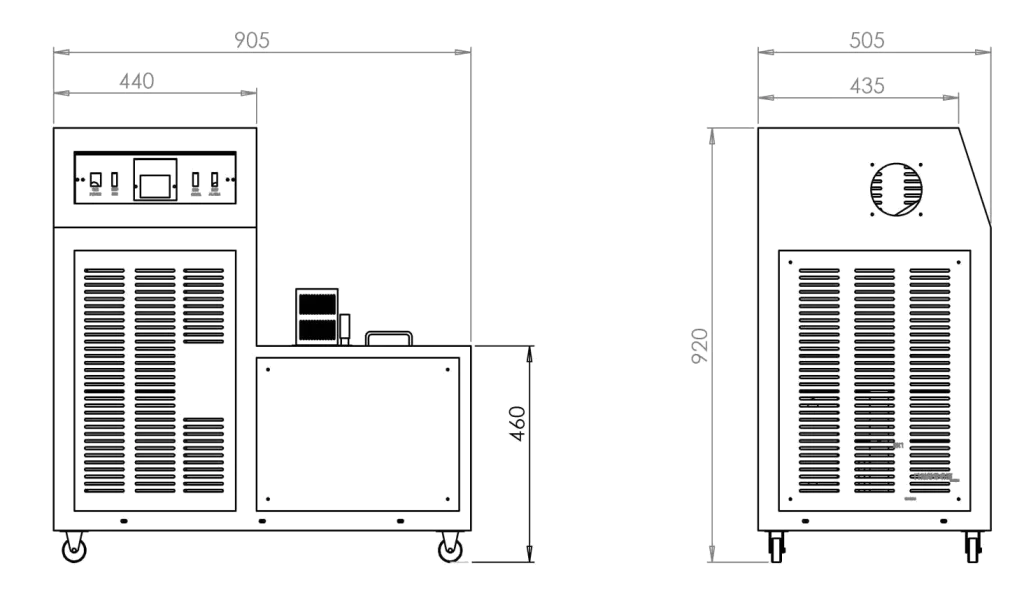
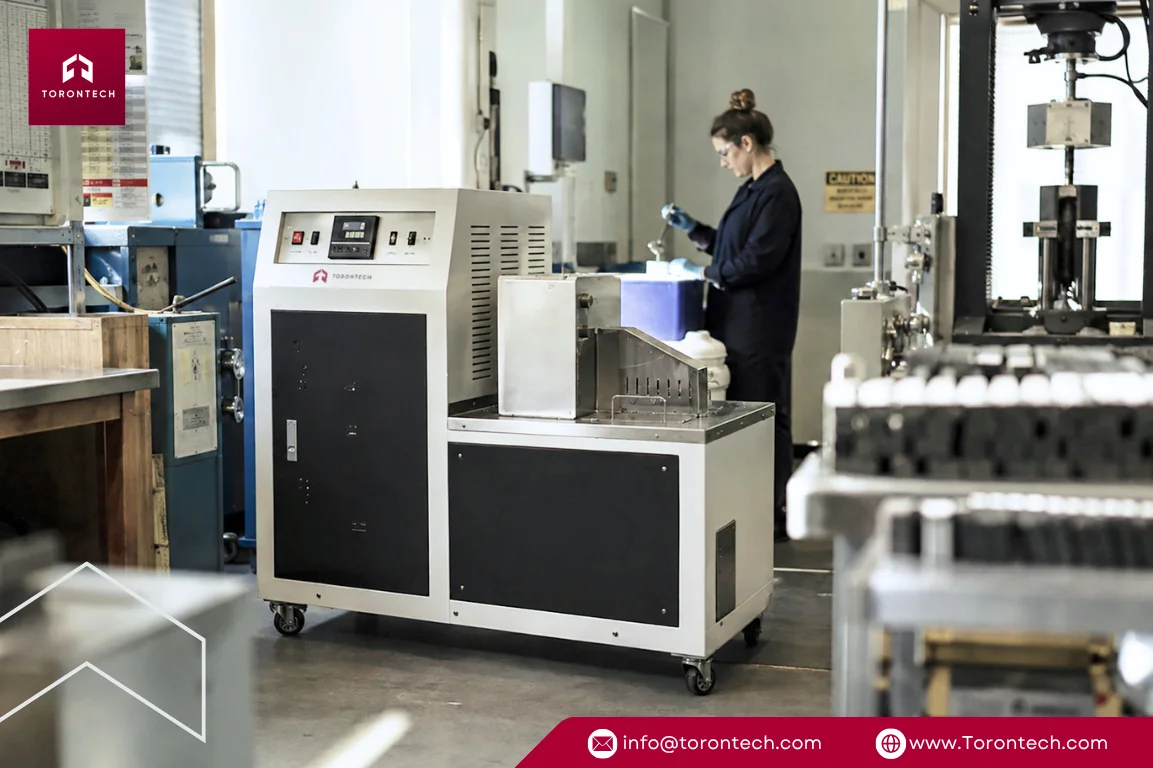
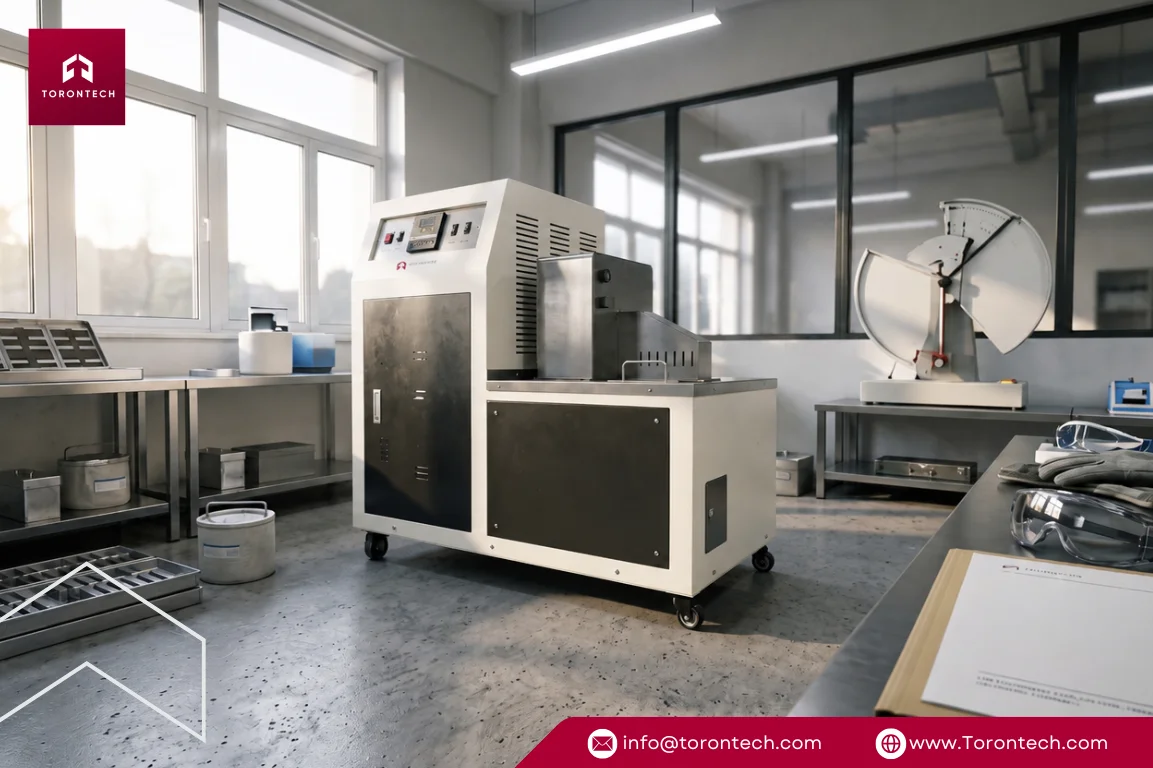
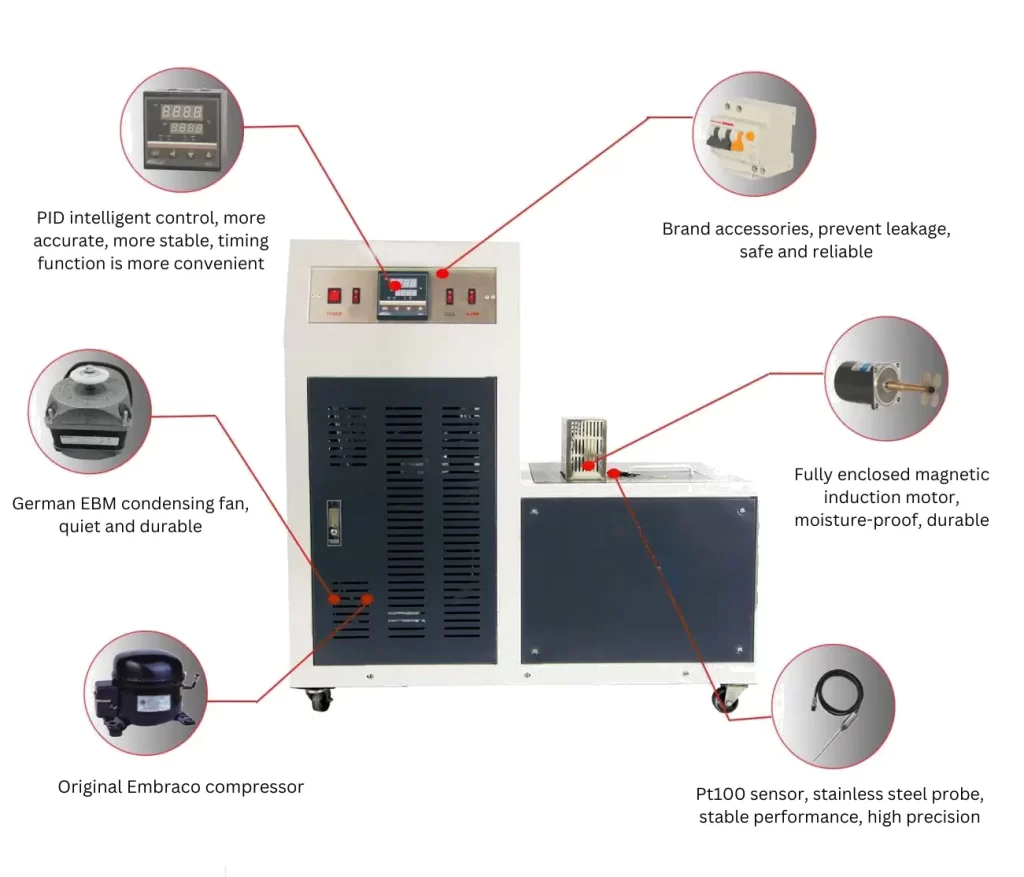
- User-Friendly Design: The machine has a functional "L" shape, with the control section elevated for easy observation and temperature setting, while the lower section houses the freezing tank, allowing for easy placement and clamping of samples. Its height aligns with the impact testing machine, facilitating quick and precise sample positioning.
- High-Quality Refrigeration System Components: Equipped with an fully enclosed compressor and premium core components, the system is built for long-term, stable operation. The Condensing fan ensures low noise, long life, and supports environmentally friendly refrigerants.
- Precise Temperature Control: Utilizing a high-precision temperature control instrument with automatic PID adjustment, the system maintains stable temperatures. The High-performance platinum resistance sensor and stainless steel probe ensure accuracy. Its magnetic induction stirring motor operates reliably in low-temperature, high-humidity environments, while forced agitation in the tank promotes uniform temperature distribution.
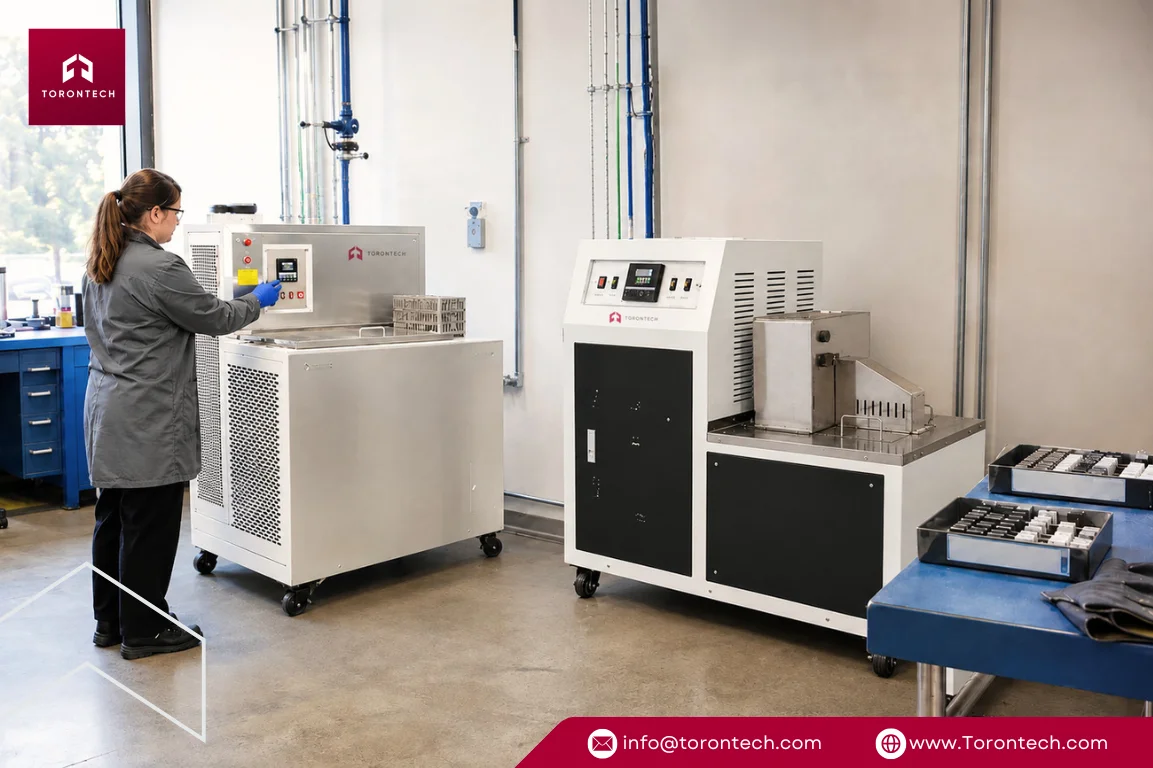
- Large Sample Capacity: Three sample baskets can hold up to 60 standard-sized samples (10 x 10 x 55 mm) simultaneously, with capacity for even more smaller samples, such as 7.5 x 10 x 55 mm, 5 x 10 x 55 mm, and 2.5 x 10 x 55 mm.
- Easy Operation and Mobility: The unit is equipped with universal casters for easy movement. Sample baskets facilitate handling, while a liquid discharge port enables efficient recycling of cooling medium and cleaning. Additional features include temperature alarms and insulation timing to help operators plan tasks efficiently.
- Comprehensive Protection Features: The machine offers multiple protection mechanisms, including overload, leakage, grounding, compressor overload, and medium over-temperature (anti-drying) protection, ensuring safety and durability.
Configuration
- Compressor: Fully enclosed compressor with serial number — one unit.
- Condensing Device: High-efficiency finned condenser paired with an condensing fan, also in original packaging — one unit.
- Dry Filter: Includes one dry filter for reliable moisture control.
- Insulation: Rigid polyurethane foam insulation for effective temperature retention.
- Shell: Constructed from folded cold-rolled steel with an electrostatic spray finish for durability.
- Stirring Device: One complete stirring unit for consistent medium circulation.
- Temperature Control Device: One temperature control unit for precise regulation.
- Sample Basket: Three stainless steel sample baskets, providing ample storage and durability for samples.
| Technical Specification | ||
|---|---|---|
Temperature control range | +30~-30℃ | |
Temperature control accuracy | ≤±0.5℃ | |
Temperature uniformity | ≤1℃ | |
Cooling speed (when room temperature is 25℃) | Room temperature~0℃: 1.5℃/min 0℃~-20℃: 1.2℃/min -20℃~-30℃: 1.0℃/min | |
Heating speed | 3℃/min | |
Size of cooling tank | 275×160×120mm (Length x Width x Height), 5L | |
Effective size of cooling tank | 150×140×110mm (Length x Width x Height) | |
Specimen capacity | 60 pieces (impact specimen size:10×10×55mm) | |
Digital timer | 1minute ~ 9999 minutes, resolution: 1minute | |
Cooling medium | Absolute ethyl alcohol | |
Dimensions | 905×505×920mm (Length x Width x Height) | |
Voltage | AC220V,50HZ (110V is also available) | |
Power | 1.8kW | |
Operating environment temperature | 5℃~30℃ | |
Dimensions