Tablet Hardness: How to Measure, Calculate & Control It
Producing pharmaceutical tablets that possess the structural integrity to survive the supply chain without compromising patient safety is a difficult balancing act. In solid dosage manufacturing, getting the breaking force (commonly known as "hardness") exactly right is the primary safeguard preventing a costly product recall.
For production managers, the objective is clear: you must figure out how to measure hardness of tablet batches with absolute repeatability, and understand how to calculate hardness of tablet data to standardize your results. This guide examines the practical science of physical testing, mixing mathematical formulas with our straightforward perspective on troubleshooting.
Why You Should Prioritize Physical Durability
Before we discuss the equipment, we need to address why this creates such a headache. We frequently remind our clients that hardness isn't just a digital readout on a display; it is the deciding factor between a compliant batch and a wasted one. Prioritizing this physical durability is crucial because it ensures mechanical integrity during manufacturing, transport, and handling, preventing breakage and maintaining consistent drug release profiles (Hare et al., 2018; Abdelbary et al., 2004).
If the dosage form is overly dense, the active ingredient might fail to release effectively within the body—a trade-off we consider the most frustrating to manage. On the other hand, if the tablet is too soft, it is going to chip, abrade, and degrade during coating or packaging. Ultimately, balancing hardness and disintegration is essential for achieving tablets that are both durable and effective in drug release (Roy et al., 2025; Nakamura et al., 2021).
How to Measure Hardness of Tablet (The Reliable Way)
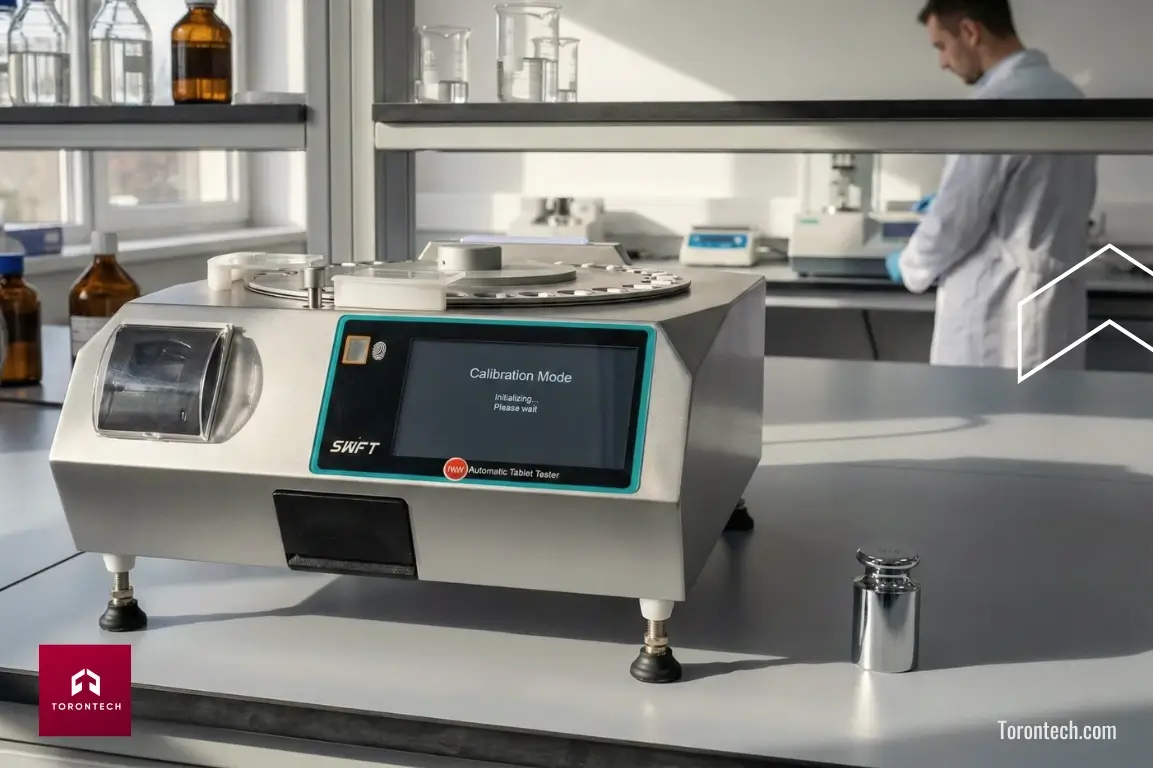
The methodology we use for tablet hardness testing has shifted significantly. While legacy manual devices had their era, we firmly hold the opinion that modern regulatory standards leave no space for operator variability.
Tablet hardness is typically assessed using testers that apply diametric compression, though we are seeing newer in-line methods like optical coherence tomography (OCT) offer real-time, non-destructive monitoring of hardness and porosity (Fink et al., 2024). However, for standard batch release, strict adherence to procedure on a benchtop tester is non-negotiable.
Here is how to execute the process correctly:
Step 1: Statistical Sample Selection
Isolate a statistically valid number of units (typically 10–20 tablets) so you aren't basing decisions on an outlier. Relying on a single sample is a shortcut that leads to inaccurate batch records. We also recommend inspecting the sample for visible defects (like capping or lamination) before testing, as a pre-damaged tablet will skew your breaking force data downward.
Step 2: Platen Cleaning and Zeroing
Before placing the sample, ensure the compression surfaces are free of powder residue. Accumulated dust from previous tests acts as a cushion, artificially increasing the force required to break the tablet. Verify the instrument reads zero before every run.
Step 3: Precise Alignment
Position the tablet between the two compression jaws. We cannot emphasize this enough: you must align them in the identical orientation every single time (diametrical or longitudinal). For scored tablets, decide whether you are testing across the score or parallel to it, and stick to that decision. Inconsistency here renders the data useless.
Step 4: Controlled Force Application
The instrument drives the jaw forward until the unit snaps. Ideally, this is done automatically to ensure the speed of compression remains constant.
Note on Speed: Many pharmacopoeias distinguish between Constant Speed (measuring displacement per second) and Constant Loading (measuring force increase per second). We prefer Constant Speed systems because they handle different formulations more predictably.
Step 5: Data Capture and Fracture Analysis
The precise moment of structural failure is logged. Modern systems will immediately digitize this figure. However, look at how it broke. A clean snap indicates a valid test. If the tablet crumbles or laminates (splits horizontally) rather than breaking, the hardness value might not be a true reflection of its strength, but rather a sign of internal structural flaws.
Our Professional View: Repeatability is the priority. We strongly endorse testing instruments that utilize constant speed measuring principles. In our view, removing the variable of "how quickly the operator rotates the handle" is the most effective step you can take to secure your data reliability.
How to Calculate Hardness of Tablet (and Tensile Strength)
On the manufacturing floor, "calculating" usually implies verifying the readout on your automated system. However, we always advise R&D teams to look beyond the basic numbers. Knowing how to calculate hardness of tablet forces into Tensile Fracture Strength (TFS) is critical if you are comparing tablets of different sizes.
Calculating hardness often involves tensile strength measurements and indices that relate mechanical properties like bonding area and bonding strength to tabletability, with compaction pressure and material plasticity playing significant roles (Shi & Sun, 2024; Hiestand & Smith, 1984).
If you rely solely on raw hardness figures to compare a large, thick tablet against a smaller variant, you will get misleading data. To truly comprehend the mechanical properties, you need to run the equations:
Where:
- σx = The true mechanical strength (Tensile Strength in MPa)
- F = The amount of pressure required to crush it (Newtons)
- d = The width of the tablet (mm)
- h = The thickness of the tablet (mm)
Hypothetical Calculation
Let’s apply this to a theoretical scenario to demonstrate how to calculate hardness of tablet strength in action. Imagine you are analyzing a standard round tablet with a diameter (d) of 10mm and a thickness (h) of 4mm. The digital tester reports a breaking force (F) of 80 Newtons.
σx = (2 × 80) / (3.14159 × 10 × 4) = 1.27 MPa
By converting the raw force into Megapascals, you can now directly compare the intrinsic strength of this formulation against a different tablet size, something raw hardness data alone cannot provide.
The "Standardization" Unit Conversion Table
We frequently see laboratory personnel struggling with historical data sheets that utilize obsolete units of measurement. To save you the trouble of constant cross-referencing, here is the standard conversion chart we utilize:
| Unit | What it actually equals |
|---|---|
| 1 Kilopond (Kp) | 9.807 Newtons (N) |
| 1 Strong-Cobb (SC) | ≈ 0.7 Kiloponds (Kp) |
| 1 Newton (N) | 0.102 Kiloponds (Kp) |
| 1 Pound (lb) | 0.454 Kiloponds (Kp) |
Before You Adjust: Environmental Factors
This is the oversight that causes the most unnecessary work. Before you rush to modify the settings on the tablet press, examine the ambient conditions. We have witnessed perfectly valid formulations fail simply because the laboratory environment shifted.
Relative Humidity (The Plasticizer Effect)
Moisture functions as a plasticizer. We often observe tablets softening in high humidity because water molecules interfere with the inter-particulate binding sites.
Illustrative Scenario: Consider a situation where a technician calibrates a rotary press during a rainstorm when humidity is peaking. If production resumes on a dry Tuesday, the tablets might suddenly become brittle and cap immediately upon ejection. The machine settings didn't change; the air did.
Temperature Fluctuations
If the room is too warm, the friction heat generated by the machinery can soften low-melting-point binders. This is particularly problematic for formulations containing waxes or PEG, which can become pliable during the run and then harden unpredictably once they cool down.
Post-Compression Curing
We strongly suggest measuring hardness immediately after ejection and after a designated relaxation period. Many formulations "cure" and become significantly more durable after sitting for 24 hours. If you base your batch release solely on the hardness measured at the press exit, you might be shipping tablets that become too hard by the time they reach the consumer.
Troubleshooting: Controlling the Durability
Reaching that ideal state—where the tablet is solid but not impenetrable—requires adjusting both the compression machinery and the powder blend. Hardness can be increased by optimizing formulation variables (e.g., binder type, particle size) and process parameters (e.g., granulation method, compression force) (Máthé et al., 2025).
Here is how we approach the challenge of how to increase hardness of tablet batches, or conversely, how to soften them.
How to Increase Hardness of Tablet
When a batch is too fragile and you need to figure out how to increase hardness of tablet structure to pass the friability drum test, consider these corrections:
- Increase Compression Pressure: The most direct solution. Intensify the main compression force. However, exercise caution—if you apply excessive pressure, the tablet cap might separate (capping), creating a new problem.
- Modify the Binding Agents: In the mixture, increase the ratio of the ingredients responsible for adhesion. Hardness is significantly influenced by binder type—polyvinylpyrrolidone (PVP K30) and hydroxypropyl methylcellulose (HPMC) are known to increase hardness, while starch often leads to faster disintegration but lower hardness (Roy et al., 2025).
Formulation Example: For instance, coarse herbal ingredients often refuse to bond using standard starch paste. In such cases, switching to a stronger grade of PVP and increasing the concentration slightly allows the batch to pass friability without needing excessive compression force.
- Improve Granule Quality: If you have an excess of fine powder and insufficient coarse granules, the matrix won't lock together.
Adjust Moisture Content: It seems counterintuitive, but if the blend is excessively dry, it lacks the cohesion to bond. A controlled addition of moisture can often resolve the issue.
Related article: Difference Between Hardness and Friability of Tablet
How to Decrease Hardness of Tablet
If your tablets are overly dense and taking an excessive amount of time to dissolve, you need to determine how to decrease hardness of tablet strength immediately. Decreasing hardness may involve reducing binder concentration or using disintegrants to promote faster tablet breakdown (Abdelbary et al., 2004; Nakamura et al., 2021).
- Reduce the Pressure: Dialing back the punch force is the first logical step.
- Incorporate Disintegrants: Add "super-disintegrants" that expand rapidly upon contact with fluid, forcing the tablet structure apart.
- Check the Lubrication: We see this constantly—the lubricant (Magnesium Stearate) is being mixed for too long. It coats the particles so thoroughly that they cannot bond with one another. Reducing the mixing duration is often a quick remedy.
- Increase Porosity: Alter the particle size distribution to create more microscopic void spaces within the tablet.
Formulation Example: Take chewable Vitamin C tablets as an example. If they are compressed into a rock-hard state, they risk breaking teeth rather than crumbling safely. By slightly increasing the particle size of the primary excipient, you introduce more air pockets (porosity) into the internal structure, lowering the breaking force without changing the chemical composition.
Torontech: Innovation That Fits Your Budget
At Torontech, we have positioned ourselves as the logical alternative in a market defined by inflated pricing. Whether you are salvaging a crumbling batch or validating a new product line, we don't believe you should have to exhaust your capital budget just to get reliable, compliant data.
Our ToronTAB Series automates the entire physical testing process—measuring Hardness, Thickness, Diameter, and Weight in a single sequence—eliminating human error without the exorbitant cost of legacy brands.
High-quality compliance shouldn't require a high-end budget; explore our Tablet Hardness Testers today to see how our cost-conscious technology can streamline your laboratory operations.
References:
- Abdelbary, G., Prinderre, P., Eouani, C., Joachim, J., Reynier, J., & Piccerelle, P. (2004). The preparation of orally disintegrating tablets using a hydrophilic waxy binder. International journal of pharmaceutics, 278(2), 423-33.
- Fink, E., Celikovic, S., Fraga, R., Remmelgas, J., Rehrl, J., & Khinast, J. (2024). In-line porosity and hardness monitoring of tablets by means of optical coherence tomography. International journal of pharmaceutics, 124808.
- Hare, C., Bonakdar, T., Ghadiri, M., & Strong, J. (2018). Impact breakage of pharmaceutical tablets. International journal of pharmaceutics, 536(1), 370-376.
- Hiestand, H., & Smith, D. (1984). Indices of tableting performance. Powder Technology, 38, 145-159.
- Máthé, R., Casian, T., & Tomuțǎ, I. (2025). Multivariate Data Analysis to Assess Process Evolution and Systematic Root Causes Investigation in Tablet Manufacturing at an Industrial Scale—A Case Study Focused on Improving Tablet Hardness. Pharmaceutics, 17.
- Nakamura, S., Fukai, T., & Sakamoto, T. (2021). Orally Disintegrating Tablet Manufacture via Direct Powder Compression Using Cellulose Nanofiber as a Functional Additive. AAPS PharmSciTech, 23.
- Roy, P., Biswas, A., Pratihar, S., & Ghosh, A. (2025). Effect of Different Binders on Tablet Hardness and Disintegration. International Journal of Pharmaceutical Research and Applications. doi.org/10.35629/4494-100216121620
- Shi, L., & Sun, C. (2024). Understanding the roles of compaction pressure and crystal hardness on powder tabletability through bonding area - Bonding strength interplay. International journal of pharmaceutics, 124253. doi.org/10.1016/j.ijpharm.2024.124253