Difference Between Hardness and Friability of Tablet
Transforming a mix of raw powders into a finished dosage form that stays intact is a significant engineering challenge. At Torontech, we believe that producing a tablet that doesn't degrade into unusable powder before it reaches the bottle is practically an art form.
We have analyzed enough production lines to know that testing tablet friability and hardness is far more than a simple compliance checklist. It is the defining factor between a flawless product and a manufacturing headache. But here is the reality: you do not need to drain your capital budget to acquire the precise data you require.
Defining Tablet Hardness
Technically, the industry terms this breaking force or crushing strength. We prefer to call it the structural limit. Tablet hardness measures exactly how much force is necessary to fracture a tablet across its diameter.
We view this as a delicate balancing act. It is a relative property, meaning you require a dosage form strong enough to withstand the mechanical impact of manufacturing, packaging, and shipping.
Read more: Tablet Hardness Tester: The Complete Guide
Yet, we must be careful: if the tablet is too dense, it may fail to dissolve properly inside the patient. Finding that precise operating window where the tablet is durable but still bioavailable? That is the ultimate goal for any formulation scientist (Osei-Yeboah & Sun, 2015; Paul & Sun, 2017).
Factors influencing these properties include excipient type, compression force, and lubricant concentration. Studies indicate that while increasing compression force generally increases hardness, overusing lubricants to reduce ejection force can negatively affect hardness (Kittipongpatana et al., 2024; Monton et al., 2023).
Consider this practical comparison:
Take a large chewable Vitamin C supplement versus a slow-release pain reliever. If that chewable tablet is compressed until it is rock-solid, the manufacturer risks a chipped tooth, which is a liability nightmare.
Conversely, if the slow-release painkiller is too soft, it disintegrates immediately upon reaching the stomach, dumping the entire dose at once rather than over twelve hours. We help you distinguish between these two critical extremes.
Defining Tablet Friability
Then there is friability. This refers to the tendency for your tablets to chip, crumble, or break during handling and transport, typically expressed as a percentage weight loss after tumbling (Osei-Yeboah & Sun, 2015; Seitz & Flessland, 1965). Unlike hardness, which verifies the internal bond strength, friability assesses the surface durability.
We call high friability the "dusting effect." If your tablets exhibit this trait, they will lose mass and look unacceptable—pitted and worn—by the time they reach the coating pan. In our opinion, rejecting a batch due to simple aesthetic defects is one of the most preventable losses in pharmaceutical production.
The Difference Between Hardness and Friability of Tablet
It is a common misconception, but there is a substantial difference between hardness and friability of tablet formulations.
As established in pharmaceutical research, hardness measures the resistance to crushing under force, while friability assesses the tendency to chip or crumble (Osei-Yeboah & Sun, 2015; Seitz & Flessland, 1965). A tablet can be extremely hard—requiring significant force to crush—yet surprisingly brittle. It might withstand the pressure test but fail the tumbling test.
Related article: The Importance of Tablet Hardness Testing in Pharmaceutical Industry
A Common Industry Scenario:
Imagine a batch of coated tablets that registers a massive 20 kp on the crushing scale. You might assume they were indestructible. Yet, if you run the tumbling test, those same tablets might lose over 2% of their mass—double the acceptable limit. The core was hard, but the edges were brittle and dry. Without running both tests, that batch would likely ship out and fail inspection upon arrival.
This clarifies why the two tests must be viewed differently:
- The Stress Type: Hardness resists compressive force (crushing). Friability resists abrasive shock (tumbling and rubbing).
- The Failure Mode: Hardness testing identifies the point of total structural fracture. Friability testing identifies surface erosion and mass loss.
The Comparison Breakdown
Feature | Tablet Hardness | Tablet Friability |
Definition | The force necessary to fracture a tablet across its diameter. | The tendency to chip or crumble under mechanical rotation. |
Primary Focus | Structural Integrity (Internal bonding). | Surface Durability (Abrasion resistance). |
Stress Method | Compressive load (Squeezing). | Abrasive/Shock load (Tumbling). |
Failure Indicator | The tablet snaps or breaks apart. | The tablet erodes or creates dust (Mass loss). |
Regulatory Standard | USP <1217> Tablet Breaking Force. | USP <1216> Tablet Friability. |
Technologies for Testing Tablet Friability and Hardness
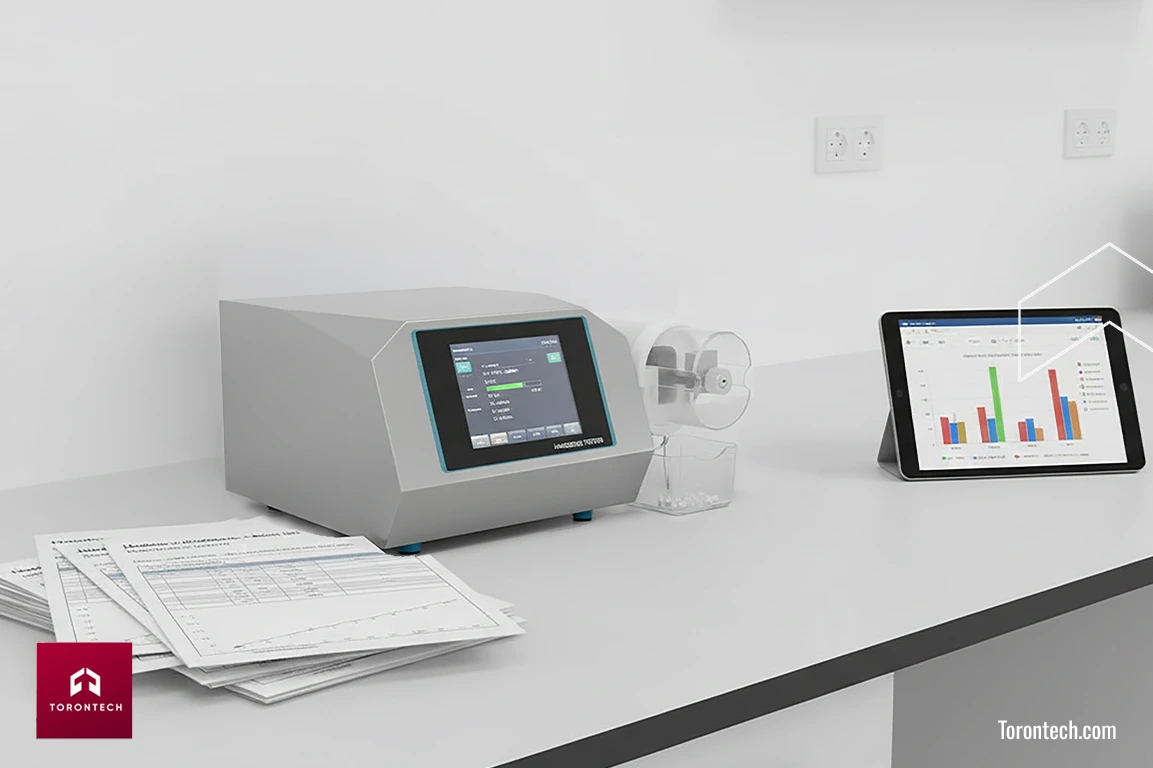
To measure these physical properties accurately, you require dependable equipment. Technologies for testing these properties include the diametrical breaking test for hardness and the pharmacopeial friability test using a rotating drum apparatus (Osei-Yeboah & Sun, 2015).
However, we have a disagreement with the current market trend: there is a prevalent notion that "high cost" equals "superior performance." We argue that, often, you are simply paying for a brand legacy. At Torontech, we choose to operate differently when it comes to testing tablet friability and hardness.
1. Testing Tablet Hardness
Legacy hardness testing often involved manual gauges that introduced user error. Modern protocols require you to measure hardness, thickness, diameter, and weight simultaneously to construct a complete physical profile.
For comprehensive analysis, our TAB-5 Series is engineered to measure up to five parameters in one automated sequence, though we also offer streamlined models for laboratories that simply need thickness and hardness data efficiently.
We also recognize that not every test happens in the central lab. If your QA team needs to move around the facility for spot checks, we offer the Portable Tablet Hardness Tester that eliminates the need to haul samples back and forth.
For specialized needs, such as testing gelatine capsules which require a different approach entirely, we recommend the Auto PharmaCheck.
Related article: Tablet Hardness: How to Measure, Calculate & Control It
2. Testing Tablet Friability
Friability is verified using a rotating drum (the Roche friabilator). Recent advances allow for expedited friability methods that correlate well with standard tests and allow faster formulation development (Paul & Sun, 2017).
In our view, consistency in this test is non-negotiable. Standard testing typically requires a dual-drum setup for efficiency, which is the standard for our Friability Testers. For laboratories that demand seamless data integration to avoid manual transcription errors, we offer variants with direct weighing scale interfaces.
Furthermore, for R&D departments that need to stress-test formulations at different velocities, the ToronFRITUS offers variable speed control. We even address niche formulations; if you are working with granules rather than compressed pills, our ToronFRI-G1 is specifically engineered for that purpose.
The Requirements: USP and EP Standards
In the North American market, adhering to regulations is mandatory. Tablet hardness and friability standards generally require friability to be less than 1% weight loss and hardness values that ensure mechanical integrity without compromising disintegration (Koirala et al., 2021; Alemu et al., 2024).
USP <1217> for Breaking Force
This standard mandates strict controls on the mechanics of the test. It specifies that the platens used to crush the tablet must be perfectly polished and parallel to ensure even distribution of pressure. Furthermore, the loading rate—the velocity at which the jaw closes—must be consistent. Variable speeds produce variable data, which we consider unacceptable for quality control.
USP <1216> for Tablet Friability
This chapter outlines the exact geometry of the drum and the rotational speed required to validate the test. Typically, this is set at 25 rpm for a duration of four minutes. If your equipment fails to maintain this constant rotation, the gravitational drop height changes, invalidating the stress test.
If your equipment is imprecise and misses these engineering benchmarks, your data is unusable during an audit. We engineered instruments like the TAB Series and ToronFRI line to meet these North American and European standards strictly, ensuring you face inspections with confidence.
Troubleshooting Defects: Capping and Lamination
One of the most valuable aspects of analyzing tablet hardness and friability is the ability to diagnose production errors early. We advise our clients to look beyond the simple "pass/fail" result and identify how the tablet fails.
Detecting Capping Issues
Capping is defined as the partial or complete separation of the top or bottom crown of the tablet from the main body (Seitz & Flessland, 1965). In our experience, this almost always indicates air trapped within the powder bed during the main compression event, or a punch that is exiting the die too quickly.
Practical Example: If an operator notices severe capping during a trial run, a quick glance at the fracture lines usually reveals the problem. Often, this indicates the pressure dwell time was too short. By adjusting the pre-compression force slightly, the capping defect typically vanishes.
Recognizing Lamination
Lamination is slightly different and often more problematic.
This is the splitting of the tablet into distinct horizontal layers, often caused by inadequate formulation or compression parameters (Seitz & Flessland, 1965). If your hardness tester detects inconsistent fracture patterns, or your friability tester reveals excessive layering, it is a clear indicator to adjust your binder formulation or pre-compression force.
Reliable equipment identifies these root causes before full-scale production begins, saving significant resources.
Strengthen Your Quality Control with Torontech
Balancing strict regulatory requirements with a managed budget is a difficulty for every manufacturer. We understand the situation. You require results that are accurate, repeatable, and defensible, but you prefer not to pay for an inflated brand logo.
At Torontech, we focus on efficient solutions that respect your capital. We are dedicated to providing the instruments you need—whether it involves diagnosing capping issues using our TAB Series or ensuring your batch meets USP standards with our ToronFRI units—to support your laboratory's output.
References:
Osei-Yeboah, F., & Sun, C. (2015). Validation and applications of an expedited tablet friability method. International journal of pharmaceutics, 484 1-2, 146-55.
Paul, S., & Sun, C. (2017). Dependence of Friability on Tablet Mechanical Properties and a Predictive Approach for Binary Mixtures. Pharmaceutical Research, 34, 2901-2909.
Kittipongpatana, O., Trisopon, K., Wattanaarsakit, P., & Kittipongpatana, N. (2024). Utilization and Evaluation of Rice Bran and Rice Bran Wax as a Tablet Lubricant. Pharmaceutics, 16.
Seitz, J., & Flessland, G. (1965). Evaluation of the physical properties of compressed tablets. I. Tablet hardness and friability. Journal of pharmaceutical sciences, 54 9, 1353-7.
Koirala, S., Nepal, P., Ghimire, G., Basnet, R., Rawat, I., Dahal, A., Pandey, J., & Parajuli-Baral, K. (2021). Formulation and evaluation of mucoadhesive buccal tablets of aceclofenac. Heliyon, 7.
Monton, C., Wunnakup, T., Suksaeree, J., Charoenchai, L., & Chankana, N. (2023). Impact of Compressional Force, Croscarmellose Sodium, and Microcrystalline Cellulose on Black Pepper Extract Tablet Properties Based on Design of Experiments Approach. Scientia Pharmaceutica.
- Alemu, A., Tegegne, A., & Getaw, N. (2024). Evaluation of Seven Different Brands of Metformin Hydrochloride Tablets Available in the Market in Gondar City, Ethiopia. Drug, Healthcare and Patient Safety, 16, 19 - 28.