
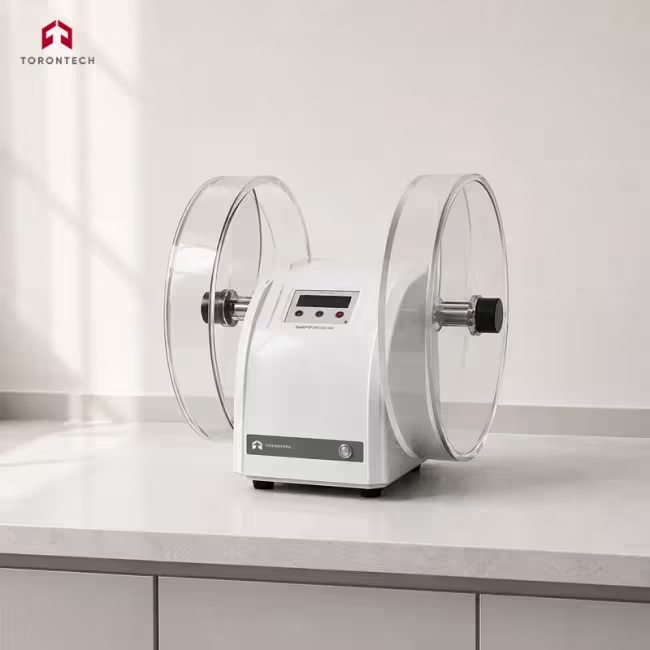
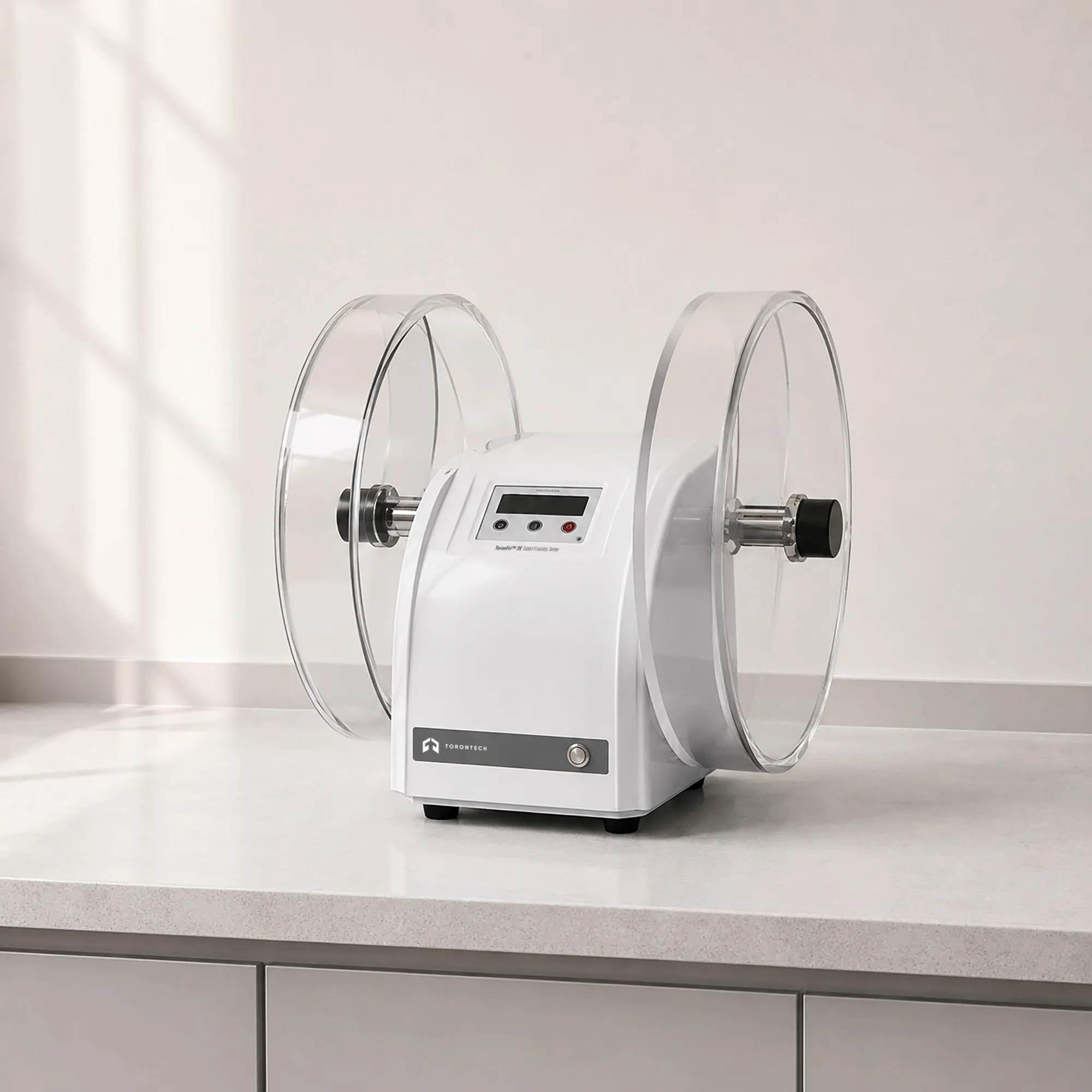
Tablet Friability Tester
Tablet Friability Tester - ToronFRI™ 2E
ToronFRI™ 2E tablet friability tester delivers mechanical strength characterization of tablets and other solid dosage forms for pharmaceutical QC labs, formulation development groups, and academic research programs. The instrument tumbles tablets inside two independent drums under controlled rotation, then reports the mass loss that quantifies tablet resistance to abrasion, chipping, and breakage during handling, packaging, and transport. Torontech built the platform around a touchscreen operator interface, adjustable rotation parameters, and bidirectional drum motion to serve both routine batch release testing and comparative method development.
Two parallel drums let operators test two samples simultaneously or run duplicate replicates for statistical confidence in one session. Rotation speed adjusts across 20 to 50 RPM around the 25 RPM default, and total cycle count programs from 1 to 1,000 with a 100-cycle default matching common pharmacopoeial friability test methods. Drum inner diameter of 286 mm and depth of 39 mm produce the tablet drop height that gives consistent, reproducible mechanical stress across every test.
Torontech supplies the ToronFRI™ 2E with IQ/OQ qualification documentation for GMP validation and CE certification for the EU market. A universal-input DC 12 V power supply lets the instrument operate on any laboratory mains voltage without a hardware change, simplifying deployment in multi-region contract testing operations.
Tablet Friability Tester - ToronFRI™ 2E Applications
The ToronFRI™ 2E supports friability testing across pharmaceutical QC, formulation, and packaging validation workflows.
- Batch Release Testing of Compressed Tablets: routine friability QC of uncoated tablets, film-coated tablets, and sugar-coated tablets under standard 100-cycle test protocols with dual-drum throughput
- Formulation Development: comparative friability profiling of prototype tablet compositions to guide binder selection and compression parameter optimization
- Manufacturing Process Validation: verification of compression force settings, granulation quality, and tablet press tooling against friability acceptance criteria
- Coating Integrity Verification: mechanical stress testing of film-coated, enteric-coated, and sugar-coated tablets to confirm coating adhesion and abrasion resistance
- Packaging Design Validation: tablet stress tolerance testing to predict integrity through blister packaging, bottling, and shipping handling
- Stability Program Testing: long-term friability monitoring under ICH storage conditions to detect coating degradation, moisture uptake effects, and tablet aging
- Contract Testing Laboratories: friability analysis for CRO and CDMO clients supporting formulation development and ANDA submissions
- Academic Pharmaceutical Research: teaching and research labs evaluating novel excipient systems, direct compression versus wet granulation, and controlled-release matrix formulations
Standards
The ToronFRI™ 2E carries CE certification for the EU market under the Machinery Directive and Electromagnetic Compatibility Directive.
- EN ISO 12100:2010 - Safety of Machinery: General Principles for Design, Risk Assessment and Risk Reduction
- EN 60204-1:2018 - Safety of Machinery: Electrical Equipment of Machines
- EN 61010-1:2010+A1:2019 - Safety Requirements for Electrical Equipment for Measurement, Control, and Laboratory Use
- EN IEC 61326-1:2021 - Electrical Equipment for Measurement, Control, and Laboratory Use: EMC Requirements
CE certification covers the EU Machinery Directive 2006/42/EC and EMC Directive 2014/30/EU. IQ/OQ qualification documentation is available upon request.
Tablet Friability Tester - ToronFRI™ 2E Key Features
The ToronFRI™ 2E combines two independent tumbling drums with adjustable rotation parameters and touchscreen operation in a compact benchtop workstation.
- Two Independent Tumbling Drums: parallel testing of two samples or duplicate replicates in one session, doubling throughput without a second instrument
- Adjustable Rotation Speed: 20 to 50 RPM range with 25 RPM default covers standard pharmacopoeial friability methods and research protocols requiring alternate mechanical stress rates
- Programmable Cycle Count: 1 to 1,000 cycle range with 100-cycle default supports both standard batch release testing and extended-cycle research studies
- Bidirectional Rotation: clockwise and counterclockwise operation removes sample-orientation bias and enables comparative research on rotation-direction sensitivity
- Full-Color Touchscreen HMI: intuitive touchscreen navigation for test setup, run control, and result review, replacing multi-button controllers and paper method sheets
- Standardized Drum Geometry: 286 mm inner diameter and 39 mm depth produce the tablet drop height that matches pharmacopoeial apparatus requirements for reproducible mechanical stress
- Universal Voltage Power Supply: DC 12 V input with a universal AC adapter runs the instrument on any regional mains voltage without hardware change, simplifying multi-region deployment
- Multi-Language Interface: interface language selection supports laboratories operating in multiple regional languages
- Compact Benchtop Footprint: dual-drum format fits shared bench space in QC labs, R&D groups, and academic research settings
- IQ/OQ Qualification Package: factory-supplied installation and operational qualification documentation supports GMP validation on delivery
Theory and Method
Friability testing measures the mass loss of tablets subjected to controlled mechanical stress inside a rotating drum. A defined tablet mass loads into the drum, which rotates at a specified speed for a specified cycle count, and a curved baffle plate lifts the tablets on each revolution before dropping them back to the drum floor. This tumbling simulates the abrasion tablets experience during coating, packaging, and shipping. The tablets are dedusted and reweighed, with percentage mass loss reported as the friability value.
Reproducibility depends on tight control of drum geometry, rotation speed, cycle count, and drop height. The ToronFRI™ 2E holds drum inner diameter to 286 mm and depth to 39 mm, matching the geometry envelope specified in common pharmacopoeial friability methods. Rotation speed programs across 20 to 50 RPM with a 25 RPM default matching standard test protocols, and cycle count adjusts from 1 to 1,000 with a 100-cycle default that represents the pharmacopoeial reference condition for uncoated tablet friability.
Bidirectional drum rotation is a distinguishing capability of the ToronFRI™ 2E. Standard friability methods specify one rotation direction, but symmetric bidirectional operation reduces sample-orientation bias for coated tablets, enables comparative testing under alternate stress patterns, and supports research applications exploring the sensitivity of friability values to test direction. Two drums operate independently under a shared controller, letting each drum run its own product, sample mass, or test schedule.
Tablet Friability Tester - ToronFRI™ 2E Technical Specifications
| Parameter | Specification |
|---|---|
| Number of Drums | 2 drums |
| Rotation Speed Range | 20 to 50 RPM |
| Default Rotation Speed | 25 RPM |
| Rotation Count Range | 1 to 1,000 cycles |
| Default Rotation Count | 100 cycles |
| Rotation Direction | Clockwise / Counterclockwise |
| Drum Inner Diameter | 286 mm |
| Drum Depth | 39 mm |
| Voltage | DC 12 V, 3.0 A (universal voltage adapter) |