Tablet Hardness and Friability: What is the Difference?
For every report focused on a drug's complex formulation, there is a quality control professional whose primary concern is ensuring the tablets don't degrade into a bottle full of ineffective dust.
Getting hardness and friability right is more critical than many other metrics that get more attention. These two properties sound alike, but they measure completely different things. Figuring out the difference between friability and hardness isn't just for regulatory approval. It is fundamental to making a product that works as intended.
Here is a practical look at why these two properties are so frequently misunderstood.
Key Takeaways
- Hardness measures the internal breaking force of a tablet, while friability tests its resistance to surface abrasion and shipping damage.
- Confusing these metrics can lead to manufacturing defects like capping and lamination when compression force is misapplied.
- Regulatory compliance requires adhering to USP <1217> for hardness and USP <1216> for friability to ensure patient safety.
- Torontech offers cost-effective solutions like the ToronFRI™ series and ToronTAB™ to help labs meet strict standards without overspending.
What is Tablet Hardness, Really?
Tablet hardness refers to the mechanical strength of a tablet, indicating its ability to withstand pressure or force without breaking. It is typically measured by the force required to crush a tablet and is crucial for ensuring tablets can endure handling, packaging, and transport without damage (Donea, 2022; Prasad et al., 2025; Rosaini et al., 2023). You can think of it as the tablet’s core strength.
For instance, consider the difference between a chewable vitamin and a standard extended-release painkiller. The vitamin requires a lower breaking force so the patient can chew it easily without risking dental damage. The painkiller, however, generally needs a higher breaking force to ensure it remains intact until it reaches the stomach for proper dissolution.
- Why it’s a big deal: A tablet that is too soft will likely fracture during coating or packaging. One that is too hard may not dissolve correctly inside the body. This is why testing often involves more than just breaking force. Advanced units like the ToronTAB™ 5 measure thickness, diameter, and weight simultaneously to ensure the hardness value makes sense in context.
- The Rulebook: USP <1217> provides the official guidance on this, ensuring consistency from one batch to the next.
- Our Take: We see hardness as a critical part of the user experience. A tablet that feels weak or crumbles in the hand erodes patient confidence in the medication long before it's ever taken.
So, What’s the Friability Story?
Friability, on the other hand, measures the tendency of a tablet to crumble or break into smaller pieces under mechanical stress. It is often assessed by rotating tablets in a drum and measuring weight loss due to chipping or abrasion (Paul & Sun, 2017; Hare et al., 2018; Seitz & Flessland, 1965).
Take uncoated herbal supplements as an example. These formulations can be prone to surface wear. If the friability is too high, the friction from shipping will grind the edges down. This leaves a layer of loose powder at the bottom of the bottle, which looks unprofessional and alters the actual dosage delivered.
Related article: Friability Test in Pharmaceutical Industry
This issue isn't limited to finished tablets, either. Sometimes you need to test granules or pellets before compression, which requires specialized equipment like the ToronFRI™ G1 to handle the smaller particle size.
- Why it’s a big deal: Throughout the supply chain, tablets are constantly rattling against each other. High friability leads to chipped edges and excess dust, which is a significant quality failure.
- The Rulebook: According to USP <1216>, a tablet batch generally cannot lose more than 1% of its total weight.
- Our Take: We consider friability the true test of a tablet's real-world readiness. Its condition coming off the press is one thing, but its condition after being shipped across the country is what truly matters.
The Difference Between Friability and Hardness Explained
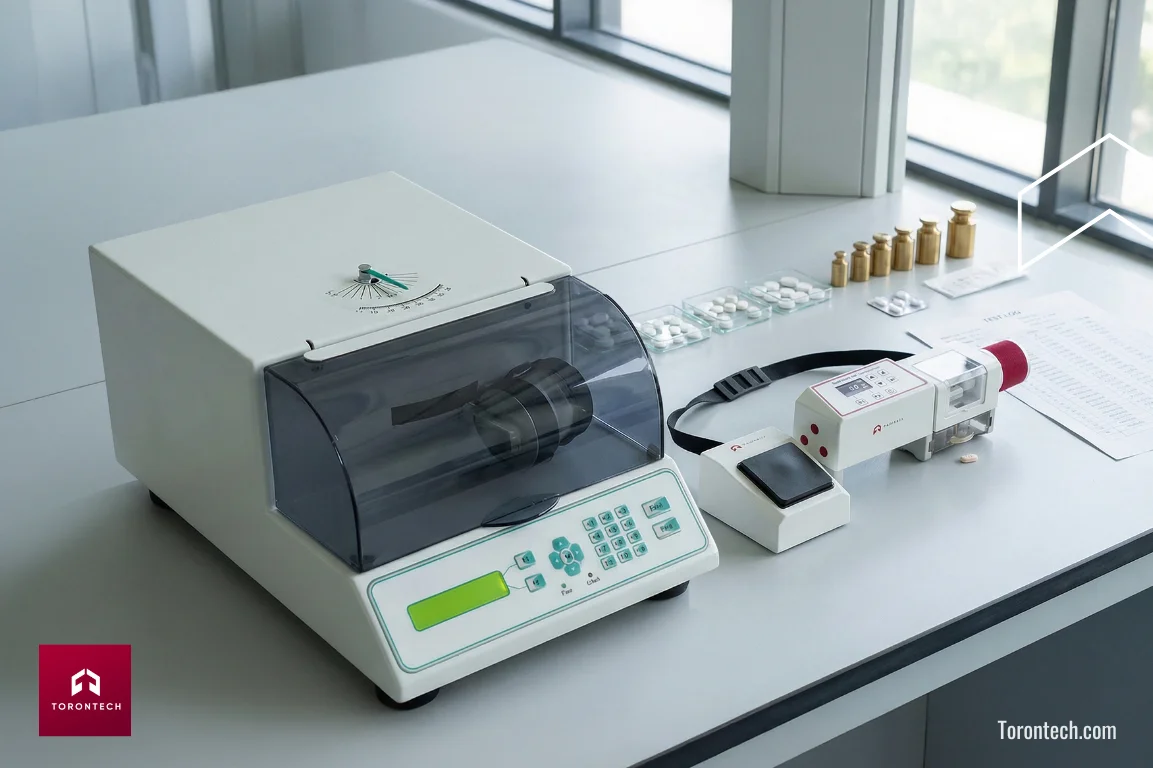
A clear grasp of the difference between hardness and friability is essential for any QC process. The key distinction is that hardness tests the tablet's resistance to breaking under compression, while friability evaluates its resistance to surface wear and abrasion during handling (Hare et al., 2018; Seitz & Flessland, 1965).
Hardness is related to the tablet's internal bonding strength, whereas friability reflects the tablet's durability against mechanical shocks and surface damage (Paul & Sun, 2017; Wahyudi et al., 2024).
| The Gist | Hardness (The Snap Test) | Friability (The Tumble Test) |
|---|---|---|
| What it's really about | The tablet's internal structure and mechanical strength. | The tablet's surface and resistance to abrasion. |
| The kind of abuse | A single, compressive force until fracture. | Repeated impacts, friction, and tumbling. |
| What goes wrong | It won't dissolve (too hard) or it breaks under minimal pressure (too soft). | It arrives chipped, capped, or with significant powdering. |
| How they connect | A harder tablet is often less friable, but this is not a guaranteed relationship. | It is directly related to the quality of the formulation's binding agents. |
Troubleshooting Hardness and Friability Issues
This is where production processes often go wrong. We have seen many operations try to solve a friability issue by simply increasing the compression force on the tablet press. This approach often creates more problems than it solves.
The difference between friability and hardness becomes painfully clear when you over-compress a formulation. Imagine a scenario where a manufacturer is working with a starch-based formulation that isn't binding well.
The edges appear rough, so the immediate reaction is to crank up the main compression force. While this might make the tablet feel harder initially, it often traps air inside the core.
This leads directly to common manufacturing defects:
- Capping: The top or bottom surface of the tablet cleanly separates from the main body because the trapped air pushes the layers apart.
- Lamination: The tablet splits apart into distinct horizontal layers.
A tablet with these issues may post a high number on a hardness tester but will fail a friability test spectacularly because its internal structure is compromised. We always advise our clients that hardness and friability must be balanced, not just maximized.
Read more: Tablet Lamination & Capping: Key Causes & Fixes
Good Equipment That Doesn't Strain the Budget
Regulatory bodies have clear standards for these tests. Yet, labs are often forced to choose between premium-priced equipment or low-cost alternatives that may not offer the required accuracy or data compliance.
At Torontech, we don’t believe that should be the choice. Our focus is on providing cost-effective solutions that deliver the performance and innovation you need.
1. For Friability Testing (USP <1216>)
Our Friability Testers are engineered to provide accurate, repeatable results.
- Compliance-Ready: For standard applications, the ToronFRI™ 2L offers a compact, compliant solution aligned with USP/Ph. Eur/IP standards.
- Efficient Operation: High-throughput labs often prefer the ToronFRI™ 2W dual-drum configuration, which includes a weighing scale interface to streamline data collection and eliminate manual errors.
2. For Hardness Testing (USP <1217>)
Reliable data is needed to ensure your tablets meet their breaking force specification without introducing other defects.
- A Range of Solutions: We offer everything from simple Portable Tablet Hardness Testers for quick spot checks to fully automated systems.
- Process Insight: For comprehensive analysis, the ToronTAB™ 5 allows you to track hardness alongside weight, thickness, diameter, and width. This gives you the statistical data needed to identify production trends before they lead to batch rejection.
Torontech: Innovation Without the High Cost
Ensuring your tablets have the correct physical properties is a non-negotiable part of manufacturing. Understanding the difference between hardness and friability ensures you are testing for the right failures, but the equipment you use shouldn't be an unnecessary complication.
We provide the innovative technologies needed to make sure your product survives the journey from your facility to the end-user, all while respecting your budget.
Ready to improve your laboratory's capabilities? Contact us to discuss your specific applications, or browse our full range of Friability Testers and Hardness Testers to find the right solution for your QC lab.
References
- Donea, C. (2022). DETERMINATION OF THE IMPACT OF THE COMPRESSION FORCE BY EVALUATING THE MECHANICAL AND RELEASE PROPERTIES OF MESALAZINE TABLETS. FARMACIA.
- Hare, C., Bonakdar, T., Ghadiri, M., & Strong, J. (2018). Impact breakage of pharmaceutical tablets. International Journal of Pharmaceutics, 536(1), 370-376.
- Paul, S., & Sun, C. (2017). Dependence of Friability on Tablet Mechanical Properties and a Predictive Approach for Binary Mixtures. Pharmaceutical Research, 34, 2901-2909.
- Prasad, K., Sujana, A., Raj, Y., Vainavi, V., Deepika, V., & Prasanna, S. (2025). Development and in vitro evaluation of lercanidipine hydrochloride controlled-release tablets prepared by wet granulation method. Future Journal of Pharmaceuticals and Health Sciences.
- Rosaini, H., Wahyuni, R., Zafrul, A., & Sari, E. (2023). FORMULATION AND CHARACTERIZATION OF TABLETS FROM SIMPLICIA AND EXTRACT OF SUNGKAI’S (Peronema canescens Jack) LEAF. International Journal of Pharmaceutical Sciences and Medicine.
- Seitz, J., & Flessland, G. (1965). Evaluation of the physical properties of compressed tablets. I. Tablet hardness and friability. Journal of Pharmaceutical Sciences, 54(9), 1353-7.
- Wahyudi, M., Zaida, Y., Maulidia, F., Nabila, R., Puspita, D., & Latifah, N. (2024). Pengaruh Variasi Bahan Pengikat Alami dan Sintetis terhadap Kekerasan dan Kerapuhan Tablet. An-Najat.