

Tablet Lamination & Capping: Key Causes & Fixes
Ever feel that frustration when you see perfectly formed tablets start to fracture and separate? The two main culprits, tablet capping and lamination, are notorious for disrupting entire production runs and putting product quality at risk.
Here, we'll share our direct insights on why these defects happen and offer some practical advice on how to stop them before they start.
Key Takeaways
- Tablet defects like capping and lamination are major financial risks that lead to wasted materials and lost machine time.
- Capping happens when the top separates while lamination is the splitting of layers due to internal stress or air entrapment.
- Immediate solutions include applying pre-compression to release air and optimizing granules to remove excess fines.
- Advanced research suggests that modifying ejection pressure and using punch vibration can significantly reduce these structural failures.
- Early detection using Torontech friability testers is a cost-effective strategy to ensure compliance and prevent batch rejection.
The Real Cost of Tablet Defects
Before getting into the technical details, we need to talk about the financial impact of tablet lamination and capping. Viewing these issues as minor flaws is a serious business risk. From our perspective, they are signs of a financial drain that can quietly eat away at your resources.
When a batch has to be rejected because of these issues, the loss goes far beyond the raw materials. You lose valuable machine time, pay for labor on a failed run, and risk missing critical shipment deadlines.
This is why we are firm believers in early detection. Identifying a tendency for tablets to fracture during the R&D or pilot stage is vastly more cost-effective than discovering it in a full commercial batch.
Related article: Friability Test in the Pharmaceutical Industry
What Exactly is Tablet Capping and Lamination?
Let’s define the terms clearly as the difference is important. According to industry research, these defects are often due to internal stresses or poor bonding during compression (Mazel et al., 2018; Paul & Sun, 2017).
- Capping: This refers to the partial or complete separation of the tablet top or bottom from the main body.
- Lamination: This involves the tablet splitting into layers, often along the center band. This is frequently caused by tensile stresses and factors like high compaction pressure and thin tablet bands (Mazel et al., 2018; Paul & Sun, 2017).
Both of these are compression-related failures. Studies have linked these defects to high elastic recovery, low tensile strength, radial die-wall pressure, and air entrapment within the powder (Paul & Sun, 2017; Mazel et al., 2015; Dudhat et al., 2017).
How to Solve Capping Problem in Tablet: A Quick Guide
For those times when you need a solution quickly, here is a guide based on the most common situations we’ve helped our clients resolve.
| The Tablet's Problem | The Likely Suspect | Our Recommended Solution |
|---|---|---|
| "Lid Pops Off" (Capping) | Air Entrapment: The press is moving too quickly, trapping air within the powder as it's compressed. | Use Pre-Compression: Applying a lighter, initial pressure pushes the trapped air out before the main compression event. Powder deaeration can help reduce this risk (Dudhat et al., 2017). |
| "Lid Pops Off" (Capping) | Excessive Fines: The powder blend contains too many fine, dust-like particles that fail to bond well. | Optimize the Granules: Sift the blend to remove excess fines. A powder with a more uniform particle size creates a much stronger tablet. |
| "Flaky Layers" (Lamination) | Over-Lubrication: Too much lubricant in the mix is preventing the granules from properly adhering to each other. | Reduce the Lubricant: Decrease the amount of lubricant or shorten the final mixing time. With lubricants, it is often a case of "less is more." |
| "Flaky Layers" (Lamination) | Punch and Die Shape: Deeply concave tooling can create high shear stress on the tablet as it's ejected from the die. | Assess Your Tooling: Consider using tooling with a flatter profile or dies with a slight taper. Sometimes the issue is the physical shape of your tools. |
| Both Problems | High Machine Speed: The turret is running so fast that the powder doesn't have enough "dwell time" under pressure to form a solid bond. | Reduce the Press Speed: We understand the pressure for high output. However, a slightly slower speed that produces good tablets is far better than a faster speed that produces rejects. |
Looking Deeper for a Permanent Solution
While that table offers immediate fixes, a long-term solution to tablet capping and lamination requires a closer look at the science behind the compression.
The Formulation Itself
Often, the root cause is in the recipe. An insufficient amount of binder or overly dry granules will produce a weak tablet.
We also see many cases of lamination directly caused by too much lubricant, which is a classic formulation error. Research supports the idea that powder deaeration can help reduce the risk of lamination caused by air entrapment (Paul & Sun, 2017; Mazel et al., 2015).
For instance, consider a situation where a formulation uses granules that have been over-dried. They become brittle and lack the plasticity needed to form strong bonds. The result is a tablet that looks fine coming off the press but is prone to capping with the slightest physical stress.
Press Equipment and Tooling
In our experience, tooling is an often-overlooked factor.
It isn't just about wear and tear; it is about how the machine handles the tablet. Solutions to capping include modifying unloading conditions during tablet ejection, such as asymmetrical unloading or applying pressure during ejection. These methods can significantly reduce or eliminate capping and lamination (Mazel et al., 2019).
Furthermore, novel approaches using external lower punch vibration have been shown to decrease these tendencies by improving powder compaction and tablet mechanical stability (Kalies et al., 2020).
The Critical Role of Friability Testing
Our philosophy is simple: you can't manage what you don't measure.
This is where friability testing becomes an essential part of your process for preventing tablet capping and lamination. Friability testing measures tablet resistance to abrasion and breakage, which is vital for assessing the mechanical integrity of tablets (Dudhat et al., 2017).
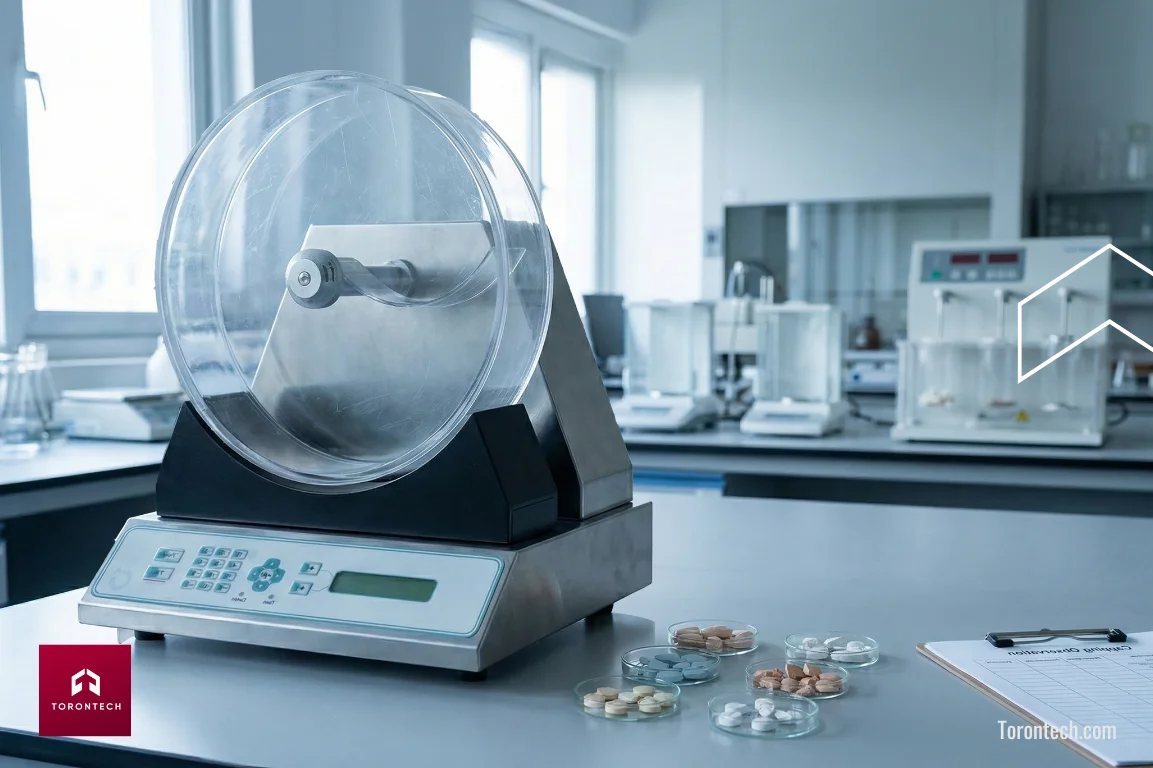
You place the tablets in a rotating drum to simulate the handling, coating, and shipping they will eventually go through. If your tablets chip or break apart here, you have identified a weakness you can correct before committing to a full production run. This is information you want to have in the lab rather than after a batch is complete.
Related article: Tablet Hardness and Friability: What is the Difference?
How Torontech Can Help
Knowing how to solve capping problem in tablet manufacturing is one part of the equation while having the right equipment is the other. At Torontech, our focus is on providing cost-effective and innovative technologies that bring genuine precision to your quality control lab.
Our Friability Testers are built to meet demanding international standards (like USP and EP) and include features we've incorporated to make your workflow more efficient:
- Higher Throughput: Models in our ToronFRI™ series have dual-drum configurations, allowing you to double your testing capacity in a single run. It's a practical advantage for any busy lab.
- Automated Sample Handling: An automatic sample discharge feature ensures tablets are moved to a collection tray after the test, which reduces manual handling and the chance of operator error.
- Variable Speed for Deeper Insight: With programmable speeds from 20 to 60 RPM, our testers allow you to perform standard tests or run more aggressive protocols to truly find your tablet's breaking point.
- Assured Compliance: Our devices support the standard 10-degree tilt required by USP/EP. We believe that if you're going to run a test, you must do it correctly and to standard.
If you are ready to improve your manufacturing process and put an end to defects like tablet lamination and capping, we are here to help. Contact Torontech today, and our team will work with you to find the right cost-effective solution to protect your product quality.
References
- Dudhat, S., Kettler, C., & Dave, R. (2017). To Study Capping or Lamination Tendency of Tablets Through Evaluation of Powder Rheological Properties and Tablet Mechanical Properties of Directly Compressible Blends. AAPS PharmSciTech, 18, 1177-1189.
- Kalies, A., Heinrich, T., & Leopold, C. (2020). A novel approach to avoid capping and/or lamination by application of external lower punch vibration.. International journal of pharmaceutics, 119195.
- Mazel, V., Busignies, V., Diarra, H., & Tchoreloff, P. (2015). Lamination of pharmaceutical tablets due to air entrapment: direct visualization and influence of the compact thickness.. International journal of pharmaceutics, 478 2, 702-4.
- Mazel, V., Desbois, L., & Tchoreloff, P. (2019). Influence of the unloading conditions on capping and lamination: study on a compaction simulator.. International journal of pharmaceutics, 118468.
- Mazel, V., Diarra, H., Malvestio, J., & Tchoreloff, P. (2018). Lamination of biconvex tablets: Numerical and experimental study. International Journal of Pharmaceutics, 542, 66–71.
- Paul, S., & Sun, C. (2017). Gaining insight into tablet capping tendency from compaction simulation.. International journal of pharmaceutics, 524 1-2, 111-120.
