Polisher Grinder Guide: Manual, Semi, or Auto?
Securing a flawless metallographic analysis begins long before the sample reaches the microscope. It starts at the grinding wheel. Whether you are validating grain structures in an innovative R&D facility or maintaining rigorous standards on an automotive assembly line, the goal is identical. You need a mirror finish free from scratches and deformation.
However, achieving that perfect surface efficiently requires matching the machinery to your specific workflow. The market offers a wide spectrum of solutions. Determining whether a manual, semi-automatic, or fully automatic polisher grinder fits your operation is the critical first step.
At Torontech, we have supported countless facilities through this selection process. We understand that every lab operates with specific targets and financial realities. We also know that the most expensive unit isn't always the intelligent choice for your specific needs. Here is our professional perspective on which machine provides the best value.
Key Takeaways
- Manual units serve as the cost-effective standard for education and low-volume tasks where tactile control is necessary.
- Semi-automatic machines improve consistency by automating force application while keeping capital costs manageable.
- Fully automatic systems offer the best ROI for high-volume labs by ensuring standardized repeatability and reducing labor.
- Your selection should depend on your daily throughput, the strictness of industry standards, and future capacity planning.
- Torontech delivers cost-effective and innovative technologies tailored to fit your specific metallographic workflow.
1. Manual Polisher Grinders: The Fundamental Approach
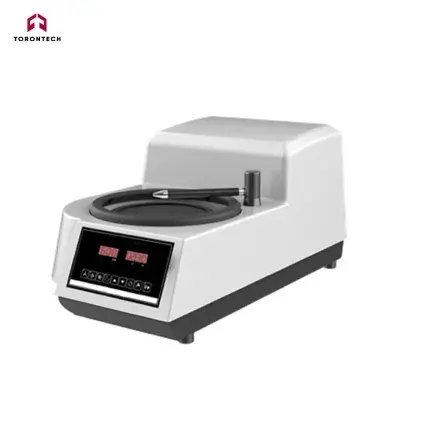
Manual polisher grinders are devices operated entirely by hand, requiring the user to control the grinding and polishing process without automated assistance. In this configuration, the operator acts as the control system by holding the specimen directly against the rotating wheel and modulating the pressure and duration.
- Ideal For: Low sample volumes, irregular component shapes, and educational training.
- Our Perspective: We will state this clearly as there is no substitute for the direct feedback of manual preparation when teaching the basics of metallography. It is foundational. However, manual polishing lacks control over material removal and final geometry (Dieste et al., 2013; Xi Hongli, 2017). Despite this limitation, a manual unit often outperforms the setup time of a computerized system for checking odd shapes or running a quick verification. It gives the operator total authority over the finish which is invaluable when dealing with unique, non-standard prototypes.
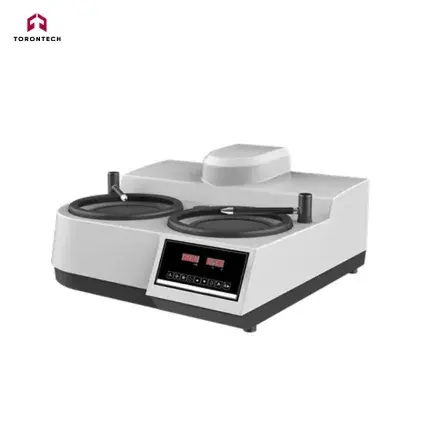
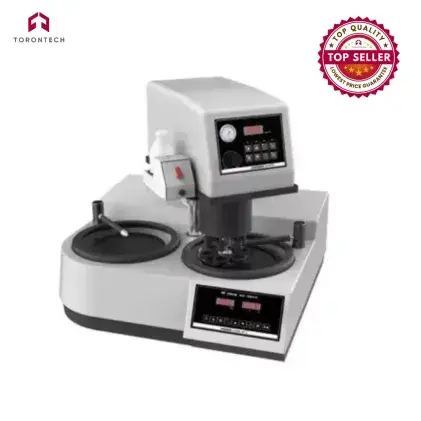
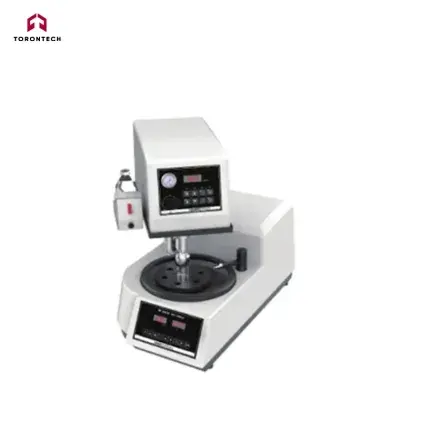
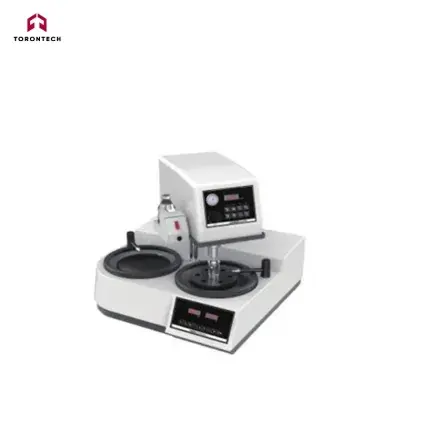
- The Torontech Solution: Our ToronPol GP-1 (Single Wheel) and GP-2 (Twin Wheel) series are constructed to endure heavy use. They feature variable speeds and durable engineering, making them the logical choice for labs where operator control is the priority.
Related article: Key Differences Between Grinding & Polishing (Metallography)
2. Semi-Automatic Polisher Grinders: The Efficiency Balance
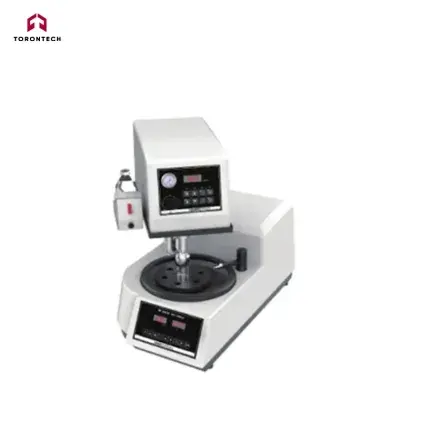
When sample volume begins to climb, relying exclusively on manual pressure inevitably leads to operator fatigue and variable results. Semi-automatic polisher grinders combine manual operation with some automated features, such as motorized polishing discs or workpiece clamping (Susanti et al., 2019; Xi Hongli, 2017; Yang, W. J., 2006).
These systems improve precision and efficiency while still requiring some user input and control. The dedicated head attachment applies constant pneumatic or mechanical force to the samples. While the operator must still exchange grinding discs and clean the samples between steps, the actual material removal process is automated.
- Ideal For: Medium sample volumes and labs requiring higher consistency than manual prep allows.
- Our Perspective: In the broader industry, this is often viewed as the "middle ground." Compared to manual grinders, semi-automatic machines offer higher precision, safety, and the ability to polish multiple workpieces simultaneously (Yang, W. J., 2006; Xi Hongli, 2017; Dieste et al., 2013). You secure better reproducibility than a human hand can provide without the higher capital expenditure of a fully programmable system. It effectively eliminates the risk of "rounding" edges or creating beveled surfaces.
- The Torontech Solution: Our ToronPol GP-1A and GP-2A Series deliver this advanced capability. We combined the durability of our base models with automated heads, allowing you to process multiple samples simultaneously with uniform pressure.
3. Fully Automatic Polisher Grinders: Maximum Precision
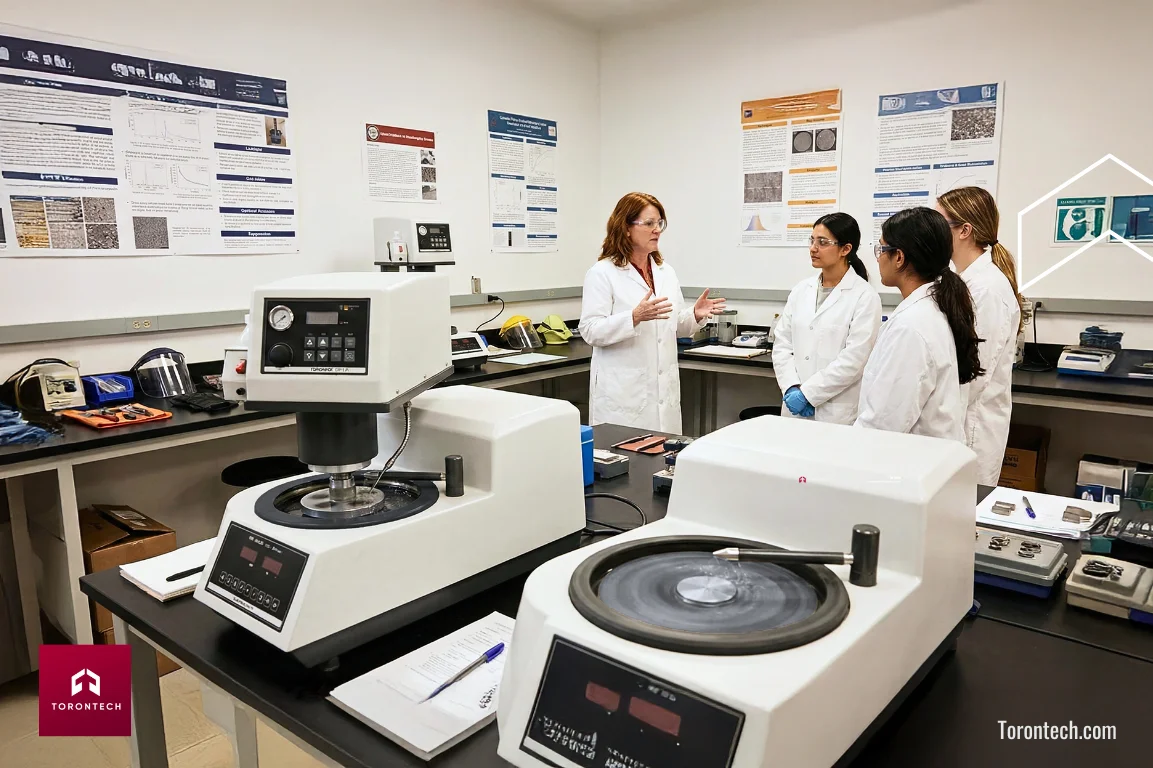
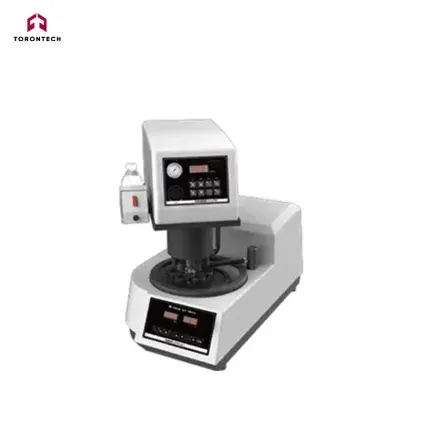
For high-output environments like manufacturing quality centers, fully automatic systems are non-negotiable. Fully automatic polisher grinders perform grinding and polishing processes with minimal human intervention, often using robotic systems or programmed controls to optimize quality, reduce processing time, and maintain consistent material removal (Dieste et al., 2013).
These systems automate path control, tool selection, and abrasive use to further enhance process control and reproducibility (Yang, W. J., 2006; Xi Hongli, 2017; Dieste et al., 2013). By removing the need for an operator to stand by the machine, you free up valuable personnel to perform analysis or other tasks while the batch is being processed.
- Ideal For: High-volume labs, strict repeatability mandates, and reducing labor costs.
- Our Perspective: We often advise our high-volume clients that you are not just purchasing speed. You are securing certainty. Fully automatic grinders are particularly advantageous for complex shapes and high-precision industries like automotive and aerospace, where consistent quality and reduced labor costs are critical (Dieste et al., 2013). Whether a sample is processed on a Monday morning or a Friday afternoon, the results are identical.
The Torontech Solution: Our ToronPol GP-1C and GP-2C Series represent the pinnacle of our innovative technologies. These fully automatic units feature intuitive touchscreens, programmable parameters, and central force loading to ensure your lab operates at peak efficiency with minimal downtime.
Related article: Grinder Polisher Guide: Central vs Individual Force
At a Glance: Which Series Fits Your Lab?
Before finalizing a decision, compare the operational differences. Viewing the data directly often clarifies the ROI potential:
| Feature | Manual (GP-1/GP-2) | Semi-Automatic (Standard) | Fully Automatic (GP-1C/GP-2C) |
|---|---|---|---|
| Throughput | Low (1-5 samples/day) | Medium (5-20 samples/day) | High (20+ samples/day) |
| Operator Skill | High skill required | Moderate skill required | Minimal training required |
| Repeatability | Operator dependent | Consistent force application | 100% Standardized |
| Cost | Most Cost-Effective | Mid-Range | Investment (High ROI) |
| Best For | Universities, R&D, One-offs | Small QC labs, Job shops | High-volume Mfg, Automotive, Aero |
How to Choose?
When selecting between a manual, semi-automatic, or fully automatic polisher grinder, we recommend evaluating these five primary factors beyond the initial price:
Assess Your Actual Throughput
Do you prepare 5 samples a week or 50 samples a day? Be realistic about these numbers. If the volume is high, we strongly advise against manual prep because the labor costs associated with a technician standing at a wheel will quickly exceed the savings on the hardware.
Define Your Consistency Tolerance
Can your process tolerate slight variations? Manual polishing lacks control over material removal and final geometry, which semi-automatic and fully automatic systems address by integrating motorized components and numerical control to improve the quality and consistency of the finished parts (Dieste et al., 2013; Xi Hongli, 2017).
Evaluate Operator Expertise
Who will be running the machine? Manual polishing is an art form that requires a skilled hand and experience to avoid artifacts. If your lab experiences high staff turnover or relies on entry-level technicians, a fully automatic system is safer because the "expertise" is stored in the machine's software rather than the operator's hands.
Consider Material Hardness and Variety
Are you polishing the same steel alloy every day, or a mix of soft aluminum, brittle ceramics, and hard composites? A lab handling a wide variety of materials often benefits from the programmable memory of an automatic system.
Plan for Future Capacity
Is your operation expanding? We frequently see labs purchase a manual machine only to outgrow it within a year. Consider where your volume will be 12 months from now before locking in your purchase.
Torontech: Precision for Every Lab
Whether you require the hands-on control of a manual unit or the high-speed efficiency of a fully automatic system, the objective remains constant. You need a perfect surface for accurate analysis.
At Torontech, we pride ourselves on delivering cost-effective and innovative technologies that empower your lab to deliver precise results. We do not believe in selling unnecessary features. We believe in identifying the solution that fits your specific workflow.
Ready to upgrade your metallographic process? Explore our full range of Grinding & Polishing Equipment here or contact us today to have a candid conversation about which model fits your specific application.
References:
- Dieste, J., Fernández, Á., Roba, D., Gonzalvo, B., & Lucas, P. (2013). Automatic Grinding and Polishing Using Spherical Robot. Procedia Engineering, 63, 938-946.
- Susanti, N., Zakiyya, H., Samani, M., & Sakti, A. (2019). Modification of Automatic Semi System and Addition of Spin Polishing Function on Metalography Grinder Machine. Journal of Physics: Conference Series, 1387.
- Yang, W. J.. (2006). Semi-automatic flat surface efficient polishing machine.
- Xi Hongli. (2017). Semi-automatic precision numerical control grinder.