
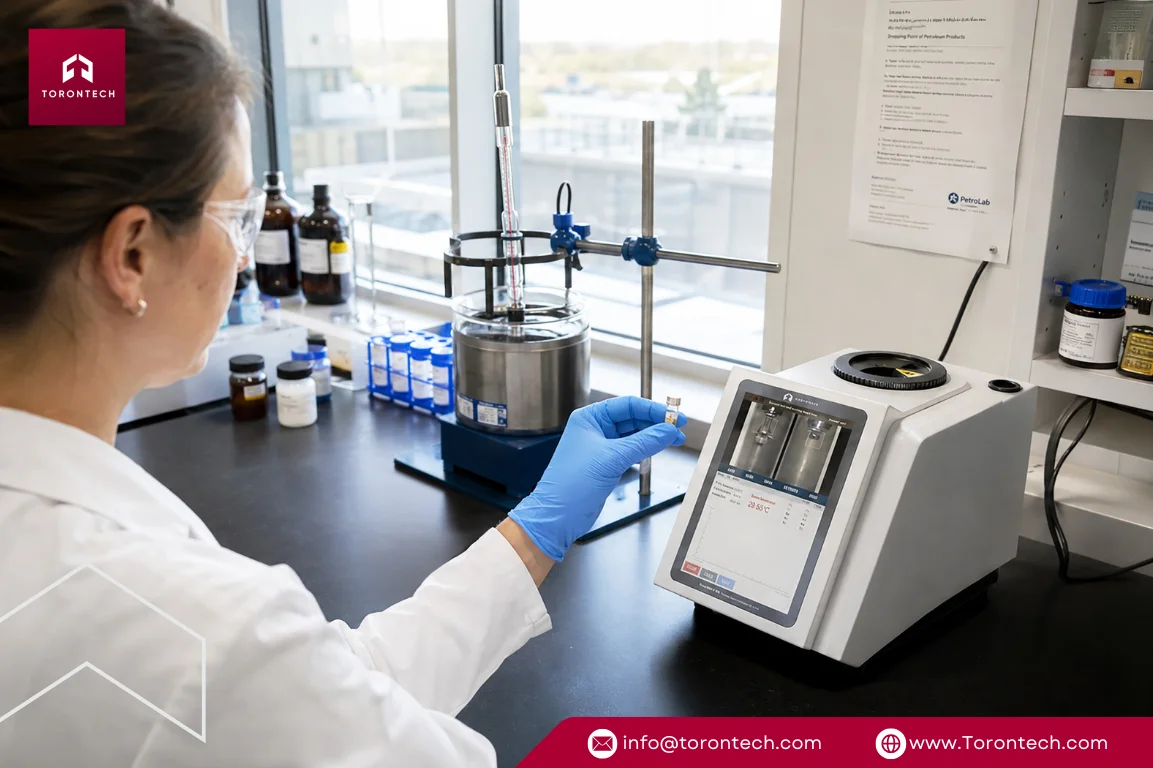
Manual vs Automated Dropping Point Testers Comparison
Is your quality control laboratory losing valuable technician hours to manual bench monitoring? Relying on continuous visual observation over glass heating tubes introduces operator fatigue, parallax errors, and non-traceable logbooks.
Automated testing apparatuses eliminate human bias through objective electronic sensing, delivering reproducible data and walk-away labor efficiency. In this buyer’s guide, we compare manual vs automated dropping point testers and automated vs manual dropping point testers across precision, compliance, and total cost of ownership to help you choose the right platform.
Quick Comparison: Manual vs Automated Dropping Point Testers
For lab managers and procurement directors seeking an immediate side-by-side evaluation, here is how the two configurations compare across key operational metrics:
| Operational Parameter | Traditional Manual Setup | Modern Automated Testing System |
|---|---|---|
| Endpoint Detection | Subjective visual operator interpretation | Objective optical or image-recording sensors |
| Thermal Regulation | Manual analog heat adjustments | Automated linear heating ramps |
| Temperature Sensor | Standard glass thermometers | Digital platinum thermal sensors with higher resolution |
| Bench Supervision | Dedicated operator presence required for 20+ minutes | Walk-away operation after initial sample loading |
| Repeatability & Bias | Inherent process risks and visual fatigue | Synchronous recording and high reproducibility |
| Documentation & Audits | Handwritten paper logbooks | Encrypted digital files, PDF export, LIMS connectivity |
| Standard Adherence | Basic compliance (ASTM D566) | Comprehensive compliance (ASTM D2265, AASHTO T 53, EN 1427, IP 396) |
| Total Cost of Ownership | Lower entry price; high recurring labor expenses | Higher initial investment; fast payback through labor savings |
In our view, this side-by-side comparison clearly shows that manual equipment carries hidden operational costs that accumulate silently over time through technician labor hours and batch re-testing.
What is Dropping Point Testing?
At its core, a dropping point test identifies the exact temperature at which a semi-solid material softens sufficiently to release its first liquid drop through a standardized cup orifice. From an engineering perspective, we view this physical property as a critical frontline check for formulation stability and batch-to-batch uniformity.
It serves as an essential quality parameter across multiple sectors, aligning with major North American and international standards such as:
- ASTM D566 / ASTM D2265 (Lubricating Greases)
- NLGI GC-LB Standards (National Lubricating Grease Institute chassis and wheel bearing specs)
- ASTM D3954 (Paraffin and Microcrystalline Waxes)
- AASHTO T 53 / ASTM D36 (Asphalt Binders and Paving Bitumen)
- USP / United States Pharmacopeia (Petrolatum Jellies and Pharmaceutical Ointment Bases)
- IP 132 / IP 396 / ISO 2176 / DIN 51801 / EN 1427 (Petroleum Liquids, Tar, and Bitumen)
It is worth noting that dropping point results carry limited predictive value for a grease's real-world service life on their own. Because this standard is a static thermal evaluation rather than a simulation of dynamic operating conditions, quality control laboratories typically pair dropping point data with cone penetration, oil separation, and rheological tests to evaluate full field performance
The Operational Reality of Manual Dropping Point Testers
A manual setup consists of a glass test tube suspended in a liquid heating bath or metal block, a glass thermometer, and an operator dedicated to continuous monitoring.
The Testing Workflow:
- The technician packs the semi-solid sample into a standardized metal cup and inserts it into the glass tube assembly.
- Heat is applied incrementally, typically at a rate of one to two degrees per minute.
- The operator remains at the bench, continuously monitoring both the sample cup and the thermometer column.
- The moment the first drop detaches, the operator manually records the temperature reading.
Primary Advantages:
- Lower Entry Cost: Minimizes initial capital expenditure for startup facilities or low-volume testing environments.
- Mechanical Simplicity: Straightforward hardware configuration with minimal electronic components.
Operational Drawbacks:
- High Susceptibility to Error: Thermometer parallax and delayed human reaction times introduce measurement variance between operators.
- Labor-Intensive Execution: Skilled personnel are tied to bench monitoring rather than conducting higher-value analytical tasks.
- Difficulty with Dark Samples: Opaque greases or dark pitches make visual drop detection challenging and inconsistent.
- Lack of Traceable Audit Trails: Manual data entry increases transcription error risks and complicates regulatory audits.
In our assessment, while manual units offer low entry costs, the heavy reliance on operator vigilance is their single biggest liability in modern QA environments.
The Advantages of Automated Dropping Point Testers
Automated systems replace manual observation and manual heating adjustments with digital PID thermal controls, solid furnace blocks, and photoelectric or camera detection technology.
The Testing Workflow:
- The operator loads the prepared sample cup and selects a pre-configured testing protocol via the touchscreen interface.
- Microprocessor controls manage the furnace temperature, maintaining standard-compliant linear ramp rates.
- Optical sensors or high-resolution camera modules monitor the sample cup continuously.
- The instant the drop breaks free, the sensor freezes the digital temperature reading automatically.
- The unit stores the data, generates a detailed report, and transfers the record to your LIMS database.
Primary Advantages:
- Unrivaled Repeatability: Electronic detection eliminates operator reaction bias and visual fatigue.
- Walk-Away Efficiency: Staff load the sample, initiate the sequence, and move on to other laboratory responsibilities.
- Higher Throughput: Multi-channel instruments permit simultaneous two-sample analysis under identical heating conditions, effectively doubling daily sample capacity.
- Audit-Ready Compliance: Automated record generation ensures full compliance with international auditing standards.
We believe the primary advantage of automation isn't just speed; it is the complete elimination of subjective human interpretation.
Accuracy, Repeatability, and Sensor Evolution
When evaluating analytical methodology, published research highlights clear structural drawbacks in manual testing compared to modern digital instrumentation:
Endpoint Detection and Human Bias
Manual methods rely on continuous operator watching, which introduces subjective interpretation at the exact moment of drop detachment. This reliance on human observation creates process risks that compromise test repeatability, directly impacting end-product consistency in petrochemical and polymer manufacturing. Automated systems remove human bias by employing light barriers or image-capturing modules that record the drop moment objectively.
Temperature Control and Sensor Precision
Traditional manual apparatuses rely on glass thermometers, which present parallax reading errors and limited resolution. Modern automated testing platforms like the ToronDSPT™ Series utilize digital thermal sensors, such as high-precision platinum resistance probes with 0.01°C measurement resolution.
Operating across a broad thermal range from room temperature up to 400°C, these automated instruments deliver measurement accuracy within plus or minus 0.2°C below 250°C (and plus or minus 0.4°C above 250°C), alongside tight repeatability of plus or minus 0.1°C. Furthermore, digital PID microprocessors maintain strict linear heating rates, ensuring that samples experience identical thermal progression during every test run.
Response Lag and Calibration Dynamics
Technical evaluations of softening and dropping point instruments indicate that temperature acquisition systems must account for thermal response lag and environmental variables. Automated instruments capable of synchronous time-temperature recording provide verified accuracy, helping laboratories maintain alignment with rigorous international standards.
Key Technological Developments in Automated Equipment
When evaluating automated platforms, considering the underlying hardware features helps justify the transition from manual apparatuses:
1. Advanced Sensor Systems: Photoelectric vs. Closed HD Video Observation
- Photoelectric Light-Barrier Sensors: These modules project an optical beam directly below the sample orifice. When the falling drop interrupts the beam, the instrument registers the exact temperature instantly.
- Closed HD Video Observation: Advanced testing platforms, such as the ToronDSPT™ Series, replace traditional microscope viewing with a closed, PID-controlled furnace equipped with HD video recording. When melt or drop behavior is borderline or complex, operators can replay the recorded video feed to visually verify the exact moment of phase transition.
2. Dual-Testing Scope: Dropping Point plus Softening Point
Optimizing benchtop space and capital allocation is essential for modern facilities. Rather than purchasing separate standalone units, advanced instruments like the ToronDSPT™ Series incorporate dual testing capabilities that execute both Dropping Point and Softening Point determinations on a single platform.
- Dropping Point: Determines the temperature at which a material flows through a standard orifice (e.g., ASTM D2265, ASTM D3954).
- Softening Point: Measures the thermal point where a sample deforms under load using cup-and-ball methods (e.g., ASTM D6090, AASHTO T 53, EN 1427 for resins, pitch, and bitumens).
In our opinion, dual-mode testing capability is one of the smartest equipment investments a multi-application lab can make to maximize benchtop ROI.
3. Data Integrity, Method Storage & Regulatory Compliance
In strictly monitored quality environments, data security is as vital as testing accuracy. Handwritten logbooks are rapidly becoming obsolete as North American regulatory expectations demand complete electronic traceability.
- Onboard Method Storage: Modern digital systems provide extensive memory reserves. For instance, semi-automatic models like the ToronDSPT™ 100 store up to 600 test methods across 64 GB of memory, while fully automatic systems like the ToronDSPT™ 200 expand storage to 128 GB for up to 800 custom test methods.
- US FDA 21 CFR Part 11 & Health Canada Alignment: Multi-level user access controls, electronic signatures, and time-stamped audit trails protect testing protocols from unauthorized edits, aligning with US FDA and Health Canada data integrity mandates.
- Flexible Connectivity & Reporting: Direct PDF and Excel report exports via USB, RS232, Wi-Fi, RJ45, and LIMS networks ensure that analytical data moves seamlessly across your organization without manual transcription risk.
Related article: How to Choose Dropping & Softening Point Testers
Industry-Specific Applications: North American Focus
Comparing manual vs automated dropping point testers highlights noticeable operational differences across distinct industrial applications:
1. Petrochemicals, Energy & Extreme Climate Lubricants
Application
High-temperature machinery greases (operating above 250°C to 300°C), mining equipment lubricants, and synthetic greases used across cold-weather operations (such as Alberta oil sands or mining facilities across Northern Ontario and Alaska).
The Automated Advantage
Meeting NLGI GC-LB certification requirements for automotive chassis and wheel bearing greases demands rigorous high-temperature dropping point stability under ASTM D2265. Visually tracking a dark drop inside a hot furnace tube is extremely difficult.
In our assessment, automated optical sensors and closed video recording in systems like the ToronDSPT™ Series resolve this operational barrier by registering drop detachment regardless of sample opacity or color.
2. Infrastructure, Asphalt & Paving Bitumen
Application
Paving asphalt binders, roofing bitumens, and polymer-modified asphalt used across US State Department of Transportation (DOT) and Transport Canada infrastructure projects.
The Automated Advantage
Under AASHTO T 53 and ASTM D36 guidelines, civil engineering and road construction laboratories require exact softening point verification to prevent pavement rutting or temperature cracking. Automated dual-mode testing ensures identical thermal ramps across bitumen samples.
3. Waxes, Resins, Rosin & Adhesives
Application
Microcrystalline waxes, synthetic resins, rosin binders, and hot-melt adhesives produced across manufacturing hubs in the US Midwest and Eastern Canada.
The Automated Advantage
Resins and sticky adhesives often exhibit high viscosity before dropping. Dual-mode systems like the ToronDSPT™ Series determine exact softening and dropping behavior under standardized heating programs, ensuring composition control across raw material batches.
4. Pharmaceuticals, Cosmetics & Fine Chemicals
Application
Ointment bases, petrolatum jellies, lipsticks, and excipient waxes processed across major North American pharmaceutical and personal care corridors (such as New Jersey, California, and Quebec).
The Automated Advantage
Formulations require gradual, controlled heating rates to determine phase shifts without thermal degradation. We argue that for regulated facilities, the automatic creation of audit-compliant digital records alone justifies transitioning away from manual glass setups.
Evaluating Your Laboratory’s Requirements
North American Labor Economics and ROI
In laboratories across the US and Canada, skilled technician compensation typically ranges from $35 to $50+ per hour. Eliminating 20 to 30 minutes of manual supervision per test run generates substantial annual labor savings, allowing automated benchtop hardware to achieve full payback in six to twelve months.
Daily Testing Volume and Workflow Automation
Facilities processing more than three to five samples daily benefit significantly from automation. Dual-channel instruments that run two samples simultaneously accelerate turnaround times. Labs seeking structured video observation with operator-guided controls benefit from semi-automatic platforms like the ToronDSPT™ 100. High-throughput QC environments requiring one-click testing and automatic endpoint detection benefit from fully automated configurations like the ToronDSPT™ 200.
Regulatory Compliance and Audit Requirements
Operations subject to ISO 17025, GMP, US FDA 21 CFR Part 11, or Health Canada standards require the security of automated digital records, electronic signatures, and LIMS connectivity to ensure unalterable data integrity.
Domestic Service and Support Footprint
Sourcing testing equipment from a North American supplier with US and Canada presence ensures fast domestic freight, local spare parts availability, and responsive technical support without overseas shipping delays.
Upgrade Your Facility with Torontech
Choosing between manual vs automated dropping point testers comes down to balancing laboratory throughput, analytical accuracy, and long-term cost efficiency. While manual setups served historical testing roles, modern commercial QA/QC laboratories depend on automated systems to eliminate human error, secure audit compliance, and maximize staff productivity.
At Torontech, we supply reliable testing instrumentation engineered to give facilities global analytical accuracy without inflated price tags. Based in North America, our focus is delivering cost-effective solutions paired with genuinely innovative technologies, ensuring your laboratory maintains strict international compliance while staying within budget.
Ready to streamline your laboratory's testing workflows? Contact the Torontech Engineering Team Today to discuss your specific testing applications, review product specifications, or request a custom quote tailored to your facility.
References (Click to expand)
- Doeden, W. G. (1975). Evaluation of Mettler automatic dropping point apparatus and statistical comparison with Wiley melting point method. Journal of the American Oil Chemists’ Society, 52(4), 124–127.
- Krevatin, M., Pavan, B., & D'Agnolo, M. (2012). Method and device for determining softening or dropping point. European Patent Application EP2530453A1.
- Mertens, W. (1973). Fat melting point determinations: A review. Journal of the American Oil Chemists’ Society, 50(4), 115–119.
- Mertens, W., & deMan, J. (1972). Automatic melting point determination of fats. Journal of the American Oil Chemists’ Society, 49(6), 366–370.
- Mettler-Toledo. (2015). Softening Point Experiments Compare Methods’ Ease, Accuracy. Application Paper.
- Pyrig, Y. I. (2019). Effect of determination conditions on the softening temperature of bitumens according to EN standards. Road Materials and Pavement Design, 75, 45–52.
- Xu-Dong, L. (2008). Optimum design of temperature test system for dropping-point tester. Instrument Technique and Sensor, 2008(5), 18–21.
- Zhou, Y., Zhang, J., & Cao, J. (2021). Time response-based synchronous calibration of the pavement asphalt softening point tester. Journal of Physics: Conference Series, 1939, 012123.
