How to Choose Dropping & Softening Point Testers
Are inaccurate phase-change measurements and manual timing errors secretly dragging down your quality control throughput?
Relying on legacy eyepiece viewing or underpowered budget hardware creates severe repeatability risks that can compromise batch acceptance. Modern laboratories need reliable dual-channel instruments that streamline ASTM compliance, eliminate subjective operator bias, and double daily sample output without overspending on capital equipment.
In this guide, we break down how to choose a dropping point tester, how to choose softening point tester, or how to select an integrated system that tackles both.
Key Takeaways
- Prioritize Automation Over Manual Eyepieces: Moving away from manual visual observation eliminates human timing errors and safeguards test repeatability.
- Verify Standardized Method Support: Select testing hardware that complies with ASTM D566, ASTM D2265, ASTM E28, and AASHTO T 53 standards to satisfy State DOT, Transport Canada, and NLGI regulatory requirements.
- Demand Dual-Sample Channel Capacity: Instruments capable of running two samples simultaneously reduce analytical execution times by half, lowering technician labor costs across US and Canadian laboratories.
- Insist on High-Definition Video Capture: HD video recording provides verifiable visual records during phase-change transitions, simplifying compliance audits and post-run verification.
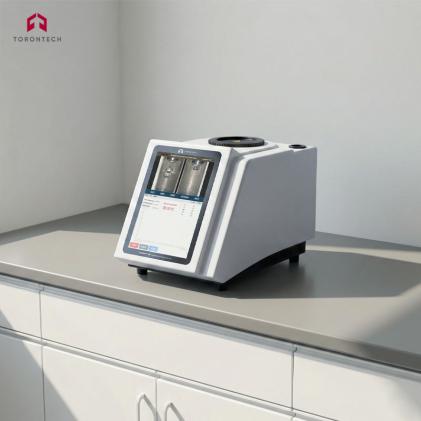
- Consider Integrated Dual-Function Testers: The ToronDSPT™ 100 (semi-automatic) and ToronDSPT™ 200 (fully automatic) combine dropping and softening point testing into a single benchtop setup, delivering high analytical accuracy and budget-friendly value.
Industry Applications & Primary Use Cases
Before evaluating hardware buttons and software interfaces, let's focus on the actual materials placed in your furnace chamber. In our view, facilities working with industrial compounds cannot afford to rely on outdated, manual observation methods where human error can compromise batch acceptance (and anyone who has dealt with audit delays knows how costly that can be!).
The ToronDSPT™ Series is engineered to address four core industrial material categories across North American supply chains:
- Grease & Lubricant QC: Batch qualification, grease identification, thickener system comparison, and lot-to-lot consistency checks aligning with NLGI (National Lubricating Grease Institute) grade requirements for automotive, mining, and heavy equipment fleets in the US and Canada.
- Asphalt & Roofing Materials: Comparing bitumen flow tendency at elevated temperatures to meet State Department of Transportation (DOT) and Transport Canada paving binder specifications, ensuring asphalt roads resist rutting through severe North American climate swings.
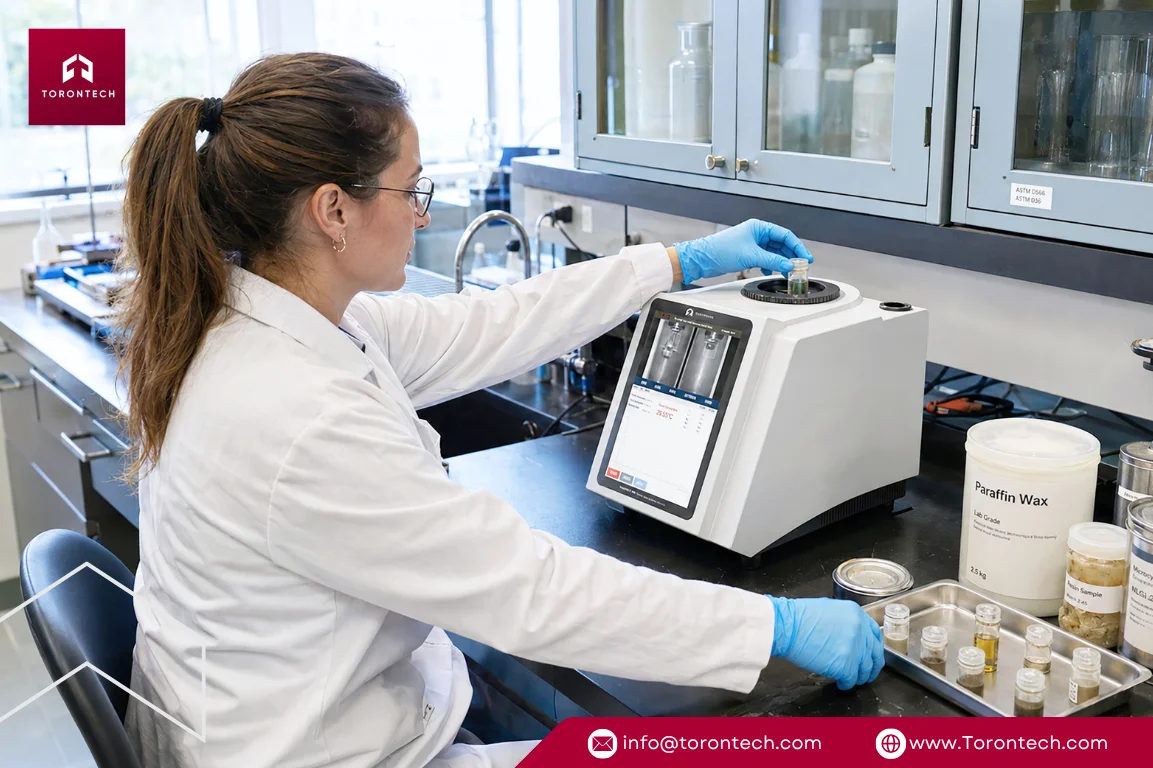
- Waxes, Resins, & Rosin for Coatings & Adhesives: Composition control for paraffin, synthetic resins, and natural rosin in coatings, inks, and packaging adhesives using standardized cup-and-ball methods.
- Petroleum Jelly & Semi-Solid Bases: Screening thermal consistency for lipsticks, face creams, medical ointments, and petroleum jelly to satisfy FDA (US Food and Drug Administration) and Health Canada product consistency guidelines.
Key Industry Standards: ASTM, AASHTO, ISO, & IP Reference
Your laboratory hardware must comply with official industrial standards. Standardized procedure adherence is essential because manual and semi-automated tests prescribed in ASTM and regional standards must be executed in a strictly standardized fashion to yield dependable results. We view owning a multi-method system that smoothly complies with multiple test codes as one of the most practical investments a lab manager can make.
| Standard Code | Test Type | Target Materials & Regulatory Scope |
|---|---|---|
| ASTM D566 / ASTM D2265 | Dropping Point | Heavy-Duty Greases & NLGI-Graded Lubricants |
| ASTM D3954 | Dropping Point | Petroleum Waxes & Synthetic Waxes |
| AASHTO T 53 / ASTM D36 | Softening Point | Highway Bitumen & State DOT Paving Binders |
| ASTM D3104 | Softening Point | Pitches & Industrial Rosins (Mettler Method) |
| ASTM E28 / CGSB Guidelines | Softening Point | Resins, Rosins, and Canadian Industrial Hydrocarbons |
| IP 132 / IP 396 | Dropping Point | Petroleum Products & Industrial Greases |
Step 1: How to Choose a Dropping Point Tester
If you are evaluating a dedicated instrument, your main goal is eliminating subjective human bias and securing consistent heating profiles. Here is what we insist you prioritize when evaluating how to choose a dropping point tester:
1. Heating Precision That Prevents Overshoot
Furnace chambers that heat unevenly directly compromise test accuracy. Look for an enclosed furnace powered by intelligent PID heating logic that maintains smooth heating profiles. In our ToronDSPT™ Series, we integrate a closed, PID-controlled furnace to guarantee thermal stability that strictly aligns with ASTM and NLGI testing guidelines.
2. High-Definition Video Capture Beats Manual Optics
Staring through an eyepiece lens waiting for a sample drop to fall creates eye strain and leads to subjective timing errors. Because operator-dependent variability increases process risks, we strongly advocate for high-definition video recording paired with automatic optical sensors. The ToronDSPT™ 200 uses automatic optical endpoint detection alongside HD video capture, detecting the exact transition event while storing video records for effortless verification when auditors review your facility.
3. Simultaneous Dual-Sample Testing
Running one sample cell at a time creates severe testing bottlenecks. We encourage laboratories to select instruments capable of testing two sample channels simultaneously. Both the ToronDSPT™ 100 and ToronDSPT™ 200 feature dual-channel testing cells, doubling testing throughput without consuming additional bench space.
Step 2: How to Choose Softening Point Tester
When researching how to choose softening point tester options for bitumen, resins, or adhesive formulations, your selection comes down to sample accessory compatibility, standard cup dimensions, and clear visual verification.
1. Accommodating Standard Sample Accessories
Published comparisons show that common softening point testing methods differ in hardware configurations across commercial instruments. Make sure the heating chamber accommodates standardized cups, steel balls, and ring holders specified in ASTM and AASHTO methods so your results remain comparable.
2. Clear Visual Verification via HD Playback
Viscous asphalt mixtures and dark resin samples rarely drop cleanly. Instead, they stretch, sag, or soften gradually. Built-in HD video observation is essential because it allows you to review the thermal transition frame-by-frame. The ToronDSPT™ 100 provides full HD video recording and playback, enabling technicians to pinpoint the exact moment softening occurs.
3. Automated Heating Ramp Profiles
Softening point measurements depend heavily on strict heating ramps (such as a steady 1°C or 5°C increase per minute). This precision is critical for traditional penetration-grade asphalt QC, roofing bitumen testing, and preliminary binder screening under AASHTO T53, where even a minor half-degree heating variance can distort results for polymer-modified asphalt (note that formal Superpave PG binder certification under AASHTO M320 requires separate DSR and BBR testing).
Step 3: How to Choose Dropping & Softening Point Tester (Combined Systems)
We regularly advise lab managers to avoid purchasing separate single-purpose instruments. In our view, paying double the capital cost and occupying extra bench space is inefficient. Selecting an integrated dual-function instrument provides significantly better long-term value while minimizing the repeatability problems documented in manual methods.
Related article: Manual vs Automated Dropping Point Testers Comparison
Here are the key factors to evaluate when determining how to choose dropping & softening point tester systems for a busy laboratory:
| Evaluation Criteria | Key Considerations | Operational Benefit |
|---|---|---|
| Automation Level | Semi-automatic vs. One-Touch Fully Automatic | Slashes manual effort and eliminates timing discrepancies |
| Visual Verification | Live HD Video Recording & Playback | Delivers verifiable visual records for audit compliance |
| Sample Capacity | Simultaneous 2-Sample Run Capability | Doubles daily sample output without increasing footprint |
| Data Connectivity | USB, Wi-Fi, RS232, RJ45, SD, U-disk, Direct Print | Makes file storage and data backups completely seamless |
| Stored Methods | Loaded with 600–800+ saved test protocols | Allows immediate switching between grease, resin, and asphalt SOPs |
Product Comparison: ToronDSPT™ 100 vs. ToronDSPT™ 200
To simplify your evaluation, here is how our two primary models compare side-by-side. We typically advise facilities with heavy audit requirements to select the fully automated version, while laboratories prioritizing visual monitoring on a practical budget gain outstanding value from the semi-automated model:
| Feature & Specification | ToronDSPT™ 100 | ToronDSPT™ 200 |
|---|---|---|
| Automation Level | Semi-Automatic (HD Video Observation) | Fully Automatic (One-Touch / Video + Optical Detection) |
| Endpoint Detection | Manual Selection via HD Video Playback | Automatic Optical Sensor Detection + Video Backup |
| Sample Capacity | 2 Samples Simultaneously | 2 Samples Simultaneously |
| Saved Methods | Up to 600 Pre-stored Methods | Up to 800 Pre-stored Methods |
| Internal Memory | 64 GB Internal Data Storage | 128 GB Internal Data Storage |
| Compliance Tools | Electronic Signatures & Audit Logs | Advanced Audit Trails & User Access Controls |
| Connectivity | USB, RS232, Wi-Fi, SD Card, RJ45, U-disk, Direct Print, QR Input | USB, RS232, Wi-Fi, SD Card, RJ45, U-disk, Direct Print, QR Input |
| Target Application | Cost-Conscious R&D & Routine QC Labs | High-Throughput Labs Requiring Automated Logging |
ROI, Easy Maintenance, and Total Cost of Ownership
In our view, true equipment value is not just about a low upfront price. It depends on long-term reliability, low maintenance demands, and straightforward operation that minimizes operator errors:
- Reducing Laboratory Labor Expenses: Skilled laboratory technician labor across North America typically averages between $30 and $50+ per hour. Testing two sample channels simultaneously cuts execution times in half, generating immediate labor savings and delivering rapid payback for US and Canadian laboratory budgets.
- Straightforward Furnace Maintenance: Enclosed heating chambers equipped with quick-release sample cups prevent sample overflow from damaging internal heaters, eliminating unexpected repair expenses.
- Audit Readiness & Flexible Data Export: Both ToronDSPT™ models feature 21 CFR Part 11-ready audit trails, user access controls, and electronic signature support to meet FDA-regulated documentation requirements. In addition, direct PDF and Excel data exporting via USB, Wi-Fi, RS232, RJ45, SD card, or U-disk prevents lost records during formal compliance audits.
Upgrade Your Testing Facility with Torontech
We strongly believe that acquiring reliable thermal analysis hardware should not require exhausting your capital budget. That is why we focus on providing North American and global testing facilities with cost-effective solutions and innovative technologies that streamline analytical workflows without inflated costs.
Whether you test heavy-duty greases, asphalt binders, synthetic resins, waxes, or petroleum jelly, our dual-function testing series delivers repeatable analytical performance and full audit readiness for your benchtop.
Ready to Upgrade Your Thermal Testing Bench? Explore Our Dropping & Softening Point Series Specifications or Contact our Application Specialists today to review your testing requirements and receive a custom quote!
References (Click to expand)
- Mettler-Toledo. (2015). Softening Point Experiments Compare Methods' Ease, Accuracy [Application Note]. Mettler-Toledo Analytical.