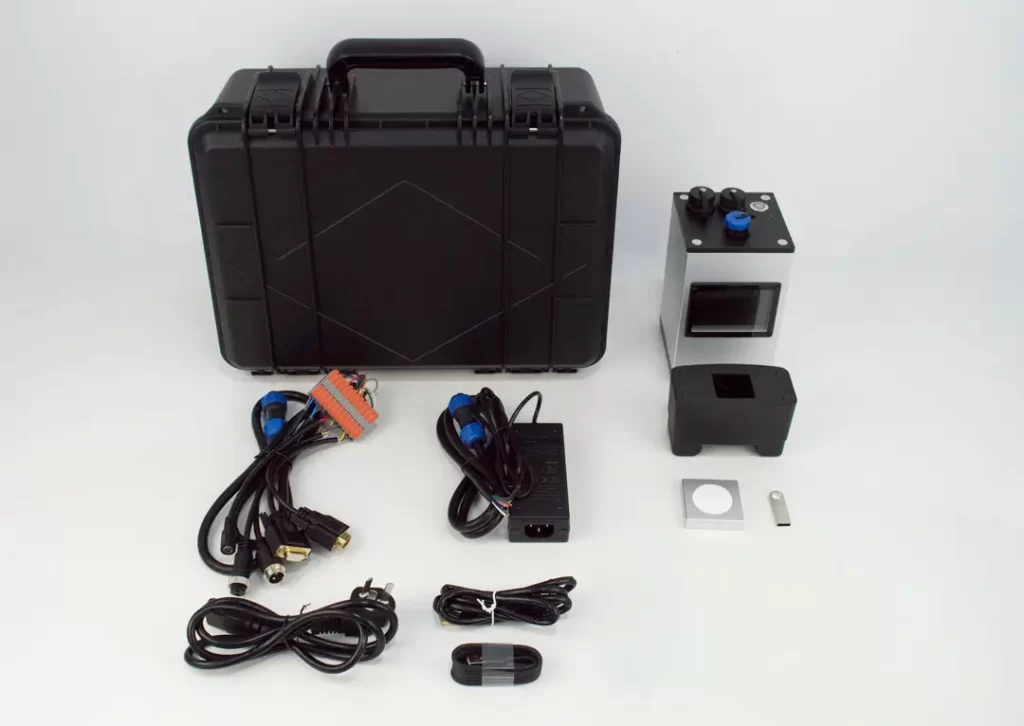
Non-Contact Color Spectrophotometer - Online Color Sensor
Real-time color measurement without touching the surface
This non contact spectrophotometer is designed for continuous, high-precision color monitoring in production environments. It uses a 45/0 optical geometry (45° circular illumination and 0° viewing angle) to accurately measure surface color without direct contact.
The built-in automatic calibration system eliminates manual adjustment, maintaining consistent performance over time. It is ideal for online color quality control of wet films, coatings, and other sensitive materials.
Key Features
- Suitable for inline color inspection in real-time processes
- Non-contact measurement distance: 5 mm
- Aperture size: 21 mm
- Repeatability: dE*ab ≤ 0.02
- Inter-station variation: dE*ab ≤ 0.25
This online spectrophotometer helps ensure uniform color across batches while reducing downtime and human error.
Application Scenarios
The non contact spectrophotometer is engineered for seamless integration into automated production lines across a wide range of industries:
- Anodization
The online spectrophotometer monitors surface color during the anodizing process to maintain consistent aluminum finishes. - Coating
During wet paint application, the non contact spectrophotometer ensures even color coverage before curing or drying. - Papermaking
Enables high-speed paper color monitoring without disrupting production, helping maintain quality in real time. - Automotive Spraying Line
Detects paint variation on car bodies directly on the spray line, reducing color mismatches with automated online spectrophotometer support. - Textile Production Line
Tracks fabric color consistency during dyeing and finishing, ensuring accurate color from start to finish. - Plastic Production Line
Provides inline color control for films, sheets, and molded parts. The non contact spectrophotometer continuously checks product color during extrusion and forming.

Product Detail Diagram
This non contact spectrophotometer is built for industrial-grade performance and easy integration into automated lines. The diagram below highlights the key components and hardware features:
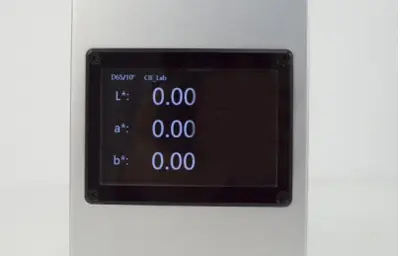
- Display Screen: Shows live L*, a*, b* color data for visual confirmation during production.
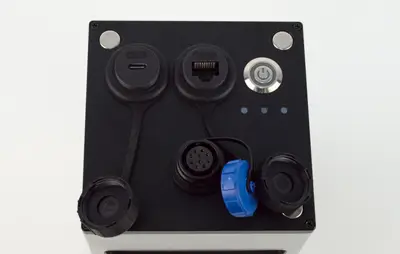
- Non-contact measurement Includes USB-C, Ethernet, and industrial multi-pin connectors to support data transfer and connection to control systems.
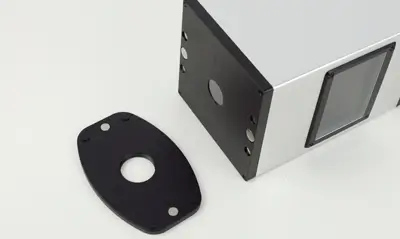
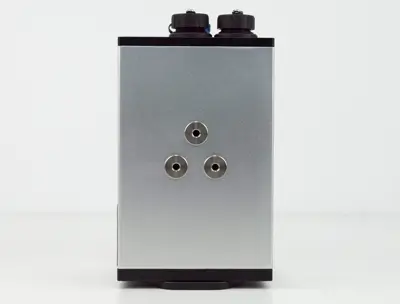
- Installing Caliber Plates / Testing Ports: Interchangeable testing ports allow flexible use with different materials and measurement requirements.
- Fixed Screw Interface: Ensures the online spectrophotometer is securely mounted for stable and accurate readings.
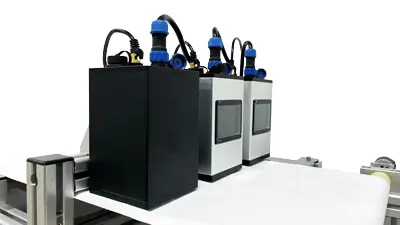
- Online Color Quality Control: Multiple non contact spectrophotometers can be deployed across the production line to provide comprehensive, multi-point color monitoring.
- Non-Contact Measurement: The device operates at a 5 mm distance from the surface, avoiding contact with sensitive materials and reducing wear, contamination, or distortion risks.
Display Screen
Interface, power switch
Installing caliber plates/testing ports
Fixed screwinterface
Online Color Quality Control
Non-contact measurement
- The dual-path spectral spectroscopy method for color measurement offers fast speed, high accuracy, and excellent repeatability.
- Capable of measuring multiple color indicators: reflectivity, CIE-Lab, LCh, Luv, XYZ, Yxy, Hunterlab, etc. Refer to the parameters for details.
- Waterproof and dustproof with a protection level of IP66.
- Supports multiple communication modes including RS232, RS485, USB, Ethernet port, and analog signal.
- Utilizes LED light sources for a longer lifespan.
- Supports internal calibration to ensure high stability of the instrument.
- Comes with powerful PC data management software as standard.
Model | TT-NCS60 | TT-NCS62 | TT-NCS66 |
Appearance color | Black | Silver | Silver |
Screen | / | Yes | Yes |
Repeatability | dE*ab≤0.1 | dE*ab≤0.05 | dE*ab≤0.02 |
Inter station difference | / | / | dE*ab≤0.25 |
Measurement indicators | 2 types | 27 types | 27 types |
Evaluate light sources | 3 types | 37 types | 37 types |
| Technical parameter | |||
|---|---|---|---|
Model | TT-NCS60 | TT-NCS62 | TT-NCS66 |
Measurement structure* | 45/0 | ||
Measurement repeatability** | dE*ab≤0.1 | dE*ab≤0.05 | dE*ab≤0.02 |
Inter station difference*** | / | / | dE*ab≤0.25 |
Display Accuracy | 0.01 | ||
Measurement/ lighting aperture | Φ8mm/Φ21mm | ||
Measurement indicators | CIE-Lab,XYZ | Spectral reflectance, CIE-Lab, CIE-LCh, HunterLab, CIE-Luv, XYZ, Yxy, RGB, chromatism(ΔE*ab, ΔE*cmc, ΔE*94, ΔE*00), whiteness(ASTME313-00, ASTME313-73, CIE,ISO2470/R457, AATCC, Hunter, Taube Berger Stensby), Yellowness(ASTMD1925, ASTME313-00, ASTME313-73), Black(My, dM), Colorfastness to staining, Color fastness, Tint(ASTME313-00), Color density CMYK(A, T, E, M) | |
Light source conditions | A,C,D65 | A,B,C,D50,D55,D65,D75,F1,F2,F3,F4,F5,F6,F7,F8,F9,F10,F11,F12,CWF,U30,U35,DLF,NBF,TL83,TL84,ID50,ID65,LED-B1,LED-B2,LED-B3,LED-B4,LED-B5,LED-BH1,LED-RGB1,LED-V1, LED-V2 | |
Lighting Source | Full band balanced LED light source | ||
Viewing Angle | 2°,10° | ||
Compliant with standards | CIE No.15, ISO7724-1, ASTME1164, DIN5033 Teil7 | ||
Spectral method | Nano spectral devices | Grating | |
A Sensor | Silicon optical array devices | Dual column high-precision CMOS array sensor | |
Wavelength Interval | 10nm | ||
Wavelength Range | 400-700nm | ||
Reflectivity measurement range | 0-200% | ||
Reflectivity resolution | 0.01% | ||
Measurement and Observation methods | Visual | ||
Calibration | Intelligent automatic calibration | ||
Accuracy assurance | Ensure that the first level measurement is qualified | ||
Time | SINGLE 110ms | SINGLE50ms | |
Measurement Interval | 1s | ||
Interface | USB,485,232,external trigger, Analog signal output, Ethernet | ||
Screen | / | Full color screen, 3.5 inches | |
Light source lifespan | 1 million times in 10 years | ||
Language | / | English and other | |
Non-contact distance | 5mm | ||
*45 ° angle circular lighting/0 ° angle reception **Measure the standard deviation of the whiteboard 30 times at 5-second intervals after calibration ***BCRA series II 12 color palette measurement average | |||