Choosing FTIR Spectrometers for Brazil's Fuel, Pharma, and Polymer Labs
A resin shipment arrives without a usable certificate. A diesel blend fails a distributor's spot check. A raw material drum reaches the dispensary floor unverified. Each case stops production until somebody confirms what the material actually is.
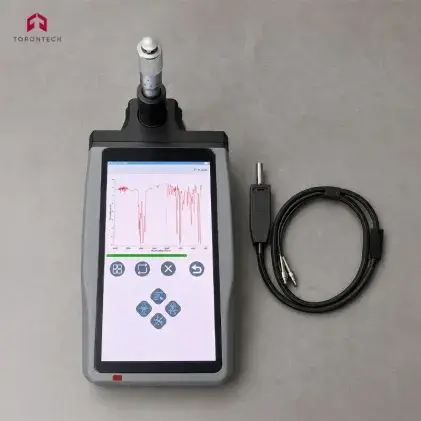
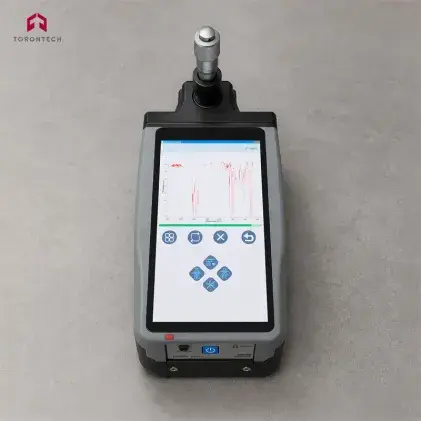
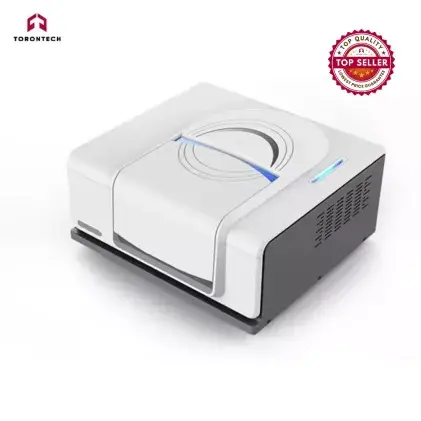
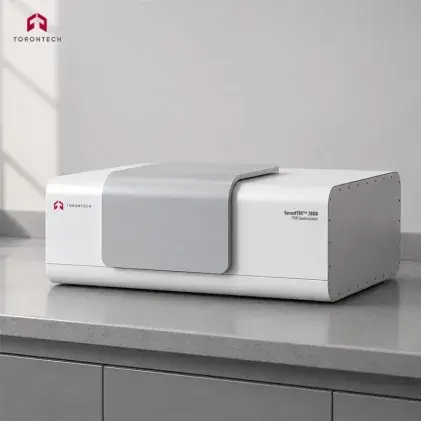
FTIR spectrometers in Brazil answer that question in minutes instead of days. Torontech supplies a full FTIR spectrometer range covering benchtop, portable, and handheld formats for laboratories and field teams nationwide.
Matching the Instrument to the Application
Format decides more than portability. It determines where the measurement happens, who runs it, and how quickly a decision follows.
| Format | Typical Setting | Common Applications |
|---|---|---|
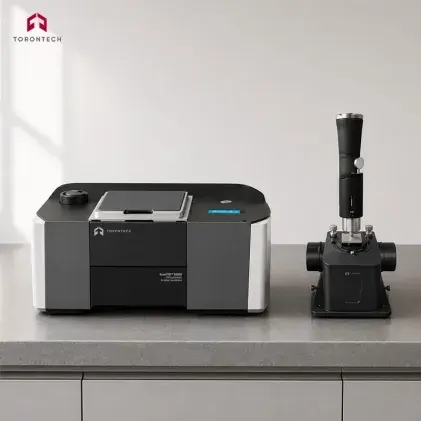
| Benchtop FTIR | Central QC laboratory | Routine identity testing, method development, library building |
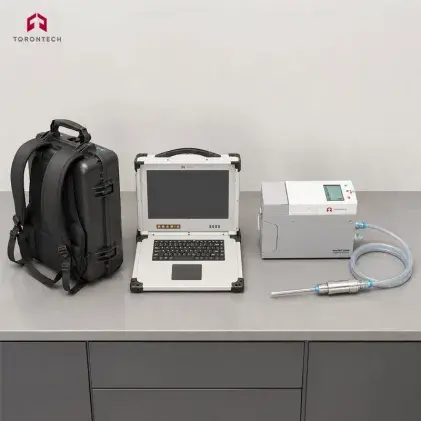
| Portable FTIR | Plant floor, depot, field site | On-site fuel screening, at-line process checks |
| Handheld FTIR or FTIR-Raman | Warehouse, receiving dock | Incoming material verification, often through packaging |
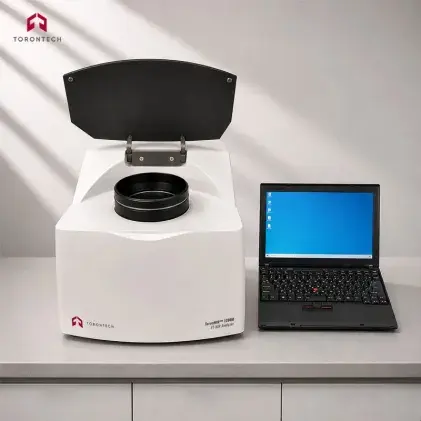
| FT-NIR analyzer | Process and agribusiness labs | Moisture, protein, and oil content in bulk streams |
Most laboratories eventually run more than one format. A benchtop unit anchors the method, while handheld units push verification out to the points where material enters the site.
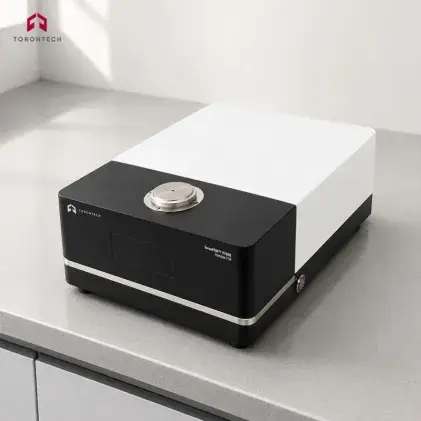
Sampling accessories matter just as much. Attenuated total reflectance handles solids, pastes, and viscous liquids with almost no preparation, which is why most incoming inspection now runs through an ATR crystal rather than pressed pellets.
Fuel and Biofuel Quality Under ANP Oversight
Brazil operates one of the world's most heavily blended fuel pools. Anhydrous ethanol goes into gasoline, and biodiesel goes into diesel at percentages the ANP revises over time.
That mandate creates a continuous verification burden. Refiners, distributors, and biodiesel producers confirm blend content and screen for adulteration before product moves further down the chain.
Ethanol carries its own checks. Producers and blenders watch water content and contaminants closely, because both affect blend stability and engine performance downstream.
Infrared analysis fits this work well. Ester carbonyl and hydroxyl bands produce clear signals, so a calibrated instrument reports blend content quickly with minimal sample preparation. ASTM D7371 describes the FTIR approach many fuel laboratories follow for biodiesel content in diesel.
Identity Testing in Regulated and Polymer Sectors
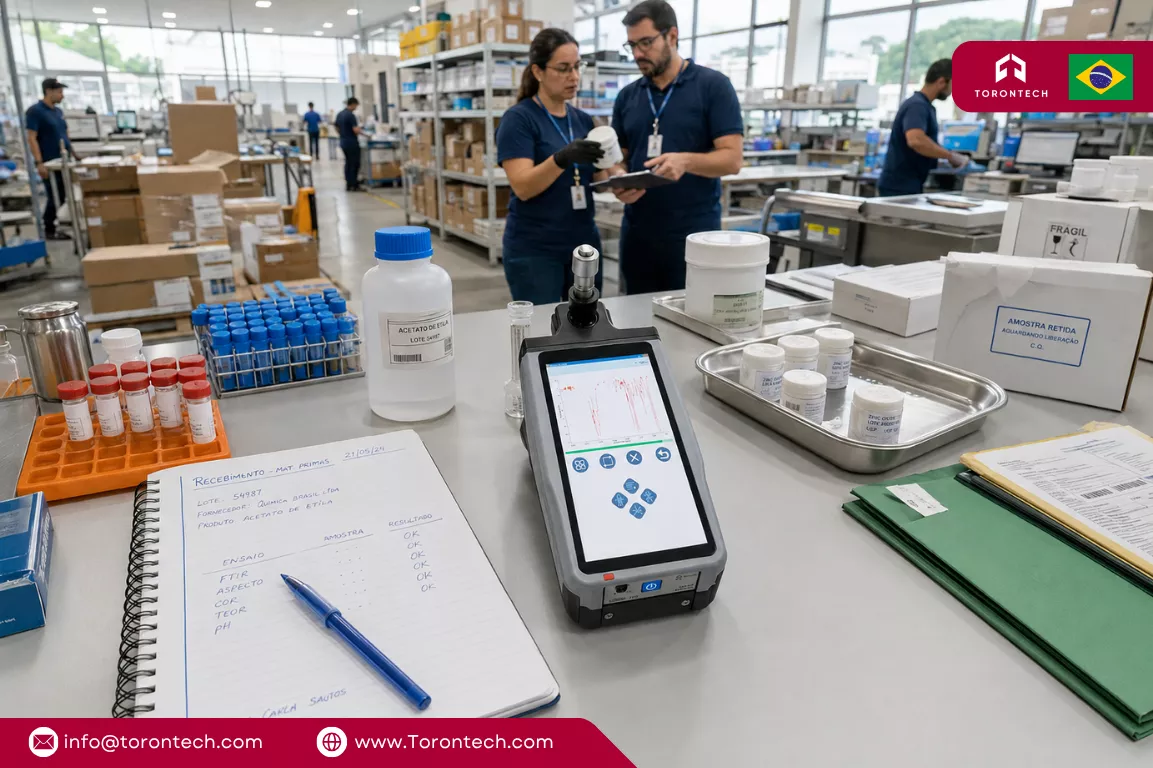
ANVISA's good manufacturing practice framework pushes pharmaceutical manufacturers toward documented identity checks on incoming materials. A handheld FTIR spectrometer lets technicians verify drums at the receiving dock without opening every container.
Polymer and rubber processors face a parallel problem. Compounders in São Paulo, Paraná, and Rio Grande do Sul confirm polymer grades, filler systems, and recyclate composition before material enters a batch.
Recycled feedstock raises the stakes further. Infrared identification separates polymer families reliably, which protects downstream properties when post-consumer material joins the formulation.
Library quality drives the result more than headline instrument performance. A match against a thin reference set returns confident-looking answers that will not survive an audit.
Agribusiness adds a fourth demand center. Crushing plants and feed mills use FT-NIR calibrations to track moisture, protein, and oil across grain and oilseed streams. Those calibrations need revalidation as crop profiles shift between harvests.
Emissions Work and Field Deployment
CONAMA sets emission limits for stationary sources, and state environmental agencies enforce them through periodic testing. Multi-gas infrared analysis measures several species in a single pass, which shortens stack survey work considerably.
Response time counts here. Continuous infrared measurement catches transient peaks that grab-sample methods miss, which helps operators trace an excursion back to a specific process condition.
A portable FTIR gas analyzer also supports industrial hygiene surveys and process troubleshooting. Field teams bring the instrument to the source rather than shipping samples to a distant laboratory.
Sourcing FTIR Spectrometers in Brazil
Brazil imports most analytical instrumentation, so lead time, documentation, and after-sales support carry real weight in procurement decisions. Buyers comparing FTIR spectrometers in Brazil should press suppliers on all three.
Laboratories pursuing INMETRO accreditation under ISO/IEC 17025 also need calibration records and traceable documentation for every instrument inside their scope.
Operator training deserves the same scrutiny. An instrument that arrives without Portuguese-language support or proper commissioning often sits underused while staff work through unfamiliar software.
Before you commit to a configuration, confirm these points:
- Spectral range and resolution matched to your target analytes
- Detector type, and how it affects sensitivity against cost
- Sampling accessories, including ATR crystals suited to your matrices
- Spectral library coverage across your material classes
- Local service, spare parts, and calibration support
Specify a Configuration Around Your Actual Samples
FTIR covers an unusually wide span of work. The right instrument depends on your materials, your throughput, and where in the workflow the measurement needs to happen.
Torontech works with Brazilian laboratories to match format, sampling accessory, and library coverage to the analytical problem in front of them. That might mean a benchtop system for method development, or several handheld units spread across receiving points.
Tell us your sample types and testing volume, then reach out to the Torontech team to specify an instrument that fits how your laboratory actually runs.