Handheld FTIR and Raman Spectrometer - ToronFTIR™ H7800M
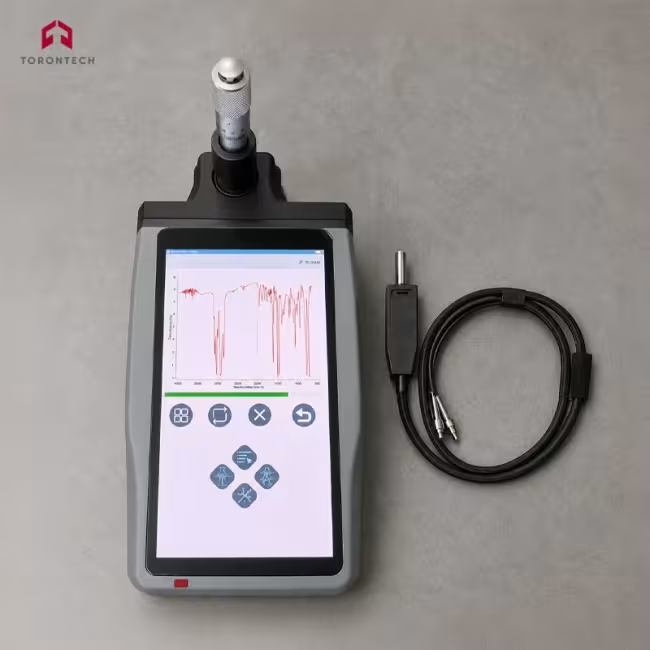
ToronFTIR™ H7800M is a Handheld FTIR and Raman Spectrometer spectrometer that brings rapid, non-destructive material identification to the field. The instrument reads a sample's molecular fingerprint and matches it against an onboard library, so an operator confirms what a material is in seconds without sending it to a lab. A dual-mode design pairs Fourier transform infrared analysis with Raman, which widens the range of materials the unit can identify. At 1.5 kg and 185 by 110 by 55 mm, the H7800M fits in one hand and travels to the sample rather than the reverse.
The ToronFTIR™ H7800M identifies organic and inorganic compounds, polymers, liquids, explosives, pharmaceuticals, and gemstones. The infrared section covers 7,800 to 550 cm⁻¹ at a resolution better than 2 cm⁻¹, while the Raman section reads 4,000 to 170 cm⁻¹ with a choice of 532, 785, or 1,064 nm laser excitation. Because infrared and Raman respond to different molecular motions, the two modes complement each other: Raman reads through transparent packaging and handles water-rich samples, while infrared resolves functional groups that Raman shows weakly. An onboard library of 20,000 to 250,000 spectra supports identification across the configured industry.
The ToronFTIR™ H7800M suits customs and border inspection, environmental and hazmat response, incoming quality control, petrochemical work, and food safety screening. An audit-trail function and IQ, OQ, and PQ qualification support help regulated users keep traceable records. Attachments for ATR, diffuse reflectance, and non-contact external reflection extend the instrument to more sample formats.
Handheld FTIR and Raman Spectrometer - ToronFTIR™ H7800M Applications
The ToronFTIR™ H7800M supports fast, on-site identification across security, environmental, and industrial settings.
- Customs and Border Inspection: identifies unknown substances, controlled drugs, and suspicious materials at the point of inspection.
- Hazardous Material and Emergency Response: screens explosives such as HMX, hazardous liquids, and unknowns, with Raman allowing measurement through sealed containers.
- Raw Material and Finished Product QC: verifies incoming materials and finished goods against reference libraries away from the lab.
- Petrochemical and Chemical: identifies solvents, intermediates, and polymers during plant and field work.
- Food Safety: screens ingredients and finished products for identity and adulteration on site.
- Plastics and Polymer Identification: distinguishes PE, PVC, PP, PC, Nylon 6, ABS, and other polymers for sorting and QC.
- Pharmaceutical and Gemstone Screening: confirms drug identity and appraises jewelry without damaging the sample.
Handheld FTIR and Raman Spectrometer - ToronFTIR™ H7800M Key Features
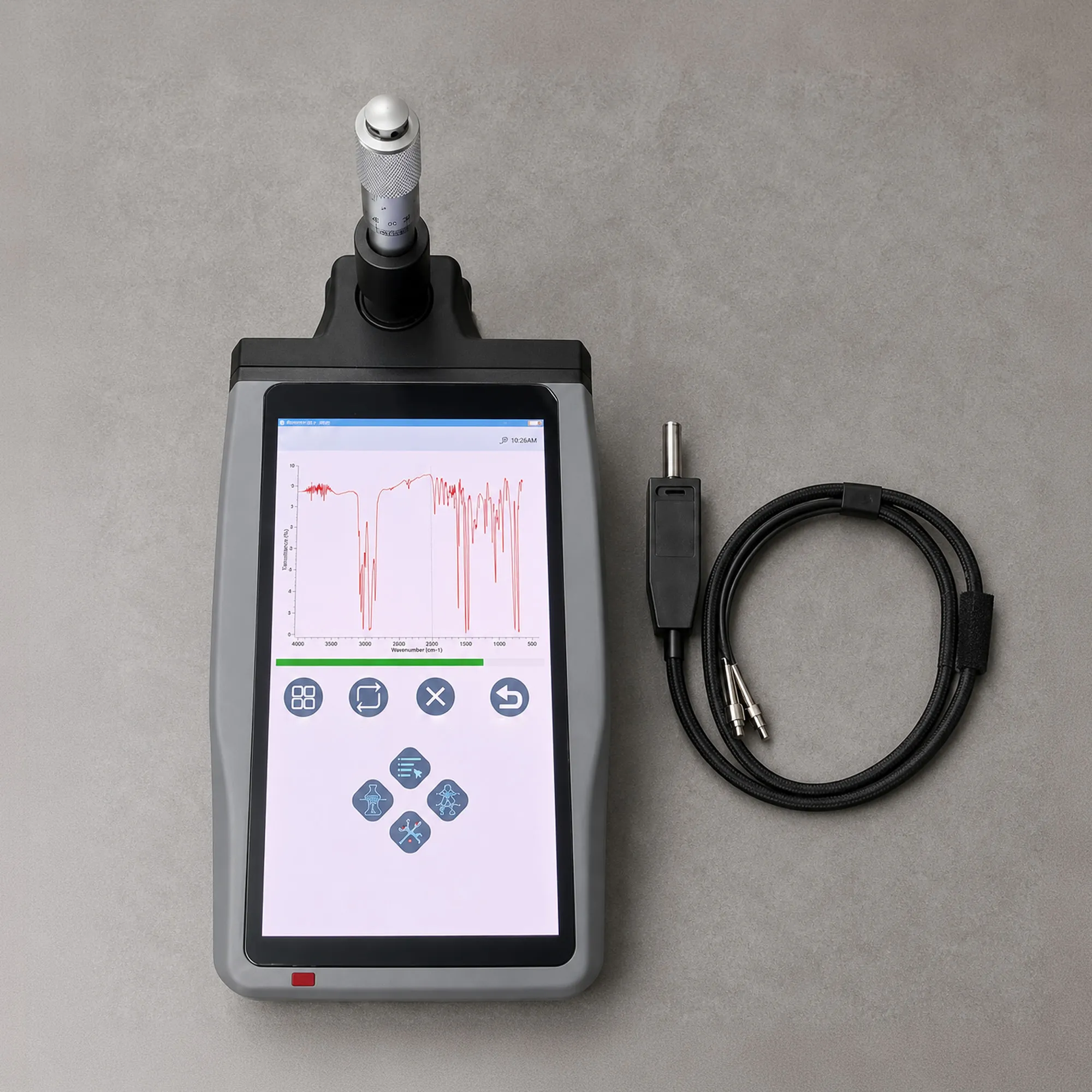
The ToronFTIR™ H7800M combines a pocketable form factor with dual-technique identification and field-ready data tools.
- Handheld, Field-Ready Design: a 1.5 kg unit measuring 185 by 110 by 55 mm travels to the sample for on-site work.
- Dual FTIR and Raman Modes: two complementary techniques in one instrument widen the range of identifiable materials.
- Non-Destructive Identification: reads samples directly without damage, so evidence and product stay intact.
- Wide Infrared Range: covers 7,800 to 550 cm⁻¹ at a resolution better than 2 cm⁻¹ for clear functional-group information.
- Raman Coverage to Low Wavenumbers: reads 4,000 to 170 cm⁻¹ at a resolution better than 8 cm⁻¹ for structural detail.
- Multiple Laser Options: 532, 785, and 1,064 nm excitation is available to match different materials and manage fluorescence.
- CCD Raman Detector: captures Raman spectra quickly for fast on-site identification.
- Large Onboard Library: 20,000 to 250,000 reference spectra support identification across the configured industry.
- Flexible Sampling: ATR, diffuse reflectance, and non-contact external reflection attachments extend the unit to many formats.
- Audit-Trail Function: records operator actions and results to support data integrity in regulated use.
- Qualification Support: IQ, OQ, and PQ routines help laboratories qualify and document the instrument.
- Long-Life Infrared Source: a high-intensity, air-cooled source gives steady output with a long service life.
Theory and Method
Fourier transform infrared spectroscopy identifies materials by the way their molecular bonds absorb infrared light. Each bond vibrates at characteristic frequencies, so the pattern of absorbed wavelengths forms a fingerprint unique to a material. The ToronFTIR™ H7800M builds this spectrum with a Michelson interferometer and a Fourier transform, recording all infrared wavelengths in a single measurement for a fast result at the point of need.
Raman spectroscopy adds a complementary view. A laser illuminates the sample, and a small fraction of the scattered light shifts in energy by the amount of a molecular vibration, a phenomenon called the Raman effect. Bonds that appear weakly in infrared often scatter strongly in Raman, so the two methods together identify more materials than either alone. Raman also reads through glass and clear plastic and works well on water-containing samples, while the choice of 532, 785, or 1,064 nm excitation helps manage fluorescence from different materials.
Turning a spectrum into an identity relies on matching. The instrument compares the measured infrared or Raman spectrum against its onboard library and reports the closest matches. Attachments for ATR, diffuse reflectance, and non-contact external reflection let the operator measure solids, powders, liquids, and films in the form that gives the cleanest spectrum, all from a 1.5 kg handheld unit.
Handheld FTIR and Raman Spectrometer - ToronFTIR™ H7800M Technical Specifications
General
| Parameter | Specification |
|---|---|
| Dimensions | 185 × 110 × 55 mm |
| Weight | 1.5 kg |
| Reference Library | 20,000 to 250,000 spectra (by configuration) |
| Sampling Options | ATR, diffuse reflectance, non-contact external reflection |
| Data Integrity | Audit trail; IQ / OQ / PQ qualification support |
Infrared (FTIR) Parameters
| Parameter | Specification |
|---|---|
| Spectral Range | 7,800 to 550 cm⁻¹ |
| Resolution | Better than 2 cm⁻¹ |
| Detector | Infrared detector |
| Beamsplitter | Moisture-proof coated |
| Infrared Source | Long-life, high-intensity, air-cooled |
| Scanning Speed | Computer-controlled, selectable |
Raman Parameters
| Parameter | Specification |
|---|---|
| Raman Range | 4,000 to 170 cm⁻¹ |
| Resolution | Better than 8 cm⁻¹ |
| Detector | CCD |
| Laser Options | 532 nm, 785 nm, 1,064 nm (optional) |
| Scanning Speed | Computer-controlled, selectable |