Portable FTIR Gas Analyzer - ToronFTIR™ G12000
ToronFTIR™ G12000 is a portable FTIR gas analyzer built for continuous emissions and VOC monitoring at fixed pollution sources such as coal-fired power, steel, cement, and waste-incineration plants. The instrument reads the infrared fingerprint of a flowing gas sample and quantifies dozens of components at once, from combustion gases like SO₂, NO, and CO to a wide list of volatile organic compounds. A heated, corrosion-protected sample cell lets the analyzer work directly on hot, humid, and corrosive flue gas without losing reactive or condensable species.
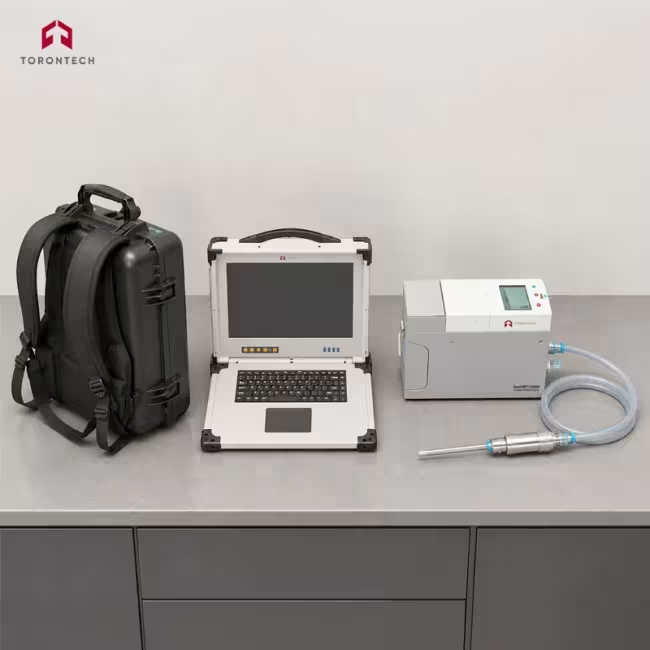
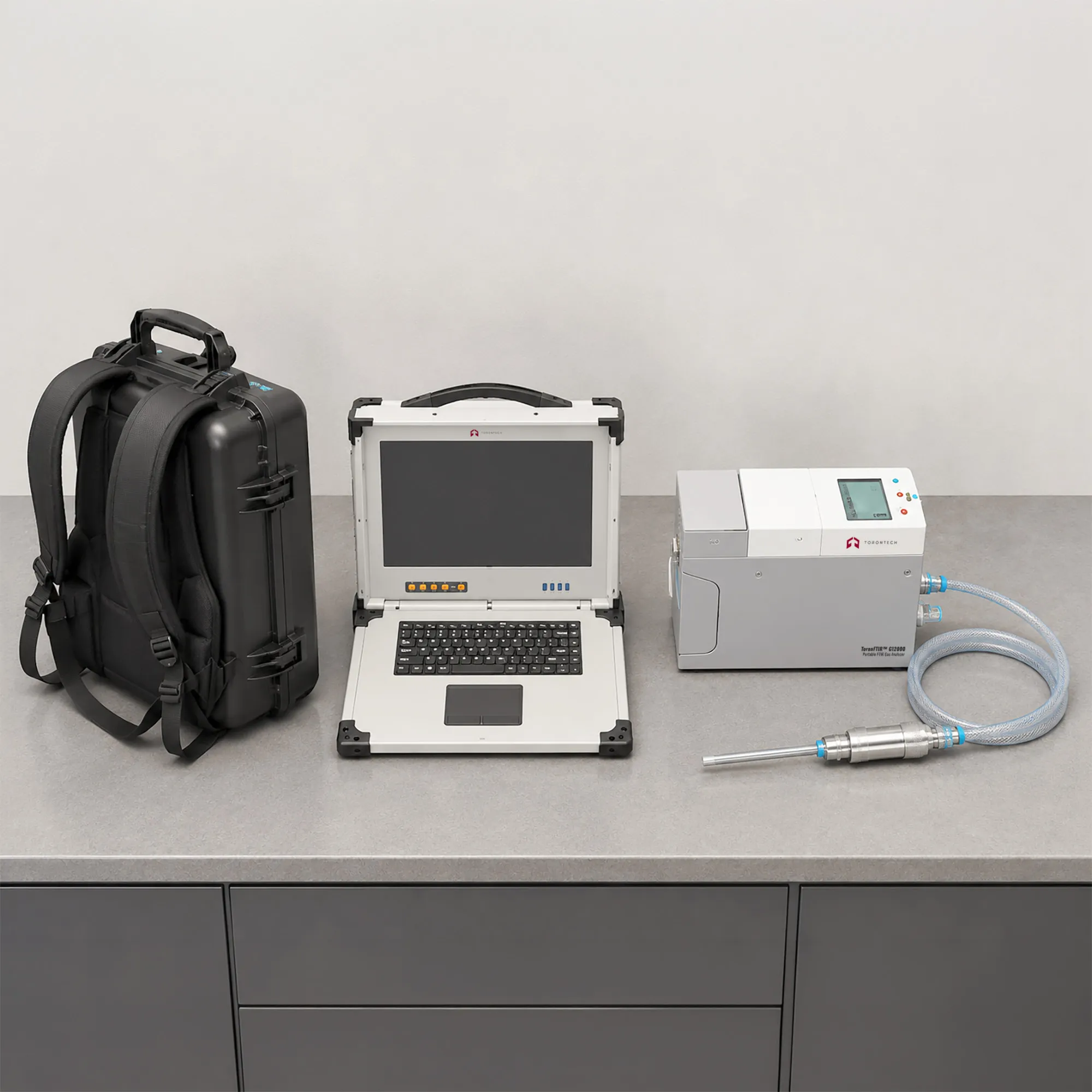
The ToronFTIR™ G12000 pairs the analyzer with a full-process heated sampling system and a flue-gas pretreatment stage, so the sample reaches the cell at temperature and free of dust. A room-temperature DTGS detector removes any need for liquid-nitrogen or thermoelectric cooling, which keeps field operation simple. Battery power, a portable workstation, and a transport case make the system practical for stack surveys, mobile audits, and emergency response away from mains power.
The analyzer measures more than fifty gas components as standard and accepts a customized gas menu on request. Software handles multi-point calibration, dry and wet concentration conversion, temperature and pressure compensation, and automatic correction of cross-interference between components. Continuous logging, trend charts, spectral replay, and Excel export give operators a full record for reporting and later review.
Portable FTIR Gas Analyzer - ToronFTIR™ G12000 Applications
The ToronFTIR™ G12000 supports emissions compliance, process monitoring, and safety work across heavy industry and environmental services.
- Fixed-Source Emissions Monitoring: measures stack gas at coal-fired power, steel, cement, glass, and waste-incineration plants for regulatory reporting.
- VOC Compliance Monitoring: quantifies organized VOC emissions in industrial flue gas across many organic species in one scan.
- Hot, Humid, Corrosive Flue Gas: heated sampling and anti-corrosion optics handle demanding stack conditions that defeat cold-cell analyzers.
- Environmental Emergency Response: screens inorganic hazardous gases and toxic organics in ambient air during spills and incidents.
- Process and Combustion Optimization: tracks CO, CO₂, NOx, and hydrocarbons to tune burners and reduce fuel use.
- Industrial Hygiene and Safety: detects toxic gases such as HCl, HF, HCN, phosgene, and carbon disulfide around production areas.
- Research and Method Development: builds spectral libraries and studies multi-component gas mixtures in academic and industrial labs.
Portable FTIR Gas Analyzer - ToronFTIR™ G12000 Key Features
The ToronFTIR™ G12000 combines simultaneous multi-gas analysis with rugged, field-ready sampling.
- Simultaneous Multi-Gas Analysis: measures more than fifty gas components in a single scan, with a customizable gas menu on request.
- Room-Temperature DTGS Detector: operates without liquid-nitrogen or thermoelectric cooling, which simplifies field deployment.
- Long 4.5-Meter Optical Path: a folded long-path cell lowers detection limits for trace pollutants.
- Heated, Corrosion-Resistant Cell: anti-corrosion coatings and 180 °C heating allow direct measurement of wet, acidic flue gas.
- Full-Process Heated Sampling: heated probe and lines above 180 °C prevent condensation and loss of reactive species.
- Three-Stage Filtration: high-temperature, corrosion-resistant filters remove 0.5 to 5 µm particles before the cell.
- Fast Scanning: at least five scans per second supports rapid trend tracking and averaging.
- Dry and Wet Conversion: reports concentrations on both a dry and wet basis to match reporting requirements.
- Temperature and Pressure Compensation: corrects for site conditions and automatically resolves cross-interference between gases.
- Continuous Logging and Trends: records spectra, displays concentration trend charts, and replays saved spectra for review.
- Excel Data Export: saves results in a spreadsheet format ready for report preparation.
- Portable Battery Operation: mobile lithium power packs and a transport case support stack surveys and remote audits.
- One-Click Remote Diagnostics: generates a status file operators can send to service engineers for support.
Theory and Method
Fourier transform infrared gas analysis identifies and quantifies gases by the way their molecules absorb infrared light. Each gas absorbs at characteristic wavenumbers set by the vibration of its chemical bonds, so a mixture produces a combined spectrum that the software separates into individual components. The ToronFTIR™ G12000 records the full spectrum in a single measurement rather than scanning one wavelength at a time, which lets it report many gases at once and repeat the measurement several times each second.
At the core sits a Michelson interferometer. A beamsplitter with moisture-proof windows divides the infrared beam into two paths that reflect off a fixed and a moving mirror. Recombining the beams produces an interferogram, and a Fourier transform converts it into an absorbance spectrum. The Beer-Lambert relationship then links absorbance to concentration: a longer optical path and higher absorbance mean more molecules in the beam. A folded path of at least 4.5 meters inside a sub-1-liter cell gives the sensitivity needed for low-level pollutants.
Sample handling decides accuracy as much as the optics. Reactive and condensable gases such as HCl, HF, NH₃, and water stick to cold surfaces or drop out as the sample cools, which biases the reading. The ToronFTIR™ G12000 keeps the probe, sample lines, and cell above 180 °C along the entire path, so the sample stays in the vapor phase from stack to detector. Anti-corrosion coatings protect the cell and reflector from acidic flue gas during extended field runs.
Portable FTIR Gas Analyzer - ToronFTIR™ G12000 Technical Specifications
| Parameter | Specification |
|---|---|
| Measurement Principle | Fourier transform infrared (FTIR) |
| Detector | DTGS, room-temperature operation (no cooling required) |
| Beamsplitter | Moisture-proof window material |
| Wavenumber Range | 600 to 4500 cm⁻¹ (minimum) |
| Spectral Resolution | 4 cm⁻¹ standard, 1 cm⁻¹ optional |
| Scanning Frequency | ≥ 5 scans per second |
| Optical Path Length | ≥ 4.5 m |
| Sample Cell Volume | < 1.0 L |
| Sample Cell Heating | ≥ 180 °C |
| Corrosion Protection | Anti-corrosion coating on sample cell and reflector |
| Indication Error (CO₂) | Within ±5% |
| Indication Error (other gases) | ±5% relative for range > 60 µmol/mol; ±3 µmol/mol absolute for range ≤ 60 µmol/mol |
| Zero Drift | Within ±3% |
| Span Drift | Within ±3% |
| Sample Flow Influence | ≤ ±2.0% FS |
| Ambient Temperature Influence | ≤ ±5.0% FS |
| Supply Voltage Influence | ≤ ±2.0% FS |
| Data Export | Excel format |
| Voltage | AC 220 V, 50 Hz, 300 W (110V is also available) |
Sampling and Pretreatment System
| Parameter | Specification |
|---|---|
| Heated Sampling System | Full-process heating, ≥ 180 °C constant temperature |
| Sampling Flow Rate | ≥ 1.8 L/min |
| Pump Force | ≥ 80 kPa |
| Filtration | Three-stage dust removal; high-temperature, corrosion-resistant, non-absorbent; 0.5 to 5 μm |
| Heated Sample Lines | ≥ 5 m and ≥ 1 m, ≥ 180 °C, with duct temperature display |
| Heated Sampling Probe | ≥ 1 m, ≥ 180 °C, front-end dust filter |
| Flue Gas Cooling | Two-stage semiconductor cooling, ≥ 80 NL/h, cool-down ≤ 30 min |
| Sample Gas Inlet Temperature | ≤ 180 °C |
| Outlet Dew Point | ≤ 5 °C |
| Precision Filtration | 0.1 μm, L = 50 mm |
| Exhaust Capacity | 3.3 NL/min |
| Anti-Negative-Pressure Capacity | -5000 Pa, 1 L/min |
| Sampling Chamber Heating | ≥ 120 °C |
| Stainless Steel Probe | ≥ 1 m, heated line ≥ 3 m, ≤ 2 μm pre-filter |
| Phosphoric Acid Titration Device | 20% to 80% concentration, peristaltic pump 1 to 5 rpm/min |
Standard Configuration
| Item | Quantity | Description |
|---|---|---|
| Portable FTIR Gas Analyzer Main Unit | 1 set | Main analyzer unit |
| Full-Process Heated Sampling System | 1 set | Heated probe (≥ 1 m), heated lines (≥ 5 m and ≥ 1 m), heated sampler |
| Portable Transport Case | 1 | Field carry case |
| Primary Metal Filter Elements | 2 | First-stage filtration |
| Secondary Metal Filters | 2 | Second-stage filtration |
| Tertiary Metal Filter Elements | 2 | Third-stage filtration |
| Analysis Software System | 1 set | Multi-substance quantitative analysis |
| Factory Gas Calibration Spectral Library | 1 set | Pre-loaded calibration spectra |
| Qualitative / Semi-Quantitative Libraries | ≥ 200 | Reference spectral libraries |
| Mobile Workstation | 1 | i7 CPU, 32 GB RAM, 1 TB storage, 14-inch 2.5K touchscreen |
| Mobile Lithium Power Sources | 2 | 24 V, 55 Ah, 1500 W rated / 5000 W peak, 8 kg each |
| Flue Gas Pretreatment System | 1 set | Cooling, filtration, and conditioning |
| Portable Printer | 1 | On-site report printing |
Measurable Gas Components
The analyzer quantifies the following components as standard. Ranges are in mg/m³ unless marked %Vol, and cover a lower and an upper calibration span.
| Gas Component | Formula | Lower Range | Upper Range |
|---|---|---|---|
| Oxygen | O₂ | 0 to 20.9 %Vol | - |
| Carbon monoxide | CO | 0 to 75 | 0 to 1000 |
| Nitric oxide | NO | 0 to 80 | 0 to 600 |
| Nitrogen dioxide | NO₂ | 0 to 50 | 0 to 600 |
| Nitrous oxide | N₂O | 0 to 50 | 0 to 400 |
| Sulfur dioxide | SO₂ | 0 to 75 | 0 to 1000 |
| Ammonia | NH₃ | 0 to 15 | 0 to 50 |
| Hydrogen chloride | HCl | 0 to 15 | 0 to 100 |
| Hydrogen fluoride | HF | 0 to 15 | 0 to 50 |
| Hydrogen cyanide | HCN | 0 to 50 | 0 to 100 |
| Methane | CH₄ | 0 to 200 | 0 to 2000 |
| Propane | C₃H₈ | 0 to 50 | 0 to 1000 |
| Ethylene | C₂H₄ | 0 to 50 | 0 to 1000 |
| Formaldehyde | HCHO | 0 to 50 | 0 to 100 |
| Benzene | C₆H₆ | 0 to 50 | 0 to 100 |
| Toluene | C₇H₈ | 0 to 100 | 0 to 1000 |
| Styrene | C₈H₈ | 0 to 100 | 0 to 1000 |
| Water vapor | H₂O | 0 to 25 %Vol | 0 to 40 %Vol |
| Carbon dioxide | CO₂ | 0 to 25 %Vol | - |
| Propylene | C₃H₆ | 0 to 100 | 0 to 1000 |
| Ethylbenzene | C₈H₁₀ | 0 to 100 | 0 to 1000 |
| Acetylene | C₂H₂ | 0 to 15 | 0 to 50 |
| Acrolein | C₃H₄O | 0 to 50 | 0 to 100 |
| Phenol | C₆H₆O | 0 to 100 | 0 to 1000 |
| Nitrobenzene | C₆H₅NO₂ | 0 to 150 | 0 to 1000 |
| m-Xylene | C₈H₁₀ | 0 to 120 | 0 to 1000 |
| p-Xylene | C₈H₁₀ | 0 to 120 | 0 to 1000 |
| o-Xylene | C₈H₁₀ | 0 to 120 | 0 to 1000 |
| Ethane | C₂H₆ | 0 to 50 | 0 to 1000 |
| TVOC | - | 0 to 50 | 0 to 1000 |
| Hexane | C₆H₁₄ | 0 to 200 | 0 to 1000 |
| Cyclohexane | C₆H₁₂ | 0 to 120 | 0 to 1000 |
| Acetic acid | C₂H₄O₂ | 0 to 25 | 0 to 50 |
| Acetone | C₃H₆O | 0 to 100 | 0 to 1000 |
| Methanol | CH₃OH | 0 to 100 | 0 to 1000 |
| Ethanol | C₂H₅OH | 0 to 100 | 0 to 1000 |
| Dichloromethane | CH₂Cl₂ | 0 to 100 | 0 to 1000 |
| Chloroform | CHCl₃ | 0 to 100 | 0 to 1000 |
| 1,1-Dichloroethane | C₂H₄Cl₂ | 0 to 30 | 0 to 1000 |
| Dichloroethylene | C₂H₂Cl₂ | 0 to 200 | 0 to 1000 |
| Trichloroethylene | C₂HCl₃ | 0 to 100 | 0 to 1000 |
| Tetrachloroethylene | C₂Cl₄ | 0 to 200 | 0 to 1000 |
| Methyl acetate | C₃H₆O₂ | 0 to 100 | 0 to 1000 |
| Amine (verify) | C₃H₈N | 0 to 130 | 0 to 1000 |
| Chlorobenzene | C₆H₅Cl | 0 to 100 | 0 to 1000 |
| Acrylonitrile | C₃H₃N | 0 to 180 | 0 to 1000 |
| Carbon disulfide | CS₂ | 0 to 15 | 0 to 50 |
| Aniline | C₆H₅NH₂ | 0 to 100 | 0 to 1000 |
| Vinyl chloride | C₂H₃Cl | 0 to 100 | - |
| Acetaldehyde | C₂H₄O | 0 to 100 | 0 to 1000 |
| Acetic anhydride | C₄H₆O₃ | 0 to 200 | 0 to 1000 |
The instrument also carries qualitative and semi-quantitative reference spectra for additional compounds, including ethanethiol, ethylamine, acetophenone, bromoethane, butane, sulfur hexafluoride, nitrogen trifluoride, ethyl acetate, acetic anhydride, diethyl ether, dimethyl disulfide, dimethylamine, phosgene, perfluoropropane, chloroethane, methyl mercaptan, dimethyl sulfide, methylamine, methyl formate, furfuryl alcohol, n-butanol, isopropanol, heptane, carbon tetrachloride, trichloromethane, trimethylamine, and propanol. The gas menu and ranges can be customized to the customer's application.
Factory Gas Calibration Components
| Gas Component | Formula | Calibration Range |
|---|---|---|
| Sulfur dioxide | SO₂ | 0 to 1000 ppm |
| Nitric oxide | NO | 0 to 2000 ppm |
| Nitrogen dioxide | NO₂ | 0 to 500 ppm |
| Carbon monoxide | CO | 0 to 5000 ppm |
| Carbon dioxide | CO₂ | 0 to 90% |
| Ammonia | NH₃ | 0 to 500 ppm |
| Hydrogen chloride | HCl | 0 to 200 ppm |
| Water vapor | H₂O | 0 to 30% |
| Nitrous oxide | N₂O | 0 to 500 ppm |
| Methane | CH₄ | 0 to 2000 ppm |
| Ethane | C₂H₆ | 0 to 100 ppm |
| Propane | C₃H₈ | 0 to 100 ppm |
| Hydrogen fluoride | HF | 0 to 100 ppm |
| Benzene | C₆H₆ | 0 to 100 ppm |
| Toluene | C₇H₈ | 0 to 100 ppm |
| Ethylbenzene | C₈H₁₀ | 0 to 100 ppm |
| Styrene | C₈H₈ | 0 to 100 ppm |