FTIR Spectrometer for Rubber Identification - ToronFTIR™ R4000
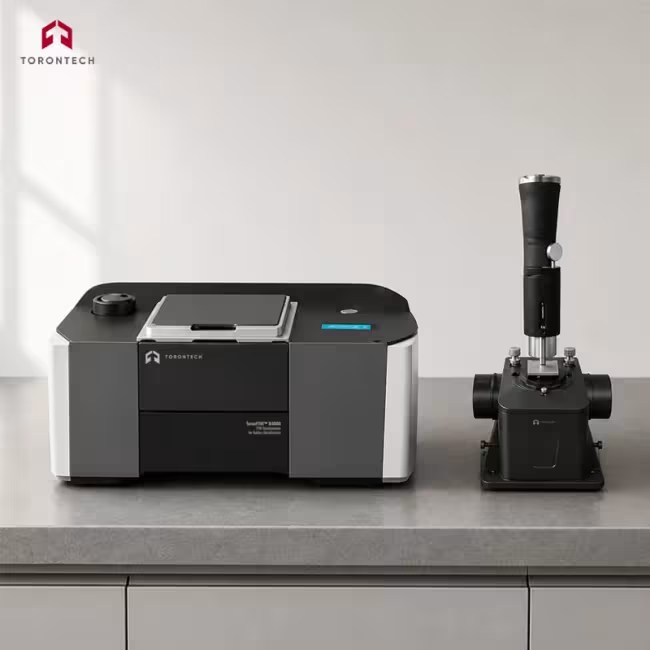
ToronFTIR™ R4000 is a compact FTIR spectrometer for rubber identification and the qualitative and quantitative analysis of organic compounds, inorganic compounds, and polymers. The instrument reads the infrared fingerprint of a sample and matches it against reference spectra to confirm the base elastomer and detect additives. A cost-conscious design keeps installation, daily operation, and maintenance straightforward, so labs can bring the R4000 online without specialist support. Flexible sampling options let the same platform handle cured rubber, raw compounds, powders, and films.
The ToronFTIR™ R4000 scans the 4000 to 400 cm⁻¹ mid-infrared region at a resolution better than 1 cm⁻¹, which resolves the closely spaced bands that separate one elastomer from another. A signal-to-noise ratio of 30,000:1 supports clean spectra even on weakly absorbing samples. An audit-trail function records operator actions and measurement history, which helps regulated labs keep traceable data. The compact 25 kg benchtop footprint fits standard lab benches without a dedicated room.
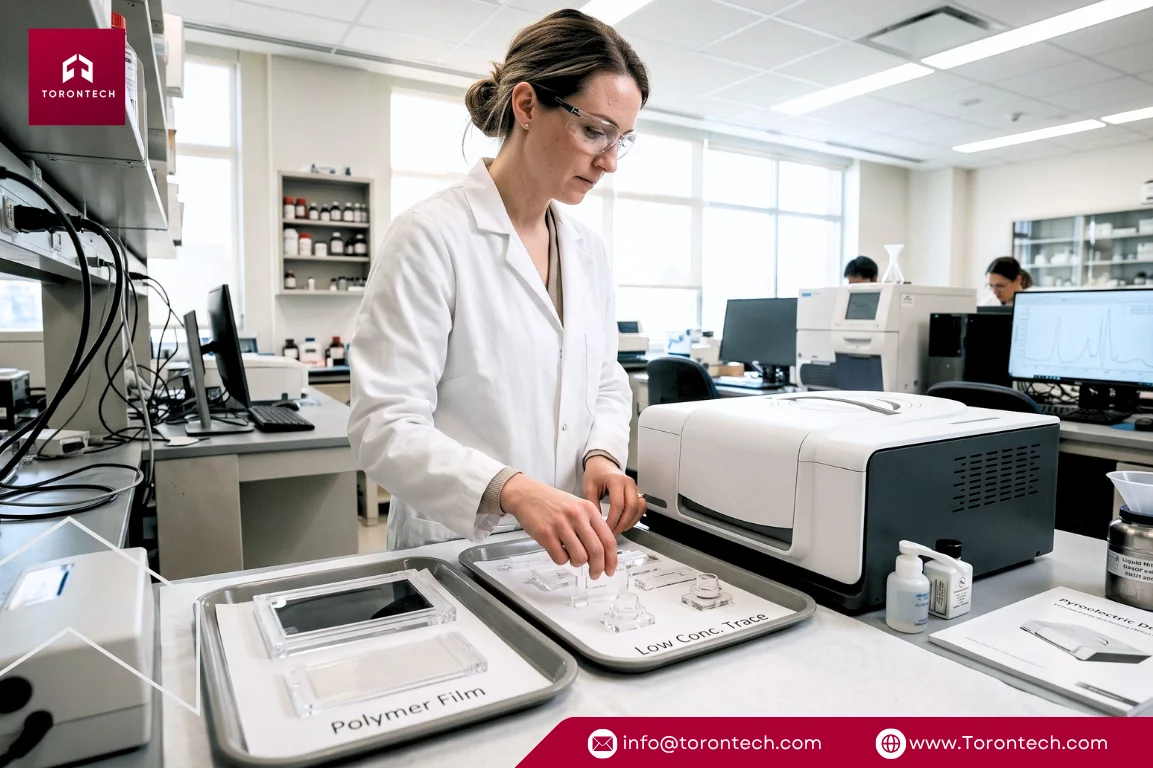
The ToronFTIR™ R4000 suits rubber and tire manufacturers, polymer processors, and material-testing labs that verify incoming compounds and investigate product defects. Expansion attachments for diffuse reflectance, ATR attenuated total reflection, and non-contact external reflection widen the range of samples the instrument can measure. This flexibility makes the R4000 a practical identification tool for both routine QC and research work.
FTIR Spectrometer for Rubber Identification - ToronFTIR™ R4000 Applications
The ToronFTIR™ R4000 supports rubber and polymer identification across production, quality control, and research environments.
- Rubber and Tire Manufacturing: identifies base polymers, verifies compound formulations, and compares cured and uncured batches for consistency.
- Polymer and Plastics Quality Control: differentiates resins, additives, and fillers to confirm material grade before production.
- Incoming Raw Material Verification: checks the identity of elastomers, chemicals, and reagents against reference spectra at goods-in.
- Failure and Contamination Analysis: traces defects, foreign material, and degradation to their molecular source during root-cause work.
- Recycling and Material Sorting: classifies polymer and rubber types in mixed or recycled feedstock streams.
- Coatings and Adhesives: characterizes binders, cured films, and surface treatments during formulation and QC.
- Academic and Research Laboratories: teaches infrared spectroscopy and supports method development for organic and polymer characterization.
FTIR Spectrometer for Rubber Identification - ToronFTIR™ R4000 Key Features
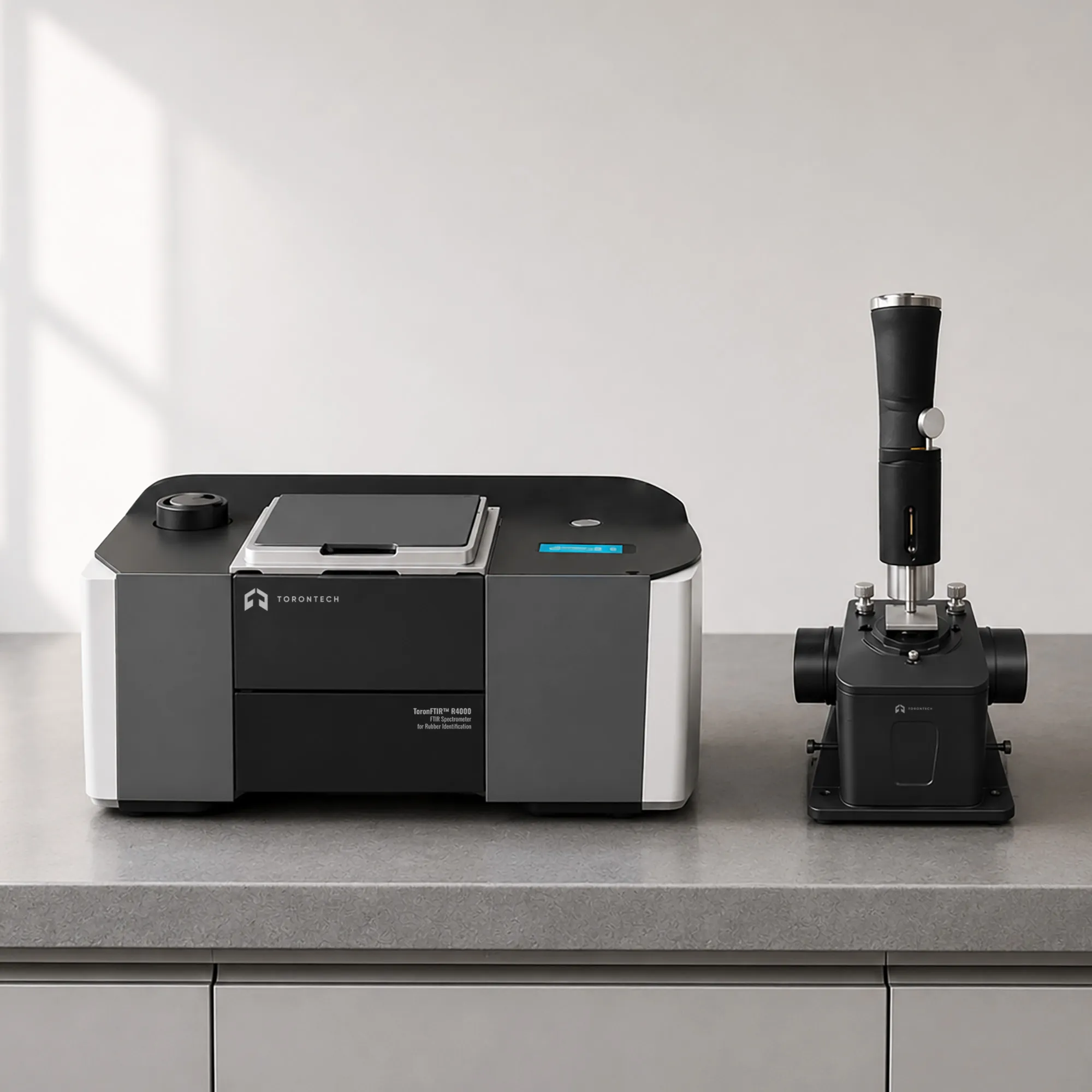
The ToronFTIR™ R4000 pairs rubber-focused identification with a stable optical platform and flexible sampling.
- Rubber-Focused Identification: tuned for elastomer and polymer analysis, with library matching that names base rubbers and flags additives.
- Wide Fingerprint Coverage: scans 4000 to 400 cm⁻¹ across the mid-infrared region where most polymer bands appear.
- High Spectral Resolution: better than 1 cm⁻¹ resolves closely spaced absorption bands for confident material discrimination.
- High Signal-to-Noise Ratio: 30,000:1 delivers clean spectra on weak or low-concentration samples.
- Stable, High-Precision Optics: a rigid optical platform holds alignment and reduces spectral drift over the working day.
- Moisture-Protected Beamsplitter: a germanium-coated KBr beamsplitter with protective coating resists humidity for reliable throughput.
- Long-Life Infrared Source: a high-intensity, air-cooled source gives steady output with a long service life.
- Flexible Sampling Options: diffuse reflectance, ATR, and non-contact external reflection attachments extend the platform to many sample types.
- Audit-Trail Function: records operator actions and measurement history to support data integrity in regulated labs.
- Compact Benchtop Footprint: a 25 kg unit measuring 450 by 350 by 210 mm fits standard lab benches.
- Simple Setup and Maintenance: quick installation and low upkeep reduce downtime and total cost of ownership.
- USB Connectivity: a USB 2.0 interface transfers data to the control PC for analysis and reporting.
Theory and Method
Fourier transform infrared spectroscopy identifies materials by measuring how they absorb infrared light. Every chemical bond vibrates at characteristic frequencies, so the pattern of absorbed wavelengths forms a molecular fingerprint unique to each material. Natural rubber, SBR, EPDM, nitrile, and other elastomers each produce a distinct set of absorption bands, which lets an analyst tell them apart with confidence. The ToronFTIR™ R4000 records the full spectrum in one measurement rather than scanning one wavelength at a time, which shortens analysis and strengthens the detected signal.
The instrument builds this spectrum with a Michelson interferometer. A germanium-coated KBr beamsplitter divides the infrared beam into two paths: one reflects off a fixed mirror, the other off a moving mirror. Recombining the two beams at varying path differences produces an interferogram, which the software converts into a readable absorbance spectrum through a Fourier transform. Matching that spectrum against a reference library then names the material.
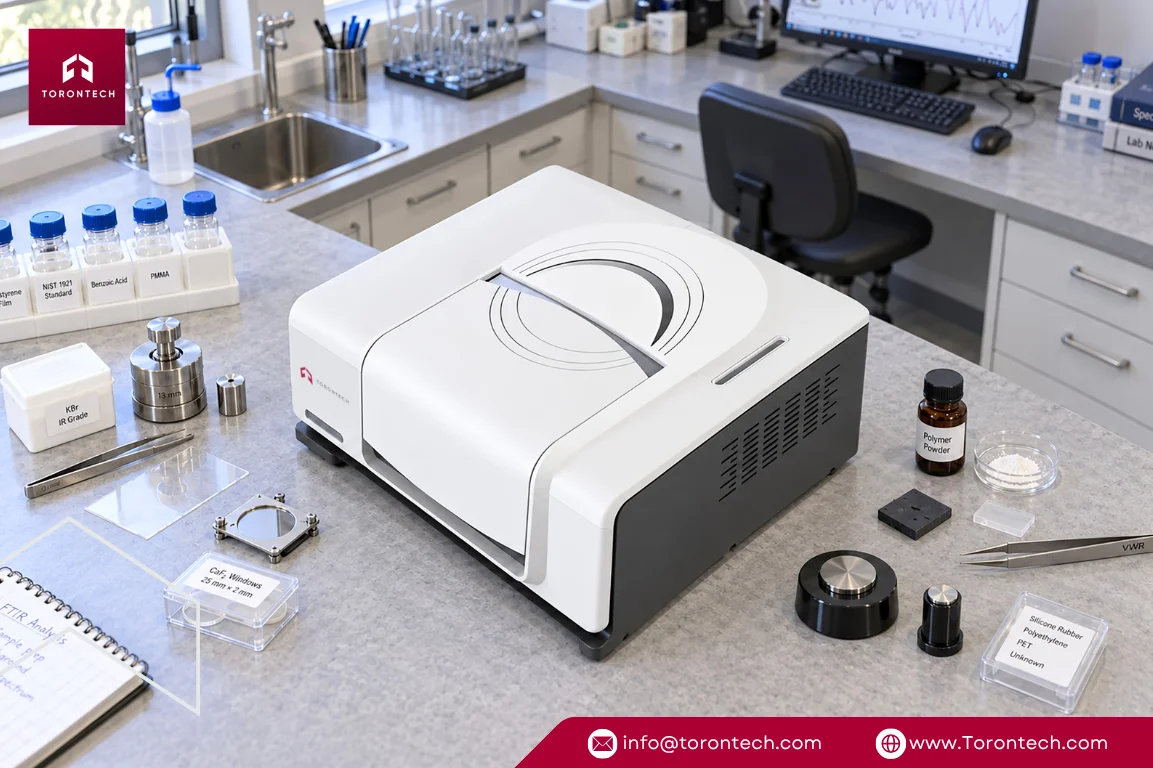
For solid rubber and other difficult samples, sampling geometry decides data quality. The ToronFTIR™ R4000 connects to diffuse reflectance, ATR, and non-contact external reflection accessories, so operators measure a sample in the form that gives the cleanest bands. A long-life, air-cooled infrared source and moisture-protected optics hold performance steady across the working session.
FTIR Spectrometer for Rubber Identification - ToronFTIR™ R4000 Technical Specifications
| Parameter | Specification |
|---|---|
| Spectral Range | 4000 to 400 cm⁻¹ |
| Resolution | Better than 1 cm⁻¹ |
| Signal-to-Noise Ratio | 30,000:1 (peak-to-peak, 4 cm⁻¹, 1-minute background and sample scan at 2100 cm⁻¹) |
| Detector | Infrared detector |
| Beamsplitter | Germanium-coated KBr substrate with moisture-proof coating |
| Infrared Source | Long-life, high-intensity, air-cooled IR source |
| Scanning Speed | Computer-controlled, selectable |
| Sampling Options | Diffuse reflectance, ATR, non-contact external reflection |
| Data Interface | USB 2.0 |
| Operating System | Windows XP / Windows 7 |
| Voltage | AC 220 V, 50 Hz (110V is also available) |
| Dimensions | 450 × 350 × 210 mm |
| Weight | 25 kg |