FTIR Spectrometer - ToronFTIR™ 7800
FTIR Spectrometer for Pharmaceutical, Polymer, Lubricant, and Petrochemical Analysis
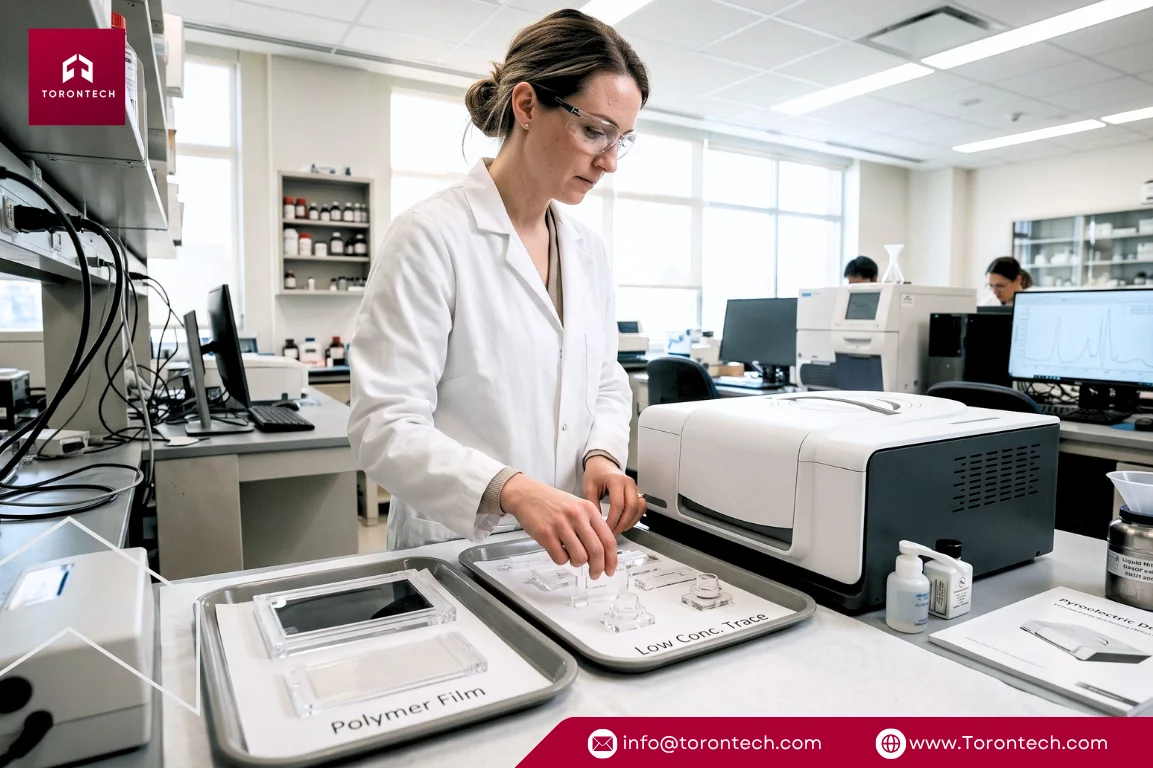
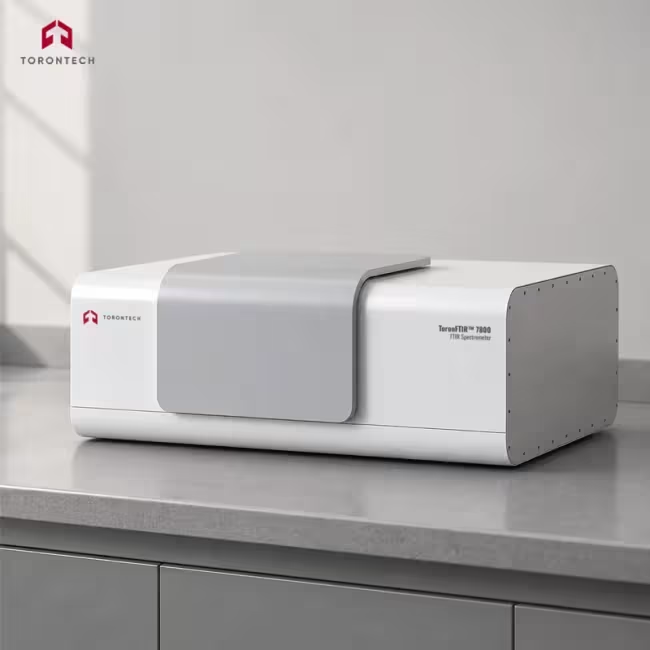
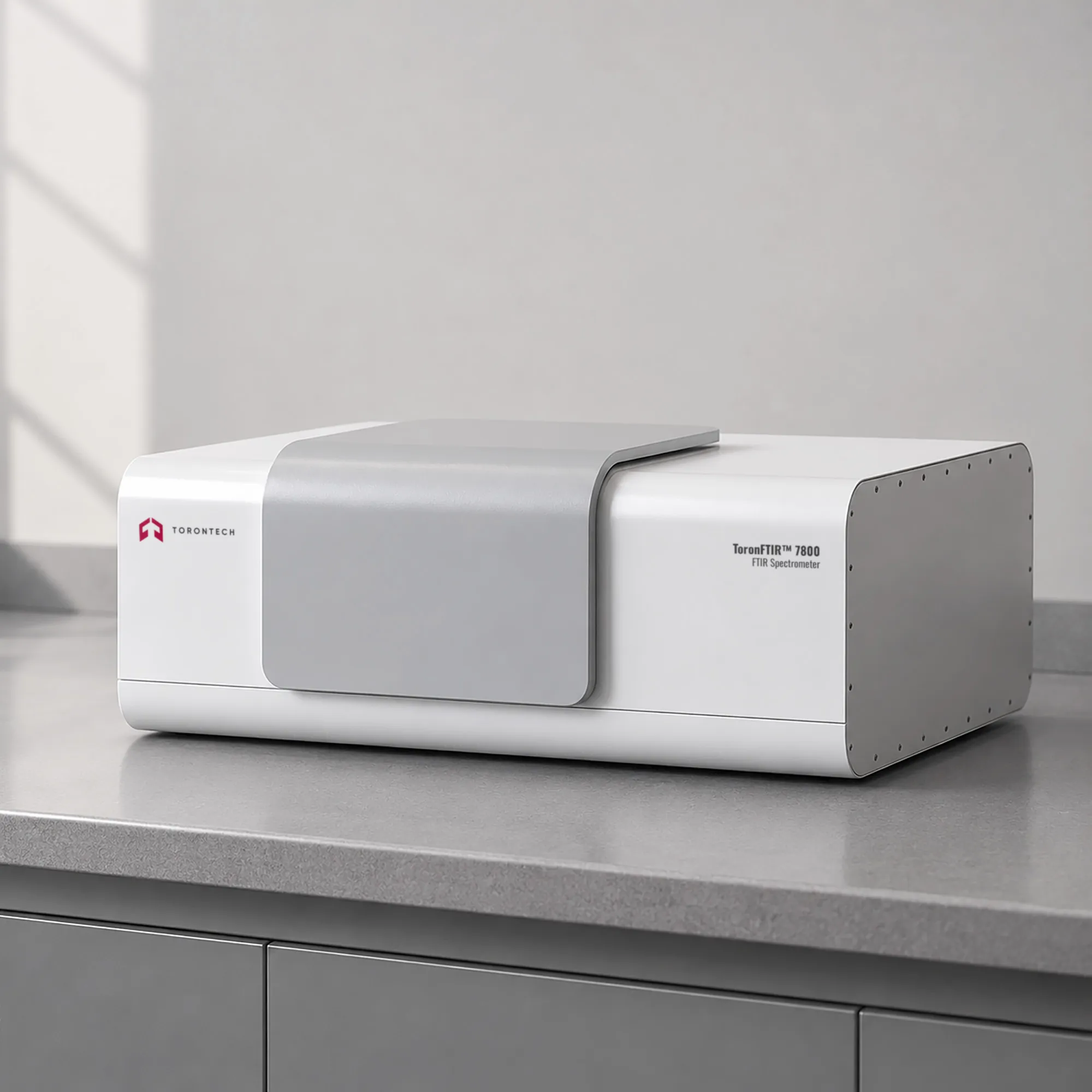
ToronFTIR™ 7800 benchtop FTIR spectrometer delivers high-resolution molecular and material analysis for laboratories, quality-control departments, and research facilities across many industries. The instrument builds on the Michelson interferometer principle and uses computer sampling to convert an interferogram into a complete infrared spectrum. This approach gives the analyst wide spectral coverage, high light throughput, and short measurement times in a single scan. The ToronFTIR™ 7800 serves material identification, contamination analysis, and quantitative work where confirming chemical composition matters.
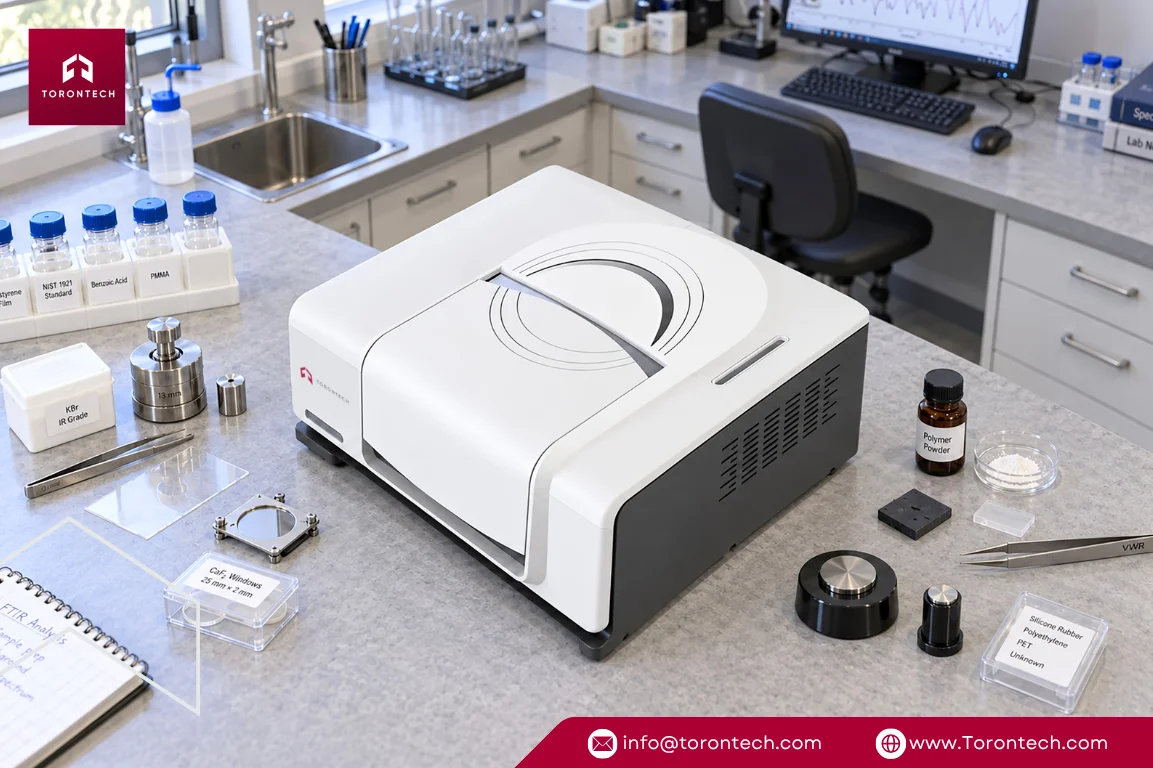
The system covers a spectral range of 7800 to 350 cm⁻¹, extending from the near-infrared into the far end of the mid-infrared fingerprint region. A fully enclosed optical bench protects the interferometer and detector from moisture and airborne contaminants, so results stay stable across changing lab conditions. Operators pair the ToronFTIR™ 7800 with a broad set of sampling accessories, which lets one instrument handle solids, liquids, powders, films, pastes, and gases without a separate platform for each sample type.
Beyond routine identification, the ToronFTIR™ 7800 supports condition monitoring of in-service oils, biodiesel FAME content testing, and polymer characterization. A bundled spectral analysis suite includes a compound reference library of more than 200,000 spectra, quantitative modules, and standard-curve models. This makes the spectrometer a practical fit for pharmaceutical QC, petrochemical labs, materials research, and general analytical testing.
FTIR Spectrometer - ToronFTIR™ 7800 Applications
The ToronFTIR™ 7800 supports infrared analysis across a wide range of sample types and industries, from raw-material verification to advanced research.
- Pharmaceutical and Healthcare: identity confirmation of raw materials, excipients, and finished products, plus food and drug packaging material testing for GMP-aligned workflows.
- Polymer and Material Science: characterization of plastics, rubber, adhesives, asphalt, and resins, along with contamination, degradation, and additive analysis.
- Lubricating Oil and Fuel Testing: trend analysis of in-service oils, T501 antioxidant content in transformer and turbine oils, and benzene content checks in gasoline.
- Petrochemical and Biodiesel: FAME content determination in middle distillates and structural cluster analysis of mineral insulating and lubricating oils.
- Environmental Monitoring: identification of petroleum and animal or plant oils in water and soil, and screening of organic solvents and reaction products.
- Building and Glass Testing: hemisphere emissivity of architectural glass, U-value of insulating glass, and general material emissivity measurement.
- Gemology and Electronics: jewelry appraisal by diffuse reflectance, and interstitial oxygen or substituted-carbon measurement in silicon wafers.
Standards
The ToronFTIR™ 7800 is designed and built to align with internationally recognized infrared test methods for in-service lubricant monitoring and fuel analysis. Bundled quantitative modules correlate directly with the methods below.
- ASTM E2412 - Standard Practice for Condition Monitoring of In-Service Lubricants by Trend Analysis Using Fourier Transform Infrared (FT-IR) Spectrometry
- EN 14078 - Liquid Petroleum Products: Determination of Fatty Acid Methyl Ester (FAME) Content in Middle Distillates: Infrared Spectroscopy Method
FTIR Spectrometer - ToronFTIR™ 7800 Key Features
The ToronFTIR™ 7800 combines a stable optical platform with flexible sampling and data tools that suit both routine QC and research settings.
- Wide Spectral Coverage: scans 7800 to 350 cm⁻¹ across near- and mid-infrared, with an optional 7800 to 650 cm⁻¹ configuration for targeted work.
- High Signal-to-Noise Ratio: better than 20,000:1 as standard, with an optional configuration better than 45,000:1 for low-concentration and trace analysis.
- Sealed Optical Bench: fully enclosed interferometer and detector compartments shield core optics from humidity and corrosive gases for consistent long-term performance.
- Gold-Plated Corner-Cube Mirrors: integrated, adhesive-free moving and fixed mirrors hold optical alignment and resist drift over the instrument's service life.
- DSP-Controlled Drive: digital signal processing manages the electromagnetic interferometer and keeps the moving mirror permanently collimated during each scan.
- Flexible Detector and Beamsplitter Options: an MCT cooled detector and a ZnSe beamsplitter are available to match demanding sensitivity and spectral-range needs.
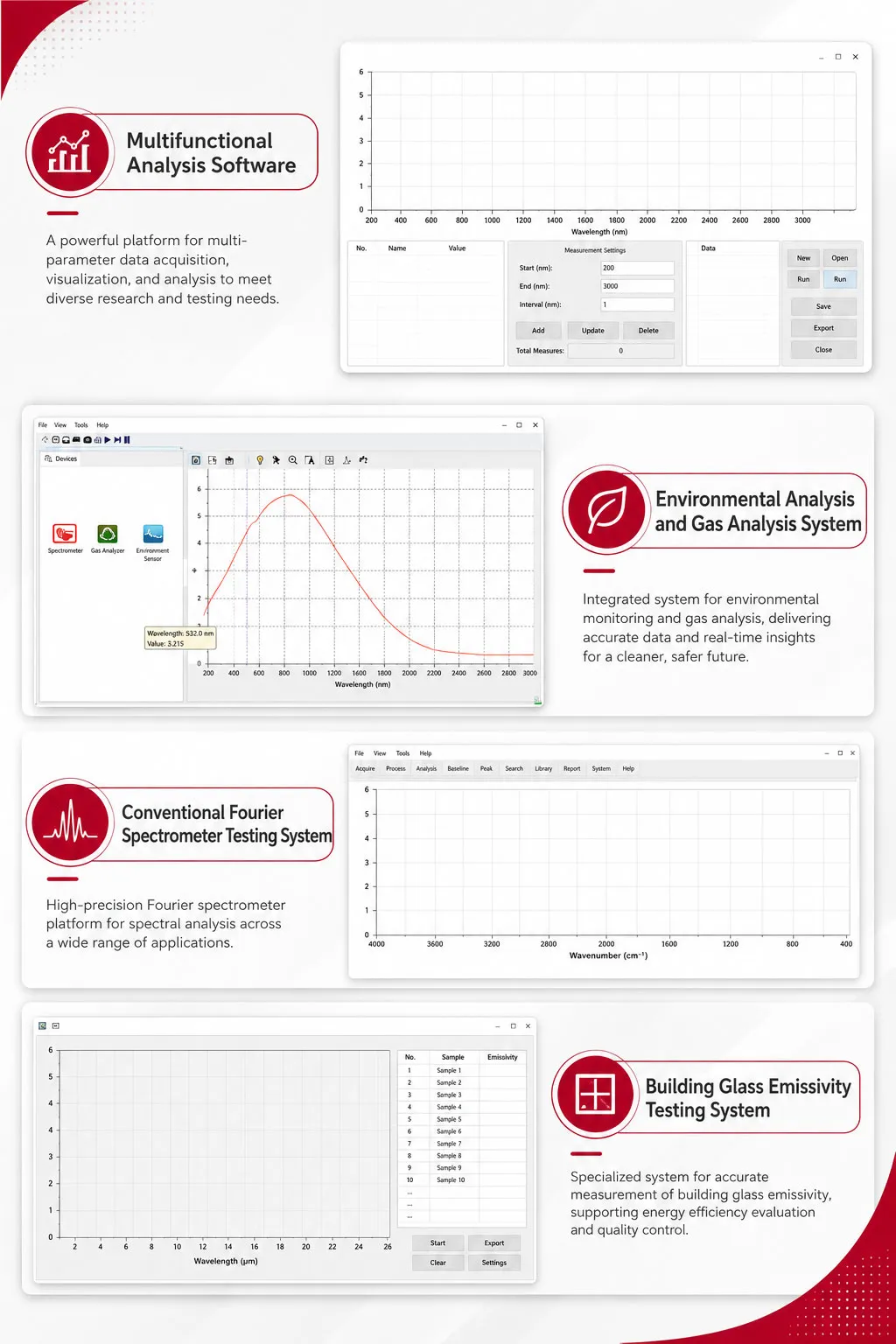
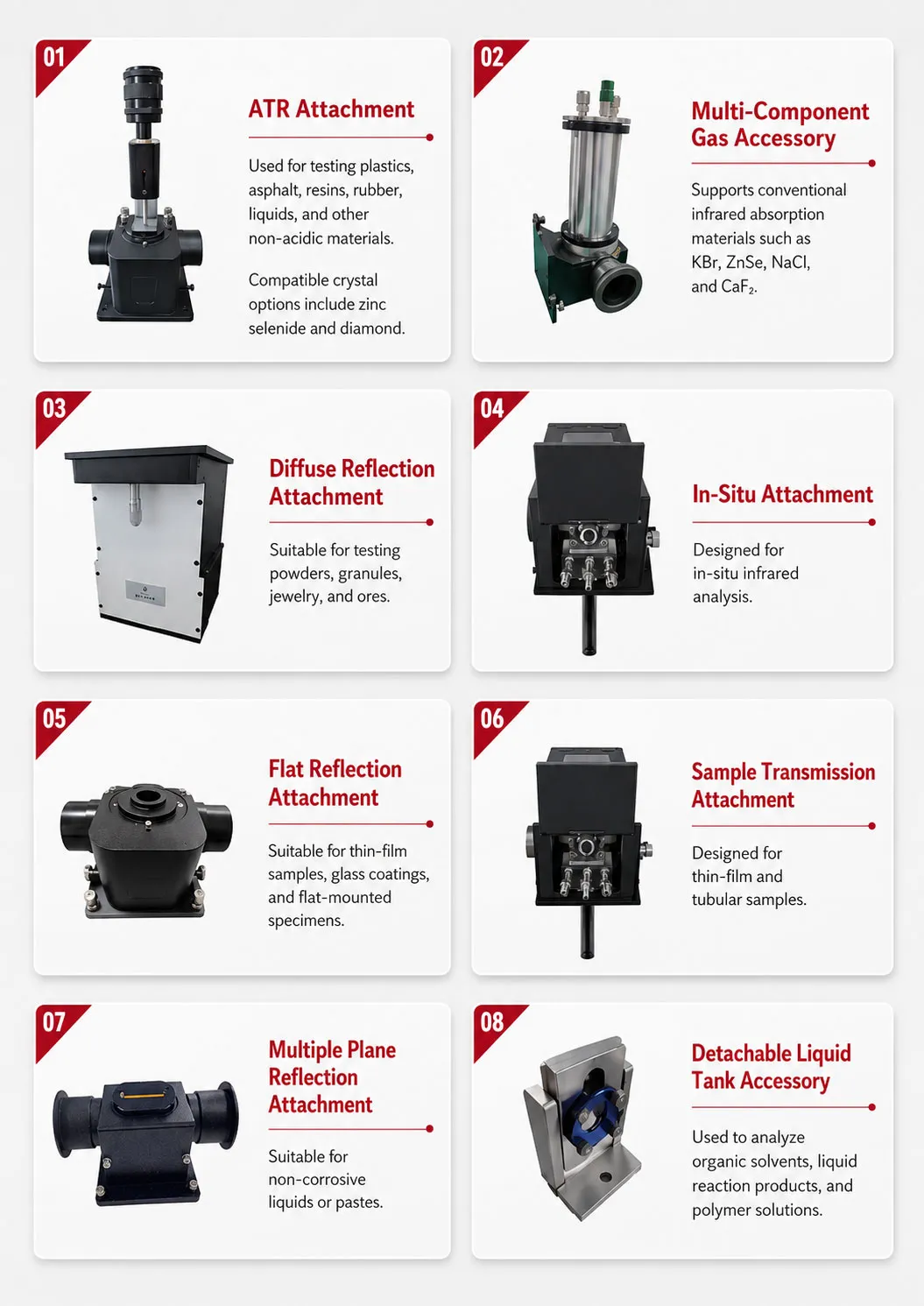
- Broad Accessory Range: ATR, diffuse reflectance, specular reflection, transmission, in-situ, and gas-cell attachments let one platform cover most sample formats.
- Extensive Spectral Library: more than 200,000 reference spectra, quantitative modules, and standard-curve models speed up identification and quantitation.
- Intelligent Environmental Control: real-time temperature and humidity monitoring alerts operators when conditions fall outside the safe range, reducing the risk of instrument damage.
- Modern Data Interface: high-speed USB 2.0 and 3.0 connectivity with Windows 7, 10, and 11 support for straightforward integration into existing lab systems.
Theory and Method
Fourier transform infrared spectroscopy identifies materials by measuring how they absorb infrared light. Every chemical bond vibrates at characteristic frequencies, so the pattern of absorbed wavelengths forms a molecular fingerprint that reveals what a sample contains. Rather than scanning one wavelength at a time, the ToronFTIR™ 7800 records all infrared wavelengths at once. This multiplex approach collects a full spectrum in a single measurement, which shortens analysis time and improves the signal available at the detector.
At the heart of the instrument sits a Michelson interferometer. A beamsplitter divides the infrared beam into two paths: one reflects off a fixed mirror, the other off a moving mirror. When the two beams recombine, the changing path difference makes each wavelength reinforce and cancel in a pattern called an interferogram. The instrument then applies a Fourier transform, a mathematical operation that converts the interferogram into a readable spectrum of absorbance against wavenumber.
The ToronFTIR™ 7800 applies this principle with integrated gold-plated corner-cube mirrors that hold alignment without adhesives, and a DSP-driven electromagnetic interferometer that keeps the moving mirror collimated during travel. A semiconductor laser tracks mirror position for accurate wavenumber calibration, while a moisture-protected KBr beamsplitter and high-intensity air-cooled source maintain throughput across the full 7800 to 350 cm⁻¹ range.
FTIR Spectrometer - ToronFTIR™ 7800 Technical Specifications
| Parameter | Specification |
|---|---|
| Spectral Range | 7800 to 350 cm⁻¹ (optional 7800 to 650 cm⁻¹) |
| Signal-to-Noise Ratio | Better than 20,000:1 (optional better than 45,000:1) |
| Wavenumber Accuracy | ≤ 0.01 cm⁻¹ |
| Detector | Infrared detector; optional MCT (mercury cadmium telluride) cooled detector |
| Laser | Semiconductor laser; optional HeNe laser |
| Beamsplitter | Multi-layer coated KBr with moisture-proof coating; optional ZnSe |
| Infrared Source | Long-life, high-intensity, air-cooled IR source |
| Scanning Speed | Microcomputer-controlled, continuously adjustable, multiple selectable speeds |
| Optical Bench | Integrated design with fully enclosed interferometer and detector compartments |
| Interferometer Mirrors | Integrated gold-plated corner-cube (moving and fixed), adhesive-free |
| Reference Spectral Library | ≥ 200,000 spectra |
| Data Interface | High-speed USB 2.0 / 3.0 |
| Operating System | Windows 7 / 10 / 11 |
| Environmental Control | Intelligent temperature and humidity monitoring with real-time alerts |
| Design Compliance | EMC electromagnetic compatibility design |
Standard Configuration
| Item | Quantity | Description |
|---|---|---|
| FTIR Analyzer Host | 1 | Main spectrometer unit with integrated optical bench |
| Tablet Press | 1 | For pressing KBr sample pellets |
| Pellet Die Set | 1 set | 13 mm inner diameter, no-demold design |
| Detachable Liquid Cell Set | 1 set | KBr windows, 30 × 5 mm |
| Spectral-Grade KBr | 50 g | For pellet and window preparation |
| Agate Mortar Set | 1 set | Sample grinding and preparation |
| Electronic Dry Cabinet | 1 | Moisture-controlled storage for optics and consumables |
| Control Terminal | 1 | i5 or higher CPU, ≥ 1 TB HDD, ≥ 21.5-inch display, keyboard and mouse |
Optional Sampling Accessories
| Accessory | Application |
|---|---|
| ATR Attachment (ZnSe or diamond crystal) | Plastics, asphalt, resins, rubber, liquids, and non-acidic samples |
| Diffuse Reflectance Attachment | Powders, granules, jewelry, and ores |
| Specular / Flat Reflection Attachment | Thin films, glass, coatings, and flat-placed samples |
| Multiple-Reflection Attachment | Non-corrosive liquids and pastes |
| Sample Transmission Attachment | Thin-film and tubular samples |
| In-Situ Attachment | Infrared in-situ reaction analysis |
| Detachable Liquid Cell | Organic solvents, liquid reaction products, and polymer solutions |
| Multi-Component Gas Cell | Gas-phase analysis with KBr, ZnSe, NaCl, or CaF2 windows |