Interpreting Polarimeter Readings & Standards
Do you ever stare at a screen in the lab and wonder if the numbers displayed are truly accurate?
Getting a green light on your quality checks should feel straightforward, not like a guessing game. By getting a handle on the factors that influence your equipment, you can turn those daily measurements into a source of confidence for your entire production line.
Key Takeaways
- Verify the core metrics. A passing reading serves as confirmation that the identity, purity, and concentration of your substance match the required specifications.
- Adhere to industry standards. Valid results must align with regulatory benchmarks such as USP <781> for pharmaceuticals or ICUMSA for sugar analysis.
- Control the environment. Precision depends on maintaining standard conditions because even slight changes in temperature or wavelength can alter the final data.
- Distinguish the terms. Operators must understand the difference between raw optical rotation and the calculated specific rotation used for reporting.
- Eliminate manual errors. Using automatic systems like the Torontech ToronAP Series prevents common failures caused by temperature drift or subjective interpretation.
The Difference Between Optical Rotation and Specific Rotation
Many operators use these terms as if they are the same thing, but separating them is vital for clear reporting.
Optical Rotation (α)
Think of this as the raw data your machine hands over. It is the actual angle that the polarized light bends when it travels through your sample. However, this number changes based on how long the sample tube is or how much substance is dissolved in the liquid. It gives you a snapshot of that specific moment, but it doesn't tell the whole story.
Specific Rotation ([α])
This is the standardized value—the "fingerprint" of the chemical. It takes the raw optical rotation and adjusts it mathematically to account for path length and concentration. This allows a lab in Berlin to compare results with a lab in Boston without worrying about different sample sizes.
The Formula
To turn your raw data into a standard specific rotation, use this equation:
- [α]: Specific rotation (the final standard value).
- T: Temperature (usually 20°C or 25°C).
- λ: Wavelength of light (typically the sodium D-line).
- α: The optical rotation (the raw angle observed).
- l: Path length of the tube (in decimeters).
- c: Concentration (in g/100mL).
Industry Standards for "Passing" Results
A reading is only "passing" if it meets the benchmarks set by the authorities overseeing your specific sector.
Pharmaceutical Sector
For those analyzing drugs or raw medicinal ingredients, the rulebook is usually USP <781> (United States Pharmacopeia) or EP 2.2.7 (European Pharmacopoeia). These guidelines are strict about temperature control, requiring measurements to happen exactly at 25°C because even a slight shift can alter the data.
Sugar & Food Production
If your facility processes sweeteners, ICUMSA (International Commission for Uniform Methods of Sugar Analysis) provides the gold standard. Here, the focus is often on the "International Sugar Scale" (°Z), where purity is everything. A passing reading here confirms that the payment you receive matches the quality of the beet or cane syrup you delivered.
Chemical Manufacturing
For general chemical purity, standards like ASTM often apply. A passing grade here usually means the specific rotation falls within a pre-agreed tolerance range (e.g., +/- 0.02°) compared to the Certificate of Analysis (CoA) from your supplier.
Understanding a Passing Reading on a Polarimeter
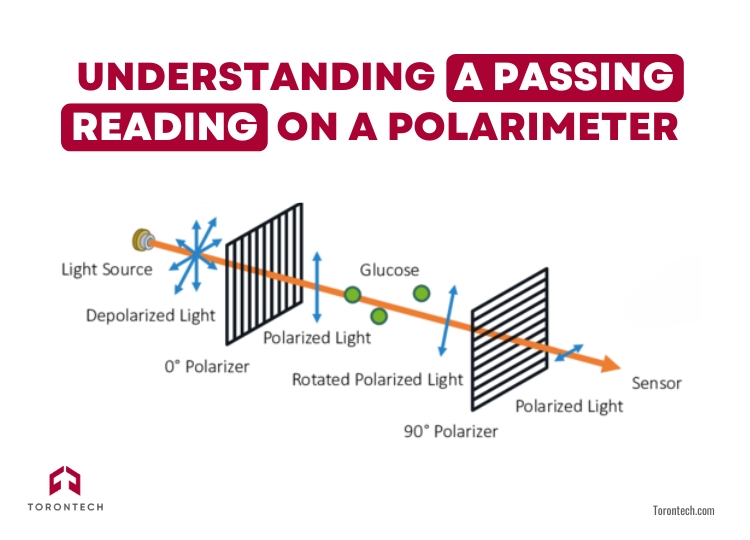
A "passing reading" on a polarimeter refers to a measurement that falls within the expected or acceptable range of optical rotation for a specific substance or application.
This range is determined by factors such as the sample's known properties, including its concentration, purity, temperature, wavelength of light used, and the path length of the sample tube.
The exact meaning of a passing reading may vary depending on the context, such as industry standards, the substance being analyzed, or the purpose of the measurement.
Related article: Sodium Lamp vs LED: The Better Polarimeter Light
Factors Influencing a Passing Reading
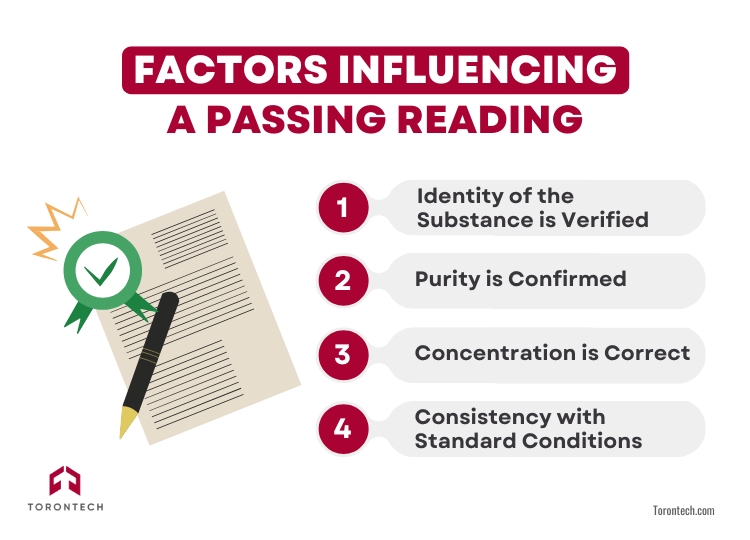
Determining a "passing reading" on a polarimeter depends on various factors that ensure accuracy and reliability in measurement. From verifying the substance's identity to confirming its purity and concentration, these factors are essential. Let's explore them in detail.
1. Identity of the Substance is Verified
The measured optical rotation matches the known specific rotation (α) of the substance, confirming its identity. For example, glucose solutions exhibit specific rotations of [+52.7∘]under standard conditions.
2. Purity is Confirmed
A sample with impurities or incorrect formulation can deviate from the expected optical rotation. A passing reading ensures the substance is free of contaminants and meets purity standards.
3. Concentration is Correct
Polarimetry is commonly used to measure the concentration of optically active substances, such as sugars in syrups or active pharmaceutical ingredients (APIs). A passing reading validates that the sample concentration aligns with product specifications.
4. Consistency with Standard Conditions
Temperature, light wavelength, and path length significantly influence polarimeter readings. A passing reading confirms that the test was conducted under the prescribed conditions (e.g., 20°C, 589 nm light, and a standard tube length).
4 Common Reasons for "Failing" Readings
If your polarimeter keeps giving you red flags, the machine is often fine, but the sample preparation might need a second look.
- Air Bubbles in the Tube: Even tiny pockets of air can scatter the light beam before it reaches the detector. This causes the sensor to struggle, leading to unstable or wildly incorrect numbers.
- Temperature Fluctuation: Many substances are sensitive to heat. If your sample was prepared at 20°C but measured at 24°C, the liquid expands, the concentration shifts, and the rotation angle changes.
- Cloudy or Turbid Samples: Polarimeters rely on a clear path for light transmission. If the solution looks hazy or contains particles, the light cannot travel through cleanly. Filtering the solution is often the quickest fix.
- Old or Strained Sample Tubes: Glass tubes that have been dropped or handled roughly can develop "strain" in the glass itself. This physical stress interacts with polarized light, adding false data to your final result.
How Automatic Polarimeters Improve Pass Rates
Moving away from manual eye-piece instruments does more than just save time; it removes the biggest variable in the lab—human eyesight.
Modern instruments, like the ToronAP Series, utilize built-in Peltier temperature control. This feature automatically heats or cools the sample chamber to the exact required degree, ensuring that temperature drift never ruins a test batch. Furthermore, the digital sensors are capable of averaging multiple readings in seconds, smoothing out minor fluctuations that might cause a manual operator to record a failing grade.
By automating the process, you create a consistent, repeatable workflow where a "passing" result is based on hard data rather than operator interpretation.
Read more: Manual vs Automatic Polarimeters: Which is Best?
Ensure Passing Results with Torontech
A passing reading on a polarimeter confirms the accuracy and reliability of your work. Whether you’re analyzing pharmaceuticals, testing sugar content, or verifying chemical purity, it reflects the precision and care you put into every measurement.
By understanding the factors that influence these readings, you enhance your ability to deliver consistent, high-quality results. Each accurate measurement supports better products, safer formulations, and trusted outcomes in your field.
References:
- Tran, D., Peverall, R., Rosson, S., Manfred, K., & Ritchie, G. (2021). High performance continuous-wave laser cavity enhanced polarimetry using RF-induced linewidth broadening. Optics Express, 29 19, 30114-30122.
- Tran, D., Manfred, K., Peverall, R., & Ritchie, G. (2021). Continuous-Wave Cavity-Enhanced Polarimetry for Optical Rotation Measurement of Chiral Molecules. Analytical Chemistry.
- Felicidario, R., & Santos, R. (2024). Measurement of ascorbic acid samples’ optical rotation via an improvised polarimeter for purity assessment. Journal of Physics: Conference Series, 2871.
- Serrano, S., Rodríguez, I., Moreno, R., & Rincón, F. (2019). Detection of key factors affecting specific optical rotation determination in honey. CyTA - Journal of Food, 17, 574 - 580.
- Kvittingen, L., & Sjursnes, B. (2020). Demonstrating Basic Properties and Application of Polarimetry Using a Self-Constructed Polarimeter. Journal of Chemical Education, 97, 2196 - 2202.
- Spiliotis, A., Xygkis, M., Klironomou, E., Kardamaki, E., Boulogiannis, G., Katsoprinakis, G., Sofikitis, D., & Rakitzis, T. (2020). Gas-phase optical activity measurements using a compact cavity ringdown polarimeter. Laser Physics, 30.
- Shi-Min, Z. (2012). Determination of Rotatory Direction of Optically Active Substance as well as Measurement and Calculation of the Optical Rotation. Research and Exploration in Laboratory.