Viscosity Testing: Best Methods, Tools, and Industry Use Cases
Viscosity testing helps you understand how fluids flow under specific conditions. Whether you're working with paint, adhesives, or syrups, knowing how your material behaves can prevent production delays, product failures, or application issues.
Accurate viscosity data allows you to choose the right material for the job. It also helps maintain product consistency, supports quality control, and guides equipment selection. This article walks you through the most reliable methods, what tools to consider, and how different industries rely on viscosity testing every day.
What Is Viscosity?
Viscosity refers to a fluid’s resistance to flow. It's the result of internal friction between layers of the fluid as they move past each other. The higher the viscosity, the thicker or slower the liquid moves. You can calculate viscosity using a basic formula:
Viscosity = Shear Stress ÷ Shear Rate
In this equation:
- Shear stress is the force applied per unit area.
- Shear rate is how fast one fluid layer moves in relation to another.
There are two common types of viscosity:
- Dynamic viscosity: Measures resistance under an external force.
- Kinematic viscosity: Compares dynamic viscosity to the fluid's density.
Read more: Dynamic vs Kinematic Viscosity: The Difference
For a better understanding of viscosity, please watch the video below.
Why Viscosity Testing Matters
A fluid’s viscosity affects how it moves through pipes, how it's dispensed, and how it interacts with surfaces. Even a small change can impact product performance. If a sauce flows too easily, it might spill. If an adhesive spreads too much, it may weaken a bond. For ink or coating, too little control can cause smudging or uneven finishes. You can avoid these issues by testing viscosity during product development, packaging design, and quality control. The data also helps when scaling production or choosing new raw materials.
Related article: How Does a Viscometer Work? The Expert Answer
Common Viscosity Testing Methods
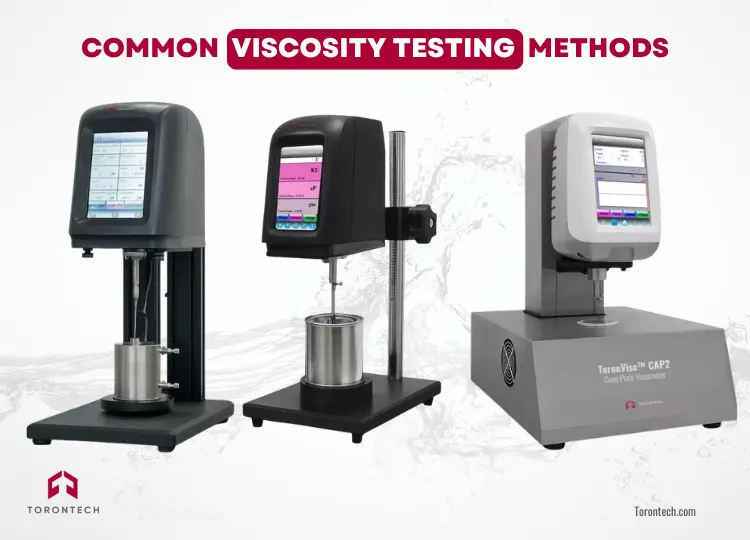
You have several options when it comes to measuring viscosity. The right method depends on your material’s flow behavior, how precise the results need to be, and how you plan to apply them. Each technique offers different strengths, especially when working with fluids that behave differently under stress or temperature changes.
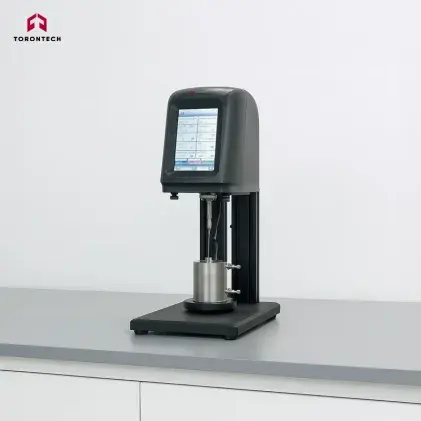
1. Rotational Viscometer
This method measures the torque required to rotate a spindle in the fluid. The greater the resistance, the higher the viscosity. It’s a popular choice in both R&D and quality control.
You’ll often use a rotational viscometer for:
- Paints and coatings
- Creams, lotions, and gels
- Adhesives
- Fluids with medium to high viscosity
Rotational viscometer systems let you adjust speed, temperature, and spindle type—making it easy to simulate real application conditions.
2. Capillary Viscometer
Capillary viscometers work by timing how long a fluid takes to flow through a thin glass tube. The result reflects the fluid’s kinematic viscosity.
These are well suited for:
- Oils and fuels
- Diluted polymers
- Solvents
- Other Newtonian liquids
Models like Ostwald, Ubbelohde, and Cannon-Fenske are widely used. Just remember: temperature control is critical for accuracy.
3. Falling Ball and Piston Viscometers
In this method, a ball or piston moves through the fluid, and the time it takes to fall is measured. This gives you a viscosity value based on resistance and fluid density.
Typical uses include:
- Transparent or clear liquids
- Syrups and lotions
- On-site fuel checks (marine or automotive)
It’s straightforward and works best when your fluid is Newtonian and free of suspended solids.
Related article: Viscosity vs Density: The Key Difference
4. Vibrational Viscometer
This method relies on a vibrating rod or probe placed in the sample. The fluid dampens the vibration, and the change is used to calculate viscosity.
You’ll find this useful in:
- Real-time production monitoring
- Inline industrial systems
- Continuous, automated testing setups
It’s a great option if you want hands-off, repeatable measurements without transferring samples.
5. Viscosity Cups (Zahn, Ford, and others)
Viscosity cups are simple tools with a hole at the bottom. You fill the cup and time how long it takes to empty. It’s a quick way to check flow in the field.
Commonly used for:
- Water-based paints
- Surface coatings
- Routine shop-floor checks
This method works best for Newtonian fluids. Shear-sensitive materials can lead to inconsistent results.
6. Krebs Stormer Viscometer
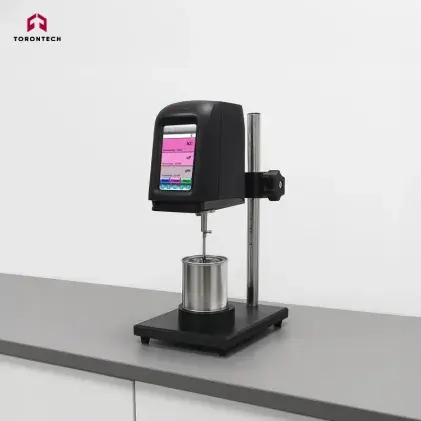
A Krebs Stormer viscometer uses a fixed-speed paddle to test viscosity and reports values in Krebs Units (KU). It's often used in the paint and coatings industry.
Use it when:
- You need reliable viscosity for brush or roller application
- You’re working with standard architectural coatings
- Consistency between batches matters
It’s a practical choice when simplicity and repeatability are more important than detailed rheological data.
7. Cone and Plate Viscometer
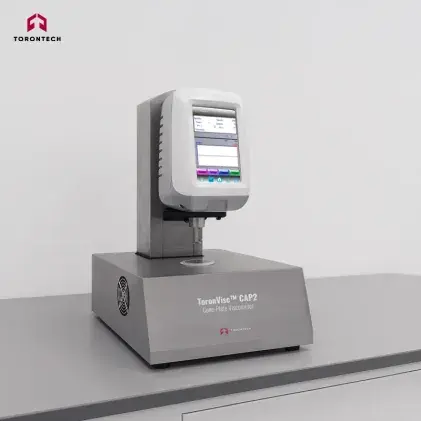
This precise method uses a sample placed between a cone and a flat plate. You apply controlled shear and measure resistance, making it ideal for more technical applications.
It’s commonly used for:
- Cosmetics and personal care products
- Biological fluids like blood
- Adhesives with complex flow profiles
Cone and plate viscometer setups are excellent for evaluating yield stress, shear thinning, or viscoelastic behavior.
Related article: Measure Viscosity Without a Viscometer: A DIY Guide
How to Choose the Right Viscosity Testing Method
The right method depends on what you're testing, why you're testing it, and how much detail you need. Use this guide to match common fluids with suitable methods:
| Fluid Type | Suggested Method | Tool Type |
| Paint and coatings | Rotational or Cone & Plate | Brookfield, Rheometer |
| Sauces and syrups | Capillary or Flow Cup | Cannon-Fenske, Zahn |
| Gels and creams | Rotational or Rheometer | Parallel Plate, Cone & Plate |
| Perfumes and blood | Vibrational or Electromagnetic | EMS-type Viscometer |
| Adhesives | Rotational + Stability tools | Brookfield, RotoThinner |
| Motor oil and fuels | Capillary or Falling Ball | ASTM D445, Ubbelohde |
You can also combine methods for better control. For example, flow cups help with quick checks, while rotational tools provide deeper analysis.
Related article: Rheometer vs Viscometer: The Right Business Choice
Viscosity Standards and Calibration
To get reliable results, you must calibrate your equipment with certified reference materials. ISO 17025 calibration oils are commonly used for this. Key standards include:
- ASTM D445: Kinematic viscosity of petroleum
- ASTM D2196: Rotational viscometer for non-Newtonian fluids
- ISO 2555: Apparent viscosity of polymers
- ISO 3219: Shear behavior using rotational viscometers
- ISO 5351: Limiting viscosity of pulp
Always control temperature, use consistent sample volume, and allow time for fluid stabilization before recording data.
Read more: Step-by-Step: How to Calibrate a Viscometer Right
Industry Applications of Viscosity Testing
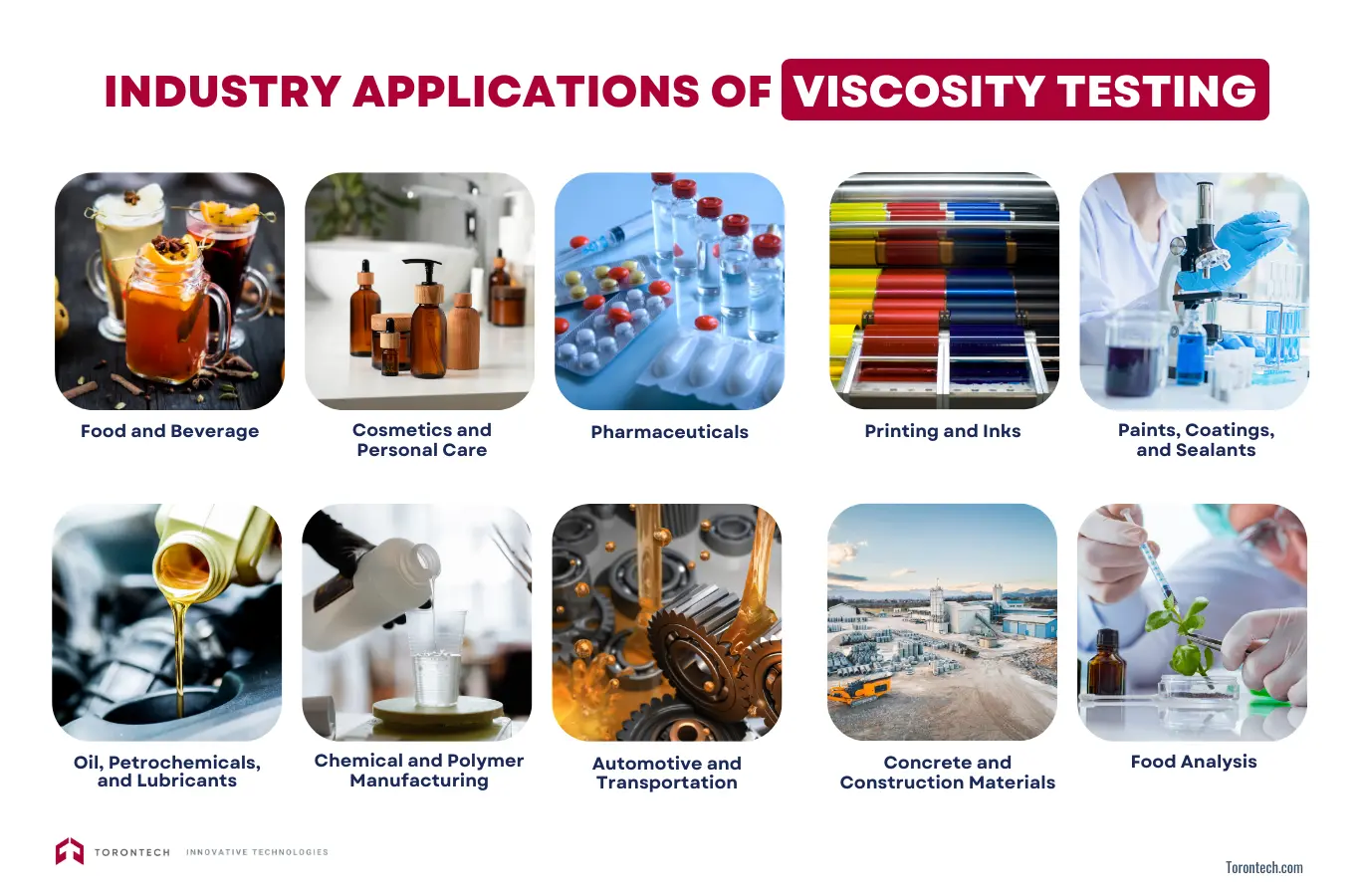 No matter what industry you're in, viscosity testing helps you maintain product quality, improve process efficiency, and keep your operations running smoothly. The way a fluid flows affects everything—from how it’s packaged to how it performs once in use. Here's how different industries rely on viscosity testing every day:
1. Food and Beverage
Viscosity directly influences texture, mouthfeel, and how smoothly a product flows during filling or dispensing. Whether you’re producing chocolate, sauces, or dairy-based drinks, viscosity testing helps you control consistency and optimize pumpability across batches.
2. Cosmetics and Personal Care
In this industry, how a product feels and spreads matters just as much as how it looks. Viscosity testing helps you design creams, lotions, and gels that stay stable, dispense easily, and deliver a pleasant user experience. It also supports packaging design by ensuring the product flows correctly through pumps and tubes.
3. Pharmaceuticals
From thick syrups to injectables, fluid behavior impacts dosing and administration. Viscosity testing ensures that medicines flow properly through syringes, maintain suspension stability, and meet regulatory standards for performance and consistency.
4. Printing and Inks
If you're working with flexo, gravure, or offset printing, the viscosity of ink determines how well it transfers to the surface. Testing helps you avoid smudging, uneven coverage, and color inconsistencies while improving press efficiency.
5. Paints, Coatings, and Sealants
Viscosity affects how paints and coatings spray, level, and adhere to surfaces. Inconsistent flow can cause streaks, poor coverage, or sagging. Testing also helps control drying time and finish quality, especially in automated or high-volume applications.
6. Oil, Petrochemicals, and Lubricants
In oil and fuel applications, viscosity controls flow during pumping, influences atomization, and determines how well a lubricant protects engine components. Routine testing ensures your materials perform across changing temperatures and stress conditions.
7. Chemical and Polymer Manufacturing
For adhesives, resins, and polymer mixtures, viscosity reflects molecular structure and reaction progress. If you're tracking batch quality or adjusting formulation ratios, viscosity testing gives you fast, reliable data for both QC and R&D.
8. Automotive and Transportation
Engine oils, transmission fluids, and fuel additives all depend on the right viscosity to perform under load. Testing helps you manage efficiency, reduce emissions, and improve long-term durability in vehicles.
9. Concrete and Construction Materials
In construction, the flow of concrete, plaster, or grout impacts safety and workability. Viscosity testing helps you verify self-leveling behavior, pumpability, and the material’s ability to fill molds or spread evenly on-site.
10. Biotechnology and Medical
Whether you’re analyzing blood plasma or designing diagnostic gels, fluid consistency matters. Viscosity testing helps you understand how biological materials behave under shear, which supports both product development and clinical research.
Final Thoughts
Viscosity testing gives you insight into how your materials will perform during mixing, filling, application, or end use. Each testing method offers different advantages, so it's important to choose the one that fits your product type, flow behavior, and budget.
Whether you're formulating something new or troubleshooting inconsistencies in production, reliable viscosity data helps you make informed decisions with confidence.
Looking for the right instrument? Explore our full range of viscometers for research, quality control, and process optimization. If you need help selecting the best option for your lab or project, contact us here, we’ll be happy to assist.