Viscosity and Temperature: A Guide to Process Control
It's a common observation in production environments: getting fluids to behave consistently is a primary operational challenge, largely because of the complex interplay of viscosity and temperature. When a viscosity test fails to meet standards, we have found the source of the issue is often this temperamental relationship.
Countless resources can be spent on problems that could be traced back to how the temperature on viscosity was affecting the material. Gaining control over the temperature dependence of viscosity is not an academic exercise; it is a direct path to more efficient production and a reduction in costly material waste.
The Essential Interaction Between Viscosity and Temperature
The principle at play here is direct, but it manifests in opposite ways for liquids and gases.
For any liquid, an increase in heat will correspond with a decrease in viscosity, making it flow more readily. This illustrates the direct effect of temperature on viscosity.
For gases, the effect is inverted. More heat introduces more molecular friction, which in turn increases the fluid's overall viscosity.
A clear demonstration of this is multi-grade motor oil.
For an engine to start without damage on a cold day, the oil must be thin enough to circulate immediately. As the engine reaches its operating temperature, that same oil must possess a higher level of viscosity to maintain a protective film.
This is a perfect working example of the viscosity vs temperature balance, and this same dynamic is active within countless industrial processes.
Related article: High Viscosity vs Low Viscosity: A Complete Guide
Where This Interaction Creates Challenges in Your Industry
Understanding the principle is one thing; identifying its impact on your operations is what creates value. This relationship has substantial consequences across many sectors, and we have helped countless clients troubleshoot these exact issues.
- Industrial Lubrication: As with motor oil, all industrial lubricants must perform across a spectrum of heat conditions. In our view, selecting a lubricant without verifying its performance profile, which is key to its temperature dependence of viscosity, introduces an unnecessary risk to equipment longevity.
- Food and Beverage Processing: The final texture and stability of many food products is a direct result of viscosity. Achieving that ideal, consistent mouthfeel is less a matter of chance and more a result of repeatable measurement—something our ToronVisc™ instruments help our clients achieve every day.
- Paints and Coatings: A high-quality finish is directly tied to viscosity control, especially when considering the viscosity and temperature relationship on the day of application. This is a common challenge for users who rely on precise Krebs Unit (KU) readings for consistency.
- Adhesives and Pharmaceuticals: With hot-melt adhesives, the material must be fluid at high temperatures for application, then build viscosity quickly as it cools. This is a classic application where one of our specialized high-temperature viscometers provides critical data on this unique viscosity and temperature interaction.
The Right Tools for Accurate Measurement and Control
Given its importance, leaving this fluid property to chance is not a viable strategy.
A quality control program is incomplete if it doesn't actively measure how a fluid's viscosity responds to changes in temperature. This is the essence of managing the temperature dependence of viscosity. This is where having the correct, reliable instrumentation becomes a non-negotiable.
The first step is selecting the right instrument for the material in question. Our ToronVisc™ line is engineered to provide industry-standard results for any viscosity vs temperature challenge without the traditional high cost of ownership.
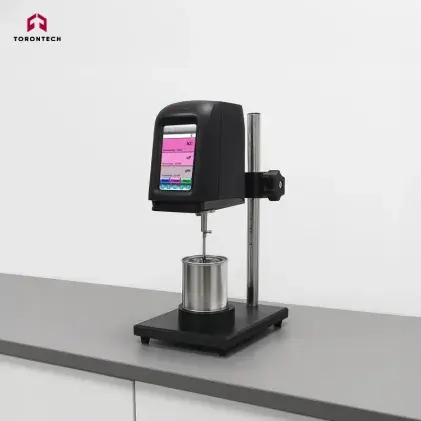
- For general quality control across a wide range of materials, a Digital Rotational Viscometer is the established instrument for most laboratories.
- For professionals in the paint and coatings sector, a dedicated Krebs Stormer Viscometer like our ToronVisc™ STM-2T provides the direct Krebs Unit readings that the industry depends on.
- For situations with limited sample sizes or where precise shear rate information is needed, an Advanced Cone and Plate Viscometer is the superior option.
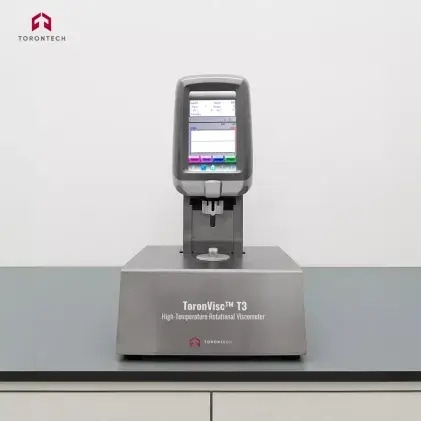
- For challenging materials like asphalt or adhesives, a specialized High-Temperature Viscometer is necessary to handle the extreme conditions.
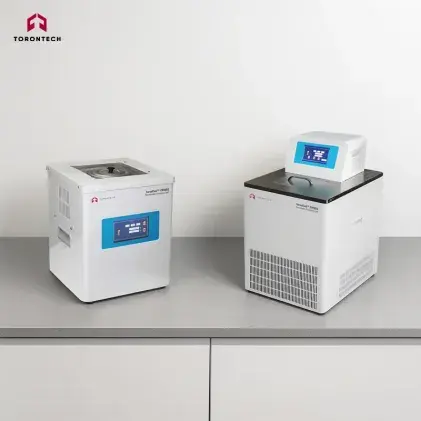
As a key recommendation, we advise pairing your viscometer with a temperature control unit, like our ToronCool™ Thermostatic Circulation Tanks. This isolates temperature as a variable, ensuring that your measurements are accurate and comparable over the long term.
Related article: Step-by-Step: How to Calibrate a Viscometer Right
Solve Viscosity vs Temp with Torontech
Ultimately, the relationship between viscosity and temperature is a significant factor in any operation involving fluids. Moving from a reactive to a proactive stance on viscosity and temperature control is, in our observation, a key characteristic of industry leaders.
By actively measuring and managing the effect of temperature on viscosity, you can create a more efficient operation and improve product reliability.
At Torontech, we are here to facilitate that transition. We appreciate that inconsistent fluid properties can lead to production halts, wasted material, and a decline in product quality—all of which affect your bottom line. We specialize in providing cost-effective, reliable testing equipment.
Our ToronVisc™ series of viscometers delivers the accuracy and repeatability expected from premium instruments, offering a direct and affordable way to meet industry standards. If you are ready to gain full control over your fluid handling processes with a Rotational, Krebs, or high-temperature viscometer, we invite you to explore our solutions.
Contact us today to speak with an expert who can assist you in selecting the right cost-effective ToronVisc™ model for your specific application. Allow us to help you convert a persistent operational challenge into a competitive strength.
Need the Right Viscosity Measurement?
Explore cost-effective Torontech viscometers for precise, reliable results.
References
- Seeton, C. (2006). Viscosity–temperature correlation for liquids. Tribology Letters, 22, 67 78. doi.org/10.1007/S11249-006-9071-2
- Woldeyes, M., Qi, W., Razinkov, V., Furst, E., & Roberts, C. (2020). Temperature Dependence of Protein Solution Viscosity and Protein-Protein Interactions: Insights into the Origins of High-Viscosity Protein Solutions. Molecular pharmaceutics. doi.org/10.1021/acs.molpharmaceut.0c00552
- Okoturo, O., & Vandernoot, T. (2004). Temperature dependence of viscosity for room temperature ionic liquids. Journal of Electroanalytical Chemistry, 568, 167-181. doi.org/10.1016/J.JELECHEM.2003.12.050
- Cassar, D. (2020). ViscNet: Neural network for predicting the fragility index and the temperature-dependency of viscosity. Acta Materialia. doi.org/10.1016/j.actamat.2020.116602
- Andrade, E. (1930). The Viscosity of Liquids. Nature, 125, 309-310. doi.org/10.1038/125309B0
- Kartika, A., Kurniawan, A., & Kresna, A. (2023). Analysis of the Temperature Effect on the Liquids Viscosity. Jurnal Penelitian dan Pembelajaran Fisika Indonesia. doi.org/10.29303/jppfi.v5i1.214
- Saravacos, G. (1970). EFFECT OF TEMPERATURE ON VISCOSITY OF FRUIT JUICES AND PUREES. Journal of Food Science, 35, 122-125. doi.org/10.1111/J.1365-2621.1970.TB12119.X
- Frenkel, J. (1930). The Viscosity of Liquids. Nature, 125, 581-582. doi.org/10.1038/125581B0