Salt Spray vs Cyclic Corrosion Testing Guide
Proving material durability starts with selecting the right test method. The choice between a cyclic corrosion test vs salt spray test comes down to matching your exact quality goals while keeping equipment spending lean.
Here is our direct breakdown of salt spray vs cyclic corrosion testing to help your team pick the right setup immediately.
Salt Spray vs Cyclic Corrosion Testing: Direct Comparison
For engineering teams looking for an immediate side-by-side evaluation, this summary outlines the fundamental differences between static salt fog and dynamic cyclic methods:
| Evaluation Criterion | Traditional Salt Spray Test (e.g., ASTM B117 / Torontech TTSS) | Cyclic Corrosion Test (e.g., ASTM G85 / Torontech TTSS-TH) |
|---|---|---|
| Environmental Exposure | Completely static; continuous 100% RH salt fog held at a constant 35 °C. | Constantly shifting; programmed sequences of salt mist, warm dry air, heavy humidity, and dwell stages. |
| Real-World Correlation | Low to moderate; produces non-representative corrosion morphology. | High; matches field degradation mechanisms and outdoor weathering closely. |
| Corrosion Mechanism | Constant chemical reduction; specimens remain submerged beneath a liquid film. | Alternating wetting and drying; salt concentrates aggressively and fractures protective oxide layers. |
| Primary Industrial Use | Anodizing facilities, electroplating lines, batch QA/QC, baseline specification sign-offs. | Automotive OEMs, aerospace contractors, marine fabricators, industrial paint R&D. |
| Standard Test Duration | 24 to 1,000+ continuous hours without interruption. | Multi-week protocols; frequently 40 to 80+ dynamic cycles. |
| Chamber Complexity | Streamlined layout; standard heating elements and steady atomization nozzles. | Advanced architecture; multi-stage controllers directing air purge, heat, humidity, and spray timers. |
| Equipment Capital Cost | Accessible investment level; straightforward on operating budgets. | Moderate to higher capital investment based on chamber automation features. |
Traditional Salt Spray Testing (ASTM B117 / ISO 9227)
Standard continuous salt fog testing has served industrial laboratories for over a century. It remains the dominant baseline method across North American production lines because it delivers a straightforward, highly repeatable pass-or-fail benchmark in a short timeframe (and anyone managing active batch verification knows the practical value of that simplicity!).
Operating Principles & Parameters
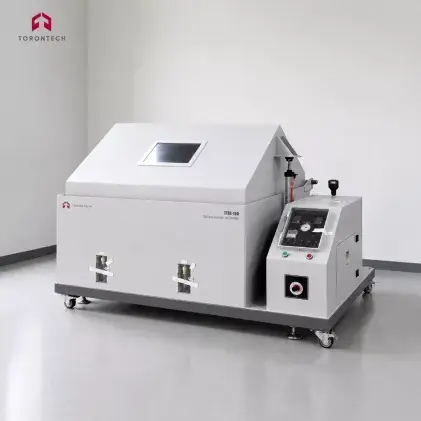
Inside a dedicated salt fog cabinet, such as our Torontech TTSS Series (which ranges from the compact 108 L TTSS-60 up to the large-capacity 1,440 L TTSS-200), test specimens sit in front of a finely atomized, continuous mist of saline solution. This is typically mixed as a 5% sodium chloride solution in demineralized water. The cabinet maintains a constant operating temperature of 35 °C (95 °F) and holds relative humidity near saturation at 100%, drawing heated air through a 2.0 mm thick seamless SUS304 stainless steel saturated pressure barrel.
Read more: Salt Spray Testing: Standards, SOP, Calibration & ROI
The primary governing standards include:
- ASTM B117: The foundational standard practice for operating continuous salt spray apparatus.
- ISO 9227 (NSS, AASS, CASS): The global standard specification covering neutral, acetic acid, and copper-accelerated salt mist environments.
- IEC 60068-2-11 & JIS H8502: Standardized specifications for electrical components and metallic coatings (with Torontech's TTSS Series officially compliant with ASTM B117-2009, ISO 9227-2006, IEC 60068-2-11-1981, and JIS H8502).
Primary Manufacturing Applications
- Uncompromising Consistency: Because test parameters remain static throughout the run (temperature holds steady, salt concentration stays locked, and the atomizing tower runs continuously), you generate consistent baseline data that allows direct comparisons between separate production batches.
- Rapid Quality Gate for Domestic Supply Chains: Across North American fastener and hardware facilities (such as Tier-2 stamping and electroplating shops in the US Midwest, Ontario, and Quebec), 24- to 96-hour ASTM B117 runs serve as the standard production gate to certify that zinc plating or hot-dip galvanizing meets baseline purchase orders before shipment.
- Cost-Efficient Capital Investment: Basic salt spray cabinets feature a straightforward mechanical layout, keeping acquisition costs accessible and maintenance demands low.
Technical Limitations & Surface Artifacts
Because test coupons remain soaked in a continuous mist, the exposure condition is artificial. Continuous salt spray maintains a thin, continuously renewed liquid film across the specimen surface, which promotes oxide film dissolution and generates corrosion morphologies that differ substantially from outdoor conditions.
In anodized aerospace alloys, for example, the mechanical washing action of continuous salt fog droplets physically strips protective corrosion-product films away from the surface. This can create inverted performance rankings where anodic films with finer pores perform worse under salt spray simply because droplets wash away their protective barrier.
In our view, peer-reviewed literature confirms what we regularly advise: neutral salt spray (NSS) should be restricted to production quality control rather than real-world durability forecasting. Its true strength lies in acting as a reliable, cost-effective screening tool for ongoing manufacturing quality control.
Cyclic Corrosion Testing (ASTM G85 / SAE J2334)
Automotive manufacturers and transport engineers recognized decades ago that continuous salt mist failed to reproduce the degradation patterns observed in severe real-world service.
A prime example is the North American "Rust Belt" and Canadian winter highways, where road maintenance departments apply heavy liquid de-icers (such as magnesium chloride, MgCl₂, and calcium chloride, CaCl₂). Vehicles travel through salty slush, park in warm garages, and dry out. That alternating sequence creates concentrated salt crusts and aggressive underbody rust that continuous fog simply cannot replicate. That operational gap led directly to the development of Cyclic Corrosion Testing (CCT).
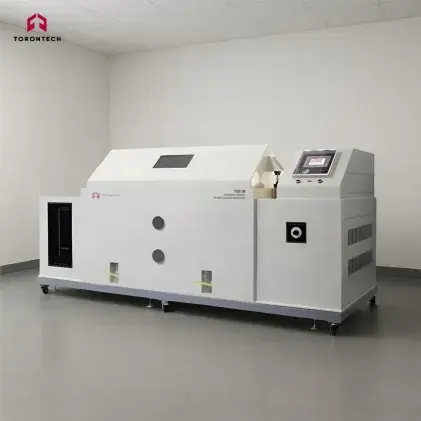
Rather than keeping parts in an unchanging, saturated fog for weeks, a combined multi-environment chamber, such as the Torontech TTSS-TH Series (available in working volumes from the TTSS-TH60 to the TTSS-TH200), automates transitions across multiple environmental stages (salt fog, dry-off, humid soak, and controlled rest) within a single testing sequence.
Environmental Cycle Mechanics
Using air-damper-connected climate compartments monitored by high-precision PT100 temperature sensors, a comprehensive cyclic test sequence progresses through distinct functional phases without requiring manual specimen transfer:
- Saline Exposure Stage: Applies the corrosive electrolyte across the specimen surface via direct spray or atomized fog.
- Heated Dry-Off Stage: Warm, low-humidity air circulates to evaporate surface moisture. As liquid disappears, salt crystals concentrate against the substrate, generating osmotic stress that promotes paint blistering and coating separation.
- High Humidity Soak: Saturated moisture (typically 95% to 100% relative humidity at 40 °C to 50 °C) re-hydrates the surface, forcing moisture deep into micro-fissures and coating defects.
- Ambient Dwell / Purge Stage: Stabilizes test conditions before the system initiates the next programmed loop.
Governing Industry Standards
- ASTM G85: The modified salt spray standard (encompassing prohesion cycles, acidified fog stages, and sulfur dioxide additions).
- SAE J2334 / GMW 14872 / VDA 233-102 / Volkswagen PV 1210 / Nissan M0158: Automotive OEM specifications that simulate roadway de-icing chemicals, seasonal temperature shifts, and humidity variations.
- JASO M 609: The unified Japanese automotive standard comprising 2 hours of salt spray, 4 hours of dry-off, and 2 hours of humid soak per cycle.
- ISO 11997-1 & ISO 16151: Standardized determinations of the resistance of coatings and metals to cyclic corrosion conditions.
Atmospheric Correlation & R&D Value
- Field-Correlated Failure Modes: Cyclic tests consistently show closer correlation to real-world atmospheric exposure. For instance, automotive cyclic protocols achieved correlation to ship-at-sea marine exposure within a 25% deviation margin.
- Eliminates Artificial Passivation: Continuous fog can generate an unrealistic layer of passive corrosion products that limits natural oxygen interaction. Cyclic drying stages break down this barrier, exposing bare metal to genuine oxidation.
In our evaluation, cyclic testing is the necessary methodology when formulating new surface treatments or qualifying safety-critical assemblies for severe field conditions.
Failure Mode Diagnostic Guide
In our view, the most practical approach to selecting a method is identifying the specific failure mechanism you need to detect. Because static fog and cyclic exposures generate different physical stresses, each method isolates distinct material flaws:
| Failure Mode | Optimal Test Method | Why This Method Succeeds |
|---|---|---|
| Plating Porosity & Pinholes | Traditional Salt Spray | Continuous wet fog penetrates micro-fissures in zinc, nickel, or chrome coatings, generating rapid, visible galvanic reactions. |
| Paint Delamination (Scribe Line Creep) | Cyclic Corrosion Test | The heated dry-off stage concentrates salt deposits within the scribe line, applying mechanical pressure that forces coatings to lift and peel. |
| Crevice & Dissimilar Metal Corrosion | Cyclic Corrosion Test | Wet-to-dry transitions pull fresh saline electrolyte into narrow joints, eliminating stagnant zones and replicating outdoor splash conditions. |
| Waterborne Coating Weathering | Cyclic Corrosion Test | While continuous salt spray causes excessive, non-representative degradation on waterborne acrylics, cyclic loops combining salt, humidity, and drying match natural weathering closely. |
| Passivation Layer Uniformity | Traditional Salt Spray | Delivers an efficient 24- to 96-hour pass-or-fail verification to confirm that stainless steel or chromate conversion dips remain uniform across production runs. |
| Structural Steel Fatigue Degradation | Cyclic Corrosion Test | Wet-dry cyclic exposure causes significantly greater loss of strength and low-cycle fatigue life in structural and stainless steels than static salt fog alone. |
We believe that pairing your target failure mode with the appropriate test method upfront eliminates weeks of wasted testing cycles (and protects your organization from unexpected quality disputes).
Test Duration & Equivalency Analysis
An evaluation question that surfaces regularly during laboratory planning is:
"How many hours of ASTM B117 salt spray equal one cycle of Cyclic Corrosion Testing?"
In our professional assessment, the short answer is direct: There is no mathematically sound conversion formula linking continuous salt fog hours to cyclic cycles. Lifetime predictions for identical materials vary substantially across test methods due to differing cumulative salt loads and drying kinetics.
Why Conversion Formulas Are Flawed
- Distinct Chemical Kinetics: In a static salt spray chamber, the specimen remains submerged under a continuous liquid barrier that restricts oxygen access. In a cyclic system, the forced-air drying phase exposes the thin, drying salt film to ambient oxygen, substantially speeding up genuine oxidation.
- Artificial Surface Passivation: Continuous salt fog can generate dense deposits of zinc hydroxychloride or related corrosion by-products that artificially protect the underlying substrate. In actual field service, natural wetting and drying remove these deposits.
- Specifying by Objective: We advise testing facilities to discard arbitrary conversion multipliers (such as assuming 1 cyclic loop represents 72 salt spray hours). Instead, facilities achieve far more defensible results by qualifying components directly against the mandated standard (such as SAE J2334 for automotive warranty sign-offs versus ASTM B117 for daily coating line quality control).
Test Method Selection Criteria
To determine whether your facility requires a continuous fog unit or a programmable cyclic system, we recommend evaluating where your testing requirements sit within the manufacturing workflow:
Choose Traditional Salt Spray Testing When:
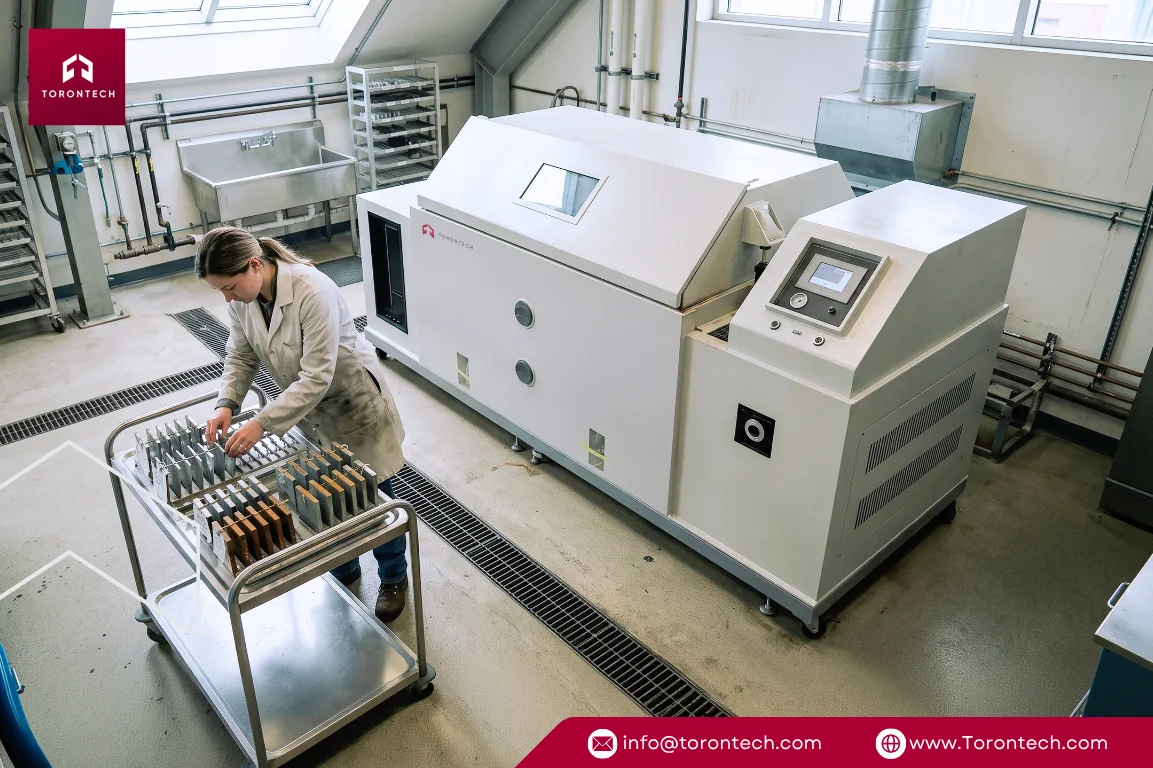
- Your mandate centers on routine Quality Control (QC): You need to verify that daily electroplating, zinc flake coating, anodizing, or powder application meets established thickness and uniformity thresholds.
- Customer contracts require standard compliance: Engineering drawings explicitly mandate ASTM B117 or ISO 9227 NSS as the quality acceptance criteria.
- High sample throughput and low operating costs are critical: Your laboratory processes steady volumes of production lots on rapid 24-, 48-, or 96-hour turnaround schedules.
Choose Cyclic Corrosion Testing When:
- You are developing new protective formulations (R&D): You are engineering advanced barrier coatings, conversion treatments, or corrosion-resistant alloys and need accurate field durability projections.
- You supply Automotive or Aerospace Tier-1/Tier-2 programs: Vehicle and aircraft specifications (such as Detroit and international OEM platforms) mandate dynamic cycling to account for winter road treatments, chemical exposure, and humidity swings.
- You are qualifying multi-material assemblies: Dynamic cycling is necessary to expose galvanic degradation where dissimilar metals make direct mechanical contact.
Standards-to-Chamber Compatibility Reference
Once your team identifies the required testing methodology, use this reference matrix to pair your standard specifications with the appropriate cabinet model family:
| Test Standard | Standard Classification | Required Environmental Stages | Recommended Torontech Hardware Setup |
|---|---|---|---|
| ASTM B117 | Continuous Salt Spray | Constant 35 °C 5% NaCl fog | TTSS Series (TTSS-60 through TTSS-200) |
| ISO 9227 (NSS) | Neutral Salt Spray | Constant 35 °C 5% NaCl fog | TTSS Series (TTSS-60 through TTSS-200) |
| ISO 9227 (CASS) | Copper-Accelerated Fog | 50 °C fog enriched with CuCl₂ & Acetic Acid | TTSS Series (Equipped for CASS testing) |
| ASTM G85 Annex A1 | Acetic Acid Salt Fog | Continuous acidified salt mist | TTSS Series (Modified Acidified Option) |
| ASTM G85 Annex A5 | Prohesion Cyclic Test | 1 hr salt mist (25 °C) + 1 hr dry-off (35 °C) | TTSS-TH Series / Prohesion-Equipped System |
| SAE J2334 / GMW 14872 | Automotive Cyclic | Saline exposure + Humid soak (50 °C) + Dry air (60 °C) | Combined TTSS-TH Series (TTSS-TH60 to TTSS-TH200) |
| JASO M 609 | Japanese Automotive Cyclic | 2 hr salt spray + 4 hr dry-off + 2 hr humid soak | Combined TTSS-TH Series (TTSS-TH60 to TTSS-TH200) |
| ISO 11997-1 (Cycle A–D) | Industrial Coating Cyclic | Alternating salt mist, warm dry air, and high condensation | Combined TTSS-TH Series (TTSS-TH60 to TTSS-TH200) |
Equipment Configuration: Dedicated vs Combined Chambers
When specifying laboratory hardware, engineering managers frequently face a key strategic choice: invest in a single multi-capability system or install separate, dedicated units.
Option A: The All-in-One Programmable Cyclic Chamber (TTSS-TH Series)
Advanced cyclic corrosion test chambers incorporate integrated heating elements, humidity generators, and forced-air drying systems. Outfitted with an optional 7-inch color touchscreen controller, operators can easily configure these units to execute static, continuous 35 °C salt fog routines (ASTM B117) or program complex, multi-stage cyclic test sequences (ASTM G85, SAE J2334).
- Operational Advantages: Broad testing versatility, a single laboratory footprint, and the capability to satisfy demanding customer specifications across diverse OEM standards.
- Operational Trade-offs: Involves higher initial capital expenditure; furthermore, running a lengthy, static 500-hour ASTM B117 batch audit ties up an advanced system that could otherwise support active R&D programs.
Option B: Dedicated Salt Spray Cabinets (Torontech TTSS Series)
Standalone salt spray test chambers are built specifically for continuous fog operations (ASTM B117, ISO 9227 NSS/CASS). Available across five distinct capacities (including the 108 L TTSS-60, 270 L TTSS-90, 480 L TTSS-120, 800 L TTSS-160, and 1,440 L TTSS-200), these units feature standard digital temperature regulators and operational hour timers.
- Operational Advantages: Highly cost-effective, mechanically dependable, simple to operate, and suited for non-stop production quality control.
- Operational Trade-offs: Cannot execute automated dry-off sequences or programmed relative humidity profiles.
- Total Cost of Ownership Considerations: Beyond the initial chamber acquisition cost, daily operational expenses shape long-term laboratory budgets. High-volume consumables like demineralized water and certified sodium chloride, combined with technician hours spent logging collection rates, add up quickly over multi-week protocols. Dedicated units like the Torontech TTSS Series keep ongoing operational costs lean for daily batch checks, while the automated stage transitions in the TTSS-TH Series reduce manual operator monitoring during complex, extended cyclic runs.
Related article: Salt Spray Chamber Buyer's Guide & Lab Checklist
From our vantage point as an equipment supplier, we believe investing in a complex cyclic system solely to run standard ASTM B117 inspections is an inefficient use of capital. If baseline batch verification accounts for the vast majority of your test schedule, a dedicated, cost-effective salt spray chamber offers the smartest return on equipment expenditure.
Chamber Engineering & Construction Specifications
Whether running continuous salt mist or cycling between heated dry air and saturated humidity, test repeatability depends on the physical construction of the testing chamber:
Non-Corrosive Structural Materials
Long-term exposure to warm, atomized salt solution degrades metallic enclosures over time. Our TTSS and TTSS-TH chambers utilize gray-white, impact-resistant compression-molded PVC board (5 mm thickness on TTSS-60/90; heavy-duty 8 mm thickness on TTSS-120, 160, and 200). This material is heat-rated to 85 °C and remains completely impervious to acid and alkali attack throughout years of continuous operation.
Advanced Heating & Pressure Saturators
To prevent internal heating element burnout, chambers incorporate titanium-alloy electric heating tubes (engineered to outlast standard stainless steel immersion heaters by 3 to 5 years). Saturated air is supplied via a 2.0 mm thick, seamless SUS304 stainless steel pressure barrel.
Precision Atomizing & Anti-Crystallization Nozzles
Consistent fog dispersion is critical. Chambers feature precision quartz-glass spray nozzles with conical mist diffusers rated to resist salt crystallization beyond 4,000 hours of continuous use. Integrated collection funnels and internal measuring cylinders verify standard deposition rates (1.0 to 2.0 mL / 80 cm² / hr).
Liquid-Sealed Enclosure & Specimen Fixtures
A water-filled sealing groove (liquid-sealed double chamber) prevents corrosive salt mist from escaping into your laboratory facility. Inside, adjustable Ø10 mm glass-fiber rods supported by a V-shaped frame hold test panels securely at standard 15° to 30° angles.
Integrated Safety & Purge Systems
Units are built with comprehensive protection mechanisms, including Italy EGO double over-temperature limiters, dual low-water sensors to prevent dry heating, low-salt-level reminders, and a manual demist purge function (standard on TTSS-90 models and above) to clear fog before operators open the lid.
Torontech Reliable Salt Spray & Cyclic Systems
Selecting between cyclic corrosion test vs salt spray test methods gives your team the clarity needed to balance everyday quality checks with long-term material development. At Torontech, we supply testing laboratories across North America and international markets with cost-effective solutions and innovative technologies that deliver dependable, audit-ready data without straining equipment budgets.
Explore Torontech’s Salt Spray Corrosion Test Chambers or contact our technical sales team today to discuss your testing specifications and request a customized quotation.
References (Click to expand)
- Fowler, S., & Quill, J. (2016). Modern Corrosion Testing: from Traditional Salt Spray Test to the Latest Innovative Methods with Advanced Environmental Controls. SSPC 2016 Greencoat.
- Howard, R., Lyon, S., & Scantlebury, J. (1999). Accelerated tests for the prediction of cut-edge corrosion of coil-coated architectural cladding: Part I: cyclic cabinet salt spray. Progress in Organic Coatings, 37(1–2), 91–98.
- Kumar, A., Borate, R., Hatwalne, M. R., & Ponkshe, S. (2023). Comparative Analysis of Different Corrosion Test Cycles. SAE Technical Paper Series.
- LeBozec, N., Thierry, D., & Pélissier, K. (2018). A new accelerated corrosion test for marine paint systems used for ship's topsides and superstructures. Materials and Corrosion, 69(4), 447–459.
- Prošek, T. (2016). Accelerated cyclic corrosion tests. Koroze a ochrana materialu, 60(2), 46–49.
- Suga, S. (1995). Cyclic Corrosion Tests in Japanese Industries. ASTM STP 1238.
- Usman, B. J., Scenini, F., & Curioni, M. (2020). Corrosion Testing of Anodized Aerospace Alloys: Comparison Between Immersion and Salt Spray Testing using Electrochemical Impedance Spectroscopy. Journal of The Electrochemical Society, 167(8), 081507.