Rotatory Disc Mills vs Vibratory Disc Mills Compared
Hitting that perfect, microscopic particle size on your very first run is an absolute win for any productive laboratory. When you have the proper gear running, you get a beautifully uniform powder with zero trace of coarse, unground grit, making your daily testing highly reliable.
If you want to save valuable labor and consistently secure these perfectly pulverized samples, choosing the right machine makes all the difference. This direct guide compares rotatory disc mills vs vibratory disc mills so you can easily select the ultimate tool to optimize your daily operations.
Quick-Reference Comparison Table
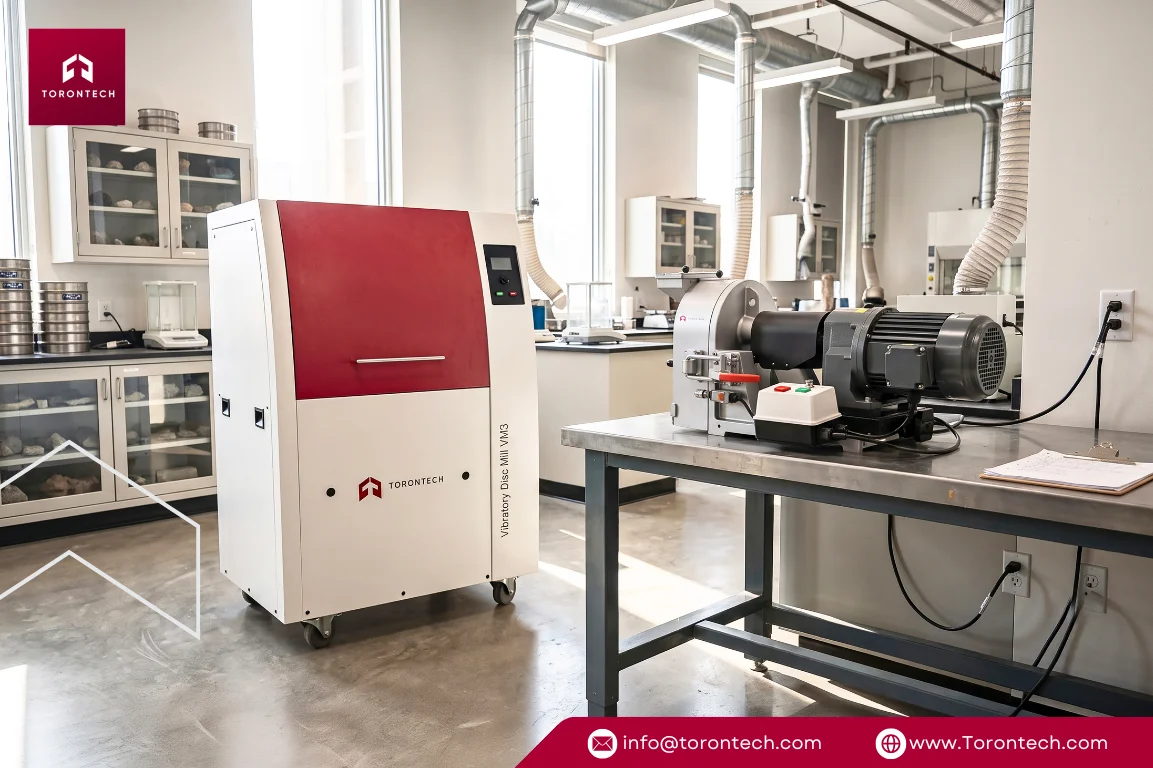
To provide some immediate answers (and save your team from reading a massive block of text), here is a straightforward, direct breakdown of rotatory disc mills vs vibratory disc mills featuring our specific Torontech models:
| Feature | Vibratory Disc Mill (Model VM3) | Rotatory Disc Mill (Model DP100) |
|---|---|---|
| How it Pulverizes Materials | Intense three-dimensional vibrations generating pressure, impact, and friction | Pressure and shearing friction created between progressively arranged teeth |
| Material Processing Style | Sealed batch processing (20g to 250g quantities) | Non-stop continuous throughput via an intake funnel |
| Operating Speeds | Highly adjustable from 700 to 1500 rpm | Steady grinding force running at 470 rpm |
| Required Input Chunk Size | Pre-crushed particles up to 15mm | Larger, bulkier materials up to 20mm |
| Achieved Fineness Level | Excellent ultimate fineness (d95 < 75μm) | Highly consistent fineness (< 75μm) |
| Specialized Hardware Features | Quick-action clamping device and automatic agate recognition | Continuous gap adjustment (0.01mm digital precision) and a built-in dust discharge connector |
What is a Vibratory Disc Mill?
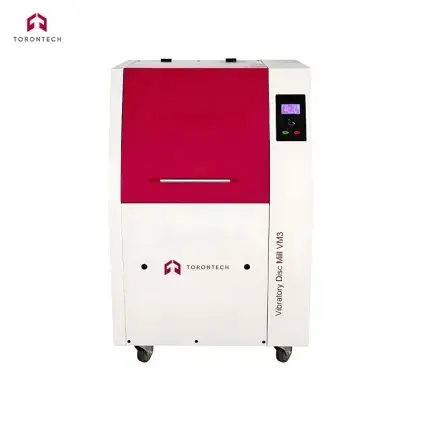
We are going to state it plainly: this machine is the true heavy-lifting workhorse of the sample preparation department. Our Vibratory Disc Mill VM3 is built for sheer, unrelenting speed, reducing stubborn, brittle, and highly fibrous samples down to an incredibly fine state during a very brief grinding duration.
Mechanism and Motion:
The way the VM3 achieves this is remarkably efficient. It utilizes a secure, heavy-duty bowl assembly firmly attached to a vibrating plate using a specialized quick-action clamping device.
An off-center motor generates intense three-dimensional vibrations with operating speeds adjustable between 700 and 1500 rpm. Vibratory mills impose oscillatory motion on the chamber, creating repeated collisions and attrition under high effective accelerations that can reach 200 m/s².
These concentrated forces quickly turn sample batches weighing between 20g and 250g into uniform powder. Keep your eye on the settings, because in vibratory designs, the internal motion depends strongly on frequency, amplitude, viscosity, and fill level. Notably, the VM3 also features an intelligent automatic speed reduction function that drops the machine to 700 rpm the moment it recognizes an agate grinding set.
Ideal Applications & Preventing Contamination:
Geological laboratories, mining companies, and metallurgy testing teams find this setup exceptionally useful. For instance, consider a standard mining facility preparing hard corundum ore or daily coal samples for strict metallurgical analysis. If that lab needs absolute assurance of zero missing particles, the closed-cup, high-speed impact of the VM3 is easily the most dependable path.
Furthermore, picking specialized bowl materials like tungsten carbide, agate, or zirconium oxide specifically prevents unwanted elemental transfer from the hardware directly into your testing batch. Because the processing happens inside completely sealed vessels, you entirely eliminate airborne cross-contamination between successive testing runs.
What is a Rotatory Disc Mill?
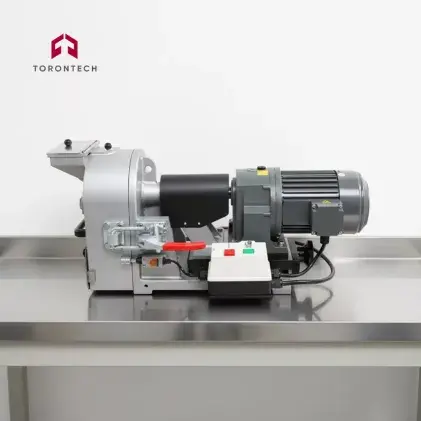
If the vibratory mill is a high-speed hammer, the rotatory disc mill is a continuous, relentless crusher. The Disc Mill DP100 takes a completely different path, focusing on grinding down large quantities of building materials and heavily dry environmental samples.
Mechanism and Motion:
Instead of vibrating, the DP100 utilizes heavy physical pressure and shearing action. Rotatory disc mills pulverize your samples by forcing material through a thin gap between rotating discs, so the breakage is dominated by friction and shear at the disc surfaces. When sample feed sizes measuring up to 20mm enter the grinding chamber, the progressively arranged teeth on the stationary and spinning discs initially crush the material.
Centrifugal force pushes the material outward for fine grinding at a consistent 470 rpm. The finely ground sample (achieving a fineness below 75μm) then falls right into a spacious 2.5-liter sample receiver.
Interestingly, multi-disc rotary mills increase size reduction as disc angular speed rises, while throughput increases with dosing speed. Operators can continuously adjust the gap between these plates with an impressive digital precision of 0.01mm to change the final output size instantly.
Related article: Why Choose Laboratory Disc Mills for Prep
Ideal Applications & Preventing Contamination:
This is a highly reliable option for processing concrete, building debris, and heavy depositional sludge. Take a typical cement manufacturing facility that needs to constantly break down large, bulky loads of coarse clinker or dry soil samples for daily quality checks. The continuous gap adjustment on the DP100 gives operations managers serious flexibility to handle high-volume, large-quantity sample processing very smoothly.
When your technicians need to switch between completely different materials, the continuous flow-through system allows for exceptionally quick purging. Plus, the built-in dust discharge connector guarantees that fine particulates stay entirely contained, preventing loose powder from drifting across the room and contaminating nearby analytical stations.
Grinding Performance Differences
Let us look at the real practical differences in physical grinding performance. Vibratory milling typically delivers a much quicker breakdown of particle size than rotary milling because the mechanical energy hits the grinding media through intense chamber shaking instead of just relying on gravity to tumble things around.
In one fascinating laboratory comparison, vibratory milling ran at more than eight times the milling speed of a ball mill despite a chamber volume over ten times smaller. For amorphous FeSiB ribbons, a vibratory disc mill handled larger quantities in shorter time, while a vibratory ball mill was better suited to small batches.
Because of this intense speed, vibratory mills are incredibly popular for producing exceptionally fine and ultra-fine powders, often dropping well below 5 to 10 μm. Reviews and comparative studies suggest energy is used more effectively in mills dominated by attrition or combined impact-attrition than in purely rotational gravity-driven systems.
Conversely, conventional rotating disc mills typically produce coarser output, around 300 to 200 μm in biorefining applications. In rotary ball mills, extremely fine particles can re-aggregate and cake irreversibly during prolonged grinding, which makes the continuous flow of a disc setup like the DP100 much more practical for bulk processing.
Practical Trade-Offs and Total Cost of Ownership
We strongly believe that the true financial impact of laboratory equipment is felt in the practical trade-offs and daily maintenance requirements, particularly when dealing with strict clean-up routines. In highly sensitive laboratory operating procedures, technicians often need to grind a blank rinsing material, like pure quartz sand, between heavily loaded testing batches to guarantee zero carryover. Giving a heavy metal vibratory puck a quick wipe-down and running a fast sand blank takes just a few fleeting moments.
The VM3 Vibratory Disc Mill includes a highly efficient quick-action clamping mechanism, meaning your technicians can swap out heavy metal grinding bowls in mere seconds, drastically reducing frustrating downtime during these cleaning phases.
On the flip side, processing highly abrasive materials (like ceramics for dentistry or recycled glass) through a spinning-disc machine can generate messy particulate matter. The straightforward cleaning design of the DP100 Disc Mill, paired with its specialized dust discharge connector, stops sample powder from dirtying the laboratory environment, ultimately saving your maintenance team hours of sweeping and wiping down surfaces.
However, the biggest upside of these spinning rotatory disc setups is their refreshing mechanical simplicity and their ability to keep your final powder size strictly controlled by the adjustable disc gap. Their main weaknesses are a small working volume, limited scale above about 500 kg/h , and very high energy demand for very fine wood milling.
Vibratory mills offer much broader fine-grinding capability, but standard designs can suffer from heavy vibration transfer to the foundation, intense bearing loads, high cooling demands, and stagnant media zones in some configurations. Interestingly, new rotary-vibration hybrids aim to remove these stagnant zones and intensify the media motion that is sometimes seen as a weakness of standard vibration mills.
Typical Mill Trade-Offs
| Mill Type | Main Breakage Mode | Typical Strength | Main Limitation |
|---|---|---|---|
| Vibratory mill | Impact + attrition | Fast fine grinding | Foundation/dynamic loads |
| Rotatory disc mill | Shear + friction | Narrow size control | Small active gap volume |
| Rotary-vibration hybrid | Combined rotary + vibratory motion | Higher fineness and shorter time in new designs | Higher design complexity |
Which One Should You Choose?
Ultimately, the choice boils down to what is currently slowing your facility down. To guide your planning, we suggest looking at these common operational scenarios:
Are you processing massive quantities of concrete, glass, or refractory clay and need a continuous feeding system? Go with the Disc Mill DP100. Its large 2.5-liter collector and continuous gap adjustment make handling bulky materials a breeze.
Are you running a highly sensitive laboratory that requires an absolutely pure, zero-contamination breakdown of rare earth minerals or oxide ceramics? Grab the Vibratory Disc Mill VM3. Its intense three-dimensional vibrations and quick-action clamping device are completely unmatched for exceptionally fast sample preparation.
Choose Your Next High-Performing Torontech Mill
Both machines bring serious processing capability to your laboratory floor, and choosing between them gets incredibly simple once you map out your daily throughput needs.
Here at Torontech, we firmly believe in offering pocket-friendly, budget-smart options packed with highly advanced engineering that stands up to the heaviest workloads. We provide cost-effective solutions and innovative technologies to keep your daily workflow running smoothly.
Ready to make your sample prep much faster? Explore our Laboratory Milling/Grinding here, and contact our team today for a quick quote!
References (Click to expand)
- Aranda, R. M., Astacio, R., Urban, P., Aranda, B., & Cuevas, F. G. (2024). Milling amorphous FeSiB ribbons with vibratory ball and disc mills. Powder Technology.
- Baigereyev, S., Guryanov, G., & Vasilyeva, O. Y. (2023). Evaluation the Effectiveness of the Comminution Process in a New Rotary Vibration Mill Using the Finite Element Method. TRUDY UNIVERSITETA.
- Baigereyev, S. R., Guryanov, G. A., Suleimenov, A., & Gabdyssalyk, R. (2024). Аpproach for determination of geometric parameters of new oval design of rotor in innovative rotor-vibration type of mills. BULLETIN of the L.N. Gumilyov Eurasian National University. Technical Science and Technology Series.
- Bańkowski, D., Młynarczyk, P., & Depczyński, W. (2026). Comparative Studies of the Effectiveness of Rotational and Vibratory Machining. Materials, 19.
- Becker, A., Hill, S., & Mitchell, J. (2001). Milling—A Further Parameter Affecting the Rapid Visco Analyser (RVA) Profile. Cereal Chemistry, 78, 166-172.
- Bogdanov, V. S., Alexandrova, E. B., Bogdanov, D., Bogdanov, N., & Gavrunov, A. (2019). Optimization of material grinding in vibration mills. Journal of Physics: Conference Series, 1353.
- Bulgakov, V., Pascuzzi, S., Ivanovs, S., Kaletnik, G., & Yanovich, V. (2018). Angular oscillation model to predict the performance of a vibratory ball mill for the fine grinding of grain. Biosystems Engineering.
- Cieplok, G., & Piekaj, P. (2021). Movement Properties of Antiresonance Vibration Mill with Symmetrical Construction. Vibrations in Physical Systems, 31, 2020302-1-2020302-11.
- Kruszelnicka, W., Hlosta, J., Diviš, J., & Gierz, Ł. (2021). Study of the Relationships Between Multi-Hole, Multi-Disc Mill Performance Parameters and Comminution Indicators. Sustainability.
- Krycer, I., & Hersey, J. A. (1980). A comparative study of comminution in rotary and vibratory ball mills. Powder Technology, 27, 137-141.
- Lomovskiy, I., Bychkov, A., Lomovsky, O., & Skripkina, T. (2020). Mechanochemical and Size Reduction Machines for Biorefining. Molecules, 25.
- Mori, T., Ogawa, Y., Yoshida, S., & Matsushima, K. (2024). A novel mechanocatalytic process by vibratory disk mill for efficient hydrolysis of cellulose, chitin and xylan. Chemical Engineering Journal.
- Rajaonarivony, K., Mayer-Laigle, C., Piriou, B., & Rouau, X. (2021). Comparative comminution efficiencies of rotary, stirred and vibrating ball-mills for the production of ultrafine biomass powders. Energy.
- Shevchenko, H., & Shevchenko, V. (2024). Analytical researches of a vibrating mill with vibroimpact excitation of a crushing chamber. IOP Conference Series: Earth and Environmental Science, 1348.
- Sidor, J., Foszcz, D., Tomach, P., & Krawczykowski, D. (2015). Młyny wysokoenergetyczne do mielenia rud i surowców mineralnych.
- Suleimenov, A., Baigereyev, S. R., & Guryanov, G. A. (2025). PRECONDITIONS FOR THE DEVELOPMENT OF A NEW MILL DESIGN WITH A V-SHAPED CHAMBER. Bulletin of Shakarim University. Technical Sciences.
- Sutejo, A., Putra, R. A., Ramdani, G., & Putri, A. D. (2025). Uji Performansi Mesin Penggiling Tipe Disc Mill untuk Penepungan Porang. Jurnal Agricultural Biosystem Engineering.
- Sutejo, A., Kurniasari, R. S., & Wicaksono, D. D. (2023). Uji Performansi Mesin Penepung Tipe Palu (Hammer Mill) Untuk Penepungan Hotong (Setaria Italica L.). Jurnal Agricultural Biosystem Engineering.
- Tomach, P. (2024). The Influence of the Grinding Media Diameter on Grinding Efficiency in a Vibratory Ball Mill. Materials, 17.
- Truee, M., Aman, S., Aman, P., Mueller, N., & Mueller, P. (2020). Measurement and evaluation of the grinding bodies’ motions in a vibratory disc mill filled with viscous fluids. Advanced Powder Technology, 31, 4376-4389.