

A Guide to Powder Flowability Testing & Equipment
From a factory floor perspective, there are few things that grind the entire operation to a halt faster than a raw material that simply refuses to cooperate.
One minute, the line is running without a hitch; the next, the material has jammed up in the hopper, causing an expensive, frustrating mess. The actual financial hit is usually the entire batch that must be quarantined or rejected.
This guide provides a clear framework for analyzing your powder's behavior and explains why accurate testing is the most effective way to manage this critical variable.
Key Takeaways
- Inconsistent Flow Costs Money: Poor powder flow leads to production bottlenecks, machine jams, and wasted batches that directly impact profitability.
- Moisture is the Enemy: Environmental factors like humidity and physical properties like particle shape are the primary drivers of cohesive behavior.
- Manual Testing is Risky: Relying on a stopwatch and visual guesswork introduces human error that makes batch-to-batch comparisons impossible.
- Standardization is Mandatory: The Torontech EFT-01 uses precise interchangeable discs to ensure testing complies strictly with USP and Ph. Eur. standards.
- Data Before Action: You must accurately measure flow behavior and identify the root cause before attempting to fix it with granulation or additives.
Why Powder Flowability is a Critical Metric
The way a material moves is an absolutely crucial measurement because it directly impacts the speed and quality of industrial processes, including material transfer, die filling, and additive manufacturing. Poor flow characteristics lead to massive production inefficiencies and terribly inconsistent product quality, making an accurate assessment absolutely essential.
Why is this such a massive priority for quality control?
- Formulation Integrity: In pharmaceutical manufacturing, sticky, inconsistent movement means the active ingredients fail to mix evenly, which completely ruins the medical efficacy of the entire batch.
- Component Quality in Additive Manufacturing: For 3D printing professionals, a material that fails to spread in a perfectly flat, even layer results in a structurally compromised and entirely unusable metal part.
- Operational Costs: Stubborn blockages lead to wasted material and agonizing equipment downtime, directly sinking your profitability. Every seasoned production manager has suffered through this specific headache.
Picture this incredibly common factory nightmare:
A high-speed tablet press is aggressively punching out pills. Unexpectedly, the material forms a stubborn arch over the feeding mechanism. The heavy machinery continues to cycle blindly, but the metal dies are no longer filling with the required medicine.
By the time a frustrated operator spots the error, thousands of hollow, out-of-specification tablets have been produced, creating a massive safety and compliance disaster.
Key Factors That Influence Powder Behavior
Figuring out exactly why a material behaves unpredictably is the very first piece of the puzzle. The main reasons a powder behaves badly involve the size of the pieces, their physical shape, how dense they are, and the invisible forces pulling them together.
To effectively fix the jams, you have to look closely at specific physical and environmental variables.
Particle Size & Distribution
Those incredibly tiny, speck-like materials (usually under 100 microns) have a massive amount of surface area compared to their actual weight. This creates a huge amount of friction and encourages them to stick together like glue rather than sliding freely.
On the flip side, if you have a chaotic mix of very large and very small pieces, the small ones will stubbornly sink to the bottom of your storage bin, completely ruining the mixture.
Morphology (Shape) & Texture
The physical geometry of the material completely dictates how it moves. Perfectly round materials—like the high-grade metal powders used in 3D printing—roll over each other with almost zero resistance.
However, if the pieces are jagged, needle-like, or oddly shaped, they lock together mechanically, building a stubborn "bird's nest" structure that refuses to budge.
Moisture & Environment
Dampness in the air is often the silent, deeply annoying troublemaker. Materials that love to absorb ambient water will form tiny liquid bridges between the pieces. This turns a perfectly good, free-moving material into a gummy, cohesive mess in a matter of minutes.
Electrostatic Charge
While moving around or being sifted, particles can easily build up a charge of static electricity. This annoying electrical charge forces them to push violently away from each other or cling aggressively to the metal walls of the machinery, completely ruining the intended path of movement.
Bulk Density & Compressibility
This describes how the material settles down and rearranges itself under pressure. If a material squishes down significantly when tapped or squeezed, it is practically guaranteed to form stubborn arches or empty "rat holes" in a storage bin.
We can illustrate this with a situation everyone has seen in their kitchen:
The way a bag of brown sugar turns into a rock-solid brick in the pantry is a perfect demonstration of sticky behavior caused by moisture. Compare that to pouring a box of dry table salt, which pours out beautifully without a second thought.
On the factory floor, you absolutely need your material acting like the salt, not the sugar.
The Problem with Makeshift Lab Setups
Historically, a highly basic mathematical formula was used to guess the rate of movement.
The Formula:
Q =
This calculates the mass of material (M) that passes through an orifice over a period of time (t).
However, this old-school method produces wildly inconsistent and unreliable numbers. The final result relies entirely on the personal technique of the technician holding the stopwatch.
This human-caused variance makes it exceptionally difficult to get numbers you can actually trust when comparing one batch to the next.
Standardized Tests for Characterizing Your Powder
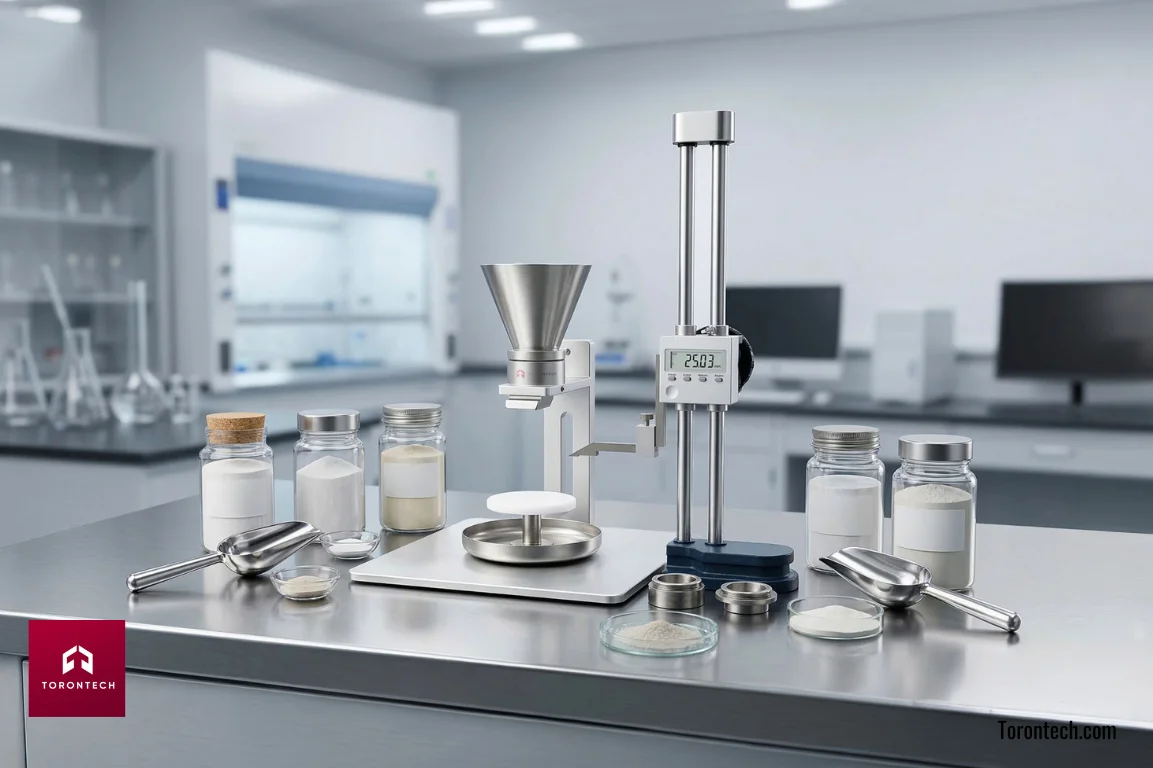
To get numbers you can heavily rely on, you have to use standardized testing methods. We consider these completely non-negotiable for any serious quality control program. Common tests include the angle of repose (AoR), compressibility index (CI), Hausner ratio (HR), and flow through an orifice, each capturing a different piece of the puzzle.
Angle of Repose (AOR)
This is the most fundamental starting point. You pour the material into a pile and measure the steepness of the resulting cone.
- A low, flat hill (<30°) indicates excellent, easy-going properties.
- A steep, pointy mountain (>45°) suggests poor, sticky characteristics.
Related article: Solve Powder Clogs: Angle of Repose vs Shear Cell Testing
Note: The Torontech EFT-01 standardizes the way this pile is formed, preventing the user from accidentally packing the powder or pouring it unevenly.
Carr’s Index & Hausner Ratio
These two numbers are figured out by looking at the material's loose density versus its tapped-down density.
A Hausner Ratio greater than 1.25 is a giant red flag that the material is sticky and will cause constant headaches. These mathematical relationships help put an exact number on the flow characteristics for specific materials.
Because no single test tells the whole story, scientific studies strongly recommend running a few different tests together to get a complete picture of how the material acts .
Read more: What is the Carr Index Flowability? A Practical Guide
Makeshift Testing vs. Standardized Equipment
We are going to call it right now (as frustrating as it is to hear for traditionalists) – relying on a random glass funnel clamped to a rusty metal stand is a total disaster waiting to happen. There is not a trace of reliability in that makeshift method (all you veteran lab technicians know exactly the nightmare we are talking about!), and the resulting data is wildly inconsistent and frustratingly subjective.
Every inch of a proper, compliant apparatus like the Powder Flowability Tester EFT-01 is engineered for sheer consistency. The interchangeable stainless steel discs are satisfyingly exact – offering strict compliance without being outrageously complicated to use – and the standardized cylinder ensures the "head pressure" of the powder is the same every single time.
Related article: Expert Tips: How to Choose a Powder Flowability Tester
| Parameter | Makeshift Lab Setups | With the Torontech EFT-01 |
|---|---|---|
| Repeatability | Terrible; wildly changes with every single operator | High; uses precisely machined interchangeable discs |
| Compliance | An absolute nightmare to validate during an inspection | Built strictly to USP and Ph. Eur. specifications |
| Construction | Fragile glass or cheap, easily scratched plastic | Heavy-duty cylinder with stainless steel discs |
| Methodology | Guessing when the flow stops | Standardized Flowability Index (Scale 4-40) |
If a testing method can spit out two totally different answers for the exact same barrel of material, the method itself is entirely useless. A proper apparatus removes that maddening variability completely.
The Solution: The Torontech EFT-01 Powder Flowability Tester
This is exactly why we supply precision-machined equipment like the Torontech EFT-01. It is built for serious professionals who require highly accurate, endlessly repeatable data. The entire system is designed to operate strictly in accordance with USP <1174> and Ph. Eur. 2.9.36, ensuring your final results meet the most demanding industry standards.
Key capabilities of the equipment include:
- Determines Flowability Index (4-40): It establishes a dependable, repeatable flowability index on a scale of 4 to 40. This creates a standard language for your procurement and quality teams to use when accepting or rejecting raw materials.[1]
- Standardized Interchangeable Discs: It comes fully equipped with a cylinder and interchangeable discs featuring 10 mm, 15 mm, and 25 mm outflow openings (as dictated by Ph. Eur. standards). Customized openings (like 5 mm) are also available if your material is unique.
- Simplifies Angle of Repose: The apparatus is designed to allow for the easy, repeatable calculation of the angle of repose without the mess of manual pouring.
- Heavy-Duty Build: Designed with dimensions of 31cm (W) x 41cm (H) x 23cm, it is a solid, stable unit built to survive the aggressive, daily wear and tear of a busy manufacturing laboratory.
With the EFT-01, you finally get the reliable data you desperately need to predict how your raw materials will perform before they cause a massive jam on the production line.
How to Address Powder Flow Issues
Once the Powder Flowability Tester EFT-01 proves that you have a flow problem, you can take corrective action. Our firm philosophy is to never attempt a quick fix until the actual root cause has been accurately identified.
Granulation (Particle Modification)
If the main issue is an overwhelming amount of fine dust, the most effective physical fix is granulation. By clumping those tiny specks into larger, heavier granules, you drastically reduce the surface friction, which allows the material to slide beautifully.
Strategic Use of Flow aids (Glidants)
In a lot of manufacturing recipes, mixing in a slippery additive like colloidal silicon dioxide acts as a dry lubricant between the pieces. However, this requires a very careful touch; dumping in too much of the additive can actually make the problem worse or completely ruin the structural integrity of the final tablet.
Strict Environmental Controls
Because dampness causes that sticky capillary bonding, setting up very strict humidity controls in your storage areas is an absolute must for materials that pull water from the air. Using heavily sealed containers and moisture-absorbing packets during transport is a simple but incredibly effective habit.
Equipment Geometry & Linings
Sometimes the material is perfectly fine, but the storage hopper is the actual villain. Making the walls of the hopper much steeper or spraying them with a slick, low-friction coating can help the mass slide down easily and prevent empty holes from forming in the middle of the pile.
Vibration Assistance
Bolting external shaking devices onto the sides of your hoppers can easily shatter temporary bridges. Be warned, though; this has to be tuned extremely carefully. Too much violent shaking can actually pack the material down even tighter or cause the heavy pieces to sink while the light pieces float to the top.
Achieve Consistent Flow with Torontech
Consistent, high-quality production outputs depend entirely on consistent, well-behaved raw materials. Relying on blind guesswork or highly subjective observations leaves your entire operation heavily exposed to unnecessary financial risk and agonizing delays.
By using a beautifully engineered instrument like the Torontech EFT-01, you finally get the hard data needed to anticipate and prevent flow-related disasters, whether you are producing pharmaceutical tablets, processed food products, or highly complex 3D-printed metal components.
Ready to completely overhaul your quality control process? Explore the EFT-01 Powder Flowability Tester or contact our engineering team to deeply discuss your specific powder handling nightmares.
References:
- Baesso, I., Karl, D., Spitzer, A., Gurlo, A., Günster, J., & Zocca, A. (2021). Characterization of powder flow behavior for additive manufacturing. Additive manufacturing, 47, 102250.
- Chendo, C., Pinto, J., & Paisana, M. (2023). Comprehensive powder flow characterization with reduced testing. International journal of pharmaceutics, 123107.
- Kiani, P., Bertoli, U., Dupuy, A., & Schoenung, J. (2020). A Statistical Analysis of Powder Flowability in Metal Additive Manufacturing. Advanced Engineering Materials, 22.
- Marchetti, L., & Hulme-Smith, C. (2021). Flowability of steel and tool steel powders: A comparison between testing methods. Powder Technology, 384, 402-413.
- Spierings, A., Voegtlin, M., Bauer, T., & Wegener, K. (2016). Powder flowability characterisation methodology for powder-bed-based metal additive manufacturing. Progress in Additive Manufacturing, 1, 9-20.
- Tan, Y., Zhang, J., Xiang, L., Xu, Y., & Wu, C. (2021). Comprehensive evaluation of powder flowability for additive manufacturing using principal component analysis. Powder Technology, 393, 154-164.
- Tharanon, W., Guo, Y., Peerapattana, J., & Sun, C. (2024). A systematic comparison of four pharmacopoeial methods for measuring powder flowability. International journal of pharmaceutics, 124454.
- Zegzulka, J., Gelnar, D., Jezerská, L., Prokeš, R., & Rozbroj, J. (2020). Characterization and flowability methods for metal powders. Scientific Reports, 10.
